Nanpan Huaguang Primary School combined daily activity records with periodic assessments of academic progress, character, wellbeing, arts and practical innovation. The case describes its phased pilot, staff training and work with families.
Effectively integrating digital and intelligent capabilities, and implementing a comprehensive evaluation of the five aspects of education – Cases of information technology supporting the organization and implementation of comprehensive evaluation of students’ overall qualities
Nanpan Huaguang Primary School, Jiujiang Town, Nanhai District, Foshan
Abstract:This case details how our school actively responds to the educational informatization reform policies in Nanhai District. With the philosophy of “ensuring that every child grows up happily under the sun”, we have established an evaluation system that combines both process-based and outcome-based aspects. Through the “Yueping Better” platform, data on students’ daily behaviors are collected, and periodic assessments of their competencies are carried out using a comprehensive assessment system. The data from these two platforms are integrated to create a comprehensive profile of each student’s development. By utilizing a four-pillar approach involving administration, technology, teaching research, and activities, we have overcome the problems associated with traditional evaluation methods, such as limited evaluation dimensions and fragmented data. Practice has shown that through strategies such as hierarchical training, collaboration between schools and families, phased implementation, integration of specialized activities, and diverse incentives, it is possible to effectively combine data from five different aspects: academic development, moral development, physical and mental health, artistic skills, and practical innovation. This leads to the creation of electronic growth records for all students, enabling dynamic collection, intelligent analysis, and visual presentation of evaluation data. After more than two years of implementation, the evaluation system has become more sophisticated, teaching and education efforts have become more targeted, and students’ overall competencies have been improved. The collaborative efforts between schools, families, and society have also been effective. This provides valuable practical experience for promoting comprehensive quality evaluation reforms in the region, with the support of information technology.
Keywords:Dual-platform integration; process evaluation; outcome evaluation; integrated development of five aspects of education
1. Analysis of the case background
With the deeper development of educational informatization, the evaluation of students’ overall qualities has become a key issue in the reform of educational evaluation in the new era. At the national level, documents such as the “Overall Plan for Deepening the Reform of Educational Evaluation in the New Era” have been issued, emphasizing the use of information technology to establish a scientific, diverse, and development-oriented evaluation system. Nanhai District in Foshan City serves as a pilot area for the Ministry of Education’s initiative to use information technology to evaluate students’ overall qualities. It has formulated the “Implementation Plan for Nanhai District’s Pilot Area for Using Information Technology to Evaluate Students’ Overall Qualities (2023–2027)” and the “Work Plan for the Nanhai Experimental Area for the Study of Large-Scale Student Growth Across Different Academic Stages”. The goal is to create a regional integrated platform for student growth data, thereby promoting changes in the evaluation methods. As one of the first pilot schools in the district, Nanpan Huaguang Primary School in Jiujiang Town feels a great responsibility. We regard this reform as an important opportunity to improve the quality of education and promote the comprehensive development of students.
Meanwhile, our school is also beginning to explore ways to use the “Yueping Xiaohao Platform (process-based)” to collect data on students’ process-based evaluations, so as to better reflect their developmental process. Since the “Yueping Xiaohao Platform” focuses on process-based evaluations, while the “Comprehensive Quality Evaluation System” focuses on outcome-based evaluations, these two systems can complement each other. Therefore, we are willing to actively explore ways to integrate the “Yueping Xiaohao Platform (process-based)” with the comprehensive quality evaluation, and determine the appropriate approach for this integration, with the support of information technology.
(1) Realistic challenges: The four limitations of traditional evaluation methods
Before implementing this case, our school faced many challenges in the evaluation of students’ overall qualities. It was necessary to utilize information technology to overcome these challenges.
1. Single evaluation dimensions, imbalance among the five aspects of education: Over time, evaluations have relied too much on written tests, focusing primarily on academic performance. There are no scientific or effective methods or quantitative tools for assessing students’ moral character, physical and mental health, artistic appreciation, labor skills, and innovative spirit. As a result, it is difficult to fully reflect the overall development of students.
2. Inefficient data collection, with numerous “data islands”: Data related to students’ development (such as classroom performance, practical activities, behavioral habits, and physical and mental health) are scattered among paper records, scattered electronic forms, or isolated systems belonging to teachers from various subjects, class advisors, and department heads (such as the Moral Education Department, Teaching Department, Sports Department, and Psychology Office). Additionally, students change classes frequently – for example, in grades 5 and 6 each year – which makes it difficult to effectively integrate, track over time, and analyze data across different educational stages, resulting in “data islands”.
3. The evaluation process is fragmented, and feedback is delayed: Traditional evaluations often focus on outcomes rather than the process. For example, the centralized evaluations at the end of the semester lead to adjustments in teaching methods, but the evaluation information is provided 2–3 months later. Moreover, data regarding the learning process are difficult to provide to teachers and students in a timely and systematic manner. Teachers have difficulty identifying the strengths and weaknesses of students during the learning process, and thus cannot effectively adjust their teaching strategies or provide personalized guidance. The diagnostic and improvement functions of evaluations are therefore weakened.
4. Poor communication between schools and parents, and inadequate collaboration: Parents have insufficient understanding of the comprehensive development of their children, and their participation is limited. There is a lack of a convenient and efficient platform for information sharing; it is difficult for parents to obtain real-time information about their children’s performance at school, especially regarding their development beyond academic aspects. There is also a lack of consensus and cooperation between schools and parents regarding educational goals and methods.
(II) Policy opportunities and platform positioning
The pilot policy in the South China Sea region requires the establishment of “full-process growth records”. Our school has clearly defined the responsibilities for the two platforms:
1. “Yueping Youhao” platform (process-based): This platform is used to record more than 50 various aspects of students’ performance in class and practical activities on a daily basis. Students who perform well each day receive immediate “points” on the platform as a form of encouragement. Additionally, it is recommended that parents provide real-time updates about their children’s performance at home through the parent section of the platform, such as uploading photos of their children’s learning, labor, and activity performances.
2. Comprehensive Evaluation System (Result-based): This platform is primarily used for the standardized literacy assessment that is conducted once per semester for students in the 5th and 6th grades. It utilizes information technology to establish a closed-loop system that integrates teaching, learning, and evaluation. This system allows for the full-process recording of students’ development data. Finally, a radar chart and development recommendations are generated, enabling intelligent analysis and visual presentation. This helps to better reflect the achievements of students after various activities over the semester. Ultimately, these results are integrated with the district-level educational quality monitoring database, thereby enabling a more accurate assessment of educational outcomes within the same period.
We realize that information technology is not merely a tool; it is also a powerful asset that helps to transform the evaluation system and promote the integration of the five aspects of education. Taking advantage of this pilot opportunity, our school is determined to establish a scientific, dynamic, and open “integration of the five aspects of education and evaluation” system based on information technology. This will enable evaluation to truly serve as a driving force for the comprehensive development of students, the professional growth of teachers, and the enhancement of the school’s quality.
II. Implementation approach: Integration of two platforms to promote effective collaboration
To ensure the effective implementation of the “Five-Education Integration Evaluation” system, our school has established a “Four-in-One” top-level design framework, along with various implementation strategies and safeguards.
(1) System architecture design: Integration of two platforms
1. The concept of integrating two platforms
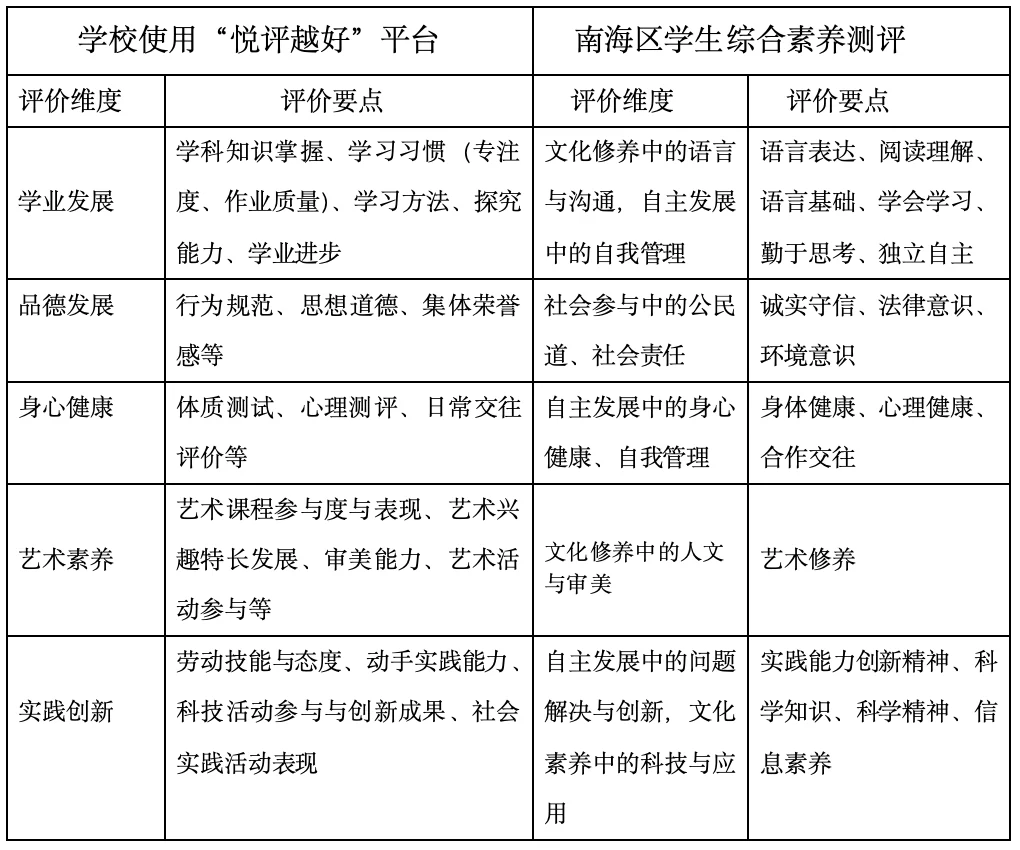
Our school uses the “Yueping Youha” platform to record students’ daily performance, and the comprehensive assessment system to conduct periodic standardized evaluations of their abilities. The data from these two platforms are interconnected and mutually corroborating: the performance data provide insights into the development of students’ skills, while the assessment results help to guide improvements in the performance evaluations. This creates a closed loop of “recording – assessment – feedback – improvement”.
2. Compare the similarities between the evaluations of the two platforms
(II) Top-level design, effective coordination
Given that most of the evaluations conducted by these two platforms share common goals, namely to promote the development of students’ competencies, our school has established a four-in-one implementation framework consisting of “administrative support, technical assistance, integrated activities, and educational research support”. This combined approach creates a strong synergy, thereby facilitating the integrated implementation of both platforms.
Administrative promotion: Top-level planning and organizational support
School administration takes the lead in implementation: The principal serves as the leader of the team, while the vice-principal in charge of moral education, teaching, and information technology acts as the deputy leader. Members include those from the teaching affairs department, moral education department, information technology center, grade leaders, and key teachers. The working group is responsible for overall planning, resource coordination, policy interpretation, and supervision of implementation.
The administrative team developed a implementation plan: Based on the district-level plan and taking into account the specific conditions of the school, a detailed “Implementation Plan for the Comprehensive Quality Evaluation of Nanpan Huaguang Primary School in Jiujiang Town (Trial)” was formulated. This plan specifies the guiding principles, basic principles, evaluation criteria (detailed in terms of the five aspects of education), implementation steps, technical platforms, safeguards, and deadlines.
Tasks during the clarity phase: Develop clear phased plans to ensure that work is carried out in an orderly and efficient manner.
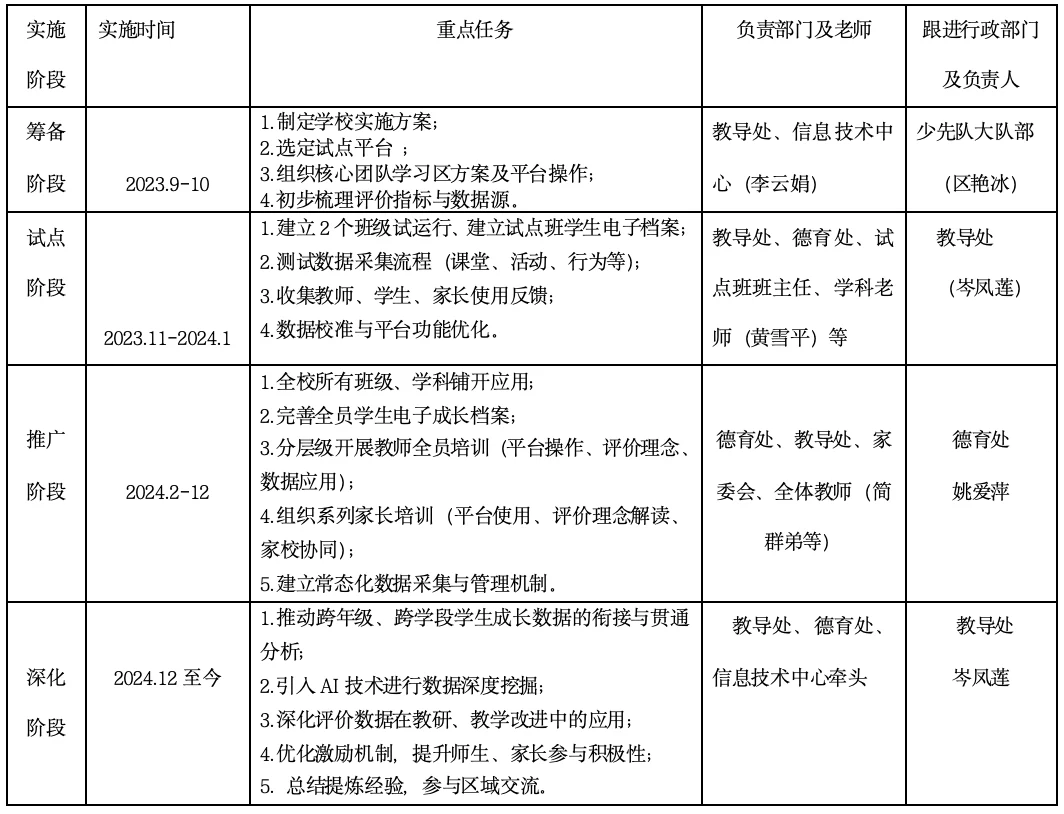
2. Technical support: Platform construction and enabling applications
Since both platforms are still in the stage of exploration and use, there will inevitably be various issues related to the application of new technologies. In order to ensure the comprehensive and effective use of these technologies, and to enable them to complement each other, technical support is given top priority.
Efforts should be made to establish technical collaboration teams: Our school has formed a “Technical Support Collaboration Team” composed of information technology teachers, key class advisors, and representatives of subject teachers. This team is responsible for the daily operation of the testing platform and the “Yueping Youjia” platform, as well as data processing and technical support.
Implement hierarchical and targeted training: First, provide hierarchical training for different teachers in the school.
Technical experts take the lead: Information technology teachers conduct in-depth testing of the platform, master functions such as backend management, data interfaces, and report generation, and identify the methods and approaches for data collection across various dimensions.
Core empowerment for class advisors: In order to promote the technology as quickly as possible, special training is provided for class advisors on how to become familiar with the operation of the testing platform. They are also taught how to export and properly integrate the relevant data collected by the “Yueping Youjia” platform – such as records of class management, observations of student behavior, and evaluations of activities – into the comprehensive testing platform.
Application of subject teachers: Train subject teachers to use the evaluation tools provided within or linked to the platform. These tools include classroom interaction tools, assignment analysis systems, and practice recording modules. Teachers should also use these tools to enter data for formative assessments, as well as to locate the test data related to various topics on the comprehensive testing platform.
Establish a data governance system: Identify the responsible persons for data collection in each dimension, and establish a mechanism for data review and updating, so as to ensure that the data is accurate, reliable, and timely. The technical team regularly exports data, allowing teachers in various disciplines to reflect on the shortcomings in their teaching methods based on the test results.
(III) Key implementation strategies: Effective promotion, focusing on breakthroughs
1. Promote step-by-step and in layers
To better implement and complete the testing, we will proceed in a planned and step-by-step manner.
Step-by-step implementation strategy: Our school adopts a strategy of “pilot testing first – optimizing issues – then widespread application across the whole school”. We strictly follow the phased implementation plan: first, select one representative class from the fifth and sixth grades to conduct a full-scale pilot. We focus on testing the ease and accuracy of data collection, the suitability of evaluation criteria, the workload of teachers, and the stability of the platform. After collecting feedback from teachers, students, and parents, we address the problems identified during the pilot phase. For example, we optimize the methods of collecting certain data items and simplify the steps required of teachers. Then, we apply this approach across the entire school. In this way, risks are effectively reduced, and the implementation efficiency is improved.
Stratified and hierarchical implementation strategy: Based on the physical and mental development characteristics and key areas of development of students at the two different grade levels, the evaluation focus is tailored differently. When designing activity-based assessments, our school adopts a differentiated approach based on the distinct emphasis of each grade level. For example, in the fifth grade, the evaluation focuses on critical thinking, practical innovation skills, self-directed learning abilities, and social responsibility. In the sixth grade, more emphasis is placed on the accumulation of procedural information, such as research reports, project outcomes, and reflection logs, as well as on the competencies required for the transition from elementary to middle school.
2. Using activities as a medium, to make the evaluation be subtle and effective
To make the evaluation process less boring and to enhance students’ participation, the Teaching Affairs Office and the Moral Education Office of our school have jointly integrated comprehensive quality evaluations into various colorful campus activities. With the “Campus Culture Festival” as the main focus and these activities as the platform, multiple forms of display and evaluation are implemented. In this way, students’ growth is integrated into a rich and diverse lifestyle, thereby further promoting their moral and intellectual development.
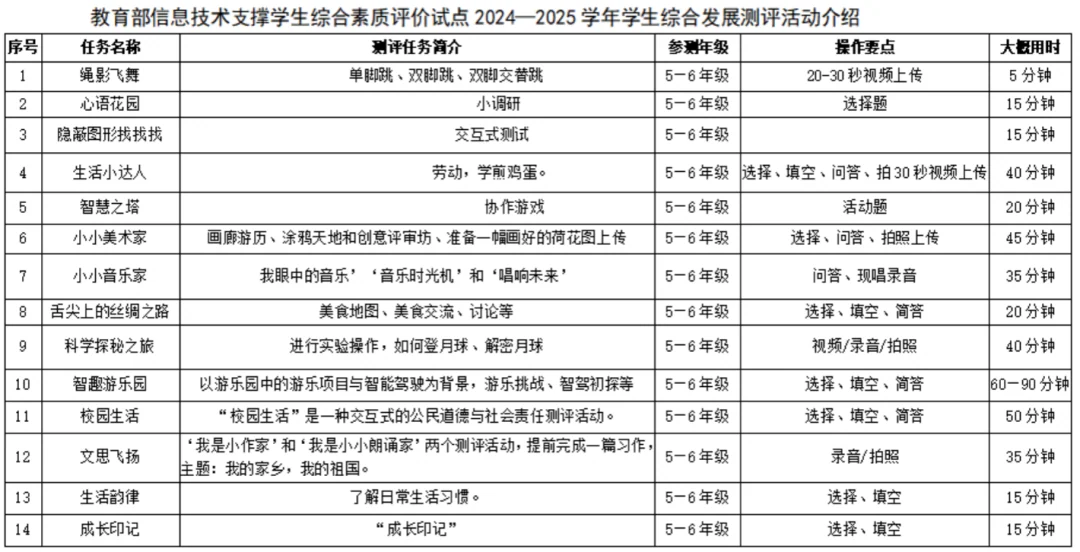
Based on the testing content of the platform and the students’ usual development needs, we have organized a series of meaningful activities accordingly. The arrangements are as follows:
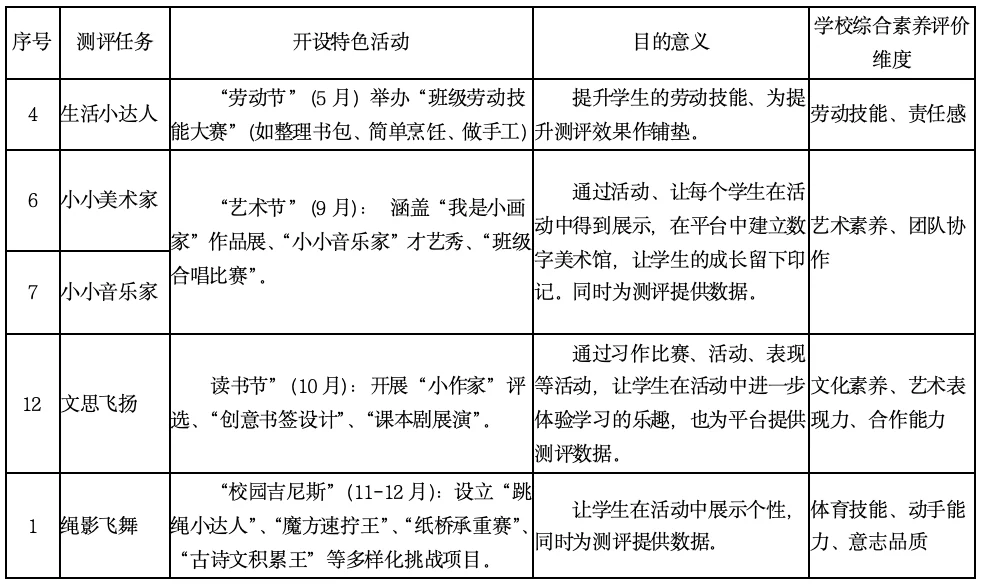
Based on the platform’s testing results and the students’ usual development needs, we have organized a series of meaningful activities accordingly. As shown in Table 5 below:
When this series of activities were designed, the relevant evaluation dimensions and observation points were integrated into the activity plans and evaluation criteria. During the activities, teachers, student judges, and parent volunteers used the mobile platform to record students’ participation, remarkable moments, outstanding performances, or areas that need improvement at any time. After the activities, the evaluation data—such as award levels, participation scores, and descriptions of key performances—were promptly collected and entered into the platform, serving as important basis for evaluating students in the corresponding dimensions. By emphasizing the integration of activities and evaluations, even in the early stages when the platform was not fully available, efforts were made to accumulate data for later entry. This allows students to improve their skills through enjoyable experiences, and evaluations to occur naturally during the activities.
3. Integrating teaching and research, enabling evaluation to drive educational reform
The evaluation system guides the direction of teaching and research: The “Five-Education Integration Evaluation” framework established by the school is deeply integrated into the school’s own teaching and research system. This framework serves as one of the important guidelines for the design of teaching and research activities.
At the beginning of the school year, our school distributed the 2022-2023 student comprehensive development assessment reports to the heads of each subject, so that they could analyze the existing problems together. Based on the data provided in the 2023 student comprehensive development assessment reports, we conducted analyses regarding the average scores in various aspects of the comprehensive quality of students in our school and similar schools in the region, as well as the balance indices in those same aspects between our school and similar schools in the region.
According to the data, the performance of our school in various aspects is slightly lower than that of similar schools in the region. In response to this situation, the school took the lead in organizing subject leaders to discuss the areas for improvement within their respective subjects, and these issues were incorporated into teaching and research activities. A regular teaching and research program titled “Teaching driven by data” was established, requiring regular thematic teaching and research activities based on evaluation data every month. The process of these activities is as follows:
(1) Data presentation: Teachers in charge of teaching and research or key teachers use the platform’s visualization tools to display overall data regarding a certain aspect of students, such as “learning habits”, “class participation”, “practical and innovative abilities”, or specific assessment criteria, such as “innovative expression in writing”. They also show the differences among students in the class, as well as individual performance.
(2) Focus on issues: Based on the data, the teaching and research group analyzes together the students’ strengths in this area, common problems, and typical cases.
(3) Strategy discussions: Based on the identified problems, discuss specific strategies and methods for improving teaching methods and designing intervention activities. For example, in response to the feedback indicating that “the content of writing is empty and lacks genuine emotion,” a special discussion was held on “how to guide students to observe life and express genuine emotions in writing instruction.” Practical tasks such as “life diaries” and “micro-writing” were introduced, and the progress of students was tracked on the platform later on. In response to the data showing “insufficient standardization in scientific experiment operations,” a research class on “standardization and innovation in experimental teaching” was organized, along with the optimization of the experimental guidance process and evaluation criteria.
(4) Practical validation and feedback: Apply the strategies developed during the discussion to subsequent teaching or activities. Continuously record relevant performance data on the platform, and observe the effects of improvement. This creates a closed loop of “evaluation – analysis – teaching and research – improvement – re-evaluation”.
(5) Transforming evaluation content into teaching resources: The teaching and research group develops corresponding micro-courses, activity plans, and evaluation criteria as teaching resources, based on the key aspects of the evaluations (such as “labor skills”, “cooperative inquiry ability”, and “artistic expression”). This makes the evaluation criteria more operational and visible.
(6) Feedback on situations: The Art and Chinese Language teaching groups realized that the artistic performance and writing abilities of students in the 2023 comprehensive assessment report were not very satisfactory. Therefore, before the 2024 assessment, they organized teaching and research sessions to address these issues in relation to the assessment criteria.
4. Closed-loop data collection, enabling effective analysis and improvement
(1) Process-based data collection: Teachers use an app to record students’ performance in class discussions, group activities, and participation in various events. For example, photos of students during physical education classes or artwork created in art classes are uploaded via the app. Additionally, students’ parents can also upload photos of their children’s daily performance on the platform, and these reports are provided to students on a weekly basis.
(2) Result-based assessment: The comprehensive quality assessment is a rigorous process. According to our school’s arrangements, it is carried out in a systematic manner, with each item and its responsible person being addressed in order.
① For activities that involve integrated evaluation, the teachers in charge of the competitions and the class advisors work together to organize the data, and then guide the students to import it into the platform. For example, in the “Jump Rope Expert” activity, while the activity is being carried out, physical education teachers and parent volunteers who attend the activity help collect the data. After the activity is completed, the class advisors guide the students to import the data into the platform together.
② For those activities that are integrated with subject teaching, they are carried out under the guidance of the subject teacher, the homeroom teacher, and parents. For example, in the “Little Musicians” activity, the music teacher will conduct teaching and guidance in class based on the assessment content. Then, together with the homeroom teacher, the subject teacher will take the students to the computer room within the scheduled time to help them complete the assessment. Students who have the necessary conditions can complete this task with the assistance of their parents.
5. Establish a dynamic feedback mechanism through collaboration between schools and families
Home-school collaboration is an important aspect in the implementation of evaluations. Under the leadership of the Moral Education Department, various channels are used to strengthen communication and participation.
(1) Concept promotion and platform training: Through parent school lectures, parent WeChat groups, parent meetings, and parent open days, as well as the distribution of “A Letter to Parents”, the significance of the implementation plans at both the district and school levels, the evaluation concepts (focusing on the process and diverse development), the functions of the platform, and the roles of parents – such as observers, recorders, and collaborators – are explained in detail.
(2) A convenient channel for parents to participate:
① A platform account is created for each parent, along with clear operating instructions (in text and video format).
② Parents can use the mobile app or web interface to view their child’s personal development records. They can obtain real-time information about their child’s performance in various aspects of the five aspects of education at school, the evaluations received (including written comments and points), as well as the exciting moments the child has participated in (photos and videos of activities).
③ Participation in evaluation: Make supplementary records and evaluations regarding a child’s behavior at home, such as household chores, reading habits, and emotional management.
④ Communication between school and home: Conduct point-to-point communication with the homeroom teacher and subject teachers, and discuss the child’s development.
⑤ Integration of Parent Open Day and various activities: During “Parent Open Day”, there should be areas for platform experiences and sessions for data interpretation. Parents are invited to participate in special activities, such as labor skills competitions or as observers or judges for art performances. By engaging in the evaluation process themselves, they can gain a greater sense of involvement and satisfaction.
Through the integration of daily life experiences and activities, parents and students completed the assessments of various tasks in a pleasant and engaging environment.
(4) Motivational drive: Multiple evaluations to stimulate internal motivation
In order to encourage teachers and students to actively participate in the comprehensive evaluation activities, our school has also established some reward measures:
1. Student reward system
By integrating the characteristics of the dragon and lion elements in schools as the basis for evaluation, points are awarded based on the completion of various assessment tasks. At the end of each semester, students are recognized as “Sunny Lions”, “Wise Lions”, “Energetic Lions”, “Intelectual Lions”, or “Diligent Lions”. The student who achieves the best overall evaluation can be awarded the title of “Excellent Lion”. As part of this evaluation system, each class has its own “Points Award” system. For example, within a class, there is a system where each student can earn 50 points for completing a particular assessment task. These points serve as one of the criteria for determining which student will be recognized as a “Diligent Lion” at the end of the semester. If a student successfully completes the “Life Expert” assessment, they can earn additional points in the “Happy Evaluation” system, especially in the labor-related assessments. If, over the course of the semester, a student ranks among the top six in this class, they can be recognized as a school-level “Diligent Lion”. Additionally, the points earned can be exchanged for “small rewards”, the ability to fulfill one “wish”, the opportunity to change seats, or a reduction in the number of homework assignments for one day.
2. Teacher rewards
The evaluation work for both platforms is included in performance assessments: The effectiveness with which teachers participate in the comprehensive evaluation is compared and evaluated. Data collection, the writing of personalized comments, and the use of data to improve teaching are all considered as factors that contribute to teachers’ performance bonuses. For example, if a teacher who is responsible for guiding the comprehensive evaluation project can guide students to complete it efficiently and effectively, they will receive an additional 5 points in their final assessment.
Class evaluation data are linked to honors: The overall participation rate of students in comprehensive assessments, the effectiveness of their performance, as well as platform activity levels, data integrity, and the development of their overall qualities, are all included in the scoring system for “Civilized Class” and other collective honors. This helps to encourage head teachers and subject teachers to work together to promote these aspects.
III. Innovation achievements: Digital and intelligent technologies enhance the development of the five aspects of education
After more than two years of solid exploration and iterative practice, the “Information Technology to Support the Comprehensive Evaluation of Students’ Qualities” reform project has achieved the following results in our school, mainly in the following aspects:
(1) The evaluation system should be scientific and dynamic, with the value of data being highlighted.
1. The school-based evaluation criteria have been established: A system of school-based comprehensive quality evaluation criteria has been developed, which focuses on the integration of the five aspects of education, covers multiple dimensions and various evaluation points, and is tailored to the specific conditions of the school and the needs of students. The evaluation content is more comprehensive, and its objectives are clearer.
2. 100% electronic growth records coverage: A dynamically updated electronic growth record has been established for every student in the school. The record integrates process and outcome data across various areas such as academics, character, health, art, and practice, thereby breaking down information silos.
3. Data visualization and convenient application: The platform provides a variety of dashboards and standard reports. Additionally, during the evaluation process, a 100% comprehensive electronic growth record for students was established, and the evaluation data is presented visually, enabling teachers to promptly understand the students’ development and take timely interventions.
4. Tracking across different grade levels is beginning to take shape: As data continues to accumulate, students in higher grades can access some of the key achievements they had during their lower grades, such as physical fitness metrics, participation in important activities, and the special badges they received. This provides a foundation for longitudinal tracking and analysis.
(2) Improvement of the quality of education and teaching
The quality and efficiency of education and teaching have been significantly improved. Teaching methods have shifted from being based on “experience” to being driven by “data”. Teachers generally find that through platform data, it is possible to better understand the overall knowledge level, skill distribution, and individual differences among students in a class. For example, language teachers use data analysis from the “writing module” to identify that students generally have weaknesses in “detailed descriptions” and “depth of ideas”. As a result, they adjust their teaching focus, design special training sessions, and provide guidance during subsequent writing exercises.
With targeted activities and teaching and research support over a year, the quality has improved.
2. Personalized tutoring is based on reliable data. Teachers can, based on the individual reports provided by the platform, such as learning habits, classroom participation, and performance in project-based learning, conduct more targeted individual conversations, tutoring, or group assignments.
3. Teaching and research activities are more targeted. Thematic teaching and research based on evaluation data have become the norm. The content of these activities focuses more on practical problems, and the teaching improvement strategies proposed are more practical and their effectiveness can be measured.
4. The atmosphere of joint education between schools and parents is strong, and parent satisfaction has increased. According to an anonymous survey conducted among all parents at the end of the 2024 promotion phase by the school (with a valid response rate of 85%), 95% of parents said that they can obtain a more comprehensive and timely understanding of their children’s performance at school through the platform; 88% of parents found the platform to be “relatively convenient” or “very convenient” for communication between schools and parents, making interactions smoother. 92% of parents agree with the school’s approach to comprehensive quality assessment and stated that they will be more actively involved in tracking their children’s development and in interactions with schools.
(3) Social recognition and resource expansion
1. A significant increase in parental support: Parents have a better understanding, trust, and support for the school’s activities; they actively participate in school events, volunteer work, and home-school cooperation programs.
2. Expansion of practice bases: The effectiveness of the school’s comprehensive quality education has been recognized by the community. Two new, stable off-campus practice bases have been established, such as local agricultural ecological parks and community service centers, providing students with more diverse opportunities for practical experience.
IV. Future Outlook: Deepening the application of smart technologies
The reform of the comprehensive evaluation of students’ qualities under the support of information technology is a systematic project that requires continuous improvement and development. Looking towards the future, our school will focus on the following tasks:
Improve the connection mechanism between primary and junior high schools
Under the coordination of district and town authorities, efforts are being made to establish effective connections between the evaluation criteria of the electronic student development records and those of the corresponding junior high schools. This ensures the continuity of students’ development and the consistency of evaluations. This contributes data and experience to the “Comprehensive Competency Assessment of Students in Nanhai District: Tracking of Growth Across Different Stages of Education”.
Optimizing precise education based on data-driven methods
Further deepen the application of evaluation data in various aspects such as teaching, moral education, and activity design, thereby creating a more effective “evaluation–feedback–improvement” cycle, and facilitating a more precise transformation of the education model.
In general, by leveraging the collaboration between two platforms to create a “record–evaluation–improvement” cycle, our school has achieved a transformation in evaluation from “experience-based judgment” to “data-driven evaluation”. This practice demonstrates that the essence of technology-enhanced evaluation is to bring education back to its original purpose: to enable every child to grow up happily under the sunlight. Moving forward, our school will continue to explore innovative ways to integrate information technology with students’ comprehensive evaluations. We strive to make evaluation a powerful force that stimulates students’ potential, promotes their holistic development, and supports the high-quality development of the school. This will provide a solid foundation for cultivating new generations who can take on the responsibility of rejuvenating the nation.
Original link: https://aiedchair.bnu.edu.cn/news-citlab-2247627407-1-en/