News

Hanoi MOOC conference explores how people and AI can work together in higher education

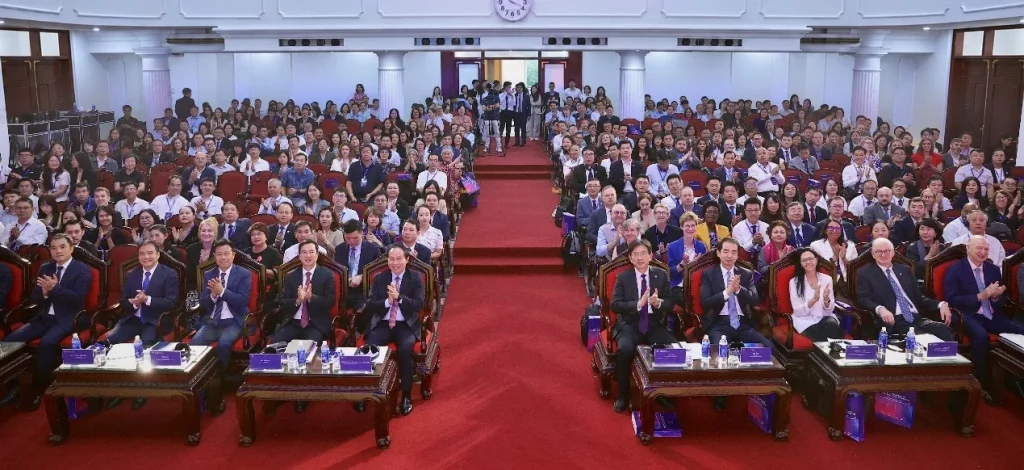
Nearly 400 delegates from more than 25 countries attended the 2026 Global MOOC and Online Education Conference in Hanoi, Viet Nam. The Global MOOC and Online Education Alliance and the UNESCO Institute for Information Technologies in Education (UNESCO IITE) co-organised the conference, which was hosted by Tsinghua University and Vietnam National University, Hanoi. At the opening ceremony on 3 November, the discussion focused on how higher education can respond to AI.


AI 如何检索英语议论文范文:四种方法的比较

Four approaches to retrieving model English essays

A team at Uppsala University compared BM25, Word2Vec, Sentence-BERT and Elasticsearch on English argumentative essays. Sentence-BERT performed best at semantic matching in this experiment; simpler approaches remained useful for keyword searches or limited computing resources.

从实验数据学数学:五年级测量不规则物体体积

Using experiments to measure irregular objects in Year 5

A primary school in Ordos linked a diagnostic task, differentiated preparation, classroom experiments and follow-up feedback. Pupils explored the volume of irregular objects through measurement and comparison, while teachers used learning data to adapt their guidance.

沈阳大东区建设区域教育数字底座

Building a district education data platform in Dadong

The Dadong District Education Bureau in Shenyang combined data governance, low-code tools and cooperation with schools. The case traces platform development, training, pilots and rollout, including the challenges of connecting separate data systems.

幼儿园微课《王冠之谜》如何使用 AI

AI in a preschool lesson on the mystery of a crown

Pujiang Ruihecheng Kindergarten in Shanghai used AI to help prepare a story, illustrations, video and narration for a preschool lesson. The case explains how teachers adapted the materials and redesigned interactions for young children.

用 EDIPT 和 AI 设计音乐学习任务

Designing music tasks with EDIPT and AI

Xingpu Experimental Middle School in Suzhou used the EDIPT design model and AI tools to develop practical music tasks. The activities address aesthetic perception, performance, creativity and cultural understanding.

六年级家风教育如何用上 AI

Using AI to teach family traditions in Year 6

Nanchang Vanke City Primary School used AI in a Year 6 unit on family traditions and revolutionary heritage. The case describes how teachers turned family stories into digital classroom activities to encourage participation.

《动物儿歌》课堂如何用 AI 改进提问

Using AI to improve classroom questions in Year 1

Teachers in Chengdu’s Shuangliu District combined AI analysis, classroom observation and pupil work to review a Year 1 lesson on an animal rhyme. They redesigned the questions to move from observation to comparison, reasoning and application.

Scroll to Top