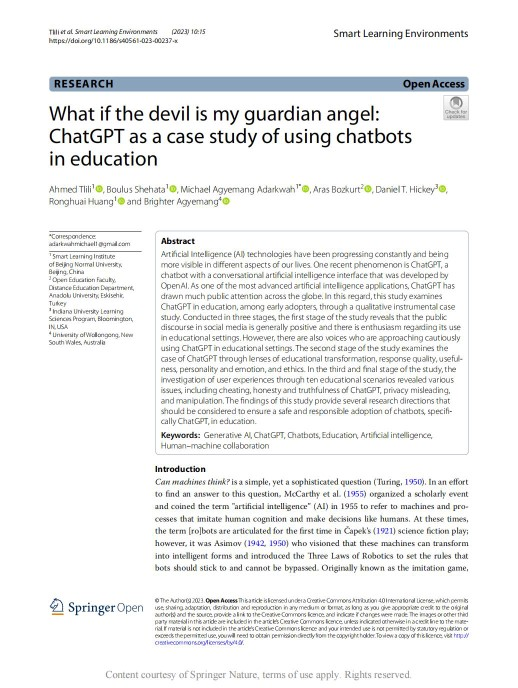
Ronghuai Huang and BNU Smart Learning Institute researchers Ahmed Tlili, Boulus Shehata and Michael Agyemang Adarkwah collaborated with scholars in the USA, Türkiye and Australia on educational chatbots’ opportunities and challenges. Published in Smart Learning Environments, the study outlines directions for safe and responsible adoption.
Method and three stages
This qualitative instrumental case study of early adopters was conducted in three stages:
- Analyze public social-media discussion: generally positive, with voices urging caution.
- Analyze interviews through educational transformation, response quality, usefulness, personality and emotional expression, and ethics.
- Investigate user experiences and issues through ten educational scenarios.
Ten educational scenarios
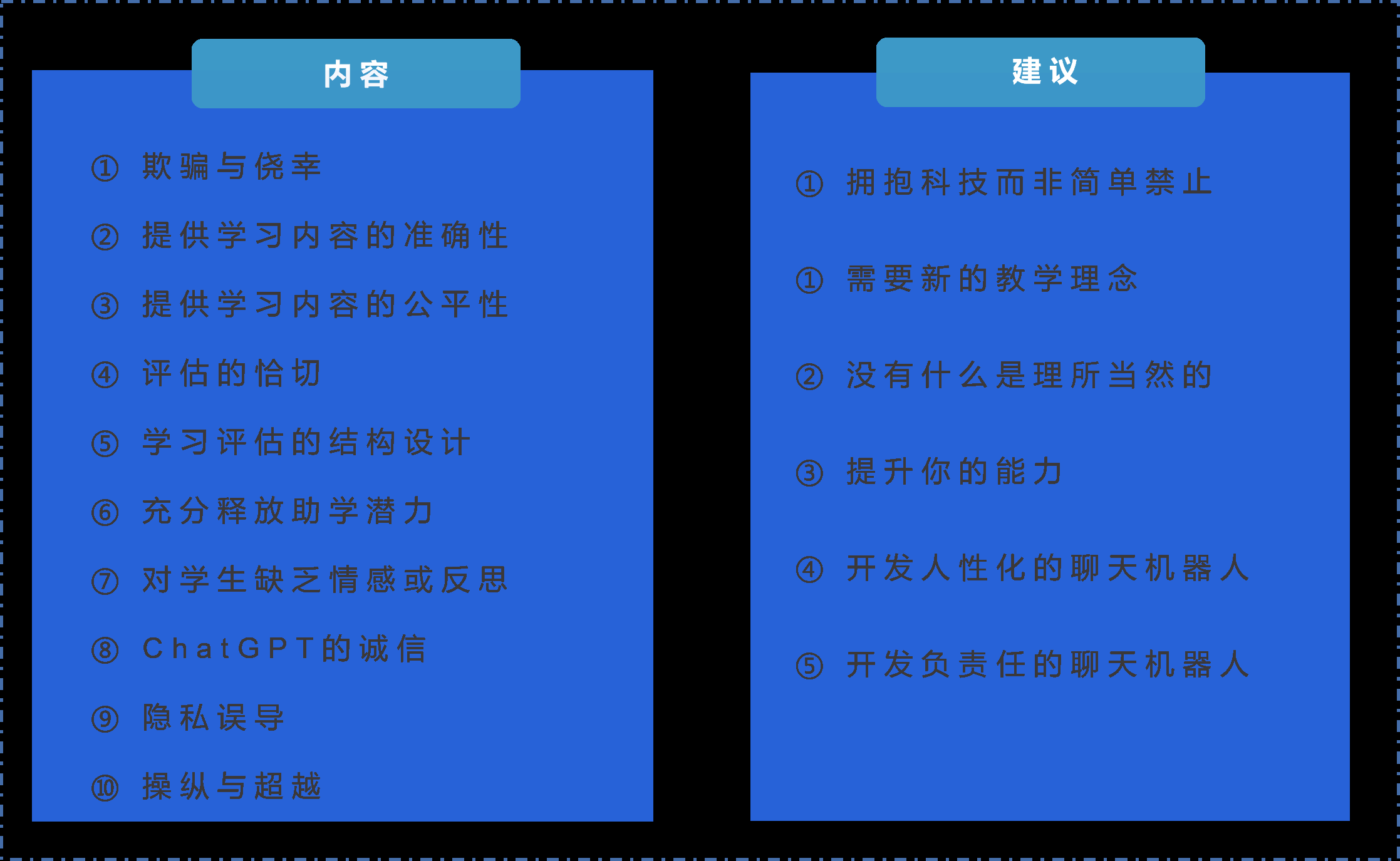
The third stage investigated user experiences in ten educational scenarios. The site’s existing summary graphic is also transcribed as text for multilingual reading:
- Cheating and getting away with it.
- Accuracy of learning content.
- Fairness of learning content.
- Appropriateness and naivety of generated learning assessments.
- Structure of learning assessments.
- Unlocking learning-assistance potential.
- Absence of emotions or reflections on student engagement.
- Honesty and truthfulness of ChatGPT.
- Privacy misleading.
- Manipulation and going beyond the request.
Six discussion directions
The paper’s discussion and the existing site graphic present six directions:
- Examine and adopt technology thoughtfully rather than relying on bans alone.
- Explore a new teaching philosophy.
- Take nothing for granted.
- Upskill users’ competencies.
- Research more humanized chatbot interactions.
- Develop responsible chatbots.
Context and interpretation
These discussions concern early ChatGPT use in 2023 and should be interpreted in that research and historical context. Response quality, emotional expression, truthfulness and privacy findings do not substitute for evaluating current products.
Original summary graphic
The original Chinese summary graphic is retained below. Its ten scenario topics and six recommendations are transcribed above. It is an illustration from the historical site report for comparison with the original introduction.
Related reading
Related reading: the theoretical study of ChatGPT, information seeking and classroom engagement considers other potential learning pathways.
Publication and source
Published on 22 February 2023, the paper appears in Smart Learning Environments, volume 10, article 15, under CC BY 4.0. The site’s original introduction date of 27 February 2023 is retained; details are available on the publisher’s page.
Reference: Ahmed Tlili; Boulus Shehata; Michael Agyemang Adarkwah; Aras Bozkurt; Daniel T. Hickey; Ronghuai Huang; Brighter Agyemang. What if the devil is my guardian angel: ChatGPT as a case study of using chatbots in education. Smart Learning Environments 10, article 15 (2023). DOI: 10.1186/s40561-023-00237-x
Original link: https://aiedchair.bnu.edu.cn/news-4711-en/