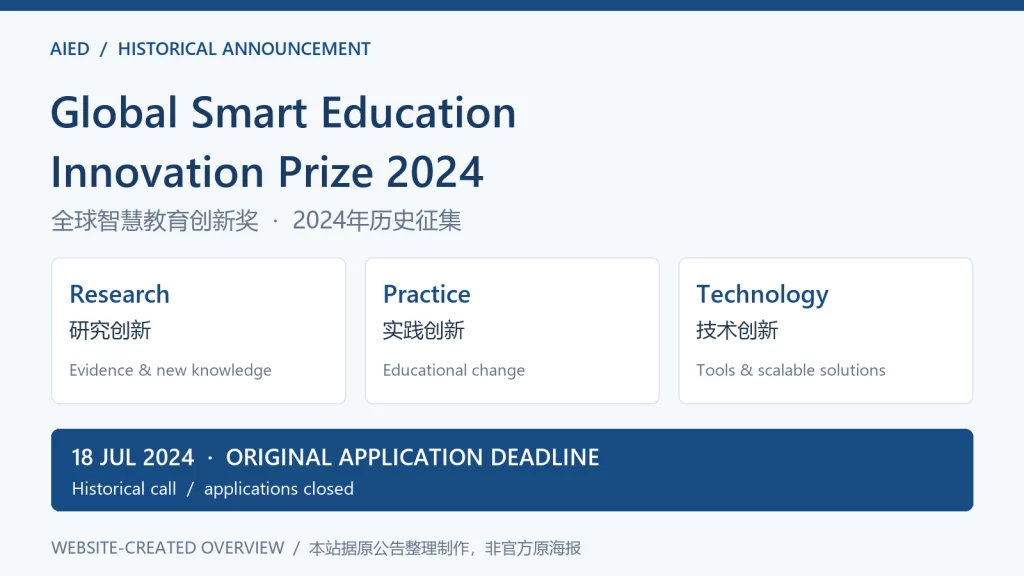
Historical call: this page preserves the 2024 Global Smart Education Innovation Prize announcement. Its application deadline was 18 July 2024 and the call has closed; this is not a current invitation to apply.
The original English announcement presented digitalisation as an important breakthrough in opening new avenues and shaping education’s future. Artificial intelligence and emerging technologies were changing teaching and learning, while generative AI was affecting institutions, teachers and learners in unprecedented ways. Referring to the agenda of the UN Summit of the Future 2024, it highlighted cooperation to revisit education’s purpose, learning environments, the teaching profession and digital transformation, and to support quality education for all.
What smart education should achieve with technology
- Increase access.
- Improve quality.
- Reduce costs.
- Support inclusion.
To promote digital transformation in education and international understanding, the Global Smart Education Conference organising committee announced the Global Smart Education Innovation Prize. It aimed to recognise innovative smart education solutions using technology to address urgent challenges in education and training.
Education levels and innovation areas
The original English call covered primary, secondary and tertiary education, including technical and vocational education and training (TVET) and lifelong learning. Innovation areas included, but were not limited to:
- Using technology to improve pedagogy.
- Reaching marginalised people and persons with disabilities.
- Developing solutions for scaling up TVET.
- Developing models for employment and entrepreneurship.
- Advancing cutting-edge research.
Three prize categories
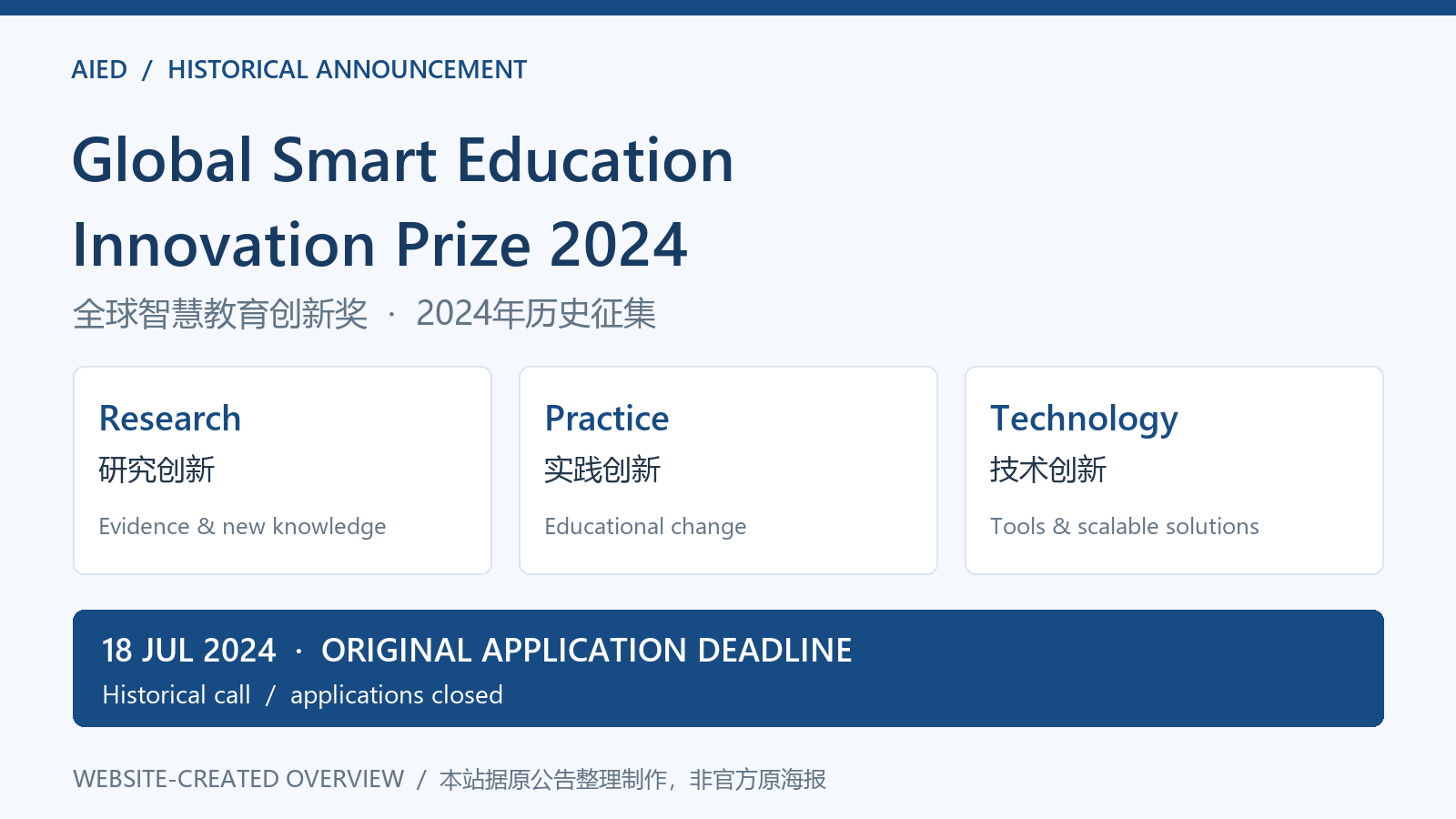
Research Innovation Prize
This recognised widely influential, empirically verified innovations in smart education by individuals, institutions or organisations, extending the frontiers of knowledge in smart education and intelligent technologies. The English original used Research Innovation Prize; the Chinese announcement called it the Theory Innovation Prize. Eligible work included, but was not limited to:
- Theoretical and empirical research.
- Innovative books, papers and research reports.
Practice Innovation Prize
This recognised practical innovations in smart education by individuals, institutions or organisations. The original English announcement included, but did not limit the scope to:
- Digital transformation in education at local, national or regional levels, relating to governance or practice.
- Improvements in classroom teaching.
- Development of innovative pedagogic models.
- Innovative uses of technology to improve educational quality and reach the unreached.
Technology Innovation Prize
This recognised technological innovations in smart education and enterprise that could help address key education and training challenges. Examples in the English original included, but were not limited to:
- Educational equipment and tools.
- Software systems.
- Coding and algorithms.
- Integrated technology solutions.
The English original encouraged individuals, institutions or organisations affiliated with a company to explore new ideas, approaches and solutions, delivering ethical innovations that could scale up and make a difference.
Original application materials and deadline
Candidates were asked to complete the Global Smart Education Innovation Prize Application Form and submit a signed Declaration of Commitment. The following arrangements belong to the 2024 call:
- Deadline: 18 July 2024.
- Submission: send the application form and relevant materials to the then official address gseprize@bnu.edu.cn.
- Application languages: English or Chinese.
Original selection process and criteria
The Global Smart Education Conference Program Committee was responsible for evaluating applications and determining the winners. It could award more than one prize in each category. The English announcement stated that its decision was final and not subject to appeal; this is a record of the historical rule. Criteria included, but were not limited to:
- Innovative digital solutions.
- Evidence of impact.
- Practical value.
- Inclusion and equity.
- Potential for effective applications and scale.
The English original said winners would be announced at the Global Smart Education Conference, where certificates and cash prizes would be presented at an awards ceremony. This preserves the original arrangement and makes no inference about individual winners or current prize rules.
Additional context from the official Chinese announcement
The SLI Chinese announcement also described changes in the world, the times and history as prompting education to adapt, and smart education as a new educational form in the digital age. It referred to the UN Transforming Education Summit’s call to harness the digital revolution and provide quality education and lifelong learning as a common good for everyone, emphasising equity, inclusion and quality. This reference is distinguished from the English original’s Summit of the Future 2024; the two summits are not conflated.
The Chinese text named the first category Theory Innovation, stressed an exemplary role for practice innovations, and described technology innovations from industry enterprises and research institutions addressing educational science problems and supporting large-scale application. It specified self-submission and said winners would be published on the conference website, with awards presented during the conference. These formulations are compared alongside the complete English original, which has not been replaced by the shorter Chinese version.
Original contacts and signatory (2024 record)
- Original application email: gseprize@bnu.edu.cn
- Conference website (current content may concern later editions): https://gse.bnu.edu.cn/en
- The SLI Chinese announcement also listed the then enquiry number 13583379533. It is retained as a historical record; its current purpose has not been verified.
Signatory: Organizing Committee of Global Smart Education Conference.
Original attachments and current availability
- Attachment 1: Announcement of Global Smart Education Innovation Prize (original English PDF).
- Attachment 2: Global Smart Education Innovation Prize Application Form (original English DOC).
Both original English attachment URLs returned 404 during this review. No downloadable file was obtained from the old attachment links in the Chinese announcement either. Attachment names and historical requirements are preserved here without failed download buttons, a claim of recovery or a new application form.
Sources and editorial notes
- The original English title, 20 May 2024 at 06:00 archive time and URL are preserved. The substantive content of all 23 original text units is retained and arranged into background, scope, categories, materials, selection, contacts and attachments. · Original Chair announcement in English · Related SLI announcement in Chinese
- The corresponding SLI Chinese announcement displays 28 May 2024 as its publication date and provides additional context. Cached text from the old GSE page or attachments does not establish that files remain downloadable. No 2025 or 2026 call has been used to replace the 2024 categories, language requirements or deadline. · Original Chair announcement in English · Related SLI announcement in Chinese
- All application, selection and contact details are archived as stated in 2024. The explicit inclusion of marginalised people and persons with disabilities is also indexed under special and inclusive education in the resource centre.
Explore AI and STEM learning resources · Explore special and inclusive education resources
Original link: https://aiedchair.bnu.edu.cn/announcement-of-global-smart-education-innovation-prize/