Dongsheng District No. 4 Primary School in Ordos drew on China’s national school platform to plan a Year 6 lesson on Lu Xun’s Young Runtu. The case shows how resources across subjects can explain the historical setting and support close reading.
Using a smart education platform to plan a primary Chinese lesson on “Young Runtu”
Dongsheng No. 4 Primary School, Ordos, Inner Mongolia
Keywords:A vast amount of high-quality resources; convenient lesson preparation; overcoming difficulties in teaching
1. Background of the case
In this era of rapid development in educational informatization, the National Smart Education Platform for Primary and Secondary Schools serves as a treasure trove filled with endless knowledge and inspiration. With its vast array of high-quality resources, convenient tools, and innovative concepts, it opens up new possibilities for teachers in preparing lessons. The platform’s unique interdisciplinary integration capabilities enable the organic combination of knowledge from various fields such as literature, history, and art, thereby effectively promoting the modernization of education.
In the “Approaching Lu Xun” unit of the sixth-grade textbook, the text “The Young Runtu” has become a key and challenging topic in primary school language teaching due to its profound meaning and literary value. Through the recollections of “me” about my interactions with Runtu thirty years ago, this text vividly portrays the image of a clever and brave rural boy who has extensive knowledge. At the same time, it also reveals “my” longing for a free life, as well as the pain caused by the class barriers. However, in traditional teaching methods, due to the significant gap between the students and the time in which the works were written, and also because of the unique language style of Lu Xun’s works, it is difficult for students to understand them. In this context, by utilizing the resource integration and interactive functions of the National Primary and Secondary School Smart Education Platform, through interdisciplinary approaches, the historical context can be restored, character images can be created through art, and class relations can be understood from a sociological perspective. This helps to create an efficient classroom environment, thereby effectively overcoming the difficulties in teaching.
II. Application Introduction
1. Application period: Unit 8 of the first volume of Chinese language for Grade 6 (compiled by the Ministry of Education): “The Young Runtu”.
2. Application role: Teacher.
3. Application scenarios: Teacher lesson preparation.
4. Introduction to the specific process:
Step 1: Open the National Primary and Secondary School Smart Education Platform, and enter your account and password to access the main page.
Step 2: Open the “Course Teaching – Teacher Preparation and Instruction” section. In the “Common Textbooks” section, select the Unified Edition Chinese Textbook for Grade 6, Volume 1. After opening it, scroll down and choose Unit 8, “The Young Ruan Tu”. On this page, there are numerous teaching resources, including teaching plans, teaching materials, video courses, learning task sheets, and after-class exercises. These resources have been very helpful for my lesson preparation.
Step 3: Open the video resources. I selected the video courses provided by Teacher Zhang Huayu and Teacher Luo Jing. In the lower right corner, there is a “Teaching Mode” option; click on it to enter the teaching mode. I carefully watched the videos taught by both teachers, studied their accompanying materials in detail, and also paid close attention to the teaching objectives and the structure of the teaching content. Through in-depth study and reflection on these high-quality resources, I, combined with the actual situation of the students in my class, gradually developed a clear understanding of the text “The Young Luantu”. I also explored the intrinsic connections between this text and various subjects, and tried to achieve interdisciplinary integration. In collaboration with the art teacher, I used elements such as colors, lines, and compositions to portray the character and personality traits of the young Luantu, allowing students to experience the charm of the literary work from different perspectives. Based on this, I completed the teaching design and learning materials for this class.
Basic information on teaching design
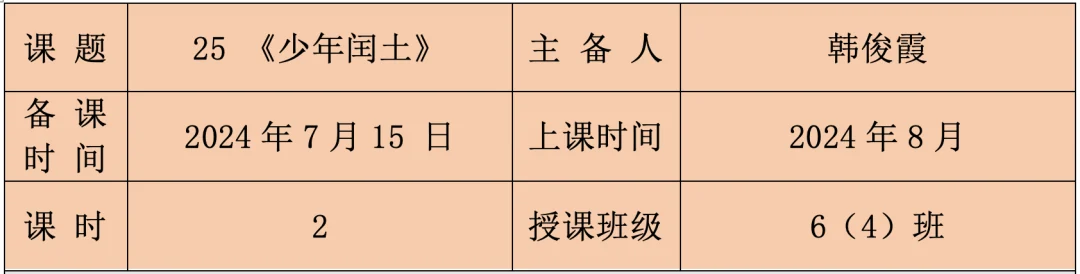
Read the table as text
| Field | Details |
|---|---|
| Topic | 25 — A Young National Luminary |
| Lead planner | Han Junxia |
| Preparation date | 15 July 2024 |
| Lesson date | August 2024 |
| Lesson periods | 2 |
| Class | Grade 6, class 4 |
Analysis of teaching content
“The Young Runtu” is a key reading text in the “Getting Close to Lu Xun” unit of the sixth-grade textbook, and it is also a classic piece of writing. This text is taken from Lu Xun’s short story “Hometown”. It describes the memories of “me” regarding the life we lived with Runtu thirty years ago. By describing various events from the childhood time spent with Runtu, the author portrays the image of a clever, brave, intelligent, and well-informed young boy from the seaside village. This text reflects “me”’s brief but sincere friendship with Runtu during his childhood, as well as my nostalgia for him.
Analysis of learner characteristics
Sixth-grade students have developed a certain level of independent learning ability. They can think while reading, make notes, and express their opinions on sentences and words that resonate with them. They also know how to gather relevant materials based on the text content to aid their understanding. Therefore, in this lesson, my focus is on “developing students’ ability to describe characters through their appearance, speech, and actions”. Appropriate teaching objectives were set based on the students’ current knowledge level and skills.
Interdisciplinary integration
Deeply explore the intrinsic connections between the text and various disciplines, and achieve interdisciplinary integration. Work together with art teachers to depict the character and personality traits of the young Runtu through elements such as colors, lines, and compositions. In this way, the charm of literary works can be appreciated from different perspectives.
Learning objectives
1. Can write 12 characters such as “Zheng, Bai”, and 14 words such as “endless horizon, family scenery”.
2. Understand the image of Runtu in “my” mind, and read the text emotionally based on that understanding. Also, memorize the first paragraph of the text.
3. Be able to grasp the key sentences and phrases, and use the relevant materials to understand the “me”’s inner world.
4. Following the style of the first paragraph, describe a moment in life captured by a photograph.
Key points and difficulties of teaching
1. Be able to describe what kind of young man Runtuo was, and understand the beautiful image he holds in “my” mind.
2. Be able to describe what the “I”’s inner world is like.
Teaching process (first class)
Learning Task 1: Introduce the new lesson and get to know Lu Xun. The teacher guides the students to pay attention to the introduction of Lu Xun in the unit introduction: In this unit, we will get closer to this great man through a series of texts. In the text we are studying today, we will meet a young man who is about the same age as us. He is not only healthy, innocent, and lively, but also intelligent, brave, and well-informed. His name is – the young Runtu. The teacher reveals the title of the lesson, writes it on the blackboard, and the students read the title together. By watching the teaching plan prepared by Teacher Zhang Huayu on the National Primary and Secondary School Smart Education Platform, I help the students understand the language elements of this unit at the beginning of the new lesson, and enable them to grasp the learning objectives overall.
Learning Task Two: Initial Perception, Understanding the Content. (1) Read the text initially to check preparation: Read freely to pronounce correctly and make sentences flow smoothly. (2) Learn words and characters: Present words, have the teacher read them individually, understand difficult words, and through using a dictionary and reading annotations in the book, know the meanings of words such as “猹”, “大祭祀”, “家景”, “祭器”, “装弶”, “项圈”, “秕谷”, “希奇”, “检贝壳”, “祖像”, “供品”; students identify the new characters they need to write, and the teacher guides them to pay attention to words that are easy to misspell, reminding students that “租, 撒, 缚, 猬, 伶, 俐” should be written with the left side narrower and the right side wider. (3) Pay attention to word usage and sentence order in the text: Read silently, mark the sentences in the text where word usage and sentence order differ from current usage, and explain your understanding. By watching videos by Teacher Zhang Huayu on the National Primary and Secondary School Smart Platform, I can understand and clarify the sentences in the text where word usage and sentence order differ from current usage, which helps students easily comprehend the meaning of the text. Additionally, through after-class exercises, students can clarify the structure of the article, making the content of the article clear to them. (4) Organize the content of the text: Quickly skim the text and state how many parts it is divided into. Students skim the text and organize the plot.
Learning Task Three: Analyze the text carefully and appreciate the descriptions of characters. Focus on the section “Runtu, who we first meet”: read the first five paragraphs silently, mark the descriptions of Runtu’s character, and make simple notes. Then, share your findings with the class; the teacher will write on the blackboard that “Runtu is clever and brave, and very agile”. During Teacher Zhang Huayu’s lesson, the emphasis was placed on key words and sentences, allowing students to get a preliminary understanding of the characters’ personalities. During the guidance on reading, I also learned about various methods of describing characters. I designed this teaching activity to integrate it with writing instruction, thereby laying the foundation for the subsequent writing exercises.
Learning Task 4: Reflect on moments, combining reading and writing. Read the first to fifth paragraphs of the text with emotion; Writing practice: Photos capture the moments in our lives. Please choose a photo from your collection, and follow the style used in the first paragraph of the text. First, describe the scene in the photo, and then use appropriate descriptive techniques to portray the characters in the photo. Discuss and evaluate with the whole class. Evaluation criteria: Ability to describe characters’ characteristics through descriptions of their environment, appearance, and actions. Based on the photos that capture beautiful moments in students’ lives, along with guidance on writing, this practice is a good opportunity for students to practice their writing skills, enabling them to truly apply what they have learned.
Teaching process (second class period)
Learning Task Five: Review and recap, then introduce the new lesson. Conduct a review to reinforce the new words: write down the words “sincere, offerings, ritual instruments, kitchen, collar, hedgehog, smart, tidal surge”. Also, recall the sections of the text that were covered. Transition: Through the learning in the previous lesson, we got to know Runtu, a lively and shy, simple person. In this lesson, let’s listen to what Runtu said, and continue to discover what kind of young person Runtu is in my mind.
Learning Task Six: Perceiving images and understanding the inner world. Study the content related to “Runtu, who tells interesting stories”: Read paragraphs 6–18 silently, think about what interesting things Runtu told “me”, try to summarize them with short headings. The teacher writes down the titles: “Fishing for birds in the snow, collecting shells by the sea, protecting against bears while watching melons, and dealing with foxes”. Try to understand the character of Runtu reflected in these four events. First, make notes in the book, then work in groups to complete the learning sheets together. When studying “Fishing for birds in the snow”, ask students to find the verbs used in this part, understand what they indicate, and realize that Runtu is knowledgeable because there is “everything” mentioned. When studying “Collecting shells by the sea”, describe what the shells Runtu found are like. When studying “Protecting against bears while watching melons”, appreciate Runtu’s simplicity and kindness while protecting the melons from the bears; find words describing Runtu’s actions to show his wisdom and bravery, and words describing the bears’ actions to show their cunning. Understand the meaning of “the sky at the four corners of the high wall”, realize that “me” and my old friends have a limited range of life, and express your feelings and relate them to your own life. When studying “Dealing with foxes while watching melons”, read the text to feel the novelty of the fox. Think: Which of these four events is described in the most detail? Why? (2) Understand “me”’s inner world: Read the three sentences below, explain what they describe, and mark their positions in the text. These three sentences are included during Runtu’s stories; what can we feel from them? Runtu is knowledgeable, but what can “me” and my old friends see? Read paragraphs 6–18 in roles, and through the dialogue and psychological descriptions in the text, further understand “me”’s envy and longing for Runtu’s rich life. In the teaching video by Teacher Luo Jing on the National Primary and Secondary School Smart Education Platform, Teacher Luo Jing guides students to focus on the descriptions of actions and language, to appreciate the characters, and through comparative reading, narrow the distance between students and the author, allowing students to feel the author’s rich inner world, making them feel like they are there, and developing their thinking and comprehension abilities. This design is very inspiring to me.
Learning Task Seven: Enduring Separation, Deepening the Theme. Study the section “Runtu at the Time of Separation”: Read paragraph 19 silently, and think about how “I” felt when I parted with Runtu. Time spent together is always short; as I had to say goodbye to Runtu, I cried loudly. Why? Because I would never see Runtu again, and I would no longer hear those interesting stories. He could only live in a small world, and I felt a strong desire and envy for his life.
Learning Task Eight: Extended Reading. What will the “I” in the text and Runtu become when they grow up? Read an excerpt from “Hometown”, and discuss the thoughts and emotions expressed by the author. Students read the selected text and think about related questions, then share their thoughts. Expected outcome: The young Runtu is intelligent, brave, and skilled; the adult Runtu has a aged face, a numb spirit, and a difficult life. These two versions form a clear contrast, reflecting the author’s sympathy for the working people, his dissatisfaction with the current situation, and his strong desire to transform the old world and create a new life.
Learning Task Nine: Expansion and Interdisciplinary Integration. 1. Cultural Expansion: Through the folk stories and coastal customs described by Runtu in the text, students can learn about the regional culture, folk traditions, and folk legends of Shaoxing. 2. Artistic Integration: Based on the descriptions of the young Runtu character and the coastal scenes in the text, art-related activities can be carried out. In art classes, students are encouraged to create paintings about the young Runtu, using various forms such as watercolor paintings, sketches, or children’s art. 3. Connection with History and Society: The life of the young Runtu can be linked to the social conditions in China at that time. Students are asked to consider the impact of the feudal society on the lives of people from lower classes. Teachers can also guide students to pay attention to similar phenomena in modern society, such as the gap between urban and rural areas, and the disparity between rich and poor. This helps students to observe society from their own perspective and express their thoughts through art, thereby enhancing their social awareness and cultural competence.
Task design
Migration Writing Practice: Photos capture the moments in our lives. Choose one of your photos and write a piece in the style of the first paragraph.
Extended reading: After observing the learning sheets designed by Teacher Luo Jing on the National Primary and Secondary School Smart Platform, I recommend that children read Lu Xun’s works with the same theme as “The Young Runtu” — “The Village Games,” “A Chang and the Classic of Mountains and Seas,” and “From the Hundred-Plant Garden to the Three-Flavor Study.”
Others: Copy down new words and beautiful sentences, and complete the exercises in the workbook.
Blackboard design
By referring to the video courses provided by Teacher Zhang and Teacher Luo, I designed the “Four Small ‘Good Classes’ Guidance Sheets”.
Learning guide for the first class of “The Young Runtu”. Pre-class learning tasks: 1. Search for information independently; 2. Read the text, pronounce the words correctly using a dictionary, mark long sentences, and make preliminary annotations on the key sentences in the text; 3. Read the introductory guide for this unit to gain a basic understanding of the unit’s content and language skills. In-class learning tasks: 1. Partners should read the following words to each other and correct each other’s mistakes: home, scene, solemn, offerings, ritual objects, attention to detail, hope, kitchen, felt hat, collar, hedgehog, smart, experience, tidal wave, boundless; read the text silently and complete the exercises according to the text’s content, and outline the structure of the article: (living together, parting, memories, meeting) → ( ) → ( ) → ( ). 2. Review the methods of searching for information. By referring to the annotations and introductory information about Lu Xun’s literary knowledge in this lesson, search for the background of the text in a targeted manner, thereby laying the foundation for a deeper understanding of the text.
Teaching guide for the second class of “The Young Runtuo”. Pre-class learning tasks: 1. Read the text and mark in the book how many interesting things Runtuo told “me”. 2. Search for relevant information specifically, and understand the difficult parts of the text. 3. Get a basic understanding of the character’s image. In-class learning tasks: [Learning Task 1] Focus on the scene of watching the jackal while looking at the melon, and describe how many interesting things Runtuo told “me”. [Learning Task 2] Focus on the same scene, and by identifying key sentences, understand what kind of young Runtuo he was. [Learning Task 3] Why does the author write about watching the jackal while looking at the melon twice? Is this repetition unnecessary? [Learning Task 4] Use the provided information to understand the meaning of “the four-sided sky”, and appreciate the childhood lives of the two different young people in that historical context. Recommended reading resources: It is recommended to read excerpts from “Hometown”.
III. Analysis of innovation points
(1) High integration of resources, which saves time spent on lesson preparation
The National Primary and Secondary School Smart Education Platform integrates various resources related to “The Young Runtu” – including teaching plans, teaching materials, video courses, learning task sheets, and after-class exercises – into one place. This platform serves as a “one-stop” resource hub, which greatly saves teachers the time spent on preparing lessons and improves the efficiency of lesson preparation. In addition, “The Young Runtu” can be integrated with various subjects: with history, to understand the impact of social conditions during Lu Xun’s era on Runtu; and with art, to create drawings and visual representations based on the descriptions in the text.
(II) Broaden teaching perspectives to facilitate personalized teaching methods
By utilizing the interactive features of the platform, when preparing for “The Young Runtu”, I watched the video courses taught by Teacher Zhang and Teacher Luo. From these courses, I learned their teaching methods, approaches, and concepts. I then adjusted and optimized these methods according to my own circumstances. This interactive learning method that transcends time and space has enriched my teaching ideas, bringing new vitality to teaching innovation.
(3) Combine various methods to stimulate interest in learning
The rich resources provided by the platform facilitate teachers in integrating various teaching methods. In the teaching of “The Young Runtu”, teachers can combine different teaching methods such as lectures, discussions, and situational teaching methods. First, teachers can create a situational context to help students immerse themselves in the scenario described in the text; then they can explain the key words, sentences, and paragraphs in the text. After that, students can participate in group discussions to analyze the characteristics of Runtu’s character and the emotions expressed in the text. This innovative approach to combining various teaching methods can stimulate students’ interest in learning and improve their learning outcomes.
IV. Insights and suggestions
Experience: By using the National Primary and Secondary School Smart Education Platform for lesson preparation, I have truly appreciated the great convenience that comes from its rich and integrated resources. On this platform, there is everything related to “The Young Runtu”. From carefully designed teaching plans to vivid video courses, from targeted learning tasks to various forms of after-class exercises – everything is available. This platform has opened up a treasure trove of resources, thereby greatly improving the efficiency of lesson preparation.
Recommendation: With the continuous development and reform of education and teaching practices, the content of textbooks and teaching requirements will also change regularly. Therefore, it is recommended that the platform should keep up with the changes in textbooks in a timely manner, continuously optimize and update teaching resources, and ensure the relevance and applicability of these resources. When there are updates to textbook versions or changes in teaching syllabuses, the platform should promptly provide new teaching designs and related resources to meet the teaching needs of teachers.
Original link: https://aiedchair.bnu.edu.cn/news-citlab-2247627484-7-en/