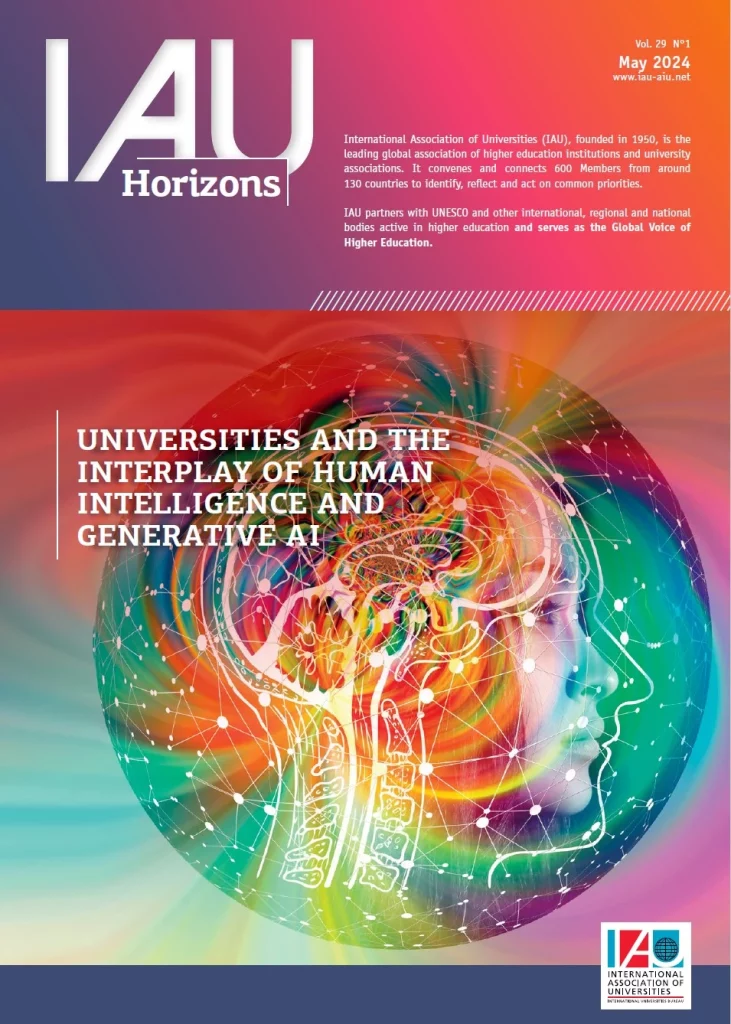
At the invitation of the International Association of Universities, Professor Huang Ronghuai, UNESCO Chair on AI in Education and Co-Dean of the Smart Learning Institute of Beijing Normal University, published a signed article in IAU Horizons entitled “Reshaping Higher Education with Vital Competences in the Intelligent Era”.
By Huang Ronghuai, UNESCO Chair on AI in Education and Professor & Co-Dean, Smart Learning Institute, Beijing Normal University, China, as credited in the journal.
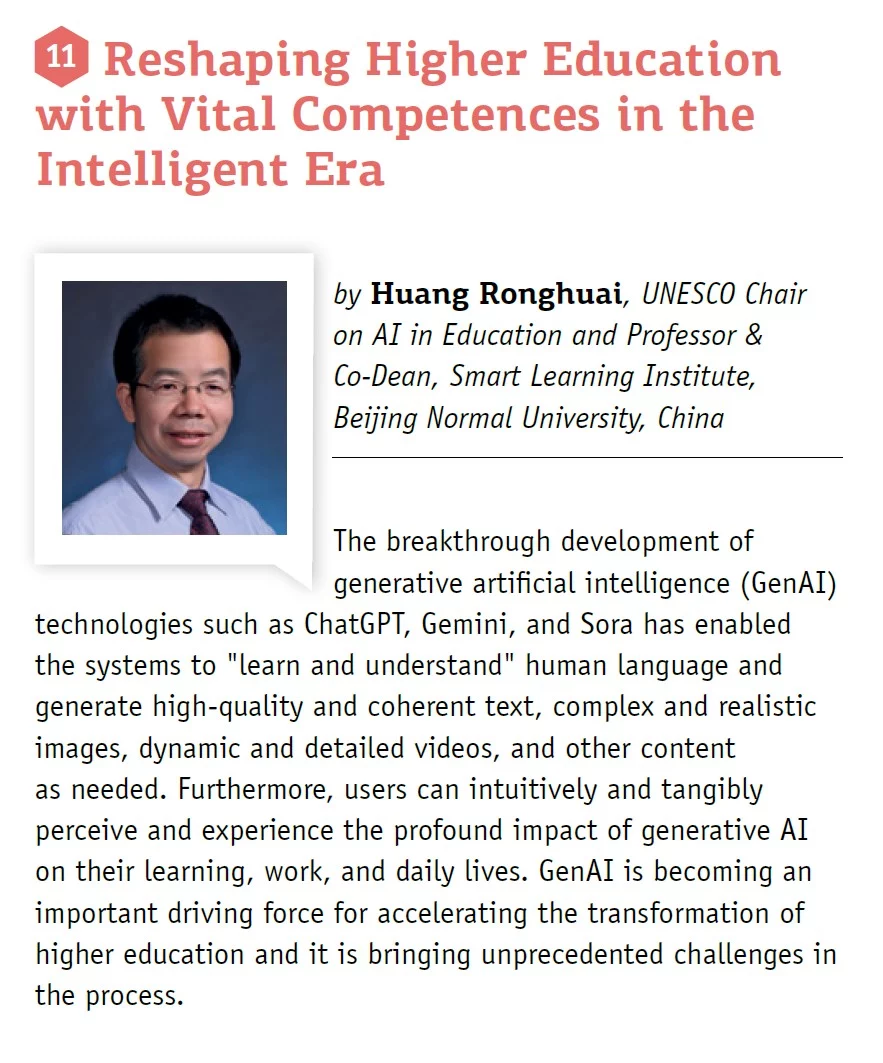
Reshaping Higher Education with Vital Competences in the Intelligent Era
Generative AI: opportunities and challenges
The breakthrough development of generative artificial intelligence (GenAI) technologies such as ChatGPT, Gemini, and Sora has enabled the systems to “learn and understand” human language and generate high-quality and coherent text, complex and realistic images, dynamic and detailed videos, and other content as needed. Furthermore, users can intuitively and tangibly perceive and experience the profound impact of generative AI on their learning, work, and daily lives. GenAI is becoming an important driving force for accelerating the transformation of higher education and it is bringing unprecedented challenges in the process.
On the one hand, its emergence has led to a gradual reduction in many simple, repetitive, and standardized manual tasks within higher education institutions, such as administrative paperwork, data entry, and routine grading, providing more time and resources for innovative research and personalized instruction. Additionally, generative AI brings a series of ethical challenges to higher education, including the disappearance of certain positions, the crisis of academic integrity caused by homework “cheating” and academic “plagiarism”, and the technological ethics formed by human-machine coexistence.
In response to the continuous evolution of intelligent technology, we should recognize the inherent logic of AI’s role in transforming education, rethink the changes in educational concepts in the era of intelligence, grasp the concerns of cultivating the “vital competence” of the new generation of citizens in higher education, and promote the high-quality development of higher education.
Four changes in educational philosophy
To prepare for the revolutionary effects of the intelligent era, whether educators, parents, or society at large, everyone needs to adapt to fundamental changes in educational philosophy, especially the conceptual changes regarding knowledge, learning, curriculum, and instruction.[1]
Knowledge created beyond experts
The first change is Knowledge Created beyond Experts , which we should learn in schools. In the intelligent era, knowledge demonstrates substantial collective wisdom. Humans collaborate with AI technologies to produce knowledge, each becoming a producer and disseminator of knowledge.
Learning coupled to digital environments
The second change is Learning Coupled to Digital Environments , where technology serves an important role for students. In an environment of intelligent interconnectivity, digital technology offers endless possibilities for creating various learning scenarios. The fragmentation and dynamism brought about by multi-space interconnection and cross-space interaction require students to engage actively in deep learning.
Curriculum integrated with multiple subjects
Another change is Curriculum Integrated with Multiple Subjects , fostering interdisciplinary learning and holistic understanding among students. This shift transforms the curriculum from singular and rigidly preset group courses to diverse and personalized courses across multiple subjects. This leads to the formation of a more comprehensive, interconnected, and integrated curriculum system.
Instruction assisted by intelligent systems
The last change is Instruction Assisted by Intelligent Systems , facilitating a symbiotic relationship between teachers and AI technology. Teachers coexist, collaborate, and learn with AI technology, enabling personalized instruction analysis, decision-making, and implementation based on data to become normalized.
Five vital learner competences
In order to adapt to the deep integration of generative AI into various aspects of production and life, it is necessary to cultivate students’ vital competencies in the intelligent era, focusing on five key concerns: active learning, creativity, adaptability in employment, and the ability to handle various situations and environments.
Active learning during lifetime
The first competence lies in Active Learning during Lifetime . This skill will emerge as the central learning aptitude in the intelligent era, highlighting students’ sense of self-efficacy and subjective initiative in higher education. Through various behaviors such as self-planning, self-decision-making, self-monitoring, self-management, and self-evaluation, individuals can actively uphold and refine their learning trajectory during their time at the university and throughout their lives.
Creatively using AI
The second competence involves Creatively Using AI . This ability not only underscores the capacity to utilize past experiences for novel problem-solving and integrate diverse viewpoints for innovative solutions but also emphasizes applying acquired knowledge and experiences to address real-world challenges in everyday life. Higher education should foster and nurture students’ critical thinking and problem-solving skills, directing them toward conducting original research and practical applications with advanced technological resources. This competence may unlock their potential for innovation and creativity.
Adaptability of flexible employment
The third competence is Adaptability of Flexible Employment . This ability ensures that students can adapt to diverse work environments and meet various job requirements. They can seamlessly transition between different roles and responsibilities to fit various work scenarios and occupational demands. In the intelligent era, students will require strong professional skills and interdisciplinary literacy to effectively adapt to the dynamic developments across different industries and respond to changes in social needs.
Resilience to uncertain circumstances
The fourth competence is Resilience to Uncertain Circumstances . This skill involves cultivating the ability to make wise decisions in complex environments and adhere to the principle of technology for good, ensuring that technological innovation benefits humanity while respecting individual privacy, safeguarding data security, and promoting social fairness and justice. Moreover, it entails coping with social uncertainties, requiring students to possess critical thinking and risk assessment abilities to make wise decisions in constantly changing social and economic conditions.
Furthermore, it involves the ability for security and technological ethics, where students can understand and address safety and ethical issues in the intelligent era, possess technical ethics awareness and ethical judgment abilities, use technology resources reasonably, protect personal privacy and information security, and understand the ethical dilemmas and social impacts that technological developments may bring.
Survival in rich AI environments
The fifth competence involves Survival in Rich AI Environments . This skill describes the close collaboration between humans and machines within rich AI environments. While prioritizing individual subjectivity and initiative maximizes human creativity and the multitasking efficiency of machines. By combining the strengths of both humans and machines, optimal performance is achieved.
Higher education for the future
In this era of rapidly updating knowledge and frequently iterating technology, cultivating students’ vital competencies becomes particularly crucial. The integrated development of these competencies will help students adapt to changes in higher education and lay a solid foundation for success in the intelligent era.
Through reshaping educational philosophies and emphasizing the cultivation of competencies, such as being active during their learning throughout Life, creativity leveraging of AI, adaptability to flexible employment, resilience to uncertainty, and thriving in rich AI environments, students can allow to meet the challenges of an increasingly complex and changing knowledge production in the future and make positive contributions to the progress and development of society.
About the International Association of Universities
Founded in 1950 with the support of UNESCO, the International Association of Universities (IAU) is a leading global association of higher education institutions and university associations. The Chair’s 2024 report described more than 600 member organizations in over 130 countries and regions. IAU serves the global higher education community through expertise and trend analysis, publications and portals, advisory services, peer learning, events and global advocacy.
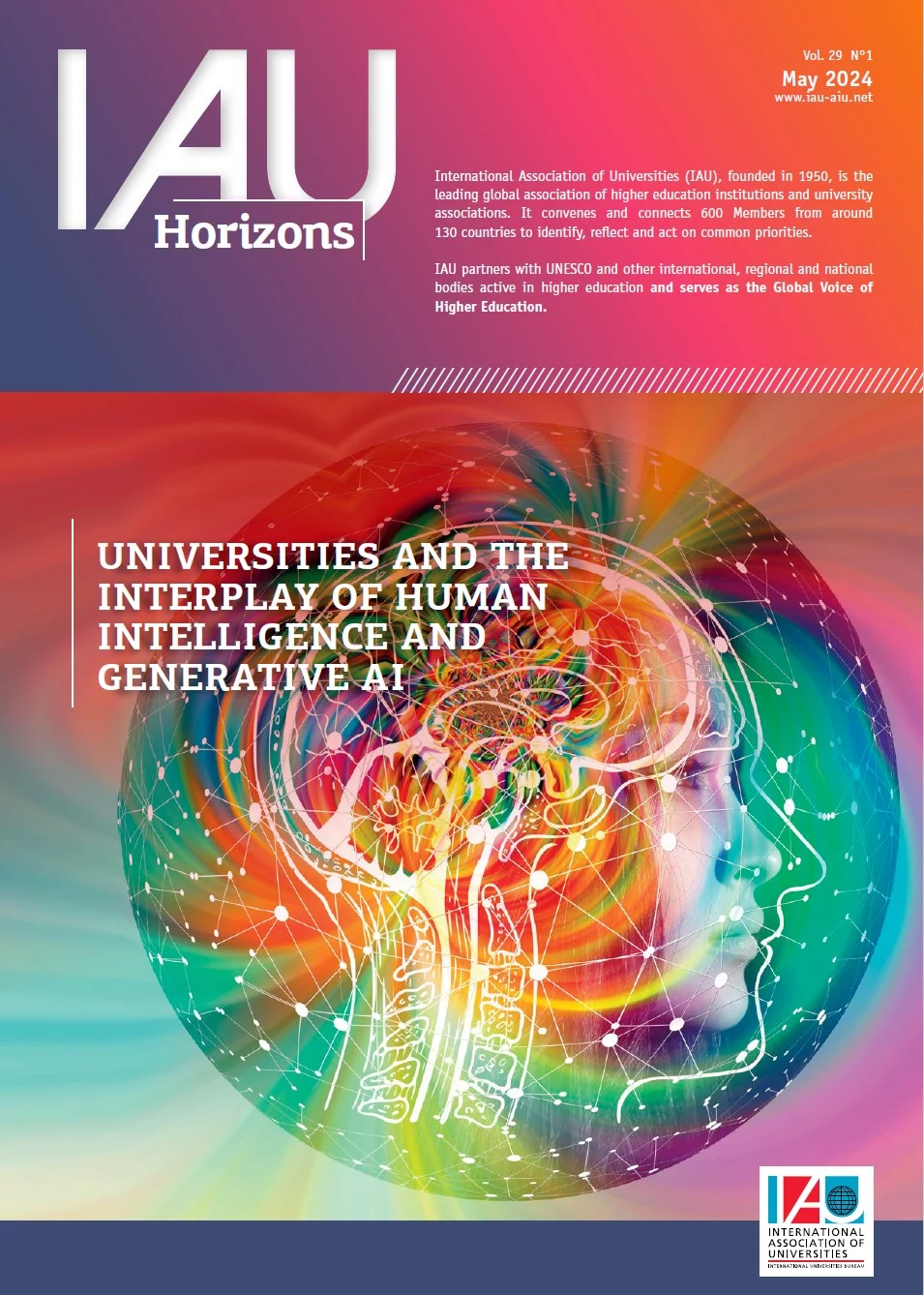
Journal and references
[1] Huang, R. H. (2023). Artificial Intelligence is Accelerating Educational Transformation: Realistic Challenges and Countermeasures. Journal of the Chinese Society of Education (in Chinese), (06), 26–33.
- Published in IAU Horizons, volume 29, number 1, May 2024, pages 31–33; its reference appears on page 41. This site retains its archive date of 27 June 2024 at 18:00.
- The full signed English article is retained. The Chinese edition keeps the Chair’s original complete translation and identifies additional details from the English text. Positions, technology examples and membership figures reflect the 2024 sources.
Official IAU journal page · Full original issue in English (PDF) · Original reference page · AI and STEM learning resources
Original link: https://aiedchair.bnu.edu.cn/news-8829-en/