

Historical notice for 2025. This page retains the Chair website’s original publication date of 15 April 2025. Eligibility, salaries, benefits, supervisors and contacts reflect the original notice and do not establish that positions remain open. Please consult the latest official notices for current recruitment and policies.
On this page

01 About us
Beijing Normal University (BNU) is a key university directly under China’s Ministry of Education, distinguished by teacher education, educational science and foundational disciplines in the arts and sciences. The 2025 notice described its participation in Projects 211 and 985 and the Category A world-class university initiative, and its contribution to humanities, social sciences and technological innovation. It reported that BNU’s education disciplines ranked among the global top 20, highlighting its educational technology innovation, standing in internet education, smart education research, testing facilities and industry–university–research collaboration.
The National Engineering Research Center of Cyberlearning and Intelligent Technology (CIT) was jointly established by BNU, Tsinghua University, China Mobile, NetDragon Elernity and iFLYTEK. As part of the national innovation system, it addresses the uneven distribution of quality educational resources, insufficient personalized learning services and the complex governance of digital learning products and services. Its research platform supports the development and engineering of distance teaching interaction systems, knowledge modeling and analysis, learner modeling and analytics, learning environment design and assessment, digital education governance and public digital resource services.
The Smart Learning Institute, jointly established by BNU and NetDragon Elernity, integrates scientific research, technology development and educational experimentation. It studies learning in information-rich environments and develops smart learning environments and lifelong learning platforms that support the diverse, personalized and differentiated needs of digital learners.
The Education Informatization Strategy Research Base (Beijing), based at BNU, conducts strategic research on smart education, applications of AI in education and international comparisons of educational informatization.
The UNESCO Chair on AI in Education promotes research, training, resource sharing and exchange. Its work includes capacity building, policy dialogue, technological innovation, learning resources and collaboration in AI and education.
The China Smart Education Industry–University–Research Collaborative Innovation Platform aims to build a smart education ecosystem spanning all domains, elements, processes and operational stages. It fosters an open, shared and collaborative environment for innovation in theory, scenarios, technology and industrial models.
The Lab of AI Governance and Planning in Education was initiated by BNU. The original notice described partnerships with the UNESCO International Institute for Educational Planning and the UNESCO Institute for Information Technologies in Education, among others, to advance AI applications in educational planning and governance, responsible AI governance in education and resilient smart education systems.
To meet its research needs, the Center’s 2025 notice invited applications from postdoctoral researchers in China and overseas. Further information was provided through:
Website: https://cit.bnu.edu.cn/
WeChat Official Account: CITlab

02 Fellowship categories and remuneration
National-program postdoctoral fellowships
These fellowships were jointly supported by national postdoctoral special funding and the university. Eligible national schemes included the Postdoctoral Innovative Talent Support Program, inbound and outbound International Exchange Programs, the Hong Kong Scholars Program, the Macau Young Scholars Program and the China–Germany Postdoctoral Exchange Program.
For fellows selected for the National Postdoctoral Management Committee’s inbound International Exchange Program or Postdoctoral Innovative Talent Support Program, the notice stated an annual pre-tax salary of RMB 350,000 and an annual housing subsidy of RMB 50,000. Subject to availability, postdoctoral apartments could be rented at market rates. During the normal appointment term, eligible children could be assisted with admission to BNU Experimental Kindergarten’s new Shahe campus or the primary division of BNU Changping Affiliated School in Shahe. Funding and benefits for other national-program fellows depended on the relevant program and policies.
Liyun postdoctoral fellowships
This flagship BNU fellowship referred to the eligibility standards of national schemes such as the inbound International Exchange Program and the Postdoctoral Innovative Talent Support Program. Applicants were expected to have substantial research achievements and strong potential for research innovation.
The notice stated an annual pre-tax salary of RMB 300,000 and an annual housing subsidy of RMB 50,000. Subject to availability, fellows could rent postdoctoral apartments at market rates. During the normal appointment term, eligible children could be assisted with admission to BNU Experimental Kindergarten’s new Shahe campus or the primary division of BNU Changping Affiliated School in Shahe.
Category A postdoctoral fellowships
Applicants were required to have obtained a doctorate from a leading university in China or overseas within the preceding three years; demonstrate excellent character and academic performance; be in good health and under 35; and commit to full-time work throughout the appointment. They were also expected to have produced high-quality research in the relevant field during the preceding five years.
The annual pre-tax salary stated for Category A was RMB 180,000–240,000, with access to overseas exchange programs and research performance incentives. Outstanding fellows could receive salaries aligned with the Liyun fellowship standard.
Category B postdoctoral fellowships
Applicants were required to hold a doctorate, be under 35, demonstrate good character and show strong research potential.
The annual pre-tax salary stated for Category B was RMB 180,000, with access to overseas exchange programs and research performance incentives. Outstanding fellows could receive remuneration aligned with Category A standards.
03 Related research projects
National Key R&D Program projects included: large-scale longitudinal research on student development across educational stages; key technologies and application demonstrations for smart connected learning environments; behavioral sensing and risk detection in internet education applications; intelligent assessment of rural teachers’ teaching capabilities and precision teaching assistance; and key technologies for cultivating and evaluating children’s innovation capabilities.
Other research projects covered: the Internet Plus education system; AI and the future of education; strengthening smart education strategies for the 2030 Agenda; international comparisons and cooperation mechanisms in digital education; experiments in educational and social governance under AI; smart education demonstration zones; digital education in ethnic minority regions; digital transformation in vocational education; AI courseware factories; educational robotics; virtual reality in education; digital textbooks and knowledge graphs; digital literacy and leadership in digital education; future learning and future experimentation; and large models for education.
04 Research fields and collaborating supervisors
Distance teaching interaction systems
Research covered interaction theories and models, natural interaction technologies, multimodal data fusion and real-time high-speed remote transmission based on multi-network integration and multipoint interaction, supporting the development of distance teaching interaction systems.
Collaborating supervisors included Professors Yu Shengquan and Ma Ning; Associate Professors Li Baoping and Lu Yu; and Adjunct Researcher Liu Geng.
Knowledge modeling and analysis
Research covered key technologies for modeling subject knowledge, knowledge analysis and knowledge services; standards, models and tools for subject knowledge and learning resources; and knowledge graphs and service platforms.
Collaborating supervisors included Professor Li Yanyan; Researcher Xu Bin; and Associate Professors Zhou Ying, Zheng Lanqin and Zhao Guoqing.
Learner modeling and analytics
Research covered intelligent technologies for educational data collection, learner modeling and learning analytics; models of learners in the internet era; and the development and demonstration of experimental systems for monitoring student development and systems for monitoring teaching processes and analyzing learning.
Collaborating supervisors included Professors Chen Li, Zheng Qinhua, Feng Xiaoying, Zhang Jingjing and Li Shuang, and Adjunct Researcher Wu Xiaoru.
Learning environment design and assessment
Research involved constructing representative learning spaces and designing and assessing smart learning environments across multiple settings.
Collaborating supervisors included Professor Huang Ronghuai; Adjunct Professor Liu Dejian; Professor Asha Singh Kanwar; Associate Researcher Ahmed Tlili; Senior Engineer Zhu Lixin; and Associate Professors Zhang Jinbao and Chen Guang (陈桄).
Digital education governance
Research covered content-review knowledge graphs and algorithm monitoring for digital education products, efficiency and quality control in human–AI classrooms and pathways to wider application, and intelligent campus network upgrades based on 5G and AI. The notice described ongoing National Key R&D, natural science foundation and foreign expert projects, alongside established regional joint talent-development arrangements in China and overseas.
Collaborating supervisors included Professors Chen Guangju and Tong Lili; Associate Professor Zhuang Rongxia; and Adjunct Professor Yang Junfeng (杨俊锋).
Public digital resource services
Research covered technologies for designing and developing digital resources suited to different learners and learning scenarios, together with digital resource design and development centers, demonstration centers, applied practice bases and support service centers.
Collaborating supervisors included Professors Wu Fati, Dong Yan, Li Yushun and Fu Qian, and Associate Professors Wu Juan, Zhang Zhizhen and Cai Su.
05 Selection procedures and contact information
The notice invited applications from China and overseas and provided for selection on merit. The original flowchart is retained below, followed by an equivalent text version.
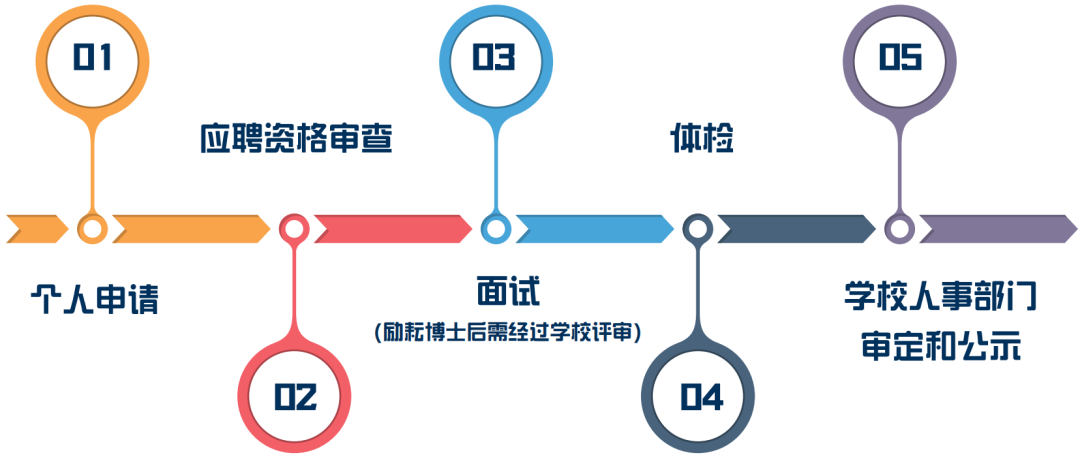
Text version of the selection flowchart
- Individual application.
- Eligibility screening.
- Interview. Liyun fellowship candidates also undergo university evaluation.
- Medical examination.
- Final approval and public announcement by the university’s human resources department.
Required application materials
Applicants were asked to email the following materials to cithr@bnu.edu.cn, using the subject line “应聘博士后+姓名+毕业学校” — application for a postdoctoral position + name + graduating institution.
- A curriculum vitae, including educational background and work experience.
- Three representative academic papers from the preceding five years.
- Other relevant supporting materials.
Contact us
Applicants were to be invited for interview following document screening; video interviews could be arranged in exceptional circumstances. Those who passed the interview were to prepare the required materials and complete appointment procedures after approval by the university and the postdoctoral management committee. The BNU Human Resources postdoctoral section provides procedural information:
https://hr.bnu.edu.cn/bsh/index.htm
Contacts: Dai and Chen
Telephone:
+86-10-58807205; +86-10-58806553
Email: cithr@bnu.edu.cn
Website: https://cit.bnu.edu.cn/
WeChat Official Account: CITlab
Address: Changping Campus, Beijing Normal University, Jia No. 2 Manjing Road, Shahe Town, Changping District, Beijing, China.
Archive and source notes
The article preserves all substantive content of the Chair’s original Chinese notice, its three images and public contact details. Numbering, punctuation and spacing have been standardized. The duplicated heading “数字资源公共资源” is corrected to “数字资源公共服务”, consistent with the CIT Chinese brochure. Historical rankings, institutional descriptions and partnerships are presented as statements in the 2025 notice, not as newly verified current claims.
The CIT Chinese and English brochures are supporting references. Their wording and supervisor lists are not identical to the Chair archive; this page translates the Chair’s original version rather than silently replacing it. The brochure links and BNU Human Resources section are provided for comparison and current information.
Original link: https://aiedchair.bnu.edu.cn/news-11670-en/