Historical report from 2024. The Chair’s original publication date of 5 September 2024 is retained. Positions, statistics and views below refer to the time of the original reporting.
On this page
Changes in the world, in our times and in history are unfolding in unprecedented ways, driving changes in education worldwide.
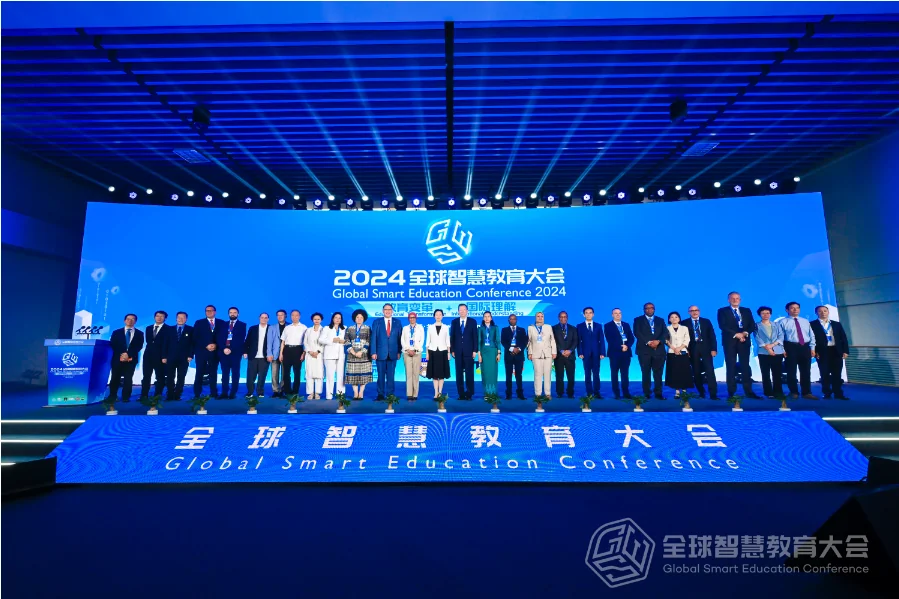
More than 400 guests from over 60 countries recently gathered at the Global Smart Education Conference 2024 to discuss ‘Educational Transformation and International Understanding’. Their discussions sent a signal: global awareness and respect for diversity have become prominent concerns in educational transformation.
Focus 1: How can digital technology support quality education?
Although participants at the conference spoke different languages, they conveyed a common message: digital technology has become a leading force in educational transformation.
‘UNESCO has long focused on the potential of digital technology in education and is committed to addressing its ethical, social and economic implications,’ UNESCO Assistant Director-General for Education Stefania Giannini said at the conference’s plenary session.
The reporter learned that, since the 2022 UN Transforming Education Summit identified digital transformation in education as one of its five priority action areas, countries have actively explored how digital technology can help make quality education available to everyone as a common good.
In Asia and the Pacific, the use of digital technology places greater emphasis on technology-rich, interactive learning environments that meet students’ diverse needs and depend on comprehensive education-policy support. Western Europe and North America focus more on gender and cultural equality, strengthening teachers’ professional development through global practice and intercultural exchange. Eastern Europe emphasises coherence between education policy and practice, advancing education gradually through meaningful technology integration and continuing professional training for teachers.
To support quality education, China had implemented its national education digitalisation strategy for three consecutive years: integrating quality resources to develop a national digital public-service system for education; strengthening AI applications and advancing the initiative to empower education with AI; and expanding international exchange and cooperation to contribute knowledge and capacity to the digital transformation of education worldwide.
The priorities of countries’ digital transformation also support the view set out in the conference report ‘Global Understanding of Smart Education in the Context of Digital Transformation’: smart education is a shared strategic vision through which countries can address the key challenges of the AI era and achieve quality education.
Focus 2: How can education respond to the new challenges posed by AI?
‘With glasses incorporating generative AI, you could walk through the streets of the Maldives and learn about the country’s culture and history whenever and wherever you are.’ A team of university students from the Maldives presented this design at the higher-education-track final of the Seventh Global Competition on Design for Future Education, held during the conference.
‘The participating students’ understanding of education shows me that many countries have developed a new view of learning,’ said competition judge Hu Xiangen, a professor at The Hong Kong Polytechnic University. He explained that this view brings students together with peers, teachers and machines to acquire knowledge, skills and attitudes in a learning environment where humans and machines coexist.
Worldwide, digital technology, particularly AI, is helping create new forms of educational development. Yet many participants also noted that differences in countries’ existing digital infrastructure and research capabilities could prevent the benefits of AI from being realised.
Nie Xiaolin, senior vice-president of iFLYTEK, said that concerns about content safety, privacy and knowledge accuracy made it inappropriate at that time to give students completely unrestricted access to educational large models. ‘However, China has specialised education sectors and a wealth of application solutions, providing the foundational capacity to develop educational large models. It is now creating education-specific large models through a co-creation approach that combines research and use.’
‘China is one of the few countries that have developed, or are developing, AI frameworks or research programmes,’ said Svein Østtveit, Acting Director of UNESCO’s International Bureau of Education. He described China as being at the forefront of applying AI to educational development, adding: ‘We are willing to work closely with China to address the new challenges that AI presents to education.’
Focus 3: How can teachers strengthen their technological capabilities?
Many conference participants called for teachers, faced with changes in how people are educated in the digital era, to uphold the principle that people come before technology.
Professor Romero of Université Côte d’Azur in France said that there was an anti-technology trend in Europe, with some families wanting their children to use less technology in learning. ‘We urgently need to strengthen teachers’ capabilities and help them use technology to empower teaching, so that more families will accept it.’
‘Many children in Africa still experience educational deprivation. To address this, teachers’ professional capabilities need to be more practically useful, and teacher training needs to include technological skills and digital literacy,’ said Quentin Wodon, Director of UNESCO’s International Institute for Capacity Building in Africa.
How could teachers’ technological capabilities be improved? ‘Through cooperation across governments and departments, we bring teachers into systems for training in technological capabilities, thereby advancing the transformation of education as a whole,’ explained Seychelles Minister of Education Justin Valentin.
Hu Xiaoyong, professor and Director of the Teacher Development Centre at South China Normal University, recommended an orderly approach to digital teaching practice, improving teachers’ practical use of technology by sharing advanced, transferable, high-quality experience in digital teaching.
Huang Lulu, reporter for China Education Daily.
Sources and photograph
The complete original Chinese text on the Chair’s website was checked against the official SLI reprint and the publisher’s original article. The newspaper issue and its page image establish publication on 4 September 2024, page 2; the SLI reprint is dated 9 September. Its footer’s reference to 3 September conflicts with the original issue. The Chair’s existing title and publication date are preserved. The lost original image has not been recovered. The SLI reprint’s stock illustration, credited to Baotu, and its full newspaper-page image are not republished here. An official photograph from the same conference’s opening report is added instead, with its complete frame and watermark retained.
Original link: https://aiedchair.bnu.edu.cn/news-8538-en/