Historical research article | e-Education Research, 2024, issue 1, pp. 5–12, 35. Originally posted by the Chair on 19 September 2024. Statistics, standards versions and arguments retain their historical research context.
HUANG Ronghuai1, LIU Mengyu1, HU Ying1, GUO Jiong2
1. National Engineering Research Center of Cyberlearning and Intelligent Technology, Beijing Normal University, Beijing 102200; 2. School of Educational Technology, Northwest Normal University, Lanzhou, Gansu 730070.
Article contents
Abstract and keywords
Abstract: A shared destiny is a defining feature of today's world, and interpersonal interaction has considerable practical significance for social production and development. Information technology has expanded the spaces in which students grow. Digital interaction has become a major form of interpersonal contact, and online communities a principal space for their development. Yet students also face alienated interaction and a loss of subjectivity associated with digital social life. From the perspective of communicative rationality, this study develops a CSS framework for digital society with three dimensions: digital culture, individual space and social order. The framework provides a trustworthy mechanism for members' lives, development and social interaction in the new era. It also identifies the competencies individuals need: tool awareness, digital literacy and subject efficacy within digital culture; self-awareness, identity and behavioural self-regulation within individual space; and group awareness, emotional management and social participation within social order.
Keywords: digital society; student communities; student interaction behaviour; communicative rationality; spaces for student development
I. Introduction
The world is experiencing changes unprecedented in a century. Economic globalisation and the information transformation of society continue to advance, deepening countries' interaction and mutual dependence. A shared destiny has become a defining feature of the contemporary world[1]. President Xi Jinping has observed that humanity lives in one global village, at the intersection of history and the present, and increasingly forms an interconnected community with a shared future[2]. He has emphasised that building such a community brings countries with different social systems, ideologies, histories, cultures and levels of development together through shared interests, rights and responsibilities in international affairs, establishing the broadest common ground for a better world[3]. Viewed through people as the subjects of civilisation, the fundamental character of this idea lies in treating interdependence as its core. Interdependence is the social interaction emphasised by Marx[4]. World history is a history of interaction between human civilisations, and interaction among real individuals advances social production and development.
Before the internet, people lived in physical and social spaces. Education is a process of social life, and a school is a miniature society and a form of social life[5]. In traditional social interaction, communities are an important space for student development, with attention to students' exchanges, interactions, contradictions and conflicts within community life[6]. As technology developed, the internet created a new information space. Production and everyday practice now take place across physical, social and information spaces[7]. In spaces built and supported by digital technologies, both the components and operation of social interaction have undergone digital change, reflecting digital forms of interaction and digital values[8]. Online social interaction has consequently become an important means for students to communicate with others and the wider world, while online communities have become a principal space for development in the digital era.
Digital social media, the paper notes, connect nearly half the world's population[9], forming communities across the globe. Digital communication enables real-time conversations between people in different places, but also provides platforms for extremist speech and misleading information that reinforce prejudice and provoke conflict. Internet anonymity and the detachment of cyberspace may lead individuals to display more pronounced negative social behaviour than in face-to-face life, making communicative rationality important. It calls for truthful, sincere interaction and equal communication between subjects, recovering the nature of social exchange[10]. Contemporary students are digital natives who have grown up with technology, constantly using it and experiencing and understanding their world through technological products[11]. They directly encounter alienation and loss of subjectivity associated with technological development and digital social interaction. Examining students' social practices and community formation through communicative rationality, and establishing norms for interaction, is therefore important for harmonious, sustainable interpersonal relationships.
II. Online communities and the framework of digital society
As humanity enters the digital era, technologies represented by the internet are embedded in the lifeworld. They constitute most everyday settings, connecting and organising work, learning, social interaction and almost every other activity[12]. Social life can be divided into material life and community life[13]. Communities are social units of different scales, formed by individuals who share characteristics such as norms, values, identity or a sense of belonging to a geographical area or virtual space[14]. Digital technology expands the traditional concept of community. Virtual social groups gradually emerge, and their characteristics and components evolve.
1. Communities and online communities
A community is a particular organisational form produced by interaction within society. Members unite through agreement or shared intention to meet common needs, depending on one another and cooperating through a division of labour. The concept of community (also rendered in Chinese as gongtongti, or a shared collective) forms through members’ positive relationships and is characterised by connection and association[15]. It encompasses distinctive patterns of connection as well as a collection or category of people, forming a social structure with definite expectations of its members. Members identify with one another and develop a distinctive culture of shared beliefs and values[16]. Communities are basic structural elements of society. Broadly, they comprise people with common interests who join in shared activities through sustained social interaction or relationships[17]. Their formation and operation involve relatively clear membership, continuing interaction[17], shared group awareness and norms, and an internal division of labour supporting cooperation and coordinated action. These features distinguish communities from other gatherings.
The rise of digital technologies and products fundamentally changes communication and social structures. Cyberspace has become a prominent extension of social space, and social organisation increasingly forms around information networks. This develops alongside networked individualism, contrasting with traditional structures such as families and geographically based communities[18]. Information networks organise people around common interests, values and activities without requiring geographical proximity[19], producing online communities. These extend traditional communities into internet-based virtual spaces and are highly dynamic and continually evolving forms of interaction. They extend real-world relationships into cyberspace, as with group chats created through messaging tools such as WeChat, and also enable entirely new relationships online. Digital communication and social media give members of existing communities broader spaces and richer forms of contact beyond everyday physical life[20]. Their characteristics resemble those of physical communities: sustained exchanges and stable relationships, common awareness and norms guided by shared values, and clear arrangements for cooperation and division of labour. People can communicate and share at any time and place. The internet and social media create virtual spaces beyond immediate physical reality, in which virtual social groups gradually develop.
2. Communicative rationality and the framework of digital society
Digital technology changes established ways of living and interacting, reduces constraints of distance and time, and reconstructs the nature and processes of social contact. An anonymous digital world offers opportunities to realise multiple selves and escape constraints in physical society. Through new identities in virtual spaces, people can loosen the practical meaning of existing relationships and the identity restrictions associated with them[21]. Such release in online communities can lead to domination of others, social repression of individuals and alienated relationships. Digital social interaction virtualises self-expression and may produce an illusory state of self-awareness[21], undermining the authenticity of interaction, a continuing sense of subjectivity and the essential character of social relations.
Habermas's ideas on communicative action and communicative rationality offer a perspective on these problems. Communicative rationality is the practical rationality of life embodied in communicative action and the structures of the lifeworld: equal and reasonable intersubjective relations established through universal norms[22]. Communication is important to the lifeworld. Its initial purpose is mutual understanding between speaker and listener, whereas technological rationality encourages action directed at predetermined ends, contributing to alienation. Communicative rationality is the capacity to coordinate relationships so that participants reach mutual understanding through language and social norms[23]. For Habermas, language expresses reality, personal feelings and thoughts and helps establish reasonable interpersonal relationships. Such relationships are especially important: only with them can the effects of technological alienation be better overcome[24].
The lifeworld of communication comprises culture, society and personality, providing background conditions for communicative action. Culture supplies information and knowledge; society supplies norms and maintains order between groups; personality enables individuals to integrate into social groups[24]. Habermas describes culture as a stock of knowledge: the totality of human language, knowledge and information that underpins understanding and communication and motivates interaction. He describes society as a legitimate order in which participants in a shared lifeworld follow common norms and develop shared feelings and understandings to reach communicative agreement[25]. Personality encompasses the motives and capacities that enable a subject to speak and act[26]. Individuals are the basic elements of community formation, and recognising and respecting their personalities is a precondition for a community of communication.
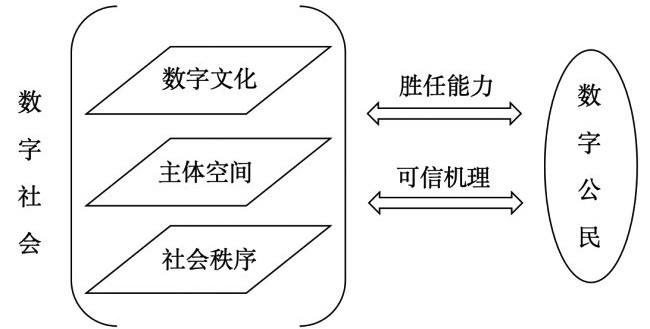
As an extension of the physical lifeworld, the digital lifeworld follows the same three-dimensional structure, while integration with digital technology broadens culture's meaning. Communities in the digital era are units of interpersonal interaction with social and subjective dimensions and a culture incorporating technology. From communicative rationality, communities in digital society should comprise digital culture, individual space and social order. Together these form the CSS framework of digital society shown in Figure 1. It provides trustworthy mechanisms for the lives, development and interaction of digital citizens. Members also need appropriate competencies to adapt to technology-driven social change and actively support positive social development.
Native journal image; printed page 7, PDF page 3.
Complete description of Figure 1: three levels and two bidirectional relationships
The left side contains three parallel planes within a rounded enclosure; a vertical oval stands on the right. Two horizontal double-headed arrows connect the two sides. The diagram contains seven text labels:
- Digital society: a vertical label beside the left enclosure, encompassing its three levels.
- Digital culture: the upper plane inside the enclosure.
- Individual space: the middle plane.
- Social order: the lower plane.
- Digital citizen: the vertical text inside the oval on the right.
- Competence: the label above the upper double-headed arrow linking the framework and the citizen.
- Trustworthy mechanism: the label above the lower double-headed arrow, also linking the framework and the citizen.
Within CSS, digital culture is the shared cognitive basis for social interaction and agreement, representing common understanding within communities. It includes basic awareness of technological tools, skills and literacy for using them appropriately in social life, and confidence in responding effectively to future technologies. Individual space protects members' subjectivity and self-identity so that they can express themselves freely and participate in communication. Clear self-awareness helps members recognise their value and form identities, while cultural and institutional norms guide behavioural self-regulation. Social order regulates interaction and maintains members' social positions to support solidarity and cooperation. It also calls for group awareness, an ability to accept and understand varied conflicts and problems, and social and emotional skills supporting effective interaction and active participation. Each dimension thus implies a developmental path from awareness through capability to practical participation. This dynamic path helps members develop the competencies needed for digital society and supports its continuing development as technologies change.
III. Social cognition in student communities: digital culture
Digital communication is deeply embedded in production and daily life, creating new spaces for interpersonal interaction. Digital culture has become the shared cognitive foundation of social exchange. Individuals need awareness of tools and the ability to apply technology to respond to continuing technological change and adapt to digital environments. Rapid development creates an information-rich, diverse social setting. Living well, developing oneself and participating in social activities in the digital world have become necessary capabilities for every citizen.
1. Tool awareness: basic understanding of technology use
People in the digital era are digital citizens who use technology to learn, work and live. A digital citizen participates in social activities through digital technologies, possesses basic awareness of tools and their use, and uses the internet regularly and effectively. Tool awareness within digital culture means recognising and understanding different digital tools, technologies and resources and being conscious of how to apply them. Competent digital citizens use tools lawfully and safely and participate appropriately and responsibly in social interaction, supporting harmonious relationships.
Students are a major focus of digital citizenship education. The International Society for Technology in Education has issued three versions of its student technology standards, systematically describing the capabilities needed to adapt technology to learning and life. The first, published in 1998, identified knowledge and skills including basic technological concepts and applications, understanding social and human issues in technology use, proficiency with productivity, communication and research tools, and using technology to solve problems and make decisions[27]. It stressed awareness of tools and technology. The second edition, published in 2007, proposed six areas, including communication and collaboration, digital citizenship, and technology operations and concepts[28]. It highlighted students' digital citizenship and the importance of technological awareness and understanding. The third, released in 2016, identified seven roles or competency areas, including empowered learner, digital citizen and global collaborator[29], emphasising technology's positive contribution to learning goals and social activity. Across the 1998–2016 revisions, every version called for basic tool and technological awareness and integration of technology into learning and life, supporting educational goals and digital-era communication and collaboration. Conscious use of tools and attention to technological updates are necessary capabilities for members of digital society and foundations for digital culture.
2. Digital literacy: reasonable norms for applying technology
Digital literacy and tool awareness are closely related. Awareness establishes the foundation of digital culture; literacy builds on it, emphasising appropriate, norm-governed technology use so members can process information, solve problems and participate in social interaction effectively. It is an important part of students' core competencies and a basic capacity for life in digital society. Access to information matters for integration into social environments and ordinary social activity. As information becomes digital and online interaction more widespread, improving digital literacy and skills becomes increasingly important.
Digital literacy extends information literacy. UNESCO's global digital literacy framework describes it as the ability to access, manage, understand, integrate, communicate, evaluate and create information safely and appropriately through digital technologies: a set of interconnected skills. It identifies seven domains: basic hardware and software operations; information and data literacy; communication and collaboration; digital content creation; safety; problem solving; and career-related technological competencies[30]. Communication and collaboration stress interaction through digital technologies, demonstrating their importance to social relations. The European Union's digital competence framework interprets literacy through knowledge, skills and attitudes and distinguishes information and data literacy, communication and collaboration, digital content creation, safety and problem solving. It describes eight proficiency levels: completing simple tasks with full guidance; working independently while sometimes needing guidance; independently completing clearly defined tasks; independently completing tasks that meet one's own needs; guiding others to complete tasks and solve problems; collaborating with others on tasks in complex settings; integrating relevant knowledge and guiding others in specific problem-solving methods; and proposing innovative approaches in relevant fields[31]. These frameworks specify capabilities for technological communication and collaboration, helping people use technology effectively, select appropriate tools and communication strategies, and benefit from technology in their exchanges and cooperation.
3. Subject efficacy: the internal drive to master technology
Subject efficacy is confidence and belief in one's ability to complete tasks or achieve goals. Within digital culture, it concerns using digital tools, responding to technological changes and challenges, and achieving goals in digital settings. Efficacy in digital technology is important for improving individual digital literacy[32] and strongly influences willingness to participate in social activities through technology. People who withdraw from digital society because they reject technological applications cannot easily benefit from them. Their capacity for social participation gradually weakens[33], deepening the digital divide and increasing interpersonal conflict.
Digital inclusion emerged in response to technological exclusion and the widening digital divide. The International Telecommunication Union sets its goal as ensuring that everyone benefits from digital technologies and their applications, requiring appropriate skills and equal opportunities for all. Analyses of international policies and their practical application identify preparation, readiness and participation as dimensions of inclusion[34]. Digital readiness explicitly includes strengthening citizens' confidence in technology use and their sense of efficacy. Better digital services, wider digital education and protection of digital privacy support this goal. People with stronger efficacy can gradually improve their skills, overcome digital challenges, participate more actively and contribute to harmonious communities.
IV. Individual development in student communities: individual space
Members' individual subjectivity drives communities' development and continuity. Self-awareness is an important feature of an independent individual. A self-aware subject discovers identity through interaction with others and the world. Each member has independent consciousness and an irreducible character, yet emphasising only the assertion of subjectivity inevitably creates problems. Differences between subjects must therefore be recognised, and behavioural self-regulation should support harmonious communication and interaction.
1. Self-awareness: the internal expression of the individual subject
Self-awareness is important to personality development and behavioural decisions, strongly shaping responses to the environment[35]. Consciousness rests on immediate, reliable perception[36] and involves responses based on self-understanding and agency. Digital technologies provide students with more tools, platforms and spaces for expressing self-awareness, producing new forms of digital self-expression. The digital self is self-awareness existing in cyberspace after digital representation: a digital expression of the real self[37] and an extension of self-awareness in the digital era. For example, through social media such as WeChat Moments, students can consciously construct identities and images in the digital world.
In student communities, self-awareness helps establish one's position, express oneself and one's personality, understand others and protect privacy. People can identify their roles, choose communities matching their interests, skills and goals, and connect with like-minded members to build positive relationships and support networks. Awareness helps them recognise their interests, values and characteristics and express these online. It also supports understanding others' perspectives, emotions and needs. Recognising one's own existence and distinctiveness can make empathy and resonance easier, improving communication. Finally, awareness can encourage vigilance about disclosure and protection of personal information in online communities, helping prevent harassment, fraud and intrusion.
2. Identity: a comprehensive understanding of personal value
People often form communities through discussion and interaction and develop reflective self-understanding in their relationships with others. By identifying relationships of opposition or complementarity, individuals express and negotiate identity and clarify their position within a group[38]. Self-identity is rooted in society: a self-concept formed through reflection on, interpretation and understanding of personal experience[39]. Continuing reflective activity in everyday settings creates and sustains this concept and helps individuals maintain a sense of identity.
Self-identity develops through continuing reflection in interactions between individuals and society. It involves both understanding oneself as a whole and recognising one's position in social structures and relationships. It becomes possible through connections between the social and the personal[38]. In the digital lifeworld, identity supports belonging and community participation, cohesion and consensus, and interaction between communities. A sense of connection to a particular community encourages participation in activities and discussion, offering social support and satisfaction. Shared identities also foster cohesion and common goals: members connect, form close networks and pursue shared interests, purposes and values. Finally, common identity helps members understand others and be understood, improving communication and interaction in online social communities.
3. Behavioural self-regulation: managing the norms of personal interaction
As subjectivity becomes more prominent in modern society, an inflated sense of self may cause one sphere to encroach upon others. Self-restraint therefore becomes particularly important. Behavioural self-regulation is an independent individual's capacity to control and manage behaviour, emotions and desires consciously. It involves internal processes of self-management and adjustment that support observance of social norms. When facing conflict or challenges, people can restrain impulses and desires and act more consistently with their values and social expectations.
In digital society, behavioural self-regulation helps maintain community order and public morality. It encourages observance of public rules and ethical principles in online communities, preventing malicious attacks, abuse, rumour-spreading and other misconduct and supporting a friendly, civil environment. Self-restraint also helps people remain calm when emotions run high, avoid excessively aggressive or hurtful words and consider consequences before acting impulsively or inappropriately. This sustains a constructive community atmosphere. Furthermore, self-regulation encourages careful evaluation and selection of information rather than unthinking forwarding of false information or rumours. Responsible information-sharing protects the accuracy and reliability of online information and supports productive interaction, trust and cooperation.
V. Mutual trust for the sustainable development of student communities: social order
Social order is important to harmonious social development. It provides the trustworthy mechanism through which digital communities operate: arrangements that members can trust and rely on. Its core is to regulate interaction, maintain relationships and members' standing, and promote solidarity and cooperation. Building on an understanding of social structures, cultural and value diversity, and social norms, individuals need social and emotional skills to interact effectively, understand and respond to different views and cultures, participate in activities together, and maintain an orderly, harmonious community.
1. Group awareness: understanding and accepting cultural diversity
Group awareness is an individual's understanding of social structures, cultures, values and norms in social interaction, including the ability to understand and empathise with people from different cultural backgrounds and environments. It helps people recognise how their behaviour and decisions affect others and the surrounding social environment, encouraging acceptance of others' perspectives and feelings and greater attention to social norms and order. It also promotes consideration of shared interests, integration into social groups and healthy, inclusive, interactive relationships. Understanding and acceptance provide a constructive basis for interaction and a more open, inclusive and positive social climate.
Group awareness encourages reflection on one's cultural assumptions and prejudices, movement beyond a single cultural perspective, and recognition of each culture's distinctive value and contribution. This can break down cultural barriers, promote dialogue and cooperation, reduce misunderstanding and conflict, and improve relationships in multicultural settings. Developing group awareness can also draw attention to inequality and discrimination. Understanding the challenges faced by different cultures makes individuals more likely to advocate social justice and inclusive, equitable development. Greater sensitivity to cultural differences encourages equal, respectful treatment of members of every culture and a shared social space of inclusion and mutual respect. Overall, group awareness concerns understanding and accepting cultural diversity and showing tolerance and empathy. It is an important cognitive step from the individual self towards social interaction and a foundation for the effective implementation of social norms and institutions.
2. Emotional management: affective skills for interpersonal interaction
Emotional management is a key capacity for social interaction. It means not only regulating one's own emotions appropriately but, more importantly, positively influencing others' emotions. CASEL describes social and emotional competence as the ability to manage emotions effectively, build positive relationships and make responsible decisions to address problems in social life. This includes recognising one's emotions and values; setting and achieving goals and managing emotions to complete tasks; understanding and empathising with others' views and feelings; working effectively as both a team leader and member and resolving conflicts appropriately; and making ethical, constructive choices in social behaviour[40]. The UK's Department for Education and Skills views social and emotional learning as a comprehensive approach that helps individuals manage life and learning effectively and develop social and emotional skills. It includes knowing and valuing oneself and understanding one's thoughts and feelings; managing emotions, coping with and transforming negative emotions and strengthening positive emotions; pursuing goals with persistence and optimism; understanding, valuing and supporting others; and building and maintaining relationships and solving problems[41]. Emotional management develops awareness of one's own and others' emotions and the ability to sustain good relationships in a complex, changing social environment.
Many countries cultivate students' social and emotional competence through varied social and emotional learning practices. CASEL identifies effective classroom instruction, active student participation in activities inside and outside the classroom, and extensive parent and community involvement in planning, implementing and evaluating programmes as best practices[42]. This comprehensive approach develops a broad range of social and emotional skills. Through classroom activities and practical projects, students better understand and manage emotions, build positive relationships and apply these skills in wider social settings. Active participation by parents and communities provides richer opportunities for social and emotional learning.
3. Social participation: actively advancing social activities
Social participation means actively engaging in community activities and interacting effectively with others. It is an important component of students' core competencies. The Research Report on Core Competencies for Chinese Student Development calls for well-rounded development and divides core competencies into cultural foundations, autonomous development and social participation. It emphasises responsibility and practical ability[43], encouraging students to participate actively in social activities and adapt proactively to social development. In an interconnected, interdependent world, awareness of participation and social responsibility is particularly important. UNESCO identifies a major challenge for national education systems: enabling every member of society to recognise their citizenship and develop responsibility for social affairs[44]. Guidance towards participation helps students connect self and others, individual and society; understand their relationship with society and their rights and duties as members; care about public affairs; and assume social responsibility more effectively.
Social participation also advances community activities. Active involvement in public affairs deepens individuals' integration into social life and their understanding of and concern for social issues, supporting the comprehensive development and continuing transformation of social groups. Participation can stimulate social innovation and individual problem-solving. Its different forms generate new ideas and approaches, giving communities impetus towards greater sustainability and innovation. It also strengthens internal cohesion and cooperation. Thus, participation stimulates individual members' willingness to engage in social affairs and supports the community's continuing development and progress as a whole.
VI. Conclusion
Changes driven by digital technology affect every aspect of human life. Information space merges with existing social and physical spaces, transforming a two-part spatial structure into a three-part one. Technology expands students' environments for growth, and online communities become a principal setting for development in the digital age. Students face alienation in relationships and loss of subjectivity associated with technological rationality. Analysing digital communities through Habermas's theory of communicative rationality yields the CSS framework of digital society, comprising digital culture, individual space and social order. This framework identifies requirements for members' competence development and provides normative safeguards for adapting to technology and becoming competent digital citizens. Its dimensions influence and interact with one another to promote harmonious social development. Each also contains a dynamic pathway from awareness through competence to practice.
First, digital culture supplies the shared knowledge background for communities in the digital age and the basis for exchanging information, knowledge and values. Tool awareness, digital literacy and subject efficacy reinforce and influence one another, together constituting digital culture. Tool awareness provides the necessary foundation for digital literacy; improved literacy deepens awareness and enables more effective tool use. Subject efficacy, expressed in confidence and belief, is supported by both and helps people face situations and challenges in the digital world more confidently. These interwoven elements build the cultural foundations of digital society and promote continuing cultural improvement.
Second, individual space safeguards personal development, subjectivity and self-identity. Its main components are self-awareness, identity and behavioural self-regulation. Self-awareness provides a cognitive foundation for identity, while behaviour guides and regulates both to some extent. Their mutual support promotes balanced personal development within communities. The three remain in dynamic balance: as experiences and social interactions change, self-awareness, identity and self-regulation adjust and evolve to fit changing social environments. Personal development simultaneously helps shape digital culture.
Finally, social order provides a trustworthy mechanism for community operation and advances the sustainable development of social activities. Its key elements—group awareness, emotional management and social participation—form a positive cycle. Group awareness gives emotional management and participation a cognitive foundation. Understanding structures and norms supports positive emotional attitudes and a willingness to participate. Better emotional management and accumulated participation experience, in turn, deepen social understanding and group awareness. Social order is jointly created and maintained through the transmission of group awareness, social and emotional resonance, and participation in practice. These mutually supportive elements shape the complex relationships of social order and together construct the institutions and norms of interaction in digital society.
References
All 44 numbered entries and their original languages are retained. Entries 8 and 21 duplicate the same work in the journal; their numbering and citation relationships are preserved. Citations link to entries, whose numbers return to the first citation. Historical URLs and access dates are retained.
- [1] 温东,丛文清.习近平关于构建人类命运共同体重要论述的“六论”及其逻辑论析[J].江苏大学学报(社会科学版),2023,25(4):15-27.
- [2] 习近平.国家主席习近平在莫斯科国际关系学院的演讲[EB/OL].(2013-03-24)[2023-11-30].https://www.gov.cn/ldhd/2013-03/24/content_2360829.htm.
- [3] 习近平.习近平出席中华人民共和国恢复联合国合法席位50周年纪念会议并发表重要讲话[EB/OL].(2021-10-26)[2023-11-30].https://www.gov.cn/xinwen/2021-10/25/content_5644755.htm.
- [4] 杨洪源.人类命运共同体思想的文明“术语革命”[J].中共中央党校(国家行政学院)学报,2022,26(3):22-29.
- [5] 约翰·杜威.学校与社会·明日之学校[M].吴志宏,译.北京:人民教育出版社,2005:47-48.
- [6] 赵胜军.“互联网+”时代学生社群生活与学习方式的变革[J].当代教育科学,2017(3):76-79.
- [7] 潘云鹤.人工智能2.0与教育的发展[J].中国远程教育,2018(5):5-8,44,79.
- [8] 温旭.数字生活世界的殖民化困境与合理化出路——以哈贝马斯生活世界理论为视角[J].理论月刊,2020(11):27-36.
- [9] UN.数字技术的影响[EB/OL].(2020-09-24)[2023-11-30].https://www.un.org/zh/un75/impact-digital-technologies.
- [10] 吴海琳,曾坤宁.元宇宙视域下的生活世界与交往行为转变[J].社会科学辑刊,2023(1):187-194.
- [11] 邓敏杰,张一春,李艺.试论儿童作为数字原住民的哲学基础[J].电化教育研究,2019,40(9):26-33.
- [12] 李泓江.数字时代生活世界的殖民化困境与人的存在危机[J].北京社会科学,2022(5):85-95.
- [13] 卡尔·马克思,弗里德里希·恩格斯.马克思恩格斯全集(第3卷)[M].中央编译局,译.北京:人民出版社,1960.
- [14] 董盈盈.网络社群视域下的大学生思想政治教育研究[D].上海:华东师范大学,2019.
- [15] 斐迪南·腾尼斯.共同体与社会:纯粹社会学的基本概念[M].林荣远,译.北京:北京大学出版社,2010.
- [16] 戴维·波普诺.社会学[M].李强,等译.北京:中国人民大学出版社,2007:191.
- [17] 郑杭生.社会学概论新版[M].3版.北京:中国人民大学出版社,2003:147.
- [18] RAINIE L,WELLMAN B. Networked:the new social operating system[M]. Cambridge,MA:The MIT Press, 2012.
- [19] OECD. How's life in the digital age:opportunities and risks of the digital transformation for people's well-being[R]. Paris:OECD Publishing,2019.
- [20] 徐志斌.即时引爆:社交红利2.0[M].北京:中信出版社,2015:70.
- [21] 温旭.数字生活世界的殖民化困境与合理化出路——以哈贝马斯生活世界理论为视角[J]. 理论月刊,2020(11):27-36.
- [22] 王雨辰.伦理批判与道德乌托邦——西方马克思主义伦理思想研究[M].北京:人民出版社, 2014.
- [23] 傅永军.法兰克福学派的现代性理论[M].北京:社会科学文献出版社, 2007:268.
- [24] 哈贝马斯.交往行动理论:第一卷——行动的合理性和社会合理化[M].洪佩郁,蔺青,译.重庆:重庆出版社,1994.
- [25] 哈贝马斯. 交往行为理论:第1卷[M].曹卫东,译.上海:上海人民出版社,2004.
- [26] 哈贝马斯.后形而上学思想[M].曹卫东,付德根,译.南京:译林出版社,2001.
- [27] 杨金勇,孟红娟.利用技术变革学习:新版《美国国家学生教育技术标准》解读[J].中国电化教育,2018(6):86-90.
- [28] International Society for Technology in Education. National educational technology standards for students:second edition[M]. Arlington:International Society for Technology in Education, 2007.
- [29] International Society for Technology in Education. ISTE standards:for students[EB/OL].(2017-12-31)[2023-11-30].http://www.iste.org/standards/for-students.
- [30] UNESCO Institute for Statistics. SDG 4 data digest2018:data to nurture learning[R]. Montreal:UIS,2018.
- [31] CARRETEO S, VUORIKARI R, PUNIE Y. Digcomp2.1:the digital competence framework for citizens with eight proficiency levels and examples of use[EB/OL].(2017-05-01)[2023-11-30].https://op.europa.eu/en/publication-detail/-/publication/3c5e7879-308f11e7-9412-01aa75ed71a1/language-en/format-PDF/source-search.
- [32] CHOI M, CRISTOL D, GIMBERT B. Teachers as digital citizens:the influence of individual backgrounds, internet use and psychological characteristics on teachers levels of digital citizenship[J].Computers & education,2018(121):143-161.
- [33] 董君,洪兴建.数字鸿沟的内涵、影响因素与测度[J].中国统计,2019(12):71-73.
- [34] 杨巧云,梁诗露,杨丹.数字包容:发达国家的实践探索与经验借鉴[J].情报理论与实践,2022,45(3):194-201.
- [35] 金盛华.自我概念及其发展[J].北京师范大学学报(社会科学版),1996(1):30-36.
- [36] 弗洛伊德.弗洛伊德谈自我意识[M].石磊,译. 天津:天津社会科学院出版社,2014.
- [37] 肖峰.论数字自我[J].学术界,2004(2):86-99.
- [38] 图恩·梵·迪克.话语研究:多学科导论[M].重庆:重庆大学出版社,2015:242.
- [39] 安东尼·吉登斯.现代性与自我认同:晚期现代中的自我与社会[M].夏璐,译.北京:中国人民大学出版社,2016.
- [40] DURLAK J A, DOMITROVICH C E, WEISSBERG R P, GULLOTTA T P. Handbook of social and emotional learning:research and practice[M]. New York:The Guilford Press, 2015.
- [41] LENDRUM A, HUMPHREY N, WIGELSWORTH M. Social and emotional aspects of learning for secondary schools:tools for monitoring, profiling, and evaluation[M]. Nottingham:DCSF Publications,2007.
- [42] 王松丽,陈瑞生.国际学生社会和情感能力研究趋势及其启示[J].外国中小学教育,2017(4):16-20,15.
- [43] 核心素养研究课题组.中国学生发展核心素养[J].中国教育学刊,2016(10):1-3.
- [44] 叶飞.公共参与精神的培育——对“唯私主义综合症”的反思与超越[J].高等教育研究,2020(1):18-24.
The journal's original English abstract
Show the original English title, authors, affiliations and abstract
The following English text is reproduced in its original language from the journal. The site's full article translation appears above.
Analysis of Student Community Interaction Behavior for Digital Society
HUANG Ronghuai1, LIU Mengyu1, HU Ying1, GUO Jiong2
1.National Engineering Research Center of Cyberlearning and Intelligent Technology, Beijing Normal University, Beijing 102200; 2.School of Educational Technology, Northwest Normal University, Lanzhou Gansu 730070
Abstract: A shared destiny is a distinctive symbol of today's world, and interpersonal interaction is of great practical significance for social production and development. The development of information technology has expanded the space for students' growth. Digital interaction has become the main form of interpersonal interaction for contemporary students, and digital communities have become the main space of students' growth. However, this also causes students to face the alienation of interaction and the loss of subjectivity brought about by digital social interaction. Therefore, this study constructs a CSS architecture for digital society from the perspective of communicative rationality, covering three dimensions of Digital Culture, Individual Space and Social Order, which provides a credible mechanism for the survival and development of digital society members and social interaction in the new era. Based on this framework, this study analyzes in detail the competencies that individuals should have for digital society, specifically including tool awareness, digital literacy and subject efficacy in Digital Culture; self-awareness, identity and behavioral constraints in Individual Space as well as group consciousness, emotional management and social participation in Social Order.
Keywords: Digital Society; Social Community; Student Interaction Behavior; Communicative Rationality; Student Growth Space
Journal source and editorial note
Original citation: HUANG Ronghuai, LIU Mengyu, HU Ying, GUO Jiong. Analysis of Student Community Interaction Behavior for Digital Society. e-Education Research, 2024, 45(1): 5–12, 35. DOI: 10.13811/j.cnki.eer.2024.01.001.
The body, 44 numbered references and original English abstract were checked against the official journal PDF. The native diagram is restored with a complete text alternative. Affiliation cities and postcodes and the English keyword label follow the journal; escape residues were removed. Site translations support academic exchange. Consult the original journal for the arguments, image and citations.
Original link: https://aiedchair.bnu.edu.cn/news-8000-en/