Archived activity: this is a notice for a 2024 event that has ended. The deadline, QR codes and short links in the original artwork are historical records, not current registration or meeting access. This website no longer provides the former meeting credentials or clickable registration links.
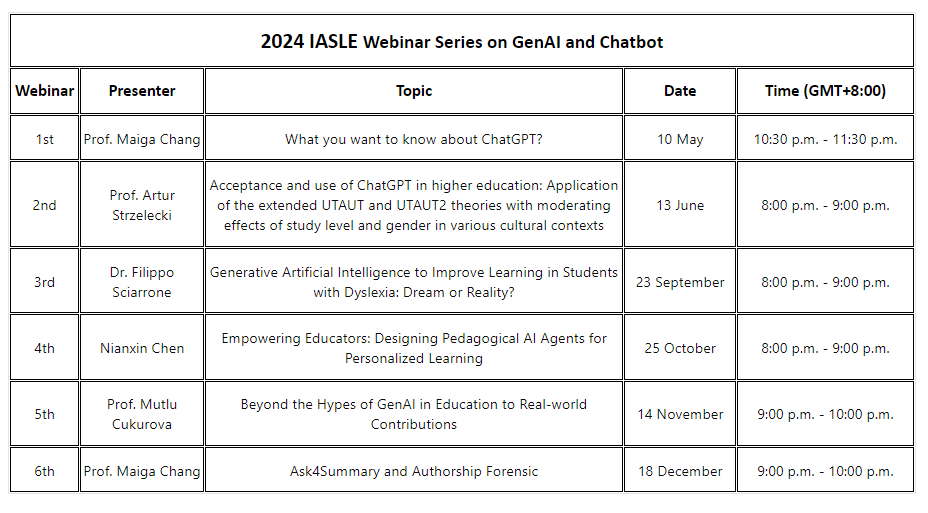
In 2024, the International Association of Smart Learning Environments (IASLE) ran a webinar series on generative AI and chatbots, sharing different perspectives, practical applications, guiding principles and experience. The original notice introduced four thematic sessions from September to December; its annual schedule also included two earlier sessions in May and June. This article archives the preview of webinar 3.
Topic and abstract
The third webinar was titled “Generative Artificial Intelligence to Improve Learning in Students with Dyslexia: Dream or Reality?”. The notice described generative AI as part of learning across age groups and ChatGPT as a tool used by millions of people for work and educational support. It also highlighted difficulties associated with dyslexia, dyscalculia, writing or spelling difficulties and other specific learning disorders, particularly in MOOCs without a continuous relationship with a teacher. The talk was intended to explore how generative AI could support students with specific learning disorders, especially dyslexia, during learning. It would review work on intelligent systems, focus on intelligent chatbots and demonstrate systems considered state of the art at the time. This is the 2024 description of the planned talk, rather than an evaluation of its outcomes.
Speaker
Filippo Sciarrone, Associate Professor at Universitas Mercatorum, Italy; affiliation as stated in the 2024 event materials.

Filippo Sciarrone's doctoral research concerned personalisation techniques and methods in learning, with a focus on AI applications in education. The event biography described him as teaching computer science courses at Universitas Mercatorum in Rome. His main research interests were technology-enhanced learning, particularly applying generative AI techniques and methods in education. He had led company research laboratories developing algorithms and innovative systems for human resource management and teaching-oriented recommendation systems. At the time of the event, he was leading a group investigating generative AI for intelligent conversational agents supporting students with specific learning disorders.
Time and original participation arrangements
The original notice offered direct participation through Zoom or access through a link emailed after registration. The original free-registration deadline was 22 September 2024. The event has ended; this article describes those historical arrangements without providing former meeting credentials or a new registration service.
Convert this historical time to your time zone

Text version of the original schedule
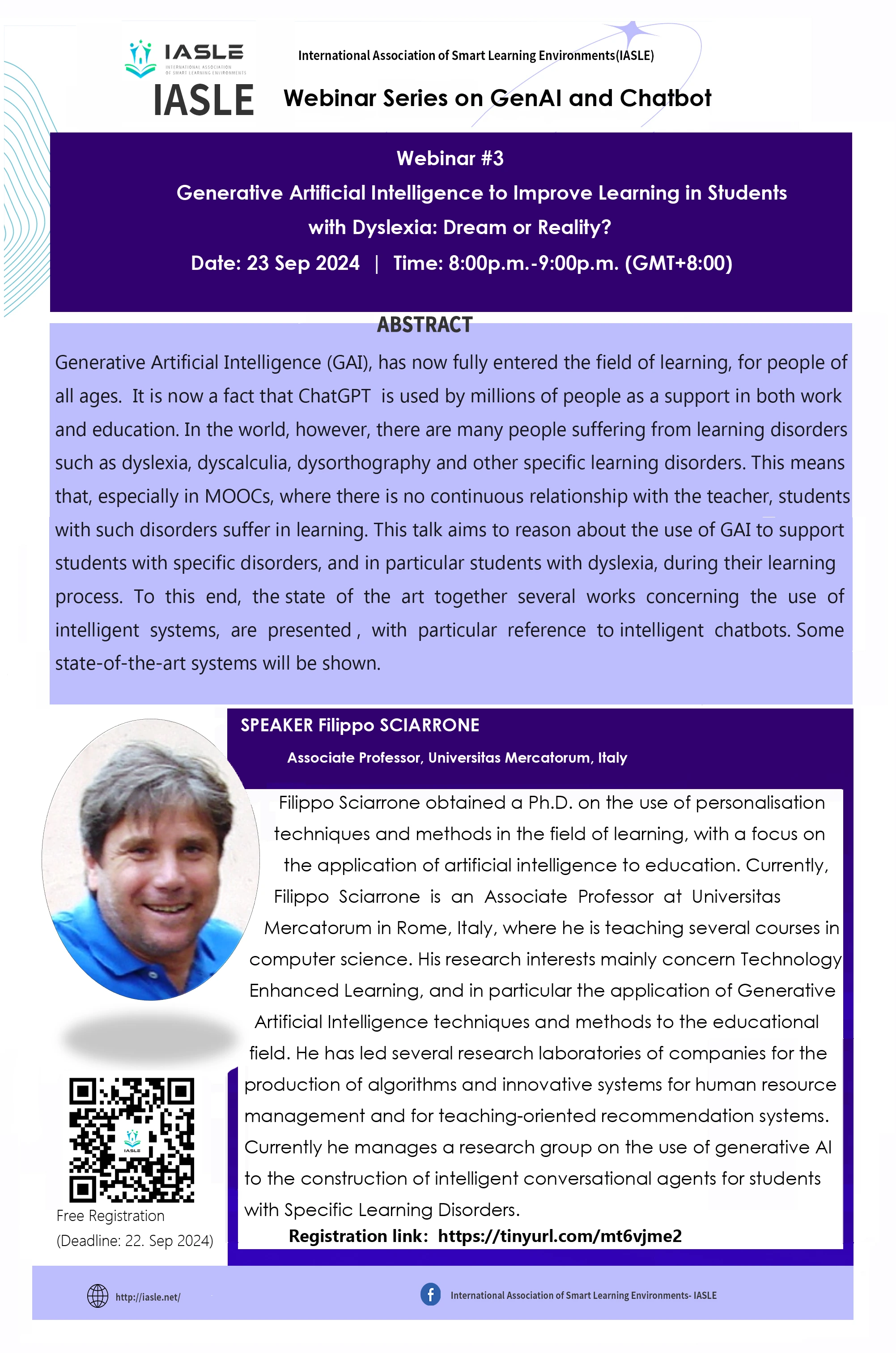
The table transcribes the six sessions in the schedule image. All dates are in 2024 and all times are GMT+8. The fourth speaker is spelled “Nianxin Chen” in the original image; that historical spelling is retained here without changing names in other articles.
| Session | Presenter | Topic | Date | Time (GMT+8) |
|---|---|---|---|---|
| 1 | Prof. Maiga Chang | What you want to know about ChatGPT? | 10 May | 22:30–23:30 |
| 2 | Prof. Artur Strzelecki | Acceptance and use of ChatGPT in higher education: application of extended UTAUT and UTAUT2 theories, with moderating effects of study level and gender in various cultural contexts | 13 June | 20:00–21:00 |
| 3 | Dr. Filippo Sciarrone | Generative Artificial Intelligence to Improve Learning in Students with Dyslexia: Dream or Reality? | 23 September | 20:00–21:00 |
| 4 | Nianxin Chen | Empowering Educators: Designing Pedagogical AI Agents for Personalized Learning | 25 October | 20:00–21:00 |
| 5 | Prof. Mutlu Cukurova | Beyond the Hypes of GenAI in Education to Real-world Contributions | 14 November | 21:00–22:00 |
| 6 | Prof. Maiga Chang | Ask4Summary and Authorship Forensic | 18 December | 21:00–22:00 |
Archive and source notes
The Chair's original article was published on 17 September 2024; its address and publication date are preserved. The corresponding SLI notice was published on 13 September 2024. The original schedule, poster and speaker photograph were recovered from the official source. Wording and QR codes within the images remain historical artwork; this website has not verified or offered current registration. The Chinese article referred to writing difficulties, while the English poster listed dysorthography, or spelling difficulties; both historical formulations are explained here.
Original link: https://aiedchair.bnu.edu.cn/news-8383-en/