Historical article: the June 2024 report and the author’s complete text are retained. Education statistics, teacher numbers and cooperation described below refer to that period.
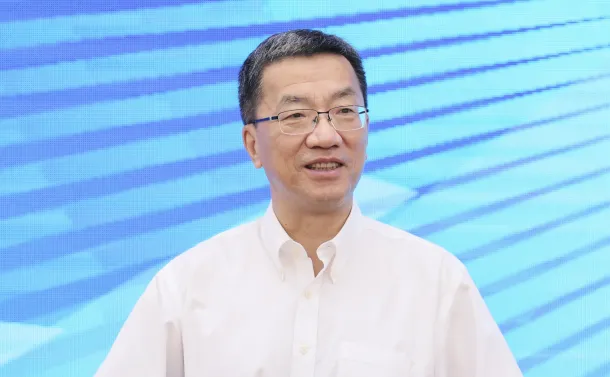
On 14 June, at UNESCO’s invitation, Minister of Education Huai Jinpeng published an English blog post on its website in his capacity as a member of the Education 2030 High-Level Steering Committee. He outlined China’s commitment to prioritizing education development and investment, pursuing people-centred transformation with digitalization as a lever and teachers as the key, and strengthening international educational exchanges and cooperation. He called for education to be prioritized and actively transformed worldwide, helping build a community with a shared future for humanity and a better future for all. The article follows in translation from the Chinese text retained in the Chair’s original report.
Prioritize development, embrace transformation and work together for a better future
Huai Jinpeng, Minister of Education of China
Chinese President Xi Jinping has pointed out that education is the fundamental means through which humanity passes on civilization and knowledge, nurtures younger generations and creates a better life. Human society now faces unprecedented challenges: progress towards the 2030 Agenda for Sustainable Development is far behind expectations, while a new technological revolution sweeps across the world. We must make good education a bridge towards a brighter future, prioritize its development and take the initiative to transform it, empowering individuals, reshaping society and leading the way forward.
Looking ahead, we must give priority to education development
Investing in education means investing in the future. Prioritizing education development is an essential choice if we are to create a better future.
China gives education priority and protection in strategic planning, public funding and the allocation of public resources. National fiscal expenditure on education has remained above 4% of GDP for eleven consecutive years, and major progress has been made in implementing the Education 2030 Agenda. By 2023, the gross preschool enrolment rate was 91.1%, the retention rate for nine-year compulsory education 95.7%, the gross upper-secondary enrolment rate 91.8%, and the gross higher-education enrolment rate 60.2%. Educational opportunities have been effectively safeguarded for everyone, with greater equity and inclusion and a marked improvement in quality. The illiterate share of the population fell to 2.67%, while new entrants to the workforce had an average of fourteen years of education in 2022, providing strong support for rapid, sustained economic and social development.
Looking ahead, we must take the initiative to transform education
A new round of technological revolution and industrial transformation is accelerating. Education is the best meeting point for developing talent, discovering knowledge and advancing technological innovation. Looking ahead, education must embrace transformation and act.
Education transformation must be people-centred.
Education lays the foundations for people’s well-being. Seeking to support people’s all-round development and meet their growing educational needs, China is building a system that integrates moral, intellectual, physical, aesthetic and labour education. It develops students’ core competencies, including cultural understanding, a scientific spirit, learning to learn, healthy living, responsibility and practical innovation. It also nurtures awareness of a community with a shared future for humanity and of ecological civilization, helping students develop themselves, contribute to society and benefit humanity. We have linked education with poverty reduction and achieved dynamic elimination of dropout from compulsory education. We provide specific support for students with disabilities and have established financial assistance covering education of every level and type, so that financial hardship does not force anyone out of education.
Education transformation must use digitalization as a lever.
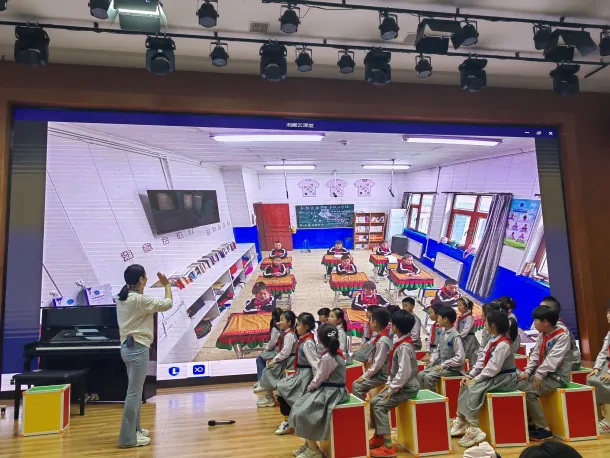
Digitalization is a major direction of future development and a powerful driver of educational change. China has implemented its national action strategy for education digitalization, putting applications first and following the principles of integration, intelligence and internationalization. We have brought together high-quality, systematic digital resources of every type on the national Smart Education public-service platform. It offers everyone round-the-clock, uninterrupted, supermarket-style access, enabling teachers and students in remote areas to share quality resources. It better serves individualized student learning, teaching, school governance, and educational reform and innovation. Committed to digital technology for good, China strengthens the protection of learners’ privacy and rights and regulates AI applications, making education more caring.
Education transformation must recognize teachers as the key.
Teachers are its principal drivers. China regards building the teaching workforce as foundational work. Guided by the spirit of exemplary educators, it has established a teacher-education system involving both teacher-training institutions and comprehensive universities, together with high-quality in-service training. AI and digital technologies empower and support teachers. Preferential policies give remote rural areas priority in the allocation of qualified teachers. Multiple measures improve teachers’ professional remuneration and social standing and encourage respect for teachers and education throughout society. Our aim is to develop a high-quality, professional and innovative workforce of 18.92 million teachers.
Looking ahead, we must strengthen educational exchanges and cooperation
Humanity is an interconnected community with a shared future, sharing both good fortune and adversity. Faced with future crises, challenges and uncertainty, we need solidarity and cooperation more than ever.
China treats opening up as a fundamental national policy and has consistently worked to strengthen international educational exchanges and cooperation.
It strongly supports UNESCO’s priorities. At UNESCO’s invitation, Professor Peng Liyuan, wife of Chinese President Xi Jinping, serves as its Special Envoy for the Advancement of Girls’ and Women’s Education. Together, China and UNESCO established the Prize for Girls’ and Women’s Education to advance the field worldwide. They have also implemented three successive phases of the Funds-in-Trust project supporting Africa, benefiting twelve African countries, more than 30,000 teachers and many students at African higher technical and vocational institutions. China provides funding and favourable conditions for UNESCO to establish an International Institute for STEM Education, expanding channels of international cooperation and supporting STEM education in developing countries. China also hosts the World Digital Education Conference, international conferences on AI and education and other meetings, creating platforms for international exchange and cooperation and advancing the digital transformation of education worldwide.
Human society stands at a crossroads in history. We must place education at the heart of the United Nations Summit of the Future agenda and act together, making priority development and proactive transformation of education the foundation for a community with a shared future for humanity and a better future for everyone!
Historical dates and sources
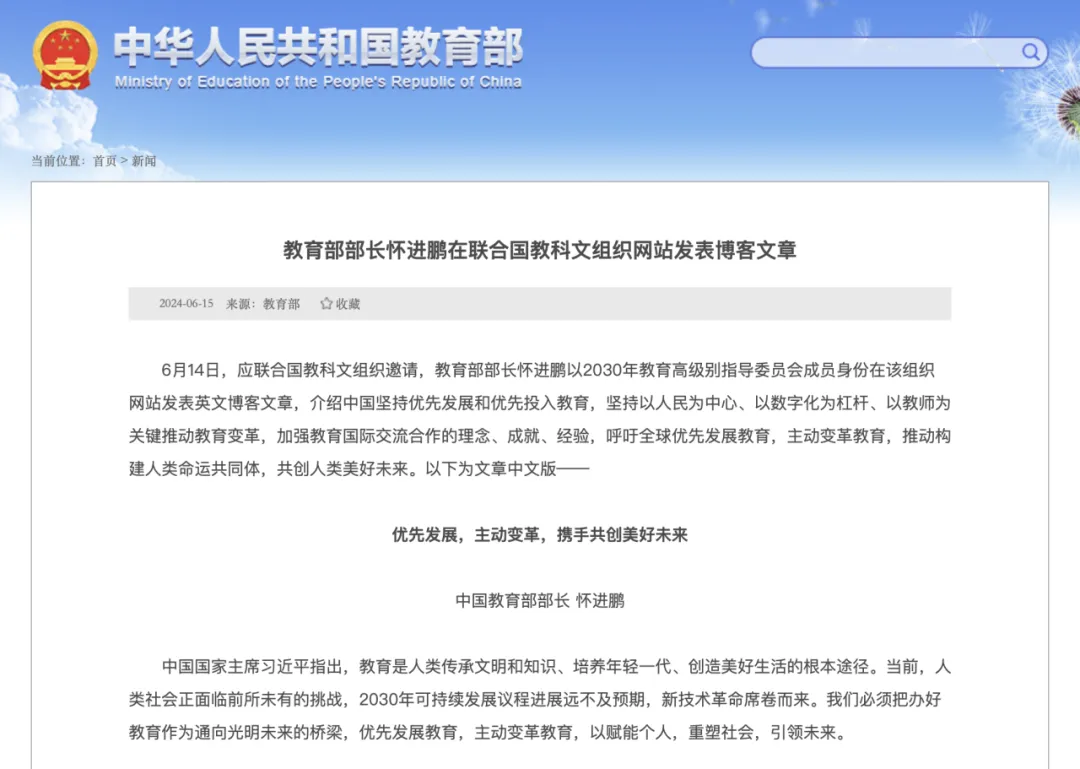
- The Chair’s original title, address and archive time of 16 June 2024, 11:30 are retained. Its introduction and the Ministry’s page dated 15 June report publication on 14 June. UNESCO’s English page currently displays 11 June 2024 and an update on 15 January 2025; its Chinese page displays 4 December 2024. These are recorded separately rather than replacing the Chair’s archive date.
- The complete Chinese archive is retained and translated, with proper headings restored. The 2023 enrolment and retention figures, 2022 workforce education figure, eleven-year investment period, 18.92 million teachers and African project beneficiaries are historical figures from the article. Its discussion of support for students with disabilities, learners’ privacy and AI governance is retained.
- The Ministry screenshot in the original Chair report is retained, with two credited illustrations from the UNESCO article added. Neither the author’s portrait nor the digital-learning scene is presented as a new photograph of a specific event on 14 June.
Ministry of Education report · UNESCO English article · UNESCO Chinese page · Education resource centre · Special and inclusive education resources
Original link: https://aiedchair.bnu.edu.cn/news-7656-en/