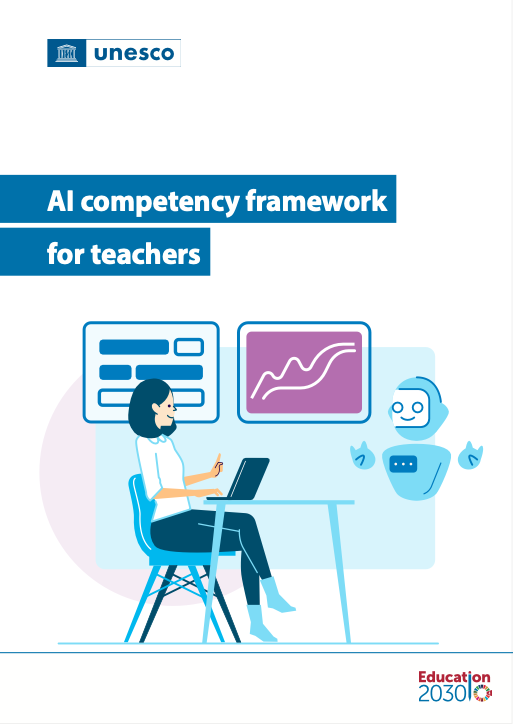
UNESCO launched its AI competency frameworks for teachers and students during Digital Learning Week 2024. Building on work including the 2019 Beijing Consensus on Artificial Intelligence and Education, they respond to AI’s implications for educational practice and human capabilities.
Shared aims
The frameworks define knowledge, skills, values and attitudes for ethical, safe, effective and meaningful use. Both take a human-centred approach, protecting dignity, privacy and human agency.
Teachers’ roles and competency structure
AI’s capacities to process information, generate content and support decisions invite reconsideration of teacher–AI–student interactions. Technology should support educational relationships and judgement; teachers’ roles and professional responsibilities remain essential.
The teacher framework emphasizes teachers’ rights, human agency and sustainability. The report noted that only seven countries had teacher AI frameworks or programmes by 2022. It addresses limited guidance through five aspects and three progression levels, forming fifteen competency blocks.
Teacher audience and purposes
Its primary audience is teachers using AI to support core-subject learning, rather than specialists teaching advanced AI. Policymakers, teacher educators, unions, school leaders and educational experts can also support continuing professional learning through the framework.
The teacher framework has three specific purposes:
- Inform national, state-level or institutional teacher AI frameworks and training programmes.
- Provide an operational framework for teacher educators designing and planning AI courses.
- Establish a benchmarking matrix for teacher competencies and professional learning.

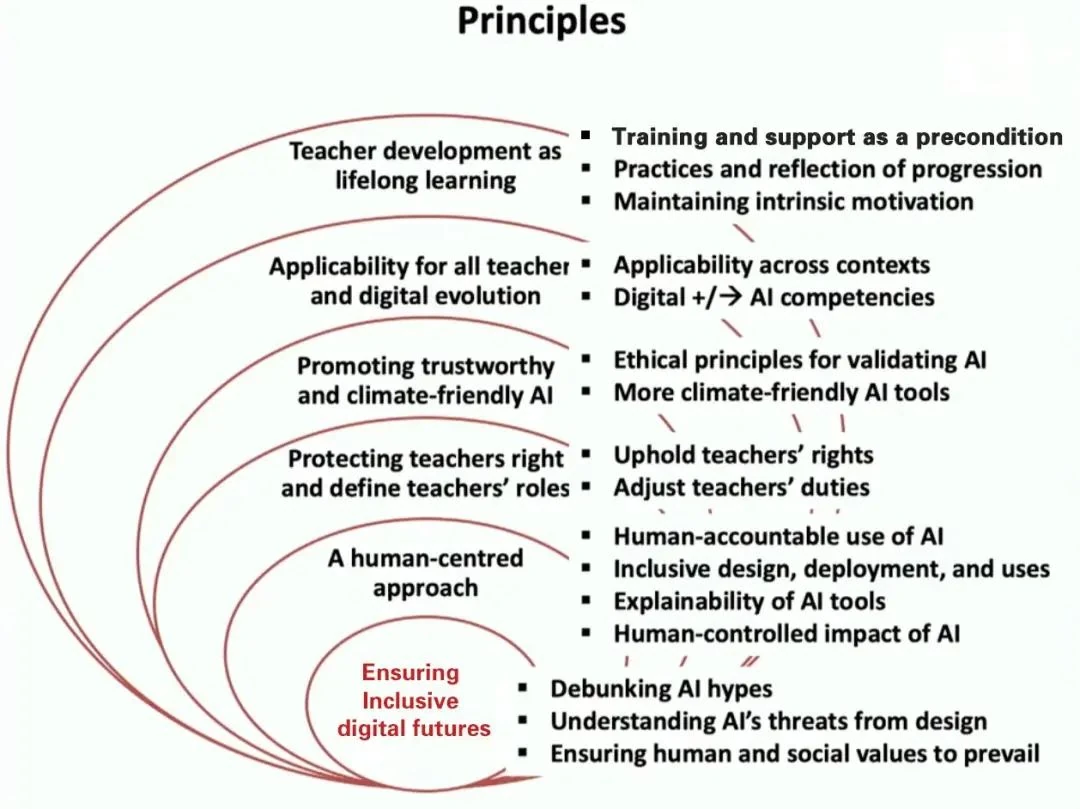
Six guiding principles
Its six interrelated principles, including the original graphic’s main points, can be summarized as follows:
- Inclusive digital futures: challenge hype, understand design risks and uphold human and social values.
- A human-centred approach: accountability, inclusive design and use, explainability and human control of impacts.
- Teachers’ rights and evolving roles: uphold rights and thoughtfully adjust duties and responsibilities.
- Trustworthy and environmentally sustainable AI: ethical validation and attention to climate impacts.
- Applicability for all teachers: respond to varied contexts and connect digital and AI competencies.
- Lifelong professional learning: training and support, practice and reflection, and intrinsic motivation.
Inclusive digital futures provide the foundation. Teachers should examine the values of human–AI interaction, question exaggerated claims and understand risks arising from design and their human and social consequences.
Three teacher progression levels
Three progression levels guide development:
- Acquire: develop basic knowledge and literacy to evaluate, select and appropriately use AI in different teaching contexts.
- Deepen: understand concepts and apply human-centred, ethical judgement in analysis, decisions, teaching and professional learning.
- Create: configure and use AI innovatively and work with communities on beneficial educational change.
Five teacher competency aspects
Five aspects cover values, ethics, technology, pedagogy and professional learning:
- Human-centred mindset: values and attitudes for human–AI interaction.
- Ethics of AI: understand, apply and help adapt ethical principles, regulations and practical rules.
- AI foundations and applications: transferable concepts and skills to select, use and customize tools for student-centred learning.
- AI pedagogy: integrate appropriate tools into preparation, teaching, interaction, social care and assessment.
- AI for professional development: lifelong and collaborative professional learning and transformation.
The fifteen teacher blocks in text
Crossing five aspects with three levels forms fifteen blocks. Each line below follows the graphic’s Acquire–Deepen–Create order:
- Human-centred mindset: human agency — human accountability — social responsibility.
- Ethics: ethical principles — safe and responsible use — co-creating ethical rules.
- Foundations and applications: basic AI techniques and applications — application skills — creating with AI.
- Pedagogy: AI-assisted teaching — AI–pedagogy integration — AI-enhanced pedagogical transformation.
- Professional development: AI enabling lifelong professional learning — enhancing organizational learning — supporting professional transformation.
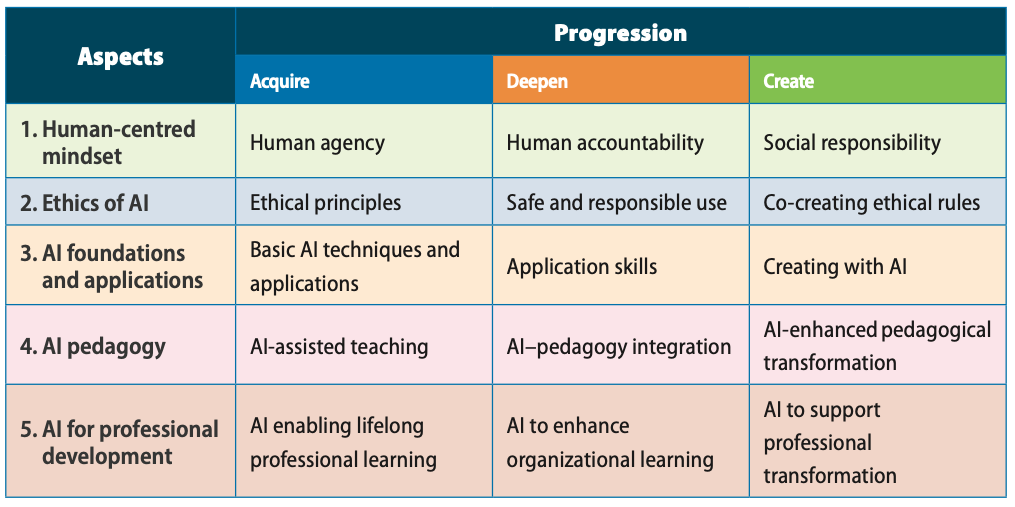
The published framework describes development as contextual and neither rigid nor linear. It offers reference outcomes rather than prescribing identical steps for every teacher.
Student vision and structure
The student framework seeks responsible users, co-creators and citizens. Citing the situation in 2022, when only 15 countries included AI in national curricula, it highlights the importance of integrating learning objectives into formal schooling.
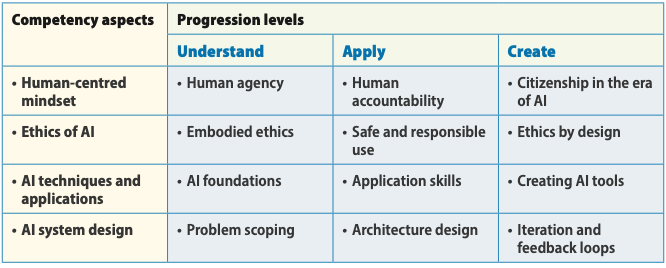
Four aspects intersect with Understand, Apply and Create, forming twelve blocks. The framework also specifies curricular goals and domain-related teaching methods.
Its vision includes critical judgement of AI solutions, civic responsibility, foundational knowledge for lifelong learning, and participation in inclusive, sustainable AI design.
Student audience and purposes
It addresses policymakers, curriculum developers, student AI-education providers, school leaders, teachers and educational experts. Local curricula, learning environments, teacher readiness and students’ prior knowledge matter in implementation.
The student framework proposes three objectives:
- Offer a global reference for core student AI competencies and national or institutional frameworks.
- Specify attitudes and behaviours at different mastery levels to guide curricular content.
- Provide an open roadmap for sequencing learning across grades.

Three student progression levels
The three student progression levels emphasize:
- Understand: all students explain age-appropriate values, ethics, concepts and methods through everyday or social examples.
- Apply: transfer and adapt values, knowledge and skills to more complex problems and tasks, critically analyzing technical methods.
- Create: combine data, algorithms and ethical design to design, implement and test solutions to real challenges, strengthening co-creation and civic responsibility.
Create is a more specialized level. The published framework recognizes that Apply may be some students’ school-stage exit point. It should not be read as requiring every age group immediately to develop complex systems.
Four student competency aspects
The four student aspects are:
- Human-centred mindset: critically judge purposes, justification, interaction and individual and institutional responsibility for a safe, inclusive and just society.
- Ethics of AI: ethical judgement, reflection and social-emotional capabilities for responsibility throughout system lifecycles.
- AI techniques and applications: conceptual knowledge, operational skills and transferable technical foundations.
- AI system design: scope problems, design, build, train, test and optimize systems through design thinking and integrated engineering.
The twelve student blocks in text
The twelve blocks below follow the original graphic’s Understand–Apply–Create order:
- Human-centred mindset: human agency — human accountability — citizenship in the era of AI.
- Ethics: embodied ethics — safe and responsible use — ethics by design.
- Techniques and applications: AI foundations — application skills — creating AI tools.
- System design: problem scoping — architecture design — iteration and feedback loops.
Eight implementation strategies
The original introduction describes eight implementation strategies:
- Use the framework as a competency foundation for AI strategies.
- Build interdisciplinary core and cluster curricula.
- Choose future-oriented, locally feasible AI domains as curricular carriers.
- Plan spiral learning sequences.
- Build enabling learning environments.
- Support teachers’ AI professional development.
- Use community guidance for pedagogy.
- Assess AI competencies.
AI and interdisciplinary learning
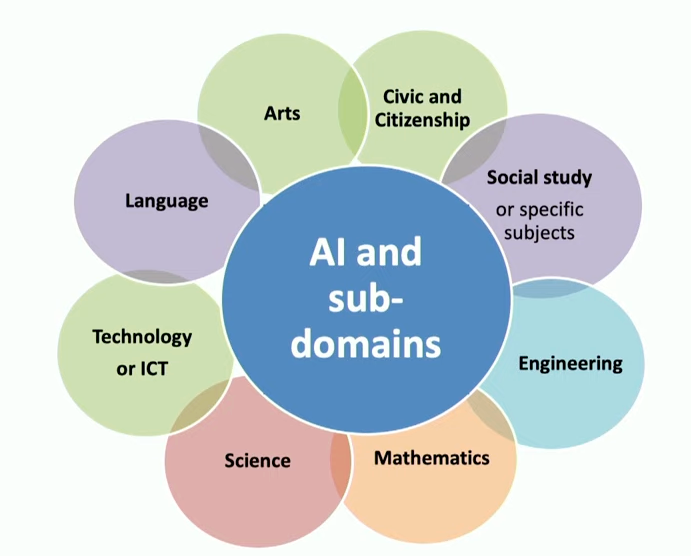
The interdisciplinary graphic connects AI and its subdomains with the subject areas below, linking core curricula, subject clusters, extracurricular activity and local practice:
- Language.
- Arts.
- Civics and citizenship.
- Social studies or specific subjects.
- Engineering.
- Mathematics.
- Science.
- Technology or ICT.
Policy and enabling conditions
UNESCO recommends integrating both frameworks into comprehensive AI capacity-building strategies across educational levels, alongside internet access, ethical design and environmentally sustainable practice.
AI should not become a shortcut around teacher shortages or inadequate infrastructure. These systemic challenges still require sustained policy attention, investment and educational support.
The frameworks provide reference points for ethical, inclusive, locally adaptable and human-centred strategies and a shared language for long-term student and teacher development.
Original attribution and illustrations
The original introduction credited the UNESCO ICHEI Official Account. This edition checks facts against UNESCO’s published frameworks and draws illustrations from the public Zhejiang Normal University STEM Education Research Centre republication, retaining UNESCO and Freepik credits. Site translations are not official UNESCO editions.
Related reading
Related reading: the 2023 draft-framework report records the development stage; this article introduces the final 2024 frameworks. See also the extended generative-AI guidance introduction and special and inclusive education resources.
Publications, licences and references
Both original publications use CC BY-SA 3.0 IGO; explicitly excluded third-party images are not covered. Consult the teacher framework publication record and official student framework page for the originals and available language editions.
Reference: Fengchun Miao and Mutlu Cukurova, AI competency framework for teachers, UNESCO, 2024. DOI: 10.54675/ZJTE2084.
Reference: Fengchun Miao, Kelly Shiohira and Natalie Lao, AI competency framework for students, UNESCO, 2024. DOI: 10.54675/JKJB9835.
Editorial note: the site’s original Chinese title, URL and 29 September 2024 archive date are retained. The duplicated paragraph under student Create has been corrected against the published framework; the 2022 country counts remain historical background.
Original link: https://aiedchair.bnu.edu.cn/news-8174-en/