
Historical research article | Authors: Huang Ronghuai, Zhang Guoliang and Liu Mengyu. Modern Educational Technology, 2024, volume 34, issue 2, pages 13–22; originally posted by the Chair on 30 September 2024. Technology descriptions, risk judgements and proposals retain the study’s historical context and are not statements of current policy or product effectiveness.
Article contents
Abstract and keywords
Abstract: The integration of intelligent technologies throughout education is transforming educational practice while generating ethical risks, including algorithmic discrimination, technology misuse, privacy breaches and displacement of educational participants’ roles. Avoiding these risks while realising the benefits of technology has become a central issue for smart education. This article first analyses reports on technology ethics and identifies orientations across four dimensions: intelligent technology, educational participants, educational data and educational oversight. It then examines different manifestations of ethical risk in six typical smart-education scenarios—teaching, learning, management, assessment, training and research—and traces their causes to untrustworthy technological tools, inadequately governed educational practice and insufficient teacher and student literacy. Finally, it proposes prevention and governance measures concerning technology improvement, risk management, accountability and oversight, data flows and literacy development, to support healthy, sustainable smart education.
Keywords: smart education; intelligent technology; ethical norms; risk manifestations; risk governance
Introduction
Alongside changes in education, intelligent technologies have introduced ethical problems involving discriminatory and opaque algorithms, misuse and dependence, data privacy breaches, difficulties in emotional communication between educational participants and blurred boundaries of authority[1][2]. These have attracted attention in China and internationally. Between 2019 and 2021, UNESCO issued documents including the Beijing Consensus on Artificial Intelligence and Education and the Recommendation on the Ethics of Artificial Intelligence[3][4], advocating ethical governance and sustainable educational applications. Mitigating ethical risks and directing technology towards the common good have become shared challenges for education worldwide[5].
Educational applications of intelligent technology are changing the form of education. Smart education, an advanced stage of educational digital development, aligns with digital transformation; ethically appropriate technology use is one of its defining practical features[6]. New technologies and products bring opportunities but also concern about ethical risks. Avoiding those risks while gaining technological benefits is therefore important. Ethical norms have developed more slowly than educational applications. Existing research largely concentrates on principles and abstract risk analysis and lacks a comprehensive ethical framework extending beyond technology’s own influence[7]. This does not adequately support smart education’s greater technological richness and systemic integration. Policymakers, researchers, practitioners, developers and other stakeholders understand these norms differently. A systematic account of ethical orientations, manifestations, causes and governance is needed to bridge the gap between what ought to guide practice and the difficulties encountered in reality, supporting healthy, sustainable smart education.
I. Normative orientations: technology ethics for smart-education practice
Ethics concerns the moral principles governing relations between people, including objective ethical relationships and their external regulation[8]. Technology ethics can be understood as the morals and principles concerning relations between technology and people, and technology and society, during development and use[9]. China’s State Council issued the New Generation Artificial Intelligence Development Plan in 2017, proposing AI applications across teaching, management and resource development and personalised provision for everyday and lifelong education[10]. As technologies enter every stage of education, ethical risks expand. Clarifying the orientations that ought to guide smart education can establish shared understanding and practical principles.
1. Analysing the orientations
Many countries and organisations have issued policies and reports addressing technology ethics to limit harmful effects. In education, these evolving reports provide a basis and forward-looking guidance for ethical norms. However, existing accounts of educational AI principles tend to converge on general technology ethics and give insufficient attention to education itself. This study reviews seven representative reports from the preceding five years and uses content analysis to identify their ethical concerns, as shown in Table 1. It seeks a model more closely aligned with the nature, values and contemporary conditions of educational technology use. Four central dimensions emerge—intelligent technology, educational participants, educational data and educational oversight—which organise the ethical elements and principles in the model.
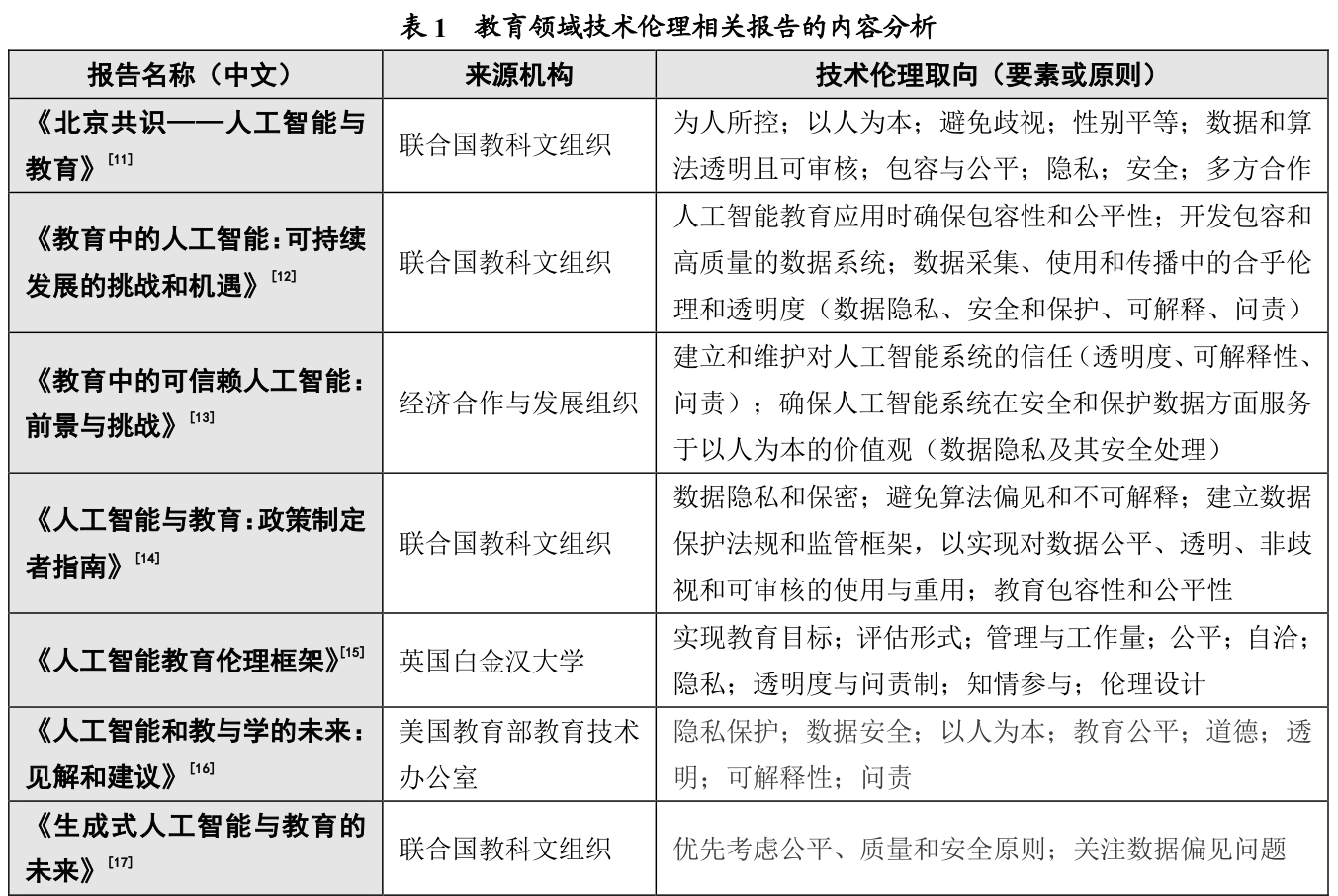
Faithful render of the journal’s vector table; printed page 14, PDF page 2.
Table 1 in full text: seven reports
The original seven rows and three columns are provided as selectable, narratable text. Titles and principles use this page’s language; the source image remains Chinese.
| Report title | Issuing organisation | Ethical orientations: elements or principles |
|---|---|---|
| Beijing Consensus on Artificial Intelligence and Education [11] | UNESCO | Human control; human-centredness; avoiding discrimination; gender equality; transparent, auditable data and algorithms; inclusion and equity; privacy; safety; cooperation among stakeholders. |
| Artificial Intelligence in Education: Challenges and Opportunities for Sustainable Development [12] | UNESCO | Inclusion and equity in educational AI; inclusive, high-quality data systems; fairness, ethics and transparency in collecting, using and disseminating data, including privacy, security and protection, explainability and accountability. |
| Trustworthy Artificial Intelligence (AI) in Education: Promises and Challenges [13] | OECD | Build and maintain trust in AI systems through transparency, explainability and accountability; ensure safety and data protection serve human-centred values, including privacy and other secure processing. |
| AI and Education: Guidance for Policy-makers [14] | UNESCO | Data privacy and confidentiality; avoid algorithmic bias and inexplicability; data-protection rules and oversight for fair, transparent, non-discriminatory, auditable use and reuse; educational inclusion and equity. |
| The Ethical Framework for AI in Education [15] | University of Buckingham, United Kingdom | Achieving educational goals; forms of assessment; management and workload; fairness; autonomy; privacy; transparency and accountability; informed participation; ethical design. |
| Artificial Intelligence and the Future of Teaching and Learning: Insights and Recommendations [16] | U.S. Department of Education, Office of Educational Technology | Privacy protection; data security; human-centredness; educational equity; ethics; transparency; explainability; accountability. |
| Generative AI and the Future of Education [17] | UNESCO | Prioritise equity, quality and safety; attend to data bias. |
2. Constructing the model
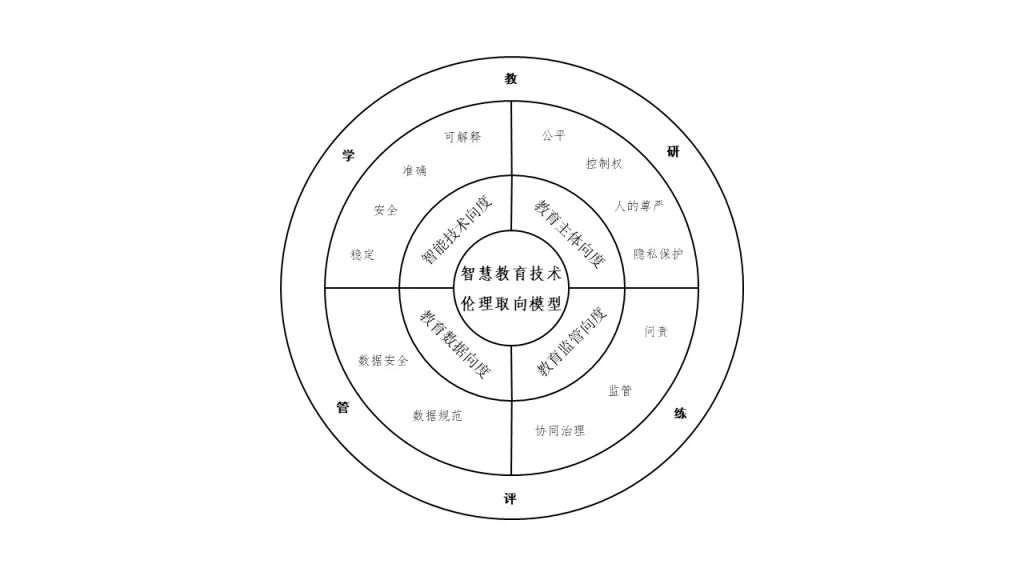
Drawing on Table 1, the study proposes the technology-ethics orientation model for smart education in Figure 1. It presents, systematically and structurally, the ethical norms that educational applications of intelligent technology should consider. Its ultimate purpose is for ethically appropriate technology to serve all six typical processes: teaching, learning, management, assessment, training and research.
The reports inform the following descriptions.
① Intelligent technology includes explainability, accuracy, safety and stability of algorithms and products. Explainability requires operating principles and decision processes to be open, understandable and traceable across inputs, outputs, performance and generated results, strengthening trust. Analysis and generated content should be accurate to avoid misleading falsehoods. Safety concerns compliant, non-harmful algorithms, human–machine interaction design and product forms. Stability concerns system robustness and reliable operation under threats, avoiding abnormal technical outcomes.
② Educational data includes security and standardisation. Data should remain secure during collection, storage, use, sharing and deletion, preventing breaches and misuse. Standardisation concerns formats and operational standards for collection, processing, storage and sharing, ensuring data quality and general usability and orderly movement between systems. Training datasets should be authentic, accurate, objective and diverse to avoid bias.
③ Educational oversight concerns accountability, supervision and collaborative governance. Rules should clarify each participant’s responsibilities and obligations in educational development and use, guide appropriate technology use and prevent disorder caused by unclear responsibility. Applications should be inspectable, assessable and manageable. Inclusive collaboration among stakeholders can distribute technological benefits across society and support sustainability.
④ Educational participants require fairness, control, human dignity and privacy. Fairness means non-discriminatory, equitable access to technological resources across countries, regions, racial groups, individuals, genders, disabilities and language communities. Control means freely choosing whether to use or discontinue technology and managing it throughout use. Human dignity is inherent and inviolable; applications must respect human rights and fundamental freedoms throughout their lifecycle. Access to personal information should be reasonable, lawful and restrained, protecting privacy.
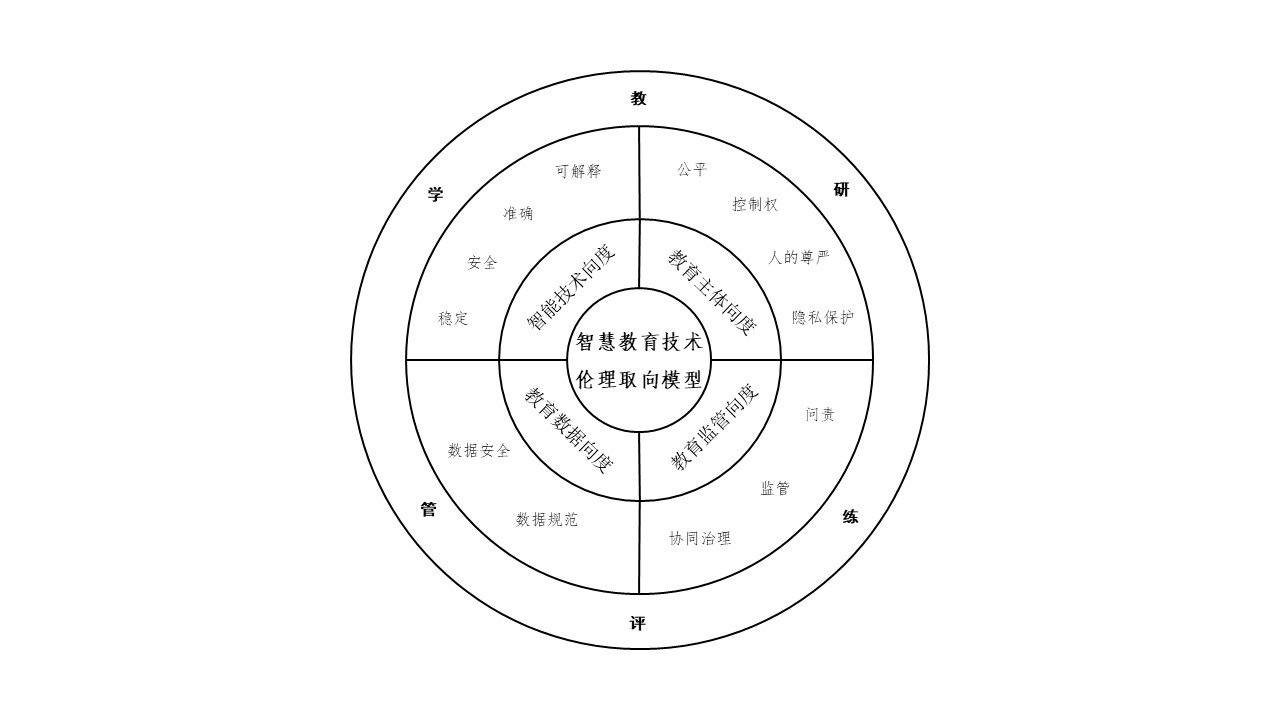
Native model image extracted from the journal; printed page 15, PDF page 3.
Figure 1 in full text: four dimensions and thirteen principles
The centre names the technology-ethics orientation model for smart education. Four dimensions occupy the middle ring, thirteen principles surround them, and six educational scenarios form the outer perimeter.
- Intelligent technology
- Explainability
- Accuracy
- Safety
- Stability
- Educational participants
- Fairness
- Control
- Human dignity
- Privacy protection
- Educational data
- Data security
- Data standards
- Educational oversight
- Accountability
- Supervision
- Collaborative governance
Six application scenarios
- Teaching
- Learning
- Educational management
- Educational assessment
- Skills training
- Research and knowledge production
II. Risk manifestations in typical smart-education scenarios
Integrating intelligent technology into education has enabled innovations such as smart campus safety, robot learning companions and virtual simulation training[18]. It has advanced teaching models, learning methods, management, assessment, skills practice and knowledge production. Yet technological development and widespread adoption also bring ethical risks. Education is a complex social activity; its technologies and practices are diverse, complex and dependent on context. Risks consequently take different forms. The study examines the practical difficulties across six scenarios: teaching, learning, management, assessment, training and research.
1. Misused educational robots challenge teaching authority and relationship boundaries
From computer-assisted instruction and intelligent tutoring systems to educational robots, human–machine relations have evolved from assistance towards collaboration[19]. Introducing a robot changes the teacher–student relationship into a teacher–machine–student relationship. Poor integration can harm learning and emotional development and undermine teachers’ roles and authority. Robots may weaken or replace aspects of human teachers’ roles, reducing personal contact and communication[20]. Learners may rely more on machine teachers, distorting teacher–student, peer and human–machine relationships. Children can attribute human cognitive, behavioural and emotional characteristics to robots[21]. Robots are technological tools but also visibly display such characteristics, making their functions and role boundaries more complex. The COMEST report on robotics ethics likewise notes that robots blur boundaries between human subjects and technological objects. It asks whether educational robots should be tutors, tools or peers and how far they can replace teachers[22]. In the period discussed, educational robots remained at an early stage, with limited pedagogical suitability, feedback and perception[23]. Moral and legal responsibility for harmful or uncontrolled behaviour also raised questions of attribution and accountability.
2. Algorithmic discrimination obstructs personalised learning and holistic development
Educational demand is moving from standardised teaching towards personalised and lifelong learning, while services move from standardised provision towards individual support[24]. Intelligent systems seek to tailor content and pathways to learners’ abilities, learning styles and other characteristics. However, discriminatory models and incomplete or biased data may treat people differently, producing ability, gender or racial bias in recommendations and teaching decisions. This can frustrate personalisation, polarise outcomes and deepen educational inequality. Recommendation algorithms can also create information cocoons. When recommendations tailored to a learner’s interests narrow information sources and learning pathways, viewpoints become one-sided and existing beliefs are reinforced. Technology may thereby foster bias and discrimination[25], impeding comprehensive development.
3. Poor educational-data management increases privacy and misuse risks
Educational data encompasses information generated by or associated with educational practice, cycling through creation, collection, possession and use[26]. Large-scale collection and analysis pose risks of privacy intrusion, breaches and misuse. Smart campus surveillance, facial-recognition attendance devices and classroom monitoring increasingly reduce students’ private space, exposing teaching and learning to a form of pervasive observation[27]. Personal information and attainment records face threats from negligent administration, unauthorised access, hacking and system vulnerabilities. Breaches and alteration can affect informational, physical, psychological and material security. The article cites a 2020 U.S. Government Accountability Office investigation reporting harm to thousands of K–12 students across 99 breaches, commonly involving grades and special-education records[28]. Online platforms and applications may sell or misuse learners’ private data for improper commercial purposes or biased decisions. The article also notes improper information collection by educational products. It refers to cases publicised in China by the Ministry of Industry and Information Technology involving commercial apps and SDKs that collected information unlawfully or demanded excessive permissions, and to instances in which student data was used for fraud, identity theft or impersonation.
4. Excessive reliance on automated assessment weakens professional judgement and fairness
Teachers’ decisions influence the effectiveness of educational practice[29]. Data-driven assessment tools analyse cognition, emotion and behaviour, build learner profiles and provide warnings, feedback and suggestions. These can support teaching adjustments and reduce repetitive work. Their automation and efficiency may, however, encourage excessive reliance on machine judgements and recommendations. Teachers can become mechanical implementers of tool-generated decisions, neglecting practical wisdom, losing sensitivity to context and learners’ emotions, and weakening their agency as decision-makers[30]. Decision effectiveness and professional development may suffer. Opaque algorithms also obscure decision processes, while unreliable data and models threaten fairness. Faulty assumptions, inaccurate information or failure to consider individual differences and exceptional circumstances can undermine assessment accuracy and credibility, distort evaluation and learning pathways, frustrate students, produce unfair treatment and affect future opportunities.
5. Immersion in virtual environments raises concerns about moral conduct
VR, AR and MR can reduce training costs, support skills practice, avoid hazards in real experiments, overcome time and distance and make learning engaging. Their immersion, presence and multisensory interaction also blur reality and simulation. Real-world ethical problems may reappear in altered forms and influence life outside the simulation. Virtual environments raise questions about finite or unlimited lives and participants’ dignity. Weak oversight of behaviour and consequences may erode moral restraint. Avatars, agents and virtual social interaction expand relationships among educational participants, but virtual identities can encourage disregard for etiquette or new forms of bullying. Identifying with an avatar’s idealised characteristics may affect real-world cognition, attitudes and behaviour[31]. Flow in VR educational games can entail emotional identification with virtual objects and loss of a sense of self, while excessive use can foster behavioural dependence and technology addiction[32]. The article also notes the immaturity of VR products and technology in its historical context. Differences between virtual and real-world parameters may cause errors in factual recall or analysis of practical experience[33]. VR can also induce motion sickness, posing physical safety risks to teachers and learners.
6. Misused generative AI can enable academic cheating and weaken creativity
Large AI models such as ChatGPT can collect, process and generate personalised learning resources[34]. Their outputs may nevertheless contain factual errors, misleading or deceptive content and convincing falsehoods. Unconstrained misuse may facilitate cheating and weaken creativity. Excessive reliance on generative AI for coursework and research can encourage shortcuts and misconduct. Dependence on recommended materials can displace active inquiry and independent thought, undermining learning, critical thinking and creativity. The article notes attention to these risks at the time: Stanford researchers had developed DetectGPT to help identify model-generated writing, and China’s Cyberspace Administration[35] published the Interim Measures for the Management of Generative Artificial Intelligence Services in July 2023, requiring providers to take effective steps to prevent minors’ excessive dependence or addiction.
III. Causes of ethical risks in educational technology use
As intelligent technology enters more educational settings, human–machine collaboration intensifies. From the perspective of humans and machines jointly teaching and supporting education, the study groups causes of ethical risks into technological tools, educational practice, and teacher and student literacy.
1. Untrustworthy technological tools
Biased, opaque algorithms and limitations in product usability are central causes.
① Algorithm design has inherent constraints. Algorithms extend developers’ reasoning: models trained on classifications encoded through human judgement can reproduce human values and biases in decisions. Complex teaching activity makes comprehensive, accurate data collection difficult. Biased training data can entrench discrimination—the bias-in, bias-out problem. Large data-driven neural models also contain structures and numbers of parameters beyond ready human comprehension, making internal input-to-output reasoning difficult to understand, review and trust. Teaching depends on teachers’ and learners’ agency, while statistical correlations alone cannot fully explain educational causation.
② Product usability is limited. Educational practice demands usable, effective tools, but development is often weakly connected to classroom experience. Developers may not understand real needs or educational processes, leaving substantial mismatches between functions and practice. Unclear development standards also undermine safety and consistency. Combining technologies creates vulnerabilities; non-compliant systems that cannot maintain stability and resist threats can harm participants’ rights and interests.
2. Inadequately governed educational practice
As unlike elements combine in the educational ecosystem, complexity increases and practice faces higher demands. Ineffective integration models and missing oversight can leave ethical risks uncontrolled.
① New technologies continually expand educational boundaries and create varied settings, complicating the choice and use of teaching models. Without effective models, practical experience and risk management, educators facing many options may integrate technologies poorly or use them indiscriminately. As machines become more capable, deciding which machines to collaborate with and how to allocate roles and tasks is important in designing human–machine collaborative teaching[36] and preventing displacement of educational roles.
② Oversight mechanisms are also essential. They act as safeguards for appropriate use and ethical behaviour. Without clear policies and principles, institutions and practitioners may lack accountability and constraints. The article notes growing concerns about misconduct under weak regulation. Teachers, administrators and other staff may all access educational data, making coherent behavioural controls difficult[37]. Unauthorised sales of teachers’ and students’ educational data and identity information without their knowledge have been reported[38]. Missing accountability and oversight create grey areas in which improper practices can develop.
3. Insufficient teacher and student literacy
People use technology; their digital literacy is crucial to appropriate educational applications. Teachers and learners need technical knowledge and skills as well as ethical attitudes and values. Deficiencies can generate risks.
① Without sufficient technical competence and literacy education, they may misuse or overuse technology, become dependent, make avoidable errors or lose agency. Inadequate knowledge can also prevent educators from maintaining systems properly, increasing failures and breaches and weakening educational benefits.
② Ethical awareness matters too. Teachers who do not understand technological risks may be unable to guide students effectively. Students with weak privacy awareness, critical thinking or ability to recognise false information may be misled by mixed-quality and harmful material, with consequences for later behaviour.
IV. Action proposals: governing ethical risks for smart education
Based on these causes, the study proposes prevention and governance measures to help educational participants, intelligent technology and practice develop harmoniously and support a broad transition towards smart education.
1. Improve the usability of intelligent educational products
Companies providing smart-education services should take responsibility for products, services and technical safeguards.
① Strengthen development standards and regulate design, development and provision. Understand actual educational needs and conditions before development. Define collection, transmission and processing requirements for integration and data flows, including standardisation, secure communications and API design. Avoid redundant functions, disconnected workflows and information silos. During development, strengthen encryption, access controls, permission management, network and system security, backups and recovery. Test prototypes, assess performance and repair vulnerabilities promptly. Respect ethical norms, users’ rights and privacy during promotion.
② Improve explainability throughout the algorithm lifecycle to support trustworthy, responsible products. Avoid biased training data. In automated decision models, consider learners’ backgrounds, attainment, interests, learning styles, individual differences and exceptional circumstances to support fair, reasonable decisions. Across deployment contexts, consider both global and local explainability, providing relevant performance indicators and information about decision-factor weights to increase transparency.
2. Strengthen risk management when introducing technology
Schools are important builders and providers of smart education. Risk assessment and management can create safe teaching environments.
① Establish assessment and response mechanisms. Before adoption, clarify objectives and scope and align technology with teaching goals. Understand suitability, limitations, potential risks and responses and assess products comprehensively. Prepare and test pilots thoroughly to ensure stable, reliable operation and prevent disruption to normal teaching.
② Share management and application experience. Schools can build supportive environments, train teachers, develop representative cases and practical teaching models, and disseminate effective approaches to managing and using intelligent technology.
3. Establish data protection, accountability and oversight
Government has guiding and supervisory responsibilities and should provide an overall framework for ethical risk governance.
① Strengthen privacy protection and standards for educational-data use. Develop classified, tiered protection and more detailed collection and use rules. The diversity of data requires advance security planning and standards to prevent personal information being misused or disclosed. Improve the authenticity, accuracy, objectivity and diversity of training datasets.
② Establish rules constraining providers, schools and educational institutions, supplying oversight and a legal basis for accountability. Rapid technical change and slower legal development can create social and ethical problems. Policies and accountability mechanisms should support resource sharing and integration and hold violations of ethical principles to account. Smart education also involves many stakeholders: education authorities should encourage cross-sector cooperation, joint pilots before large-scale adoption, shared understanding and action, and clearer responsibility across organisational boundaries.
4. Support orderly data flows between educational systems
Common data standards and sharing mechanisms are necessary for healthy flows. Standards provide the foundation; sharing arrangements support orderly exchange. Interoperability and integrated analysis require consistent formats and mechanisms for cooperation across departments. Education generates extensive basic data, but many institutions design systems only for internal or vertical administrative needs. Differences in coding, formats and quality obstruct integration across sources. Complex procedures for exchange between administrative levels increase costs and introduce security risks[39]. Standardisation—common standards and multiple uses of a single authoritative source—can therefore support both data protection and secure sharing.
5. Develop teacher and student digital literacy
Teachers and students put smart education into practice and generate much of its data. Ethical awareness of privacy and competence in appropriate technology use can reduce harmful consequences.
① Build technical literacy and ethical awareness and respond actively to change. Teachers should undertake training, learn relevant knowledge and skills, understand limitations and ethical risks and adopt a considered approach to introducing technologies, avoiding excessive or inappropriate use. Students should develop privacy awareness and critical thinking.
② Through practice, identify effective integration models and experience, take an active role in change, adapt to collaborative human–machine environments and strengthen the ability to work with intelligent technologies in smart education.
References
The journal’s 39 citation numbers correspond to 37 entries: [3]/[11] and [19]/[36] each share one reference. Every number has a working target. Original citation languages are retained, source URLs and verifiable DOIs restored, and the obvious spellings Buckingham and Paris corrected. Additional editorial reading is not presented as an original reference.
- [1]杜静,黄荣怀,李政璇,等.智能教育时代下人工智能伦理的内涵与建构原则[J].电化教育研究,2019,(7):21-29.
- [2]胡小勇,黄婕,林梓柔,等.教育人工智能伦理:内涵框架、认知现状与风险规避[J].现代远程教育研究,2022,(2):21-28、36.
https://unesdoc.unesco.org/ark:/48223/pf0000368303.locale=zh
- [4]UNESCO. Recommendation on the ethics of artificial intelligence[OL].
https://www.unesco.org/en/artificial-intelligence/recommendation-ethics
- [5]白钧溢,于伟.超越“共识”:教育人工智能伦理原则构建的发展方向[J].中国电化教育,2023,(6):9-17、24.
- [6]黄荣怀,刘梦彧,刘嘉豪,等.智慧教育之“为何”与“何为”——关于智能时代教育的表现性与建构性特征分析[J].电化教育研究,2023,(1):5-12、35.
- [7]张永波.智慧教育伦理观的建构机理研究[J].中国电化教育,2020,(3):49-55、92.
- [8]李建华.伦理与道德的互释及其侧向[J].武汉大学学报(哲学社会科学版),2020,(3):59-70.
- [9]赵磊磊,张黎,代蕊华.教育人工智能伦理:基本向度与风险消解[J].现代远距离教育,2021,(5):73-80.
- [10]国务院.国务院关于印发新一代人工智能发展规划的通知[OL].
https://www.gov.cn/zhengce/content/2017-07/20/content_5211996.htm
- [12]UNESCO. Artificial intelligence in education: Challenges and opportunities for sustainable development[OL].
- [13]OECD. Trustworthy artificial intelligence (AI) in education: Promises and challenges[OL].
- [14]UNESCO. AI and education: guidance for policy-makers[OL].
- [15]The University of Buckingham. The ethical framework for AI in education[OL].
- [16]U.S. Department of Education, Office of Educational Technology. Artificial intelligence and the future of teaching and learning[OL].
- [17]UNESCO. Generative AI and the future of education[OL].
- [18]杨俊锋,施高俊,庄榕霞,等.5G+智慧教育:基于智能技术的教育变革[J].中国电化教育,2021,(4):1-7.
- [20]Sharkey A J C. Should we welcome robot teachers?[J]. Ethics and Information Technology, 2016,18:283-297.
- [21]Beran T N, Ramirez-Serrano A, Kuzyk R, et al. Understanding how children understand robots: Perceived animism in child-robot interaction[J]. International Journal Human-Computer Studies, 2011,(7-8):539-550.
- [22]UNESCO, COMEST. Report of COMEST on robotics ethics[R]. Paris: UNESCO, 2017:33.
- [23]卢宇,薛天琪,陈鹏鹤,等.智能教育机器人系统构建及关键技术——以“智慧学伴”机器人为例[J].开放教育研究,2020,(2):83-91.
- [24]黄荣怀,刘德建,焦艳丽,等.互联网教育服务产业研究报告[R].北京:互联网智能技术及应用国家工程实验室,2017:4.
- [25]韦妙,何舟洋.本体、认识与价值:智能教育的技术伦理风险隐忧与治理进路[J].现代远距离教育,2022,(1):75-82.
- [26]刘三女牙,杨宗凯,李卿.教育数据伦理:大数据时代教育的新挑战[J].教育研究,2017,(4):15-20.
- [27]孙立会.人工智能之于教育决策的主体性信任危机及其规避[J].电化教育研究,2023,(3):21-27、43.
- [28]United States Government Accountability Office. Data security: Recent K-12 data breaches show that students are vulnerable to harm[OL].
- [29]沈书生.聚焦学习决策:指向认知发生的数据及其应用[J].电化教育研究,2021,(11):13-19.
- [30]蒋艳双,崔璨,刘嘉豪,等.教育领域中的情感计算技术:应用隐忧、生成机制与实践规约[J].中国电化教育,2022,(5):91-98.
- [31]高媛,刘德建,黄真真,等.虚拟现实技术促进学习的核心要素及其挑战[J].电化教育研究,2016,(10):77-87、103.
- [32]孙田琳子.虚拟现实教育应用的伦理反思——基于伯格曼技术哲学视角[J].电化教育研究,2020,(9):48-54.
- [33]沈阳,逯行,曾海军.虚拟现实:教育技术发展的新篇章——访中国工程院院士赵沁平教授[J].电化教育研究,2020,(1):5-9.
- [34]吴砥,李环,陈旭.人工智能通用大模型教育应用影响探析[J].开放教育研究,2023,(2):19-25、45.
- [35]中国网信网.生成式人工智能服务管理暂行办法[OL].
- [37]张誉元,张海.数据生命周期视阈下教育数据伦理问题及规约之径[J].中国电化教育,2022,(10):118-125.
- [38]赵磊磊,陈祥梅.数智时代教育大数据风险:表征样态与化解路向[J].贵州师范大学学报(社会科学版),2022,(2):72-82.
- [39]杨琳,王炜,诸纪,等.面向数据共享的教育数据标准体系研究与建设实践[J].大数据,2020,(6):3-13.
Journal source and editorial note
Article cited: 黄荣怀,张国良,刘梦彧.面向智慧教育的技术伦理取向与风险规约[J].现代教育技术,2024,34(02):13-22.
Source | Modern Educational Technology (现代教育技术)
Prepared from Modern Educational Technology, 2024, volume 34, issue 2, pages 13–22. Table 1 and Figure 1 come from the journal, with readable text alternatives. Translations on this site support academic exchange; consult the journal for the original arguments, illustrations and citations.
Original link: https://aiedchair.bnu.edu.cn/news-7951-en/