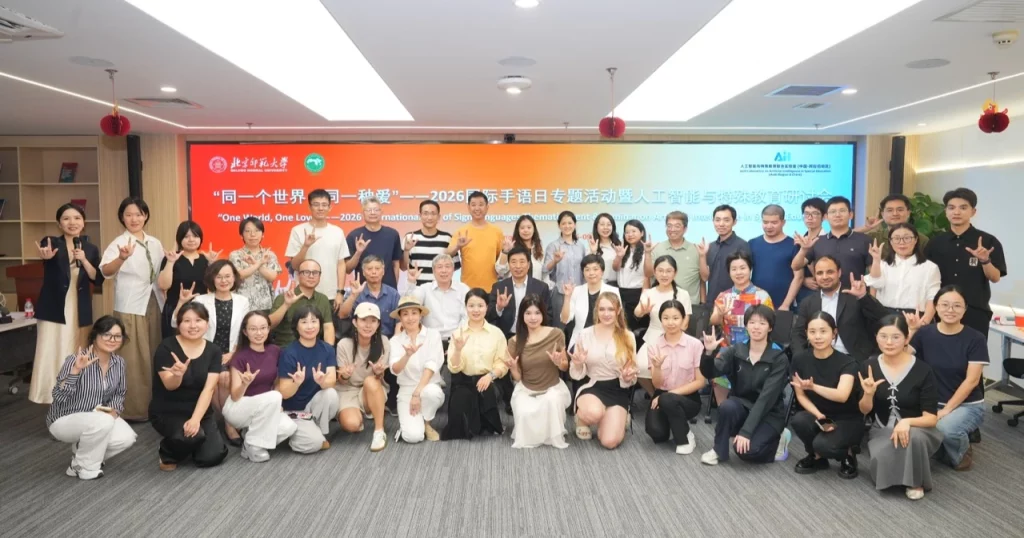
On 31 March 2023, the handbook Learning for All with AI? 100 Influential Academic Articles of Educational Robots was launched at the Symposium on Artificial Intelligence and Digital Education, held at Beijing Normal University (BNU).

The handbook was produced by an academic team led by Ronghuai Huang and Dejian Liu, co-deans of the Smart Learning Institute of Beijing Normal University. Its development was supported by the UNESCO Chair on Artificial Intelligence in Education, the UNESCO International Research and Training Centre for Rural Education, and the Smart Learning Institute. BNU postdoctoral researcher Ying Chen presented the handbook on behalf of the project team.
Literature selection and seven research themes
To investigate how educational robots can support learning, the team systematically analysed 100 influential journal articles published in recent years. The original diagram describes three selection criteria: high citation impact, including highly cited papers in Web of Science core journals; representativeness, including work by leading researchers and institutions; and coverage of emerging research, using snowball literature searches and recommendations of frontier papers. The diagram also marks stages for 100 influential academic articles and a selection of 40 papers.
The handbook identifies seven principal research themes: personalised tutoring through conversational agents; robots in STEM education; programming for robots; language learning supported by social robots; robots in classroom teaching; robot-assisted special education; and cognitive training robots for older adults.

Ten research findings
1. AI-generated content (AIGC) and large language models (LLMs) are becoming increasingly sophisticated and efficient, with a growing tendency to combine them with other AI technologies.
2. Developing critical thinking is increasingly important to ensure the appropriate use of AI technologies such as ChatGPT.
3. Robot manufacturing is using advanced technologies, including AI and machine learning, to improve automation, precision and efficiency. These developments will have substantial implications for educational equipment.
4. Educational robotics is shaped by the open-source movement, market demand, industry incentives and capital pressures. It also raises new questions about ethics and safety, human dignity and the cost of computing resources.
5. Robots are attracting growing interest in STEM education. The review indicates that more engaging learning experiences and collaborative learning can help improve students’ motivation and scientific skills.
6. Programming for robots can develop computational thinking, problem-solving, creativity, participation and collaboration among students of different ages.
7. Social robot-assisted language learning shows promise for developing children’s language skills and supporting adults learning a second language.
8. Robotics can support conventional teaching, particularly in science and engineering courses, by deepening students’ understanding of fundamental concepts, improving system design skills, and encouraging and sustaining participation.
9. The review reports positive results from social robots in supporting children’s communication and social interaction. Their playful appearance, patience, consistency and ability to take on different roles have attracted attention in special education, particularly education for autistic children.
10. Cognitive training robots offer a promising approach to cognitive training for older adults with specific support needs.
Five recommendations for development
1. Investigate human–machine collaboration and build an intelligent educational ecosystem. As robots, intelligent tutoring systems, chatbots, the metaverse and related technologies develop, research on collaboration between people and machines becomes increasingly important. Alongside ethical considerations, attention should be given to strengthening teachers’ roles and enabling collaborative teaching with AI. Theory development, platforms and expert guidance can support practice in schools and universities.
2. Improve digital teaching approaches so that educational reform responds to the intelligent age. Many AI technologies will enter education, and many have both benefits and risks. ChatGPT illustrates the need to reconsider and adjust teaching concepts, online learning, digital resources and assessment methods.
3. Rethink the core skills that students, teachers and citizens need in the intelligent age. Beyond information and communication technology skills, knowledge and abilities in psychology and communication are needed to help teachers and learners communicate and collaborate effectively with machines in education.
4. Engage with the international open-source movement and developments in open science. Relevant elements include open policies, open educational resources, open data, open methods, open peer review and open access. Studying open science and developing appropriate policies can support education and innovation in the intelligent age.
5. Expand educational social experiments and extend public teaching services. Studying the effects of AI in authentic, naturally occurring educational settings can test whether a technology is effective and provide practical evidence and data for extending public teaching services. This can advance equity, address tensions between education at scale and individual development, improve digital education and support the United Nations Sustainable Development Goal 4.
Open access and citation
The original handbook is available under the Creative Commons Attribution 4.0 International licence (CC BY 4.0). This article brings together the Chair’s existing news item and CIT’s corresponding report at Beijing Normal University, with a textual account of the original diagram; other language versions are translations prepared for this website. The findings and recommendations retain their 2023 publication context. Consult the English handbook for the full content and research methods.
Suggested citation: Huang, R., Liu, D., Chen, Y., Adarkwah, M. A., Zhang, X.L., Xiao, G.D., Li, X., Zhang, J.J., Da, T. (2023). Learning for All with AI? 100 Influential Academic Articles of Educational Robots. Beijing: Smart Learning Institute of Beijing Normal University.
Further Reading
Original link: https://aiedchair.bnu.edu.cn/news-4740-en/