Historical teaching case | Session: 19 October 2024; SLI report: 23 October 2024. Tool descriptions retain the context of the original session; check current platform capabilities.
On 19 October 2024, Yuanzhuo Academy held an online session on the use of artificial intelligence in special education. Ye Xiaowei, a Chinese-language teacher at Guangzhou Qicong School, shared her explorations and classroom practice.
The report presents AI as a driver of educational innovation within wider digital change. Drawing on her own experience, Ye discussed how it could support special education and improve teaching processes and learning experiences.

Slide text and image description
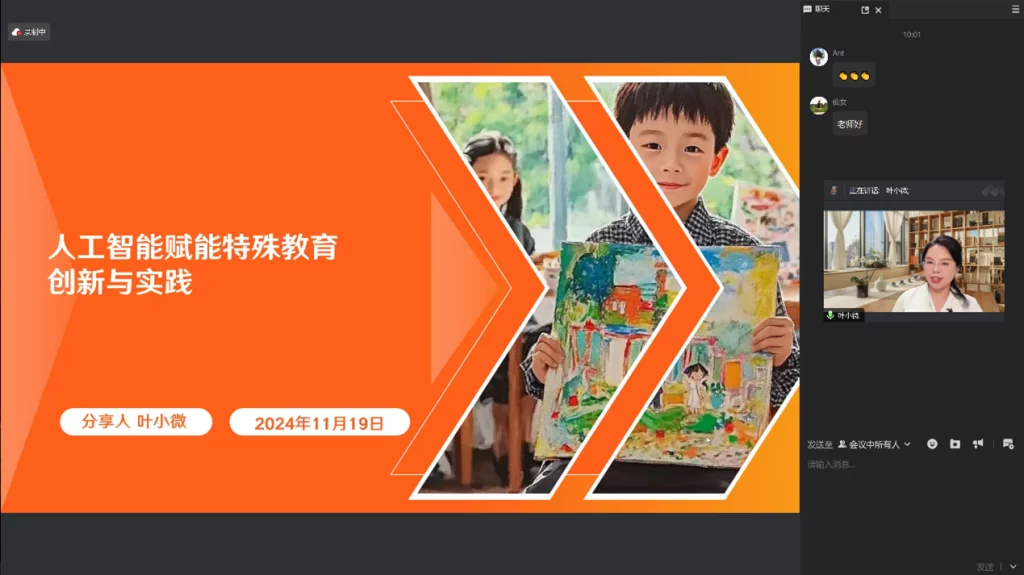
The slide is titled AI Empowering Special Education: Innovation and Practice and names Ye Xiaowei as presenter. The cover illustration shows children holding artwork; the speaker’s online video appears on the right. Its date differs from the report and official handbook; the caption explains the verified dates.
Article contents
AI tools in education
Ye introduced tools including Wenxin Yiyan, ChatGPT and Doubao, with particular attention to Kimi AI. The descriptions below reflect the 2024 session.
A closer look at Kimi AI
- 1) Long-text processing: handling lengthy inputs to help teachers work with substantial teaching materials and research literature.
- 2) Conversational continuity: the session described a memory capability that helped keep conversations coherent for sustained project work.
- 3) Versatile assistance: the report described uses across education and support for teachers’ everyday work.
These are experiences reported in 2024, not a guarantee of current features or teaching outcomes. Conversational continuity does not imply unlimited or cross-session memory.
Strategies for effective interaction with AI
Direct questioning
- 1) How to ask: formulate clear, specific questions, use relevant keywords, express requirements precisely, describe the expected kind of answer, and improve prompts through feedback and iteration.
- 2) Reported application: obtaining relevant information efficiently and refining teaching strategies.
Role-play and simulated dialogue
- 1) Multiple roles: ask AI to simulate a learner, teaching assistant or assignment-assessment assistant in realistic teaching situations.
- 2) Classroom application: explore learners’ needs and design personalized teaching plans to support learning.
Socratic questioning
- 1) Deeper examination: use a carefully sequenced set of questions to elicit more detailed analysis from AI.
- 2) Developing teaching strategies: support teachers’ reflection and critical thinking and help refine educational ideas and methods.
Developing a personalized teaching model
- Clarify learning goals: use AI to examine curriculum standards and teaching materials and relate goals to learners’ needs.
- Collect and select cases: use search and analysis functions to find relevant teaching examples and literature.
- Analyse learning information: the original report described using uploaded assessment results to examine learning characteristics and needs and develop differentiated teaching strategies. This is a historical account, not an instruction to upload identifiable student records.
- Build a theoretical framework: ask AI to help organize educational ideas and key elements into a teaching model appropriate to the teacher’s context.
- Visualize the model: generate mind maps and tables to make information easier to read and understand, then adjust and improve the model.
AI-supported Chinese-language lessons for learners who are deaf or hard of hearing
Supporting image interpretation and creation
- 1) Strengthen visual learning: translate abstract language concepts into concrete images to support learners who are deaf or hard of hearing.
- 2) Classroom example: generate images of scenes from classical Chinese poetry to help learners understand the poems’ settings and imagery.
Four classroom steps
- 1) Select or generate images: choose suitable pictures or create them with AI tools.
- 2) Upload and analyse: the session described submitting an image to AI to obtain a detailed visual description.
- 3) Observe and discuss: examine the image with learners and discuss its content to deepen understanding.
- 4) Write and express: guide learners to create their own work and use AI to help revise and improve expression.
Technology ethics in AI-supported teaching
- Respect laws and ethical norms: protect learners’ and teachers’ personal information and privacy and maintain a healthy online environment.
- Develop digital literacy: help learners understand the rules of digital life and develop computational thinking and a sense of responsibility in digital society.
- Attend to technology ethics: seek to prevent adverse effects on learning and development and avoid widening the digital divide.
Ye’s account illustrates possible applications of AI in special education and her aim of enabling learners who are deaf or hard of hearing to take part in digital change and enjoy varied learning experiences. She emphasized teachers’ responsibility, especially in special education, to help every child with special educational needs use digital resources appropriately, learn, develop higher-order thinking and take responsibility in digital society.
Course and replay
The original report provides a WeChat replay link and directs readers to the WeChat Channels account 全球智慧教育大会 (Global Smart Education Conference) to find the session recording.
Yuanzhuo course 2024-107: Digital literacy and innovative teaching
The Yuanzhuo course page currently displays “free”. Learning requires access under that platform’s login rules; consult its current lesson list. This page provides a written account; the full recordings and their captions have not been verified.
View the original QR image (historical illustration)

Sources and verification
Prepared from the official written report, retaining all five teaching themes and the four-step classroom process, with source, date and privacy notes. It is not a verbatim video transcript.
Original link: https://aiedchair.bnu.edu.cn/news-sli-yuanzhuo-ai-special-education-2024-en/