Wafangdian Wenhua Primary School piloted the Changyan system to support changes in lessons. The case describes how digital tools are used for feedback within a wider approach to academic, moral, physical, artistic and practical development.
Using iFLYTEK’s Changyan Smart Classroom across five areas of education
Wenhua Primary School, Wafangdian
[Abstract] With the further advancement of educational digital transformation, artificial intelligence technologies are being widely applied in education and teaching. This case illustrates how Wafangdian Cultural Primary School utilized iFlytek’s “Changyan Smart Classroom” system to promote classroom reform and innovation in talent development models. This approach enables the integration of digital technologies with the five aspects of education, thereby facilitating the healthy growth of students. Through this practice, the school has improved teaching efficiency and redefined the relationship between teaching and learning, providing valuable experiences for the development of smart education.
【Keywords】Open discussion in intelligent classrooms; Integration of five aspects of education; Practical research
Wafangdian City Cultural Primary School is a regular primary school located in a county-level city in Dalian, Liaoning Province. It was established in 1909 and has a history of over a hundred years. Through various changes and challenges, the school has accumulated a rich cultural heritage. The school has always adhered to the principle of putting students first, teachers as the key factor, and the classroom as the focus of its operations. Over time, it has developed many distinctive educational programs in areas such as moral education, intellectual development, physical education, art education, and labor education.
Entering the era of digital education, the school has seized new opportunities and promoted new reforms, moving forward on the path of digitalization and reform in education. In October 2023, taking the Smart Education Project in Wafangdian City as an opportunity, the school introduced the iFlytek Smart Classroom System. As a result, a smart classroom was established that covers 44 classes, 2,212 students, and 92 teachers. Technology was utilized to enhance classroom activities, and smart methods were employed to improve teaching quality, thereby further enhancing the overall educational and teaching standards of the school.
I. Breaking the Ice and Setting Off: Embracing Smart Education, Rebuilding the Educational Ecosystem
Faced with the new requirements of educational reform and the new opportunities presented by the development of information technology, our school has realized that the traditional teaching methods are no longer sufficient to meet the individualized and diverse needs of students. It is crucial for the school’s development to break through the limitations of time and space, enrich teaching resources, and innovate teaching methods. Smart education, with its strong data support, diverse forms of interaction, and flexible learning pathways, provides us with the key to solving these challenges. In October 2023, when the Smart Education Project in Wafangdian City was launched, we chose “Changyan Smart Classroom” as our practical platform. This choice was based on its ease of use, rich resources, and comprehensive functions, which are well-suited to the teaching characteristics of the primary school stage and the cognitive processes of students.
(1) Top-level design: Creating a new blueprint for intelligent education
The school leadership team attaches great importance to the development of smart education, considering it as the core factor that promotes the high-quality development of the school. We have established a smart education steering group, with the principal as the leader, including the vice principal in charge of teaching, professionals in information technology, and representatives of key teachers. This group is responsible for overall planning and coordination. Through multiple investigations and discussions, and taking into account the actual situation of the school, we have formulated a three-year development plan for smart education at Wafangdian Cultural Primary School. This plan emphasizes a student-centered approach, supported by technology, with the goal of integrating the five aspects of education. The plan includes not only the upgrade of hardware facilities, such as building high-standard smart classrooms, updating multimedia equipment, and improving the campus network environment, but also focuses on software-related efforts, including enhancing teachers’ digital skills, establishing smart teaching resource libraries, and exploring smart evaluation systems. We understand that smart education is not simply about installing various devices; it requires systematic planning and continuous investment. To this end, the school has allocated special funds to ensure the successful implementation of smart education projects. At the same time, we actively communicate with higher-level educational authorities to obtain policy support and resources, thereby creating a favorable external environment for the implementation of smart education. For example, in collaboration with the city’s education bureau, we participated in the “Central Electronic Education Center Pilot School” project for quality courses in 2025, sharing high-quality resources and exchanging practical experiences, thereby achieving mutual benefits.
(II) Comprehensive training to empower teachers with new abilities for intelligent teaching
The key to the success of intelligent education lies with teachers. In order to enable every teacher to effectively use the “Changyan Intelligent Classroom” for teaching, the school has organized multiple rounds and various levels of training activities that cover all teachers. The training content includes not only basic operations of the platform, such as resource uploading, lesson plan creation, and the use of interactive tools, but also focuses on the implementation of intelligent teaching concepts and the innovation of teaching methods. We have invited technical experts from the “Changyan Intelligent Classroom” and key teachers in the region to give lectures and conduct practical exercises at the school. At the same time, teachers with strong information technology skills in the school are encouraged to act as “seed teachers” to help other teachers grow quickly through mentoring. The training methods are diverse: there are both in-person sessions, as well as online micro-lectures, workshops, and teaching salons. We place great emphasis on the practicality and applicability of the training; after each session, practical tasks are assigned, requiring teachers to apply what they have learned in actual classrooms and share their experiences during teaching research activities. To assess the effectiveness of the training, the school regularly conducts assessments of the skills required for using the “Changyan Intelligent Classroom”. The results of these assessments are included in the teachers’ annual evaluations and awards system, which effectively encourages teachers to engage in learning and application. Data shows that after more than a year of systematic training, the proficiency of teachers in using the “Changyan Intelligent Classroom” has increased from less than 30% at the beginning to over 100%. The proportion of teachers who can use the intelligent classroom regularly for teaching has reached 100%.
(3) Creating an appropriate environment to establish an immersive smart learning space
The hardware environment is the fundamental foundation for smart education. In the construction of smart classrooms, our school strives to ensure both high-quality hardware and advanced software. In addition to basic facilities such as high-resolution interactive tablets, high-speed wireless networks, and student tablets (used in some classes as a pilot project), we also pay special attention to the flexible design and atmosphere of the learning spaces. The desks and chairs in smart classrooms are not fixed; they can be arranged freely according to teaching needs, enabling various learning modes such as group collaboration, whole-class interaction, and individual exploration. The walls around the classrooms are also utilized effectively, with electronic book corners, display areas for students’ work, and interactive message boards, making the space more technological and interactive. We also use the “Changyan Smart Classroom” function to create a learning community that combines online and offline learning. Students can access learning resources, share their achievements, and communicate with peers and teachers anytime, anywhere. This immersive smart learning environment greatly stimulates students’ interest in learning, allowing them to experience the benefits of technology in education. For example, in a Chinese language class on “Interesting Things in Space Life,” the teacher uses VR resources in the smart classroom to enable students to “experience” the space environment, thereby enhancing their sense of immersion and engagement in learning.
II. Deeply cultivate and refine: Explore new models of intelligent teaching
The school has implemented a smart teaching model based on a “three stages and six stages” teaching cycle (as shown in Figure 1). It provides a variety of resources for independent learning. Teachers provide targeted guidance through pre-class guidance, interactive activities during class, after-class assignments, extended tasks, and student support. Students, on the other hand, engage in efficient learning through effective notes, task lists, growth records, error correction, and independent exploration, thus achieving teaching that is tailored to the students’ needs.
(1) Before class: Analysis of students’ learning situations and provision of relevant resources
1. Intelligent Learning Situation Analysis System: Teachers can post preview tasks through the “Changyan Smart Classroom” platform (such as micro-lectures and learning guides). The system automatically collects students’ answer data and generates reports on their learning situations. For example, in the teaching of “Fraction Multiplication” in mathematics, the system shows that 85% of students can understand the basic concepts, while 15% have difficulty with the operation of “fraction multiplied by an integer”. Based on this, teachers can adjust the teaching focus and design differentiated exercises, thus achieving teaching that is tailored to the students’ needs.
2. Personalized resource delivery: The platform provides differentiated learning resources based on students’ academic performance. For example, students who have extra capacity are recommended with additional reading materials (such as “Stories about fractions in the history of mathematics”), while students who face difficulties in learning are given specialized micro-lectures (such as “Three-step method for multiplying fractions”). Practice has shown that personalized resources improve the effectiveness of previewing by 30%, and the relevance of classroom questions is enhanced by 50%.
(II) During classes: Intelligent interaction and collaborative exploration
1. Interactive teaching tools enhance classroom activities: Teachers use the “Changyan Tablet” to enable real-time interaction. In terms of group responses, during the teaching of “The Straw Boats Borrowed Arrows” in Chinese class, the teacher used the “Group Responses” function to launch a poll on “the key factors that contributed to Zhuge Liang’s successful borrowing of arrows”. Within 30 seconds, 200 responses were collected; the system automatically generated a word cloud, which clearly shows the distribution of students’ opinions. For visual explanations, during art classes, students take pictures of their works and upload them to the platform. The teacher can provide real-time feedback using the “Brush Marking” function. Excellent works are also displayed on the screen, thereby stimulating students’ enthusiasm for creation.
2. Group collaboration and project-based learning: Taking the science project “Production of Recycled Paper” as an example, students are divided into groups of four. They receive tasks through the “Chat Group” function (such as preparing raw materials, designing processes, recording data, and presenting results). The “AI Lab” on the platform is used to calculate the proportions of raw materials needed for recycled paper production. The “Virtual Laboratory” is utilized to simulate the paper-making process, thereby reducing practical costs. The groups present their recycled paper creations to the entire school via “Chat Live”, and the system automatically generates three-dimensional evaluation reports on aspects such as “innovation”, “practicality”, and “aesthetics”.
(3) After class: Hierarchical assignments and dynamic evaluation
1. Intelligent assignment system: The platform generates hierarchical assignments based on data related to students’ learning conditions in class. At the basic level, reinforcement exercises are provided for weak knowledge points (e.g., special problems related to “fractional multiplication” in mathematics); at the advanced level, interdisciplinary tasks are designed (e.g., “creating mathematical mind maps using recycled paper”); at the advanced level, exploratory projects are recommended (e.g., “investigating the amount of paper used by families in a week and developing strategies to reduce paper consumption”).
“Smart homework” is a distinctive feature of our school’s smart education system. The school has introduced the “Changyan Xiaoxue” system, allowing teachers to assign flexible and differentiated homework online. The system automatically corrects objective questions, and a personalized notebook for incorrect answers is generated. Students can submit their homework online and receive timely feedback, thereby having the opportunity to practice on those mistakes. Parents can use the system to get information about their children’s homework completion status and analysis reports on their children’s learning progress, enabling collaborative education between home and school. Data shows that after implementing smart homework, the average time required for students to complete their homework was reduced by about 15%, the quality of homework improved, and the pressure on parents in terms of homework assistance was significantly reduced.
In terms of “smart reading”, schools utilize the Liaoning Province’s primary and secondary school smart reading platform, which provides a wide range of picture books, stories, and science literature. Students can borrow and read these materials anytime, anywhere, using tablets or electronic reading devices in libraries. The platform also offers functions such as reading records, reading reports, and online discussions, which encourage students to share their reading experiences and develop reading habits. Some classes also carry out “AI-assisted reading” activities, where AI technology is used to read stories aloud to students, correct their pronunciation, and stimulate their interest in reading. The promotion of smart reading effectively expands students’ reading options and enhances their reading skills.
2. Dynamic evaluation system: A dual-track mechanism of “process evaluation + final evaluation” is established. In terms of process evaluation, the system records data related to students’ interactions in class, homework completion, and group collaboration, thereby generating a “learning ability radar chart”. For final evaluation, combined with final exam results, a “subject competency development report” is produced. In terms of the integrated evaluation of the five aspects of education, data related to moral education (such as points for the “CD-free action” initiative), physical education (such as tracking the number of steps taken during exercise), aesthetic education (such as uploading art works), and labor education (such as tracking household chores completed) are included in the comprehensive evaluation system, resulting in a “growth tree of the five aspects of education”.
III. Diversified practices to promote the integration of the “five aspects of education” and the improvement of overall competencies
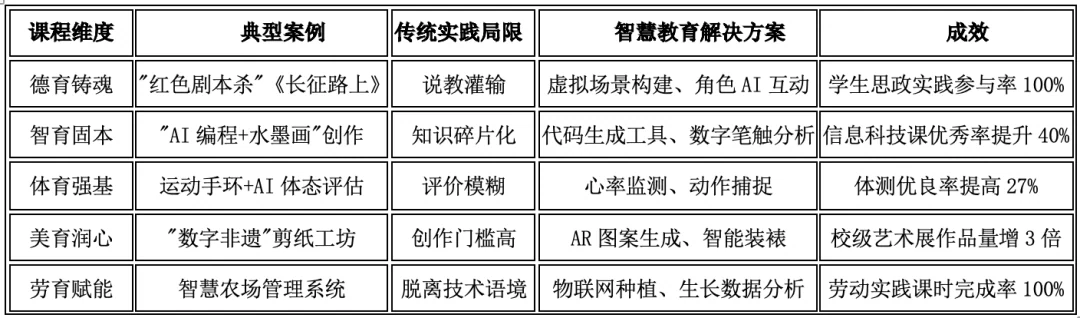
Read the table as text
| Area | Example | Limitation of prior practice | Digital approach | Outcome reported by the source |
|---|---|---|---|---|
| Moral education | On the Long March, a historical role-playing scenario | One-way instruction | Virtual settings and AI character interactions | 100% participation in practical civic and political education activities |
| Intellectual education | AI programming and ink painting | Fragmented knowledge | Code generation and digital brushstroke analysis | 40% increase in the share of excellent results in information technology |
| Physical education | Activity bands and AI posture assessment | Imprecise assessment | Heart-rate monitoring and motion capture | 27% increase in the share of good or excellent fitness test results |
| Arts education | Digital paper-cutting workshop on intangible heritage | High barriers to making work | AR pattern generation and smart mounting | Threefold increase in works submitted to the school art exhibition, as reported |
| Practical work education | Smart farm management system | Little exposure to technology in context | Connected cultivation and analysis of growth data | 100% completion of practical work lesson periods |
Table 1: Practical Approaches to Intelligent Education Integrating the Five Educations
Smart education not only transforms the methods of teaching and learning, but also serves as an important tool for promoting the integration of the “five aspects of education” and enhancing the overall quality of students.
(1) Moral education: Establish a system of “contextual immersion + behavioral profiling”
The “AI Moral Education Assistant” is developed to establish a database for students’ moral development through the identification of micro-expressions in classrooms and analysis of social networks. For example, in the “Traditional Festivals” course, the system can detect the level of empathy among students during discussions about showing respect for the elderly on the Double Ninth Festival, providing data support for joint efforts between schools and families.
The “Digital Citizen” development project was carried out. Using the virtual community function of the Changyan platform, students were organized to draft “Online Civility Guidelines”. The relevant videos won the third prize in the municipal legal education competition.
(II) Intellectual Education: Establishing a path of “AI-assisted learning + advanced thinking development”
The mathematics subject adopts a “Geometer’s Sketchpad + AI reasoning” approach. The system automatically records the students’ drawing trajectories, and a “Report on the Development of Spatial Imagination Skills” is generated. The correct rate of students in Class 3(2) in their tests on the recognition of three-dimensional figures increased from 68% to 92%. The lesson “Trying and Guessing” taught by Teacher Li Mei’s school participated in the 2024 Wafangdian City Primary and Secondary School Teachers’ Basic Skills Competition as a representative school from the alliance.
In science class, the “AI Scientist” program was implemented. Students designed an experiment on “campus noise control”. Using the platform, they collected sound wave data and built regression models. Three research reports were included in the city’s science and technology association’s collection.
(3) Sports: Establish a mechanism of “precise monitoring + personalized guidance”
In physical education classes, smart bracelets are used to monitor 15 various indicators such as heart rate and blood oxygen levels in real time. The “Exercise Load Warning Report” is generated automatically. Based on this information, teachers can adjust the pace of skipping rope lessons accordingly. As a result, the rate of sports injuries in the classroom decreased by 73%.
The “AI sports coach” system was developed, using motion capture technology to correct the posture during long jump exercises. The passing rate of sixth-grade students in standing long jump improved from 78% to 95%, and five students set new school records.
(4) Aesthetic education: Establishing a platform for “digital creation + cultural heritage”.
The “AI Intangible Cultural Heritage Workshop” was established. Students used the AR technology of Changyan Classroom to restore the art of paper-cutting, and created a digital scroll titled “Twenty-Four Solar Terms”. This project won an innovation award in a provincial art exhibition.
In music classes, the “smart composition” function is used. Students transform the ancient poem “Spring Dawn” into orchestral music. The AI automatically composes multiple versions of the works for students to choose from. This increases the efficiency of creation by 5 times. The lesson “Time is like a little carriage” taught by Teacher Jiang Huiyuan won the second prize in the 2024 Wafangdian City Primary and Secondary School Teachers’ Basic Skills Competition.
(5) Labor education: Establish a “project-based practice + data-driven empowerment” model
In the “Smart Farm” project, students use IoT devices to monitor the growth of crops. They use the Changyan platform to analyze data related to light and water conditions, and then develop optimization plans for tomato cultivation. As a result, the school’s self-sufficiency rate in vegetables increased by 40%. The lesson “Leaf Painting” taught by Teacher Huang Zhou won the second prize in the 2024 Wafangdian City Primary and Secondary School Teachers’ Basic Skills Competition.
The “Campus Carbon Footprint” project was launched. Students use Excel plugins to track water and electricity consumption, and AI systems provide energy-saving suggestions. As a result, 12,000 tons of water are saved each year. This initiative won first prize in the Youth Science and Technology Innovation Competition.
IV. Conclusion
Looking back on the implementation process of the “Smart Classroom with Qihang” system developed by iFlytek in schools, from the initial exploration to a more advanced stage, each step was the result of the efforts and wisdom of teachers and students. In terms of classroom teaching reform, traditional barriers were successfully broken down, and a smart classroom that is student-centered, interactive, and highly efficient was established. In terms of the talent cultivation model, digital technologies were utilized to integrate the “five aspects of education,” thereby enabling diverse development for students.
In recent years, under the support of higher-level authorities and various sectors of society, the Cultural Primary School has developed rapidly. The teaching environment has been continuously improved, and the facilities have been upgraded. The teaching staff possesses both moral integrity and professional expertise, resulting in significant educational achievements. The school has been awarded several titles, including “National Writing Education Experimental School”, “National Football Specialized School”, “Research and Experimental Base for the Development of Learning Abilities of Primary and Middle School Students by the Chinese Education Association”, “Model School for Basic Education Curriculum Reform in Liaoning Province”, “Model Moral Education School in Liaoning Province”, “Provincial Model School for Parent Schools in Liaoning’s Education System”, “Safe and Civilized School in Liaoning Province”, and “Model School for the “Hand in Hand Carbon Reduction Action” for Millions of Teenagers in Liaoning Province”. In the large-scale assessment for the graduating classes of primary schools held in Wafangdian City in July 2024, the average scores, the proportion of students achieving excellent results, and the proportion of students passing the exams in the three subjects of Chinese, Math, and English were all ranked first in Wafangdian City. In September 2024, during the Wafangdian City Primary and Middle School Athletics Games, our school achieved third place among urban primary schools……
However, the path forward also presents challenges. For example, some older teachers are slow to adopt new technologies, and the stability of the internet occasionally affects the continuity of teaching. In the future, schools will continue to improve and enhance their capabilities through more training and better technical support. This will enable smart education to flourish on campus, providing a solid foundation for the healthy development of students, and helping them move forward towards the goal of modernized education.
Original link: https://aiedchair.bnu.edu.cn/news-citlab-2247627206-3-en/