Historical academic article, first published on this website on 15 October 2024. Statistics, author roles and proposed systems retain their publication-era context.
QI Binbin (1), BAO Haogang (2), ZHENG Yafeng (3), LI Yanyan (1)
1. National Engineering Research Center for Cyberlearning and Intelligent Technology, Beijing Normal University, Beijing 100875, China.
2. Institute of Basic Education Research, China National Academy of Educational Sciences, Beijing 100088, China.
3. Center for Educational Science and Technology, Beijing Normal University, Zhuhai, Guangdong 519087, China.
Article contents
Abstract and keywords
Abstract: Learning environments underpin the digital transformation of education and changes in learning and teaching. Renovating and intelligently upgrading them, developing learner-centred intelligent learning environments, and delivering precisely targeted learning services are practical requirements for digital education and a high-quality education system. Addressing key questions in intelligent computing for learning environments, this article defines these environments through four dimensions: multimodal sensing and monitoring; recording and analysing learning processes across scenarios; modelling and recommending cross-setting learning scenarios; and constructing and supporting human–AI collaborative learning communities. Following the logic of data processing, model training and intelligent services, it proposes a framework covering physical environment renovation and data aggregation, data indicators and algorithmic models, and precise adaptive support and intelligent services. Scenario-based educational AI applications anchor implementation through cross-setting design and evaluation standards, learning environment computing engines, large-scale smart classroom monitoring platforms, and evidence-oriented demonstration at scale. The article also examines cloud–edge–device computing infrastructure, educational interpretability, human–AI collaboration and interaction design, and data security and privacy.
Keywords: intelligent learning environment; learner-centred; cloud–edge–device collaboration; intelligent education; digital transformation of education.
1. Introduction
The report to the 20th National Congress of the Communist Party of China called for promoting the digitalisation of education and building a learning society and country in which lifelong learning is available to all [1]. Digitalisation is becoming an important breakthrough for opening new pathways and creating new advantages in China’s educational development. Learning environments are foundational to changes in learning and teaching [2]. They are moving from traditionally enclosed campuses to internet-based environments extending from schools into homes and society [3]. For almost two decades, national policies have successively supported the Three Connections and Two Platforms initiative, large-scale Internet Plus Education platforms and new educational infrastructure, fundamentally improving schools’ digital facilities. Statistics cited in the article report more than 498,300 educational institutions of all levels and types [4], internet access in 100% of primary and secondary schools, including teaching sites, and over 5.8 million networked multimedia classrooms, approximately 68% of all classrooms. Yet this infrastructural advantage has not been sufficiently converted into momentum for educational reform. Coordination between schools, cultural and scientific venues and homes remains difficult, as does integration between local and remote and between offline and online learning, while personalised support is insufficient.
How to renovate and intelligently upgrade learning environments as a whole, place learners at their centre and deliver targeted services is therefore a practical question for digital education and a high-quality system. The New Generation Artificial Intelligence Development Plan calls for developing comprehensive multidimensional teaching environments and establishing learner-centred educational environments that deliver targeted services and customise everyday and lifelong education [5]. Breakthroughs are needed in physical environment sensing and monitoring, recording and analysing learning processes, modelling learning scenarios and delivering services, and connecting and supporting learning communities across settings and scenarios. Large-scale smart education monitoring platforms can help create ubiquitous learning environments that connect settings, centre on classrooms, integrate online and offline activity and intelligently perceive space. This can improve learning experience and performance, accelerate digital transformation and intelligent upgrading, and provide foundational technical support for high-quality education, Digital China and a strong education system.
2. What is an intelligent learning environment?
An intelligent learning environment upgrades a digitally enabled learning environment by placing learners and learning activities at the centre of renovation and development. It aims to create a human-centred intelligent environment with three characteristics.
(1) A human-centred environment focused on changes in learning in the intelligent age. Learning is understood as acquiring knowledge, skills and attitudes through collaborative construction with peers, teachers and interconnected agents in environments made up of the Internet of Things and intelligent tools [6]. Grounded in digitalisation and low-carbon development, the environment should be trustworthy, intelligently connected and integrated. Continuous upgrading should improve teaching and learning experiences and support human learning across settings and scenarios.
(2) An intelligent environment integrating three spaces. As an innovative application of new-generation AI in education, it contributes to digital education combining human society, the physical world and information space. Spatiotemporal features enable intelligent sensing and scenario modelling, supporting cross-setting behaviour analysis and adaptive services.
(3) An integrated environment that improves experience and performance across settings. Intelligent technology supports learning activities so that effective learning occurs, digital learning becomes meaningful and students develop. Innovative arrangements such as school–venue or base–home partnerships can foster coordinated education across families, schools and society.
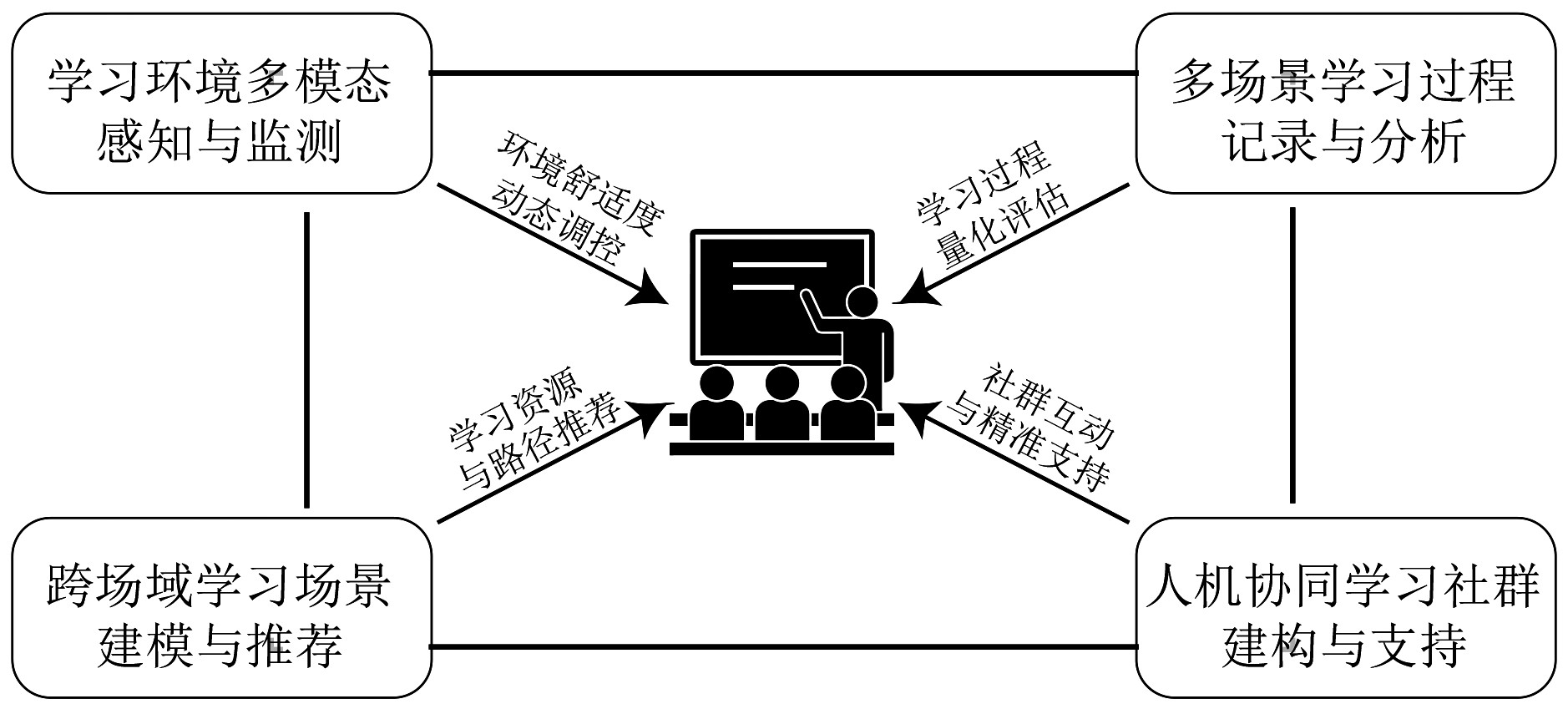
The intelligent learning environment focuses on learners’ activities. Figure 1 presents four core elements.
(1) Multimodal sensing and monitoring. Internet of Things technologies sense and control environments, improving comfort and reducing campus energy use while affecting teachers’ and students’ physical and mental health and the smooth operation of teaching. IoT systems and environmental sensors support edge-computing nodes that dynamically collect acoustic, lighting, electrical, temperature, humidity and network data in classrooms, laboratories, libraries and science museums. These form multimodal environmental state databases. Raw state data streams support dynamic representations and digital twins, allowing monitoring of spatial conditions, network quality and teaching equipment.
(2) Recording and analysing learning processes across scenarios. Compared with observation- and experience-based studies, process data offer a more objective and fine-grained basis for evaluating teaching and analysing behaviour. Standards and tools are needed to collect multidimensional data in multimedia classrooms, virtual environments and hybrid spaces. Non-interventionist, unobtrusive collection and aggregation should record multidimensional behaviour throughout learning. Multi-actor annotation can build information coding libraries for reading, discussion, practice and experiments. Cross-media computing can then recognise learning and teaching behaviours, track knowledge activation, engagement and peer interaction, and generate interpretable classroom observation records.
(3) Modelling and recommending cross-setting learning scenarios. Models combining setting and participant characteristics can represent homes, schools and venues, recognise complex activities and generate context-aware profiles of individuals and groups at different granularities. Across temporally ordered scenarios, the interests and potential intentions of learners and groups can be identified to recommend adaptive content and personalised learning pathways.
(4) Constructing and supporting human–AI collaborative communities. Specifications for collecting and measuring cognitive profiles should cover educational stage, prior knowledge, engagement, learning style and cognitive load, creating a multidimensional profile library. Interactions among learners, participants and environments can be identified, and community network topologies automatically drawn by combining spatiotemporal conditions, knowledge resources and cognitive behaviour. Expert knowledge and instructional interaction networks can underpin a human-in-the-loop [7] library of precise recommendations and interventions, supporting adaptive services across scenarios. Overall, integrating the environment’s core elements with intelligent technologies can create interconnected educational environments that support and optimise authentic, learner-centred activities in typical scenarios.
Expand the full text description of the figure
A classroom teaching and learning icon is at the centre. Four surrounding modules connect to it and are also connected around the outside. Each module and its inward support function are:
- Multimodal environmental sensing and monitoring → dynamic regulation of environmental comfort.
- Recording and analysing learning processes across scenarios → quantitative assessment of learning processes.
- Modelling and recommending cross-setting learning scenarios → recommendations of resources and pathways.
- Constructing and supporting human–AI learning communities → community interaction and precise support.
3. Framework design
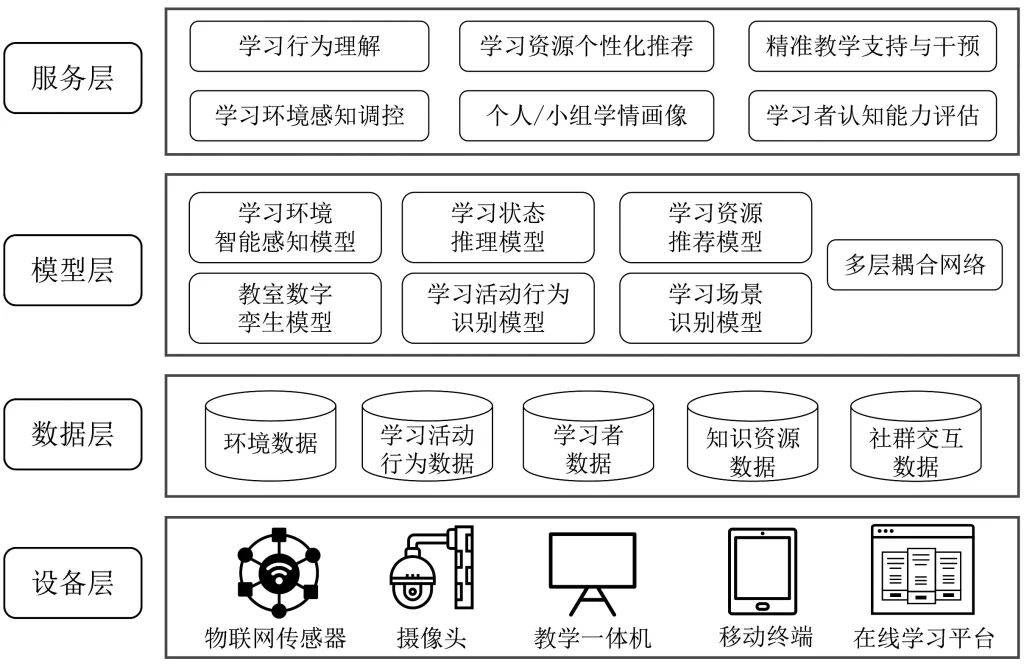
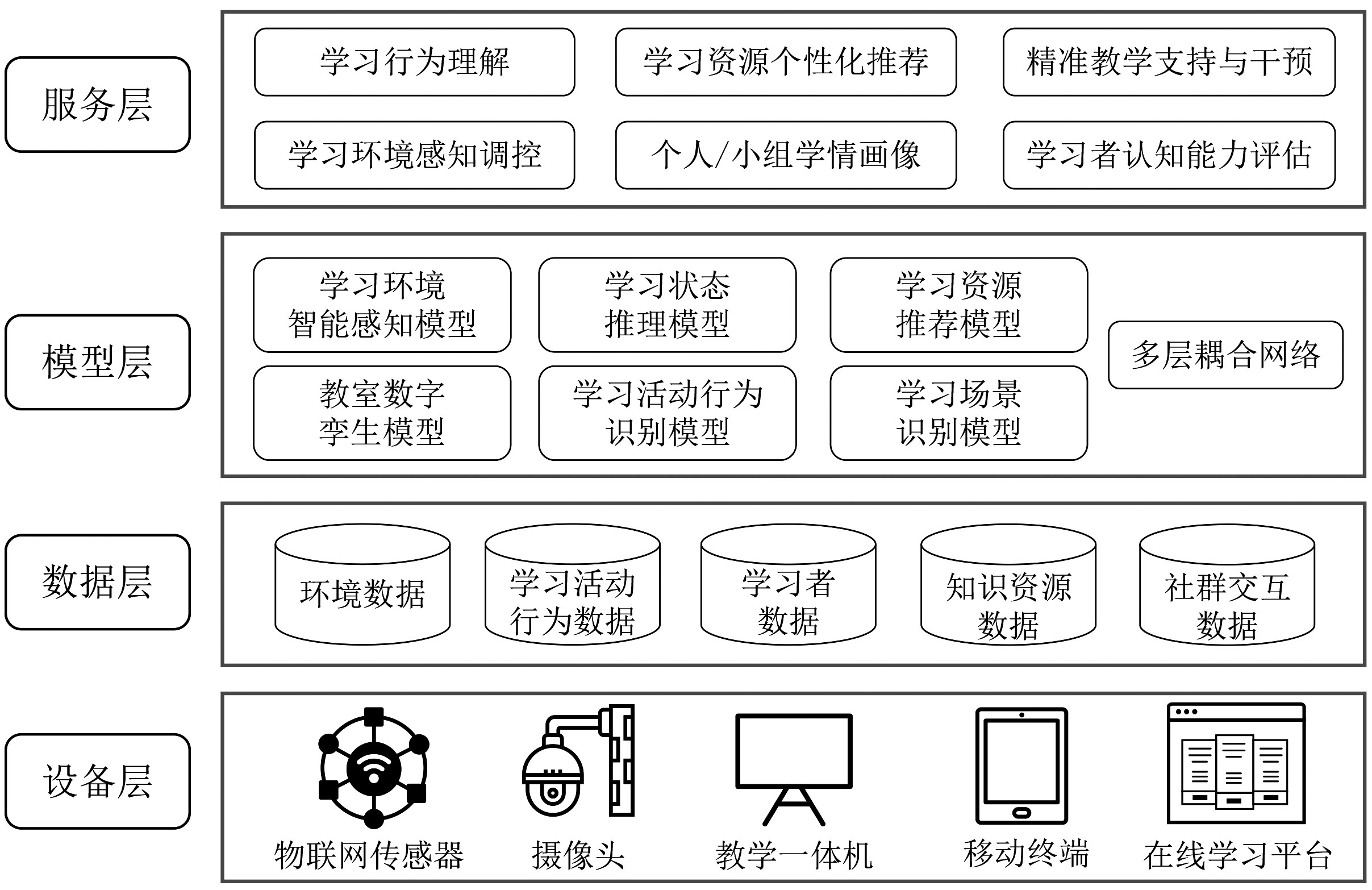
Data, algorithms and computing power are the three main elements of AI and are also central to high-quality, personalised intelligent educational services. The proposed framework includes device, data, model and service layers. Intelligent devices collect data; processing and analysis build indicator systems; algorithmic models are trained to provide personalised resources and support. Following data processing, model training and intelligent services, the framework is explained through physical renovation and data aggregation, indicators and models, and precise adaptive support and services, as shown in Figure 2.
Expand the full text description of the figure
From bottom to top, the figure contains device, data, model and service layers. Their modules are listed in the original top-to-bottom order below:
- Service layer
- Understanding learning behaviour
- Personalised learning resource recommendations
- Precise instructional support and intervention
- Sensing and regulating learning environments
- Individual and group learner profiles
- Assessment of learners’ cognitive abilities
- Model layer
- Intelligent environmental sensing model
- Learning state inference model
- Learning resource recommendation model
- Classroom digital twin model
- Learning activity behaviour recognition model
- Learning scenario recognition model
- Multilayer coupled network
- Data layer
- Environmental data
- Learning activity behaviour data
- Learner data
- Knowledge resource data
- Community interaction data
- Device layer
- Internet of Things sensors
- Cameras
- Integrated classroom teaching display
- Mobile devices
- Online learning platforms
3.1 Physical environment renovation and data aggregation
Collecting and recording learner and environmental data is a prerequisite. Existing multimedia classrooms, laboratories and practical training spaces need enhancement through IoT sensors, cameras and other intelligent sensing devices that collect environmental parameters and audiovisual data in real time. Edge nodes aggregate acoustic, lighting, electrical, temperature, humidity and network-equipment status indicators, together with physical features such as facility dimensions, materials and spatial layouts, to form environmental indicator sets. Offline behaviour sensing uses text, speech, images and video to annotate and extract gaze, movement, posture, facial expression, speech content and tone, combining modalities into learning activity datasets. Online platforms supply clickstreams, knowledge-browsing sequences and community interactions such as discussion, comments and sharing. Scales and questionnaires can measure prior knowledge, learning styles, psychological states and cognitive levels. These heterogeneous sources, including classrooms, platforms, audiovisual material, text and location, are cleaned and aggregated. Timestamps organise a data pool covering environments, learners, resources, activity behaviours and social networks.
3.2 Data indicators and algorithmic models
Object detection, multi-object tracking and attribute recognition can identify teachers, students and other objects in images and video. To address privacy, the article proposes person re-identification (ReID) [8] to locate the same person across cameras or video sequences without exposing facial features in spatiotemporal mining. Multi-scenario behaviour recognition models can then translate individuals’ multimodal data into learning and teaching sequences. Combined with classroom notes, questions and answers and facial expressions, these sequences can estimate activation of relevant knowledge and changes in engagement, teacher–student interaction and peer interaction.
Beyond classroom activities, online platform logs contain clickstreams, forum posts and assignment records describing individual learning and community communication. Their forms include text, audiovisual material, network relationships and spatiotemporal data. Login IP addresses and registration location information can indicate cities or campuses, while timestamps relate to video viewing and discussion. Knowledge resources such as syllabuses, handouts and MOOC videos contain entities and relationships for knowledge graphs within unstructured multimedia. Different modalities also reveal cognitive abilities, learning pathways and social interactions. For example, entity and relationship extraction can expose the topology implicit in teacher–student and student–student interaction networks. A graph can integrate spatiotemporal conditions, knowledge resources and cognitive behaviour, with nodes representing places, knowledge points or behaviours and edges representing spatial, knowledge or behavioural relations. Task-specific encoders and decoders enable learning and inference across scenarios. Graph neural networks (GNNs) capture node relationships and local features and analyse key nodes, community structures and propagation paths. Visualisations of dynamic multilayer coupled networks can help explain relationships and reveal hidden complex characteristics and patterns.
Scenario indicators, environmental features and activity-behaviour indicators can form multimodal datasets for schools, homes and social settings. Deep-learning object detection first identifies participants. Activity time series then support a long short-term memory network (LSTM) for recognising cross-setting learning scenarios and analysing stages and overall processes. Activity behaviours, cognitive profiles, peer interactions and knowledge activation allow multiscale profiles of individuals and groups, covering behaviour, achievement changes, method preferences and study habits. New performance data can regularly update these profiles, making them context-aware.
3.3 Precise adaptive support and intelligent services
Intelligent computation concerning physical environments, activity processes, learner profiles and communities can provide environmental monitoring and regulation, interpretable understanding of behaviour, adaptive resource recommendations, community support and instructional interventions.
(1) Environmental sensing models can regulate comfort dynamically. Multidimensional indicators should reflect the effects of lighting on visual health and noise on immersion. Edge nodes supply real-time acoustic, lighting, electrical, temperature, humidity and network streams for deep neural models. The models can adapt audiovisual encoding parameters to network conditions and predict and regulate indoor comfort in real time.
(2) Classroom observation rules and indicators can generate interpretable feedback. Individual activity sequences and scenario state sequences, combined with practising teachers’ experience and subject experts’ knowledge, underpin scenario-specific observation criteria. Methods such as the analytic hierarchy process can assess engagement, interaction, instruction and organisation, generating interactive, interpretable reports that help teachers and administrators improve strategies and classroom outcomes.
(3) Activity-aware learner profiles can personalise resources. Recognised cross-setting activities, individual and group profiles and the current scenario can generate prompts matching learner characteristics and preferences. In practical laboratory training, for example, adaptive recommendations can support lesson preparation and precise teaching. Guidance on experimental steps and warnings about errors offer interactive support for reflection and deeper understanding. Similarities and differences between learners can also guide group resources for shared learning and discussion, encouraging interaction and collaboration.
(4) Community network structures can support precise intervention. A multilayer coupled-network prototype lets educators cluster and explore community data to understand internal structures and processes. Community networks and an expert intervention library, including psychological learning support, peer support and joint family–school–community intervention [9], can form a trustworthy human–AI interaction loop and deliver support suited to particular teaching scenarios.
4. Implementation pathways
The overall framework, algorithms and intelligent services must be applied in real educational settings to support demonstration at scale. Four pathways are considered: cross-setting environment design and evaluation; event-driven learning environment computing engines; cloud–edge–device smart classroom monitoring; and evidence-oriented large-scale demonstrations.
4.1 Cross-setting environment design and evaluation
Scenario-based educational AI applications are central to renovating and enhancing cross-setting learning environments [10]. Scenario-driven innovation uses educational situations to guide technical breakthroughs, allowing technological supply and educational demand to evolve together [11]. First, investigate typical classroom instruction, collaborative learning and professional inquiry, laboratory training and online self-study. Analyse existing infrastructure and establish construction standards and technical guidance for upgrading traditional environments. Model learning events and activities, participants, devices and spaces as structured data. Second, identify learners’ behaviours, emotional changes, difficulties and needs at each stage to create learner-centred user journey maps [12]. Educational theory should inform adaptive service processes and the logic by which intelligent technologies support activities. Finally, invite teachers, students and experts to provide feedback and evaluation and refine designs through repeated iterations.
4.2 Event-driven learning environment computing engines
IoT devices, audiovisual sensors and online platforms are important data sources. Their behaviours or actions are defined as events, including sensor states, user operations and external service responses. A core model library should integrate environmental sensing, process recording, scenario recognition and community connections in an event-driven computing engine that detects behavioural and state changes across complex settings. Event-driven architecture (EDA) [13] uses publication and subscription to trigger and handle events, providing loose coupling, scalability and flexibility. Queues, schedulers, channels and handlers can respond to event types and attributes and proactively deliver services from event streams. A knowledge base for intelligent learning environment computing should also capture relationships and causality among environmental states, behaviour codes, cognitive profiles, learner profiles and support or intervention strategies. Entity descriptions and inference rules can then guide precise services across settings and scenarios.
4.3 Cloud–edge–device smart classroom monitoring platforms
A smart classroom monitoring platform centres on data computation and intelligent processing. Layered cloud–edge–device collaboration [14] allows cloud clusters, edge nodes and IoT terminals to participate jointly in sensing, learning and decision-making. At the device layer, Zigbee, LoRa and Wi-Fi support connections across manufacturers, devices and services. Edge gateways bridge IoT devices, learning terminals and the cloud, handling collection and preprocessing, protocol conversion, real-time analysis and decisions, remote monitoring and control. They coordinate sensing across edges and devices. When processing video keyframes, edge nodes can run AI models in local trusted execution environments or call cloud models, then upload results to a cloud time-series database. The cloud manages edge nodes and model training. Educational device models define properties, functions and events and register nodes and subordinate devices. Scenario data and digital resources support model training and large-model fine-tuning; cloud–edge messaging and distribution specifications enable cloud training and edge deployment. Large-scale platforms can integrate simulation design, state monitoring and efficiency evaluation, recording and analysing learners and environments throughout the process to provide adaptive support.
4.4 Evidence-oriented demonstration at scale
A cycle of design and development, implementation and validation, analysis and evaluation, and refinement should guide experiments or quasi-experiments. Control comparisons between feedback groups can examine differences in learning processes and outcomes and the effects of technologies and services, such as classroom record generation, recommendations and adaptive support, on student and teacher performance, including knowledge, practical skills and emotional motivation. This can reveal how technology supports learning, identify effective principles and strategies and provide interpretable evidence for learner-centred approaches. Optimised comprehensive multidimensional teaching environments should be used in practice. Traceability methods can clarify technologies’ key roles and actual assistance to learning and teaching. Activity theory and systematic instructional design can identify critical events and elements and factors influencing final outcomes. Existing educational theory can help explain the integration mechanisms and derive design principles for different scenarios. Regional demonstrations at scale can then validate the overall solution and educational effects, supporting cross-setting teaching services in large intelligent environments.
5. Key implementation challenges
Technological maturity, ethical risks and educational infrastructure constrain human-centred intelligent learning environments. Four challenges are examined: cloud–edge–device computing infrastructure; educational interpretability of models; human–AI collaboration and interaction experience design; and data security and privacy.
5.1 Cloud–edge–device computing infrastructure
Cloud–edge–device collaboration urgently requires renovation of existing education networks. Cross-setting applications depend on data, algorithms and computing power, and public computing capacity must support scenario-based educational services. Large-scale validation can draw on the national integrated computing service system to supply institutions dynamically with mixed, heterogeneous capacity for building, training and running models. Different scenarios require intelligent matching of computing, storage and data-transport resources and distributed coordination of computing and networks using multiple scheduling strategies. Edge nodes commonly provide CPU, GPU and NPU resources for inference, 3D rendering and video decoding. When local resources are insufficient, regional computing hubs can supply capacity across settings, meeting high-computation and low-latency requirements.
5.2 Educational interpretability of intelligent models
General-purpose analytical models do not transfer directly to teaching and learning behaviour. A single algorithm cannot handle complex educational scenarios and risks overgeneralising. Interpretability is therefore important: human analysis and decisions depend on background knowledge, so bridging human-understandable semantic space and data-feature space is essential [15]. Educational expertise should inform coding schemes for activities, scenarios and learning states, supplying prior knowledge for interpretable computation. Teaching activities should bridge low-level computer-recognisable features and higher-level educational meanings when core algorithms are developed. Visualisation and interaction can also explain the logic and operation of deep-learning black boxes [16], improve teachers’ and learners’ understanding of decisions and reduce distrust caused by opaque processes.
5.3 Human–AI collaboration and interaction experience design
Human–computer interaction and human-centred AI both aim to assist learning tasks and augment cognition, improving perception, thought, action and creation [17]. User interfaces and interaction mechanisms therefore deserve attention. Human-centred design principles should guide responses to exceptional events and learner-initiated activation in different scenarios, providing error messages and learning guidance. Usability and psychological and physiological indicators should evaluate whether experiences are comfortable, engaging and effective. In human–AI collaboration, learner characteristics and an AI system’s appearance and role influence perceptions and willingness to use it [18]. Activity flows, division of roles and emotional factors should help AI or pedagogical agents fit naturally into teaching and learning. Combining learner experience with AI-generated results can improve interaction task quality and efficiency.
5.4 Data security and privacy
Data, as a new production factor, is a strategic resource for future education. Intelligent environments collect and aggregate environmental, learner, activity, community and resource data, making responsible management and compliant use of public educational data assets particularly important. Data infrastructure needs clear responsibilities and boundaries and sound sharing and openness arrangements to enable trustworthy, efficient use across institutions and departments. Student and teacher privacy, the de-identification of sensitive data and compliance risks require close attention. Strict management systems and technical specifications should strengthen encryption and access control. Secure computation [19], privacy-preserving computing and federated machine learning [20], combining hardware and software, can support secure, compliant and effective multimodal data use while protecting privacy.
6. Conclusion
The urgent demand for high-quality education and the complexity and uncertainty of new information technologies, particularly AI, continue to challenge the integration of technology and education. Smart learning environments are an important foundation for digital transformation and innovation. Integrating core environmental elements with intelligent technologies, and advancing multimodal sensing, process recording, cross-setting scenario modelling and human–AI community support, can create learner-centred intelligent environments. The overall logic of data processing, model training and intelligent services encompasses physical renovation and aggregation, indicators and models, and precise adaptive support. Scenario-based applications, cross-setting design and evaluation standards, computing engines and large-scale monitoring platforms can promote educational AI at scale. These innovative applications offer technical support for personalised and lifelong learning and wider access to quality resources. They also contribute to networked, digital, personalised and lifelong educational systems and a learning society where everyone can learn anywhere and at any time.
Originally published in E-education Research, issue 10, 2024. For further republication, contact the journal’s editorial office at its official email: dhjyyj@163.com.
Suggested citation: QI Binbin, BAO Haogang, ZHENG Yafeng, LI Yanyan. A Learner-centered Intelligent Learning Environment: Connotation, Framework and Implementation Paths. E-education Research, 2024, 45(10): 72–78. DOI: 10.13811/j.cnki.eer.2024.10.010.
References
References retain their original citation languages, authors and numbering to support retrieval.
- [1] 中华人民共和国中央人民政府. 高举中国特色社会主义伟大旗帜 为全面建设社会主义现代化国家而团结奋斗——在中国共产党第二十次全国代表大会上的报告[EB/OL]. (2022-10-16)[2024-01-02]. https://www.gov.cn/xinwen/2022-10/25/content_5721685.htm. ↩
- [2] 黄荣怀. 智慧教育的三重境界:从环境、模式到体制[J]. 现代远程教育研究,2014(6):3-11. ↩
- [3] 李艳燕. 科技赋能教育创新:学习环境的变革与升级[J]. 人民论坛·学术前沿,2023(20):73-79. ↩
- [4] 中华人民共和国教育部. 2023年全国教育事业发展基本情况[EB/OL]. (2024-03-01)[2024-08-14]. http://www.moe.gov.cn/fbh/live/2024/55831/sfcl/202403/t20240301_1117517.html. ↩
- [5] 中华人民共和国中央人民政府. 国务院关于印发《新一代人工智能发展规划》的通知[EB/OL]. (2017-07-08)[2024-01-02]. https://www.gov.cn/gongbao/content/2017/content_5216427.htm. ↩
- [6] 黄荣怀,虎莹,刘梦彧,等. 迈向数字时代教学变革的基本理论:数字教学法[J]. 电化教育研究,2024,45(6):14-22,33. ↩
- [7] MOSQUEIRA-REY E, HERNANDEZ-PEREIRA E, ALONSO-RIOS D, et al. Human-in-the-loop machine learning:a state of the art[J]. Artificial intelligence review, 2023,56(4):3005-3054. ↩
- [8] YE M, SHEN J, LIN G, et al. Deep learning for person re-identification:a survey and outlook [J]. IEEE transactions on pattern analysis and machine intelligence, 2021,44(6):2872-2893. ↩
- [9] 武法提,高姝睿,田浩. 人机智能协同的精准学习干预:动因、模型与路向[J]. 电化教育研究, 2022,43(4):70-76. ↩
- [10] 中华人民共和国科学技术部. 科技部等六部门关于印发《关于加快场景创新以人工智能高水平应用促进经济高质量发展的指导意见》的通知[EB/OL]. (2022-07-29)[2024-01-02]. https://www.most.gov.cn/xxgk/xinxifenlei/fdzdgknr/fgzc/gfxwj/gfxwj2022/202208/ t20220812_181851.html. ↩
- [11] 张晓林,梁娜.知识的智慧化、智慧的场景化、智能的泛在化——探索智慧知识服务的逻辑框架[J]. 中国图书馆学报,2023,49(3):4-18. ↩
- [12] ALVAREZ J, LEGER P M, FREDETTE M, et al. An enriched customer journey map:how to construct and visualize a global portrait of both lived and perceived users' experiences?[J]. Designs, 2020,4(3):29. ↩
- [13] 汤小春,张克,赵全,等. 基于事件驱动架构的分布式流处理弹性资源分配策略研究[J]. 计算机学报,2023,46(2):244-259. ↩
- [14] YAO J, ZHANG S, YAO Y, et al. Edge-cloud polarization and collaboration:a comprehensive survey for AI[J]. IEEE transactions on knowledge and data engineering, 2022,35(7):6866-6886. ↩
- [15] 张钹,朱军,苏航. 迈向第三代人工智能[J]. 中国科学:信息科学,2020,50(9):1281-1302. ↩
- [16] 卢宇,章志,王德亮,等. 可解释人工智能在教育中的应用模式研究[J]. 中国电化教育,2022(8):9-15,23. ↩
- [17] SHNEIDERMAN B. Human-centered AI [M]. Oxford:Oxford University Press, 2022. ↩
- [18] 姜婷婷,许艳闰,傅诗婷,等. 人智交互体验研究:为人本人工智能发展注入新动力[J]. 图书情报知识,2022,39(4):43-55. ↩
- [19] ZHAO C, ZHAO S, ZHAO M, et al. Secure multi-party computation:theory, practice and applications [J]. Information sciences, 2019,476:357-372. ↩
- [20] WEI K, LI J, DING M, et al. User-level privacy-preserving federated learning:analysis and performance optimization [J]. IEEE transactions on mobile computing, 2021,21(9):3388-3401. ↩
Original published English abstract
Expand the original English title, authors, affiliations and abstract
A Learner-centered Intelligent Learning Environment: Connotation, Framework and Implementation Paths
QI Binbin 1 , BAO Haogang 2 , ZHENG Yafeng 3 , LI Yanyan 1
(1.National Engineering Research Center for Cyberlearning and Intelligent Technology, Beijing Normal University, Beijing 100875; 2.Institute of Basic Education Research, China National Academy of Educational Science, Beijing 100088; 3.Center for Educational Science and Technology, Beijing Normal University, Zhuhai Guangdong 519087)
[Abstract] The construction of learning environments is the foundation of the digital transformation in education and the transformation of learning and teaching methods. Promoting the renovation and intelligent upgrading of learning environments, constructing learner-centered intelligent learning environments, and realizing precise delivery of learning services are the realistic demands for the development of digital education and the construction of a high-quality education system. Focusing on the key issues of intelligent computing in learning environments, the connotation of intelligent learning environments is defined from four aspects: the multimodal perception and monitoring of learning environment, the recording and analysis of learning process in multiple scenarios, the modeling and recommendation of cross-disciplinary learning scenarios, and the construction and support of human-computer collaborative learning communities. Following the logic of "data processing, model training, and intelligent services", a framework was designed covering physical environment transformation and data aggregation, data index and algorithmic model construction, precise adaptive support and intelligent service. Taking the application of scenario-based artificial intelligence in education as a starting point, the implementation paths were proposed, which included the design and evaluation criteria for cross-disciplinary learning environments, the development of intelligent learning environment computing engines and large-scale smart classroom monitoring platforms, and the evidence-based large-scale demonstration applications. Finally, the key challenges for realizing intelligent learning environments were discussed, including cloud-edge-device computing infrastructure, the educational interpretability of intelligent models, human-computer collaboration and interaction experience design, and data security and privacy protection.
[Keywords] Intelligent Learning Environment; Learner-centered; Cloud-Edge-Device Collaboration; Intelligent Education; Digital Transformation in Education
Funding and author information
Funding: 2022 National Science and Technology Major Project for New Generation Artificial Intelligence, Key Technologies and Application Demonstration of Intelligent Computing for Learning Environments (project number: 2022ZD0115900).
Author information, as published in 2024: QI Binbin (born 1992), male, from Yancheng, Jiangsu, is an assistant research fellow with a doctorate, researching smart learning environments and virtual reality in education. Email: qidoublebins@163.com. LI Yanyan is the corresponding author; email: liyy@bnu.edu.cn.
Sources and reading notes
The text follows the Chair’s archived article. Figures 1 and 2 come from printed pages 73 and 74 of the journal’s official PDF. The original figure captions use smart learning environment. The technologies are research proposals and do not imply that this website deploys the described data collection or analytics.
Cross-setting refers to connections and transitions among schools, homes and other learning venues. Translations of the main text follow the Chinese meaning; the original published English abstract retains its wording in the appendix.
Original link: https://aiedchair.bnu.edu.cn/news-7826-en/