Historical academic article | Author: Fengchun Miao. Originally published in Open Education Research, 2024, 30(5), pp. 4–16; the Chair’s original posting date is 13 October 2024. This is the author’s scholarly interpretation, retaining its 2024 context; it is distinct from the Framework itself and from current policy guidance.
Fengchun Miao
Article contents
Abstract and keywords
Abstract: This article interprets UNESCO’s AI Competency Framework for Teachers. AI is gradually taking the technological form of human-like agents and helping construct a triangular pedagogical relationship among teachers, students and AI. Its challenge to teacher agency in human–machine interaction highlights the need for teachers to understand and uphold a human-centred mindset towards AI. The prevailing paradigm of technological production, which actively extracts human data to train AI models, accelerates the proliferation of ethical issues and the disruption and reconstruction of social relations in the AI era. AI ethics and social responsibility in an AI society have consequently become essential areas of teacher learning. As a pervasive foundational, general-purpose technology, AI has demonstrated its potential to transform production processes, social practices and ways of life. Teachers increasingly need to understand its basic operating principles, critically judge its appropriateness for education, and explore effective ways of using it to support teaching and professional development. Governments and educational institutions should therefore define teacher AI competency frameworks around rights-based, autonomous use by teachers, covering a human-centred mindset, AI ethics, AI foundations and application skills, AI–pedagogy integration, and AI-supported professional development. Training objectives, content and methods should be planned against the progression levels Acquire, Deepen and Create, helping teachers develop the competencies needed to use AI responsibly, effectively and innovatively.
Keywords: teacher AI competencies; teacher–student–AI triangular pedagogical relationship; human-centred mindset towards AI; AI ethics; AI foundations and application skills; AI–pedagogy integration; AI for teachers’ professional learning
Although scholars have not agreed on whether AI machines can acquire the status of a subject (张友恒, 2022), the educational use of technologies intended to simulate human thought and behaviour has already helped bring a teacher–student–AI triangular relationship into view, while presenting an increasingly explicit challenge to teacher agency. Protecting teachers’ rights and their agency in education and teaching has become urgent. Intelligent technologies commonly employ a production paradigm that actively seeks out and mines human data to train AI models. Their service relationships often entice or compel users to relinquish some or all data privacy in return for convenient services. This accelerates both the proliferation of ethical problems and the revision of responsive regulations, making AI ethics and social responsibility in an AI society compulsory learning areas for teachers whose own interests are directly involved. Generative AI has strengthened AI’s capacity, as a foundational general-purpose technology, to provide foundation models for changes in production, social practices and lifestyles. It has also brought the technology into a stage in which generated content is more stochastic and human–AI interaction demands greater judgement from people. Teachers therefore need new competencies for understanding how AI works and critically using it in teaching, assessment and professional development. Responding to these needs, UNESCO’s AI Competency Framework for Teachers, hereafter ‘the Framework’ (Miao, 2024), defines teachers’ values, knowledge, skills and practical capabilities across five aspects: a human-centred mindset, AI ethics, AI foundations and application skills, AI–pedagogy integration, and AI-supported professional development. It describes competencies at three progression levels: Acquire, Deepen and Create. [11] [5]
I. Why systematically define teachers’ AI competencies?
Compared with earlier generations of information and digital technologies, the integrated technological advances in AI over the preceding decade or more have profoundly affected education and other social sectors. Academic and policy communities need to examine these real effects systematically and define and develop teachers’ AI competencies with emerging teaching contexts in view.
1. Technological advances in AI and their profound implications for teacher competencies
In its basic technological form, AI is a category of technologies that uses programming to simulate human thought and behaviour, thereby directly challenging human agency. AI tools identify patterns by analysing large quantities of data about previous instances, and tend to substitute pattern-based predictions for human decision-making. Excessive promotion of AI, and misleading teachers into relying on it to replace decisions about teaching and learning management, can erode teachers’ pedagogical capabilities. To guard against AI encroaching on autonomous teaching decisions, teachers need stronger agency in judging and deciding whether and how to use AI, together with a human-centred awareness that AI should serve the development of human capabilities.
From the perspective of prevailing technological production relationships, developing AI by mining data to train models is a paradigm that is more aggressive towards human data and poses greater threats to privacy. Earlier information tools aimed to transmit and share information while responding passively to user operations. Data mining behind AI platforms, by contrast, involves unnoticed scraping and the active acquisition and exploitation of data without users’ permission. Providers’ default commercial arrangements entice or oblige users, when registering, to surrender a degree of privacy for training subsequent product iterations in exchange for access to current AI services. Information technologies had already generated privacy and security risks, but the more aggressive production and service relationships adopted by AI have triggered deeper ethical risks and can intensify social inequality. These highly contested relationships make it more urgent to enable teachers to understand and practise AI ethics and help students use AI safely and responsibly.
In terms of how outputs are generated, AI responses are characterized by limited explainability and greater stochasticity (苗逢春, 2024). In earlier information-technology workflows, the same input would trigger the same output, producing a deterministic response. With AI, particularly generative AI, identical inputs can produce different outputs or predictions. This greater stochasticity reduces the trustworthiness of generated content in education, especially for learning factual and conceptual knowledge. Faced with the technological black box of AI generation, teachers need basic knowledge of how AI works and deeper skills in critically using generated content under appropriate pedagogical principles. [6]
Regarding adaptability within complex problem spaces, AI has the capacity of a foundational general-purpose technology to provide general foundation models for different fields. Recent developments, particularly the foundation models offered by generative AI, support subsequent training for specific domains and the tuning of personalized models. This strong, dynamic adaptability is why AI is considered capable of transforming production and operating models, social practices and lifestyles. Given this growing transformative potential and countries’ successive entry into AI societies, it is vital to guide teachers in understanding AI’s social effects, develop their sense of responsibility as citizens of those societies, and motivate and support lifelong learning about AI.
Taken together, the practical effects and deeper implications of AI’s technological advances provide the theoretical and practical context for defining teacher AI competencies: a human-centred mindset, AI ethics, AI foundations and application skills, AI–pedagogy integration, and AI-supported professional development.
2. Protecting teachers’ rights and developing competencies within teacher–student–AI interaction
Before generative AI entered teaching, teachers and students were the two actors with agency in pedagogical interaction. As AI increasingly simulates human thinking, its educational use has encouraged a triangular relationship among three carriers of agency: teachers, students and human-like AI entities. In the longer term, this relationship may become an increasingly deep and complex interaction among teachers whose curriculum preparation, instructional design, teaching and assessment are strongly influenced by AI; students whose knowledge sources, thinking processes and presentation of learning outcomes are similarly influenced; and human-like AI entities pretrained on teacher and student data that operate as agentic pedagogical ‘subjects and objects’. AI has already shown advantages far beyond human capacities in processing vast bodies of literature and generating content across systems of symbolic representation. It has also demonstrated substantial practical value in capturing data beyond human sensory perception, identifying patterns, and assisting decisions and predictions.
However, insufficiently mature AI lacking legal and ethical oversight inevitably creates major visible and latent risks for students, educators, education systems and society. AI has already threatened, and may further weaken, human agency. Energy-intensive model-training paradigms have serious negative effects on the global climate. Model production based on data poaching has systematically infringed privacy on a large scale, while deliberately unrepresentative data and designers’ biases can exacerbate longstanding inequality and exclusion and generate new forms of algorithmic discrimination. In education specifically, AI may be designed and promoted on premises that devalue teachers’ educational contribution and influence and diminish the distinctive value of interpersonal relationships, reducing teaching and learning to computation and assembled automated tasks. An excessively narrow understanding and promotion of intelligent education risks a ‘pseudo-intelligent narrowing of education’: attention is confined to educational content that AI can process, teaching decisions that can be modelled, and teaching or tutoring functions that systems can perform. Broader educational values are neglected, including the development of individual thought and mind, social-emotional capabilities grounded in interpersonal interaction and social practice, and values rooted in local cultures.
The emerging triangle of teachers, students and human-like intelligent machines has also encouraged commercial intentions and educational proposals to replace teachers with AI. This threatens fundamental professional rights, including teachers’ rights to educate and teach, and makes it urgent for decision-makers to reconsider teacher roles and the AI competencies those roles require. The Beijing Consensus on Artificial Intelligence and Education (UNESCO, 2019) states that although AI offers opportunities to support teachers’ educational and pedagogical responsibilities, human interaction and collaboration between teachers and students must remain central to education. Teachers’ value cannot be replaced by machines, and their rights and working conditions must be protected. The Consensus explicitly identifies meaningful teacher–student interaction, individual capability development and human flourishing as core educational purposes. Ensuring that teachers are not replaced by AI, safeguarding their legitimate educational rights and supporting autonomous teaching constitute the policy position from which educational uses of AI and teacher competencies should be examined. From this position, education must further consider how teachers’ roles and capabilities should evolve to support ethical, effective AI use, and which competencies will help them adapt. The Framework accordingly defines teachers, both as citizens and as education professionals in an AI society, through the following roles and associated competencies: critically minded citizens of AI societies; co-creators of ethical rules and role models for AI ethics; co-designers of educational AI tools and intelligent learning environments; designers and facilitators of students’ AI-supported learning; and exemplars of lifelong learning about AI. [10]
II. Guiding principles: a human-centred social contract for human–AI interaction in education
Interactions among teachers, students and human-like AI agents are among the settings where machine agency and human agency generate the most varied applications through confrontation and cooperation. Ethical, effective and innovative educational uses of AI require human-centred rules to guide and constrain those interactions. These can be understood as a human-centred social contract for human–AI interaction. Drawing on a concrete explanation of this contract, the Framework proposes the following guiding principles.
1. A social contract for human–AI interaction towards an inclusive digital future
UNESCO’s 2021 Futures of Education report (UNESCO, 2021) calls for a new social contract for education grounded in fundamental human rights and principles of non-discrimination, social justice, respect for life, human dignity and cultural diversity. It also includes ethical commitments to care, reciprocity and solidarity. By defining and advocating principles for a social contract governing human–AI interaction, the Framework seeks to clarify and implement these proposals. As the UN system and national governments work towards a safe and inclusive digital future in the AI era (UN, 2024), such a contract is a necessary foundation of social understanding. The Framework interprets its operational principles as follows. [9]
1.1 Looking beyond commercial AI hype
The Framework guides teachers towards the basic understanding that AI is human-led. It makes explicit a fundamental fact about AI design and use: developers’ decisions determine whether, and to what extent, AI gains the transformative potential to protect human rights and enhance human capabilities. They also determine whether harmful intentions or unintended discrimination that infringe people’s beliefs or weaken their autonomy are embedded in systems. Teachers therefore need critical thinking about AI’s benefits and harms, and an awareness that ethics by design and effective ethical oversight are needed to ensure that AI serves individual capability development and social sustainability.
1.2 Understanding potential threats embedded in AI design
Prevailing AI development paradigms and content-generation methods have already caused serious and widespread visible harms and potential threats to human rights and privacy. Content generated from culturally dominant training languages can also harm Indigenous knowledge, cultures and languages. Teachers should understand how AI systems are designed and trained and how they operate, so that they can protect agency and advocate linguistic and cultural diversity when using them.
1.3 Preventing commercial profit-seeking from overriding human and social values
Profit-oriented algorithms induce addictive, highly persistent use, deepen digital immersion detached from the real world, and reinforce unreasonable distinctions and rankings between people, threatening values essential to being human and living in society. A social contract for human–AI interaction should protect and advance empathy, altruism, fairness, intercultural understanding and solidarity as they continue and evolve in the AI era. It should prevent AI from restricting relationships between people and their interactions with the world, while respecting non-digital and non-AI-mediated ways of living and learning.
1.4 Orienting AI use towards the development of human capabilities
Without sound pedagogical guidance, handing thinking and knowledge-construction processes over to generative AI weakens students’ thinking and harms the intellectual development of minors (苗逢春, 2024). Educational uses of AI should move beyond the misconception or low-level practice of merely supplying more information and standard answers. Instead, intelligent tools should stimulate and support inquiry and the development of problem-solving capabilities. [6]
2. A human-centred orientation towards AI values
The idea of a social contract for human–AI interaction is also expressed in UNESCO’s longstanding advocacy of a human-centred approach to AI. This approach has four core principles: AI design and use should enhance individual human capabilities and social sustainability; everyone should have equal and inclusive access to AI; AI promoted systematically should meet principles of explainability, safety, reliability and no harm; and selection, use and oversight should emphasize human control and accountability. Applying these values therefore entails the following operational principles.
1) Human accountability in AI use. Within teacher competency definitions, this principle means that AI tools should not replace teachers’ legally established authority over educational and pedagogical decisions. Teachers should decide whether, when and how AI is used in their teaching. It also means that policy-makers, teacher education providers and schools must first fulfil their responsibilities to train and guide teachers in appropriate AI use. Institutional accountability for training and support is a precondition for holding individual teachers accountable.
2) Inclusion in AI design and use. AI design and application often involve structural exclusion and discrimination. Teachers should recognize potential algorithmic discrimination. Within their teaching responsibilities, they should ensure inclusive AI use across genders, ethnicities, abilities, socioeconomic backgrounds and mobile or migrant populations, and deliberately design AI-supported activities that advance inclusive education and protect cultural diversity.
3) Exercising users’ rights to question AI explainability. Training should help teachers acquire knowledge and skills for understanding and critically evaluating AI tools, particularly their explainability and safety. Competency frameworks should, for example, provide opportunities to learn how AI produces responses or content, enabling teachers to assess a tool’s pedagogical appropriateness and contribute to consultation on its evaluation and selection.
4) Understanding human-controlled AI and participating in oversight. Teachers should recognize AI’s human-led nature and understand how designers’ decisions determine products’ effects on fundamental rights, dignity, social justice and environmental change. They should be able to assess designers’ intentions, improve their ability to identify risks, and provide feedback on tool improvement and harm control. Within their educational responsibilities, this enables them to benefit from AI while limiting its negative effects on students’ learning and health.
3. Advocating safe, trustworthy and environmentally responsible AI tools and uses
To put the social contract into practice, education authorities should first fulfil their regulatory responsibility to assess the safety and trustworthiness of educational AI systems before requiring teachers to comply with AI ethics rules. The Framework recommends that assessment systems at all levels fully apply ethics-by-design standards, rather than making teachers responsible for ethical governance beyond their remit. Assessment procedures should prioritize the following principles.
1) Enforcing the principle of no harm. Authorities should require review and validation of AI tools’ possible effects on fundamental rights, human dignity, and social and environmental sustainability. Admission mechanisms should ensure that only tools meeting risk-prevention and control standards enter education systems for trials or wider use.
2) Promoting environmentally responsible AI tools. The Framework emphasizes limiting AI’s environmental effects, particularly carbon emissions. Regulators should systematically review the environmental costs of training, deployment and use throughout a system’s lifecycle, especially the risks of irreversible environmental damage and worsening the climate crisis. Teachers also need knowledge and skills to estimate or monitor carbon emissions and energy consumption, and to guide students towards environmentally conscious AI design and use.
3) Assessing pedagogical appropriateness and inclusion. Assessment mechanisms should establish the intrinsic suitability of AI systems for educational purposes, with particular attention to adaptability for teachers and learners with special needs. They should prevent systems with discriminatory design purposes from entering education and protect students’ privacy and sensitive data. Age appropriateness and pedagogical suitability should also be examined before AI tools are promoted for use.
4) Establishing human accountability for AI providers. The Framework advocates helping teachers learn about human accountability and understand that technology providers and education authorities involved in development must bear legal and social responsibilities for transparency, explainability, system robustness and the potential consequences of use.
4. Transferable AI competencies for complex contexts and technological change
Competency frameworks and training should consider both continuity and technological advances between digital technologies and AI. They should help teachers connect digital educational practice naturally with teaching in the AI era, starting from their own educational needs. Building on the teacher roles discussed above, the Framework systematically identifies transferable value frameworks, conceptual knowledge structures with explanatory power across contexts, and adaptable foundational skills needed to fulfil teaching responsibilities.
1) Critically minded citizens of AI societies. The Framework identifies and explains a progression of core values and critical attitudes concerning human agency, human accountability and social responsibility in the AI era. It interprets these concepts at individual, institutional and societal levels and illustrates typical attitudes and behaviours guided by them. It also introduces the concept of citizenship in an AI society.
2) Co-creators of ethical rules and role models for AI ethics. The Framework summarizes and defines six core principles of AI ethics and the underlying ethical conflicts, the knowledge and skills for safe and responsible AI use, and the integrated competencies needed to develop rules collaboratively.
3) Co-designers of educational AI tools and intelligent learning environments. The Framework goes beyond training in operating commercial tools. It advocates brand-independent and platform-independent conceptual knowledge, transferable methods and skills, and teachers’ ability to evaluate and use open-source tools and resources critically. It supports understanding how data and algorithms train models and how systems generate outputs and responses; guides evaluation of tools’ ethical compliance and pedagogical appropriateness; and strengthens transfer through variations in tasks and contexts. Teachers are also encouraged to make tools and tune models to meet educational needs.
4) Designers and facilitators of students’ AI-supported learning. Starting from the basic teaching needs of their field or subject and local learning and technological conditions, teachers should understand how pedagogical principles inform decisions about whether, when and how to use AI in instructional design. They can progress towards designing AI-supported learning and social-emotional interaction and creating scenarios for open learning spaces. The Framework deliberately encourages examination of frontier questions: whether future AI development will challenge existing pedagogical principles or stimulate new teaching approaches. It invites teachers to explore reciprocal interactions between pedagogy and AI on a human-centred basis.
5) Exemplars of lifelong learning about AI. Through motivation for lifelong learning, self-assessment of AI competencies, and AI-supported improvement in subject knowledge and pedagogical understanding, the Framework guides teachers in learning and practising how AI can support individual development, mutual assistance and cooperation, and collaborative professional learning at an organizational level.
5. Motivating and supporting lifelong teacher professional learning in the AI era
Professional development is a lifelong learning process throughout teachers’ careers. Rapid technological iteration, increasingly differentiated ethical issues and complex, changing educational applications make the attitudes and capabilities for lifelong learning particularly urgent. The Framework advocates the following measures to support continuing learning and practice in educational AI use.
5.1 Providing graduated guidance for individual AI competency development
The three progression levels provide a navigational structure for self-assessment and assessment by others. They also incorporate training methods and suggestions appropriate to particular AI topics and objectives, helping teachers develop integrated competencies within each module step by step according to their professional backgrounds and responsibilities. They encourage transferable conceptual frameworks and confidence in learning new tools and understanding new technologies’ pedagogical, ethical and social implications.
5.2 Encouraging continuing reflection and improvement through theory and practice
The Framework recommends training through case analysis, reflection on teachers’ own practice, and internalization of values and understanding. It also encourages a spiral of lesson or learning-plan design, implementation of teaching and learning activities, reflection, redesign and continuing improvement. Depending on their existing capabilities, teachers can progressively integrate theory and practice in particular AI fields and their educational applications, developing both together.
5.3 Strengthening coherence across pre-service education, in-service training and school support
The Framework proposes integrated design or reorganization of pre-service education, in-service training, continuing peer mentoring and systematic school support. This would provide connected guidance across career stages and coordination among training institutions. It also emphasizes agile learning, peer mentorship, professional communities and institutional capacity-building in teachers’ lifelong learning.
5.4 Adapting curricula, assessment and teacher policies to encourage educational AI use
Effective, motivating policies should address systemic barriers to teachers’ AI practice: a lack of time or motivation because of other pressing non-teaching burdens, insufficient theoretical knowledge and practical guidance, and inadequate school infrastructure. Alongside providing the necessary digital and AI-supported teaching conditions, schools should reduce unnecessary workloads and ensure time and funding for professional learning. They should consider recognizing effective and innovative AI use in performance appraisal. At a broader policy level, administrators should examine whether existing curricula and assessment systems fundamentally constrain the development goals and teaching approaches needed in the digital and AI eras, and make suitable adjustments following careful deliberation and consultation.
III. A two-dimensional framework and competency modules: defining and developing teacher AI competencies through a human-centred approach
The Framework constructs a competency matrix along two dimensions. A human-centred mindset informs module definitions that are both sufficiently general and adaptable to specific contexts.
1. A two-dimensional AI competency framework guided by a human-centred mindset
The first dimension comprises competency aspects: the interconnected values, attitudes, knowledge and skills teachers need for ethical and effective educational AI use. Five aspects are covered: a human-centred mindset, AI ethics, AI foundations and application skills, AI–pedagogy integration, and AI-supported professional development. A human-centred mindset is the central guiding idea and foundational way of thinking for defining and developing the other elements. Each aspect has its own domain characteristics, while remaining organically connected to the others through complementarity, theoretical interdependence and practical cooperation. For example, the effectiveness of pedagogically guided AI use depends on teachers’ critical understanding of AI’s strengths and limitations, ethical principles and especially its foundations. Understanding ethical dilemmas and principles, in turn, depends on knowledge of model training and how AI works, together with practical experience and application skills.
The second dimension concerns the development of internal capabilities and observable behaviours that teachers can achieve across the five aspects with training and school support. The three progression levels—Acquire, Deepen and Create—provide graduated benchmarks for development. Progress across aspects may be asynchronous and non-linear. Some teachers may have third-level knowledge and operational skills while remaining at the first level in their mindset, ethical understanding or AI–pedagogy integration. Some humanities teachers may, after training, progress linearly to the third level in other aspects while their operational skills remain at the first or second. The five aspects and three progression levels form fifteen competency modules, shown in Table 1.
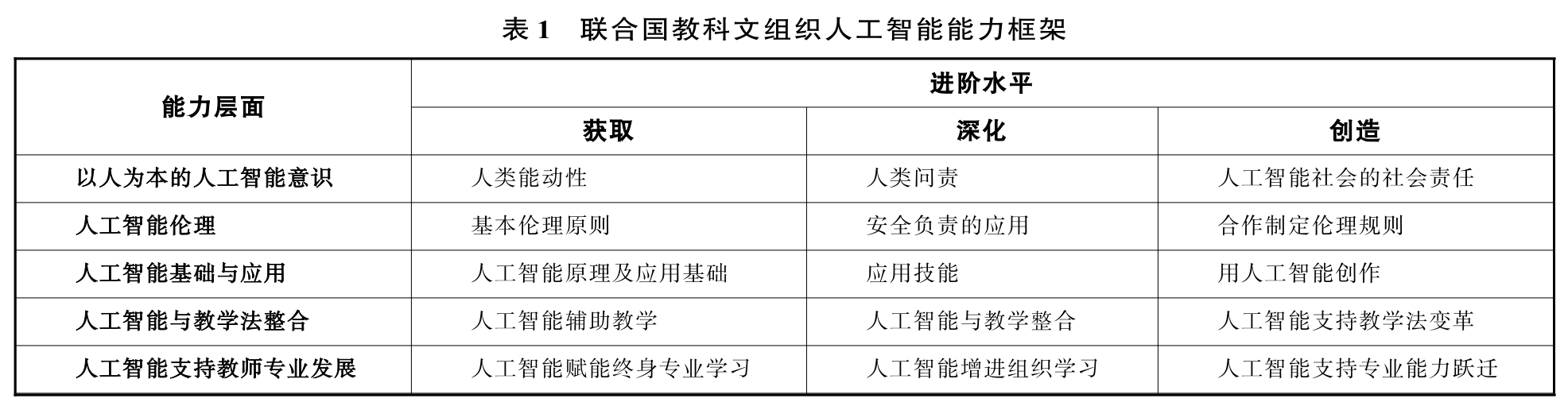
Text version of the table — Table 1 | Five competency aspects and three progression levels
| Competency aspect | Progression level | ||
|---|---|---|---|
| Acquire | Deepen | Create | |
| Human-centred mindset towards AI | Human agency | Human accountability | Social responsibility in an AI society |
| AI ethics | Basic ethical principles | Safe and responsible use | Co-creating ethical rules |
| AI foundations and applications | AI foundations and basic applications | Application skills | Creating with AI |
| AI–pedagogy integration | AI-assisted teaching | AI–teaching integration | AI-supported pedagogical transformation |
| AI-supported teacher professional development | AI-enabled lifelong professional learning | AI-enhanced organizational learning | AI-supported professional transformation |
2. Competency modules: defining core concepts and mapping their relationships
As AI progressively permeates education, competency frameworks must both adapt and redefine established concepts—human agency, teachers’ educational responsibilities, social responsibility, ethics and instructional design—and assimilate new interdisciplinary concepts emerging from AI–education interaction. The Framework’s matrix illustrates a conceptual mapping, definition and relational portrait of old and new teacher AI competency concepts within educational contexts. Its purpose is to inspire approaches to human-centred competency development rather than to delimit teachers’ AI capabilities.
2.1 Competency modules at the Acquire level
Acquire is the level all teachers should reach through training or school support: the entry point to learning about AI and the initial stage of practice. It combines the basic competencies needed to evaluate, select and use AI effectively and ethically in teaching. This can be understood as general AI competencies for all teachers, providing a necessary foundation for further progression and practical use. At this level, teachers begin acquiring and applying basic knowledge and skills, gradually understanding AI-related human rights, social justice and human values, and using these to identify educational benefits and risks of specific tools. They should understand basic ethical principles, AI’s human-led technological nature and people’s critical roles in its development and use. They acquire basic operating capabilities, begin to understand AI’s positive and negative effects on teaching processes and outcomes, and design activities supported by common tools. The Framework defines the following modules at this level.
1) Human agency. Teachers develop a critical understanding that AI is human-led and that corporate and individual decisions by its developers profoundly affect users’ autonomy and rights. They cultivate an awareness of upholding human agency when evaluating and using AI.
2) Basic ethical principles. Teachers gain an initial understanding of typical ethical conflicts and foundational knowledge of principles for human–AI interaction, including protecting fundamental rights and human agency, advancing linguistic and cultural diversity, and promoting inclusion and environmental sustainability.
3) AI foundations and basic applications. Teachers acquire foundational knowledge: definitions of AI, how models are trained using data and algorithms, and major AI categories and examples. They develop basic skills in examining a tool’s pedagogical appropriateness against AI principles and operating tools that have passed admission review.
4) AI-assisted teaching. Teachers can identify whether a particular tool can support subject-based curriculum planning, lesson design, teaching and assessment. Through design and implementation, they can develop the educational potential of approved tools while avoiding possible risks.
5) AI-enabled lifelong professional learning. Teachers can use AI for their own development and reflection, beginning to analyse professional learning needs and plan personalized learning pathways with its support.
2.2 Competency modules at the Deepen level
Deepen is the level of a leading teacher in this field that all teachers should work towards following systematic training and school support. Teachers at this level integrate AI proficiently into educational practice and fully uphold human accountability for safe, responsible use. They understand and follow national or local policies, protect safety, privacy and stakeholder rights relating to tools and generated content, and critically evaluate particular tools’ ethical effects. They lead advocacy for fairness, inclusion and diversity in design and use, understanding that design-stage decisions are prerequisites for users’ ethical practice. They can identify, evaluate, select and operate appropriate tools to improve teaching and learning, skilfully apply human-centred pedagogy, and strengthen individual and organizational professional learning. The Framework defines the following competencies.
1) Human accountability. Teachers understand human accountability and judgement in appropriate deployment and use more deeply. They critically assess risks and principles of AI-assisted decision-making and can challenge exaggerated technological claims and promotion of AI as a substitute for people in high-stakes educational decisions.
2) Safe and responsible use. Teachers internalize basic ethical rules, including privacy protection, intellectual property and other relevant laws, and habitually integrate these into evaluating and using tools, data and generated content in education.
3) Application skills. Teachers possess the knowledge and skills to operate and use AI proficiently in educational contexts. They deepen understanding across AI categories and practical skills, including those relating to algorithms, in ways appropriate to their responsibilities and educational backgrounds, integrating ethics into practice.
4) AI–teaching integration. Teachers apply AI in designing and facilitating student-centred learning in ways consistent with their subject, learners’ cognitive capabilities and broader needs. They use it to encourage engagement, support personalized learning according to abilities and interests, strengthen teacher–student interaction, and deliberately cultivate empathy, critical thinking and problem-solving.
5) AI-enhanced organizational learning. Teachers confidently use AI to tailor participation and professional learning plans within communities and collaborative development. This includes sharing resources through relevant tools and platforms, peer mentoring and mutual support, and dynamically adjusting learning plans.
2.3 Competency modules at the Create level
Create describes the expected capabilities of expert teachers in educational AI use. They critically understand AI’s social effects and their responsibilities as citizens of AI societies. They actively participate in discussion and development of educational policies and ethical principles; combine or improve tools, or tune systems, to create toolkits and customized solutions to educational challenges; and critically evaluate a broader range of systems in teaching and learning. They explore contexts where AI can provide open learning spaces and approaches. They also use it to support continuing development or potential professional transformation, combining tools to meet communities’ ongoing learning needs. For this exploratory, innovation-oriented level, the Framework offers the following forward-looking definitions.
1) Social responsibility in an AI society. Teachers develop critical views of AI’s effects on social rules and moral norms. Guided by these views, they participate in imagining and building safe, inclusive AI societies, particularly advocating design and use that enhance human well-being, inclusion and justice.
2) Co-creating ethical rules. Through communication, examination of conflicting scenarios and empathetic perspective-taking, teachers lead public attention to ethical issues and understanding and implementation of principles and regulations. Through focused discussions and collaborative oversight, they advocate addressing ethical risks, sociocultural harms and environmental concerns from the design stage, and participate actively in developing rules for educational AI use.
3) Creating with AI. Teachers proficiently apply conceptual knowledge and operational skills to develop tools that address real problems or create inclusive AI-supported learning environments, for example by improving open-source tools or adapting AI systems.
4) AI-supported pedagogical transformation. Teachers critically evaluate AI’s effects on teaching, learning and assessment. They plan and facilitate immersive AI-supported learning contexts for subject learning, interdisciplinary competencies, critical thinking, problem-solving and other learning and practical activities. Using data-based analysis and feedback on learning processes and outcomes, they continue to explore the frontiers of interaction between AI and pedagogical change with a critical, open mind.
5) AI-supported professional transformation. Teachers adapt and improve AI tools for professional development and continually investigate and validate effective ways in which AI can stimulate and support transformative growth in their own and their professional communities’ capabilities.
3. Module objectives, topics and training methods, and competency profiles across modules
The five aspects cover typical domains of human learning: developing values; social-emotional learning; internalizing ethics; understanding and investigating AI concepts; learning operational skills and undertaking projects; developing tools; theoretically understanding AI–pedagogy integration and transferring it into practice; and technology-supported collaborative professional learning for individuals and organizations. These include both well-structured knowledge systems and ill-structured problem situations. Defining goals and expected performance for teachers with different starting points is still more complex. For each module, the Framework explains the expected ‘specifications’ of training courses and school-based learning plans, including objectives, the scope and depth of topics, and training methods. Development matters in practice only when expressed in planning and implementing teaching, designing and supporting learning, and assessing outcomes and feedback. Its contextual activities therefore portray expected changes in attitudes and behaviour at particular competency levels. Teachers’ settings vary enormously across countries, regions, subjects and grades. Explanations and examples allow for this diversity, leaving room for localized development and application. Table 2 outlines the components used to describe modules, their intentions and their relationships.
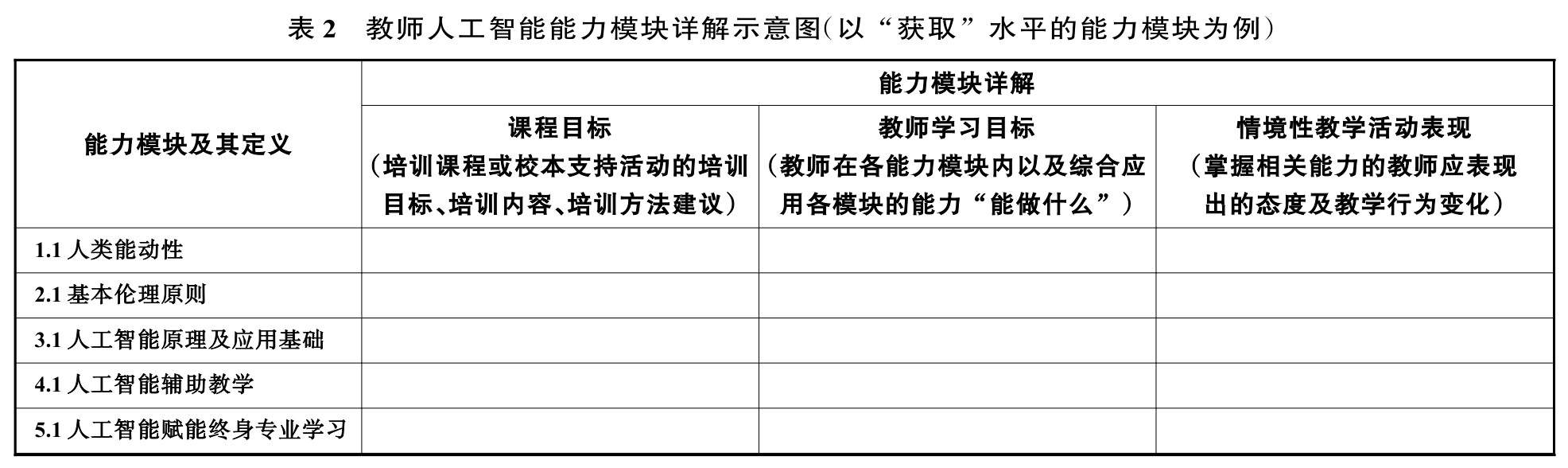
Text version of the table — Table 2 | Schematic structure for describing Acquire-level modules
The original Table 2 illustrates a descriptive structure, not a completed training plan. Its five rows and three description columns contain 15 deliberately blank cells. These are preserved; no training content has been invented.
| Competency module and definition | Module description | ||
|---|---|---|---|
| Curriculum goals: objectives, content and suggested methods for training or school-based support | Teacher learning objectives: what teachers can do within and across modules | Contextual teaching performance: expected changes in attitudes and teaching behaviour | |
| 1.1 Human agency | |||
| 2.1 Basic ethical principles | |||
| 3.1 AI foundations and basic applications | |||
| 4.1 AI-assisted teaching | |||
| 5.1 AI-enabled lifelong professional learning | |||
3.1 Module-specific curriculum goals that reflect relationships across modules
Curriculum goals are recommendations for designing systematic teacher training. From the perspective of curriculum planners and providers, they define competency-development objectives, essential topics and appropriate methods. Methods are adapted to the characteristics of values, social-emotional learning, ethics, AI principles, operational skills, and application in teaching and professional development. For a human-centred mindset, the Framework recommends perspective-taking through conflicting dilemmas. For AI ethics, it suggests scenario-based identification of sources of ethical disputes, understanding principles and internalizing ethical rules. For conceptual knowledge, it recommends inquiry into simulated problems and building and updating concept maps around specific tools. For operational and creative skills, it proposes tool-development projects based on simulated tasks and transfer exercises using task variations. For AI–pedagogy integration, case analysis, teaching or learning design, implementation and reflection support a spiral connecting theory and practice. For professional development, self-directed and peer-supported learning follow a sequence of self-assessment, motivation, tool selection and critical use.
3.2 Learning objectives defining module mastery and integrated application
Learning objectives describe professional learning outcomes directly for teachers, specifying what those with particular module competencies and the ability to combine them can do. They clarify core concepts, cross-module connections and progressively deeper relationships along dimensions running from individual to institutional actors and across the lifecycle of AI design, development, use and oversight. For practitioners, expected learning also means transferable capabilities in educational work. Objectives therefore show how a human-centred mindset shapes learning in other aspects, how ethics guides tool evaluation and selection, and how understanding AI principles in turn supports deeper internalization of ethical principles.
3.3 Contextual activity profiles illustrating whole-person capabilities in teaching
In actual teacher development, modules form an interconnected, indispensable combination of whole-person capabilities. Mastery of individual modules and the ability to apply them together jointly determine teachers’ attitudes and behaviour in different contexts. The Framework accordingly describes attitudinal changes and practical performances that are close to teaching practice and readily understandable to teachers.
IV. Practical implications of a teacher AI competency framework for China
China’s Teacher Digital Literacy standard, issued by the Ministry of Education in 2022 (教育部, 2022), approaches technology as a continuum and recommends integrated AI use in dimensions including digital educational resources, technology knowledge and instructional design. Building on that continuum, UNESCO’s Framework places greater emphasis on technological advances in AI and their effects on interaction among teachers, students and human-like AI agents, using these implications to define teacher competencies. It has the following practical implications for China. [2]
1. Combining risk classification with detailed governance to create safe, trustworthy AI environments
1.1 Classifying AI safety risks and clarifying boundaries for educational use
Schools and classrooms should not become testing grounds for AI tools with unknown risks. The author proposes that national regulators build on measures such as the Interim Measures for the Management of Generative Artificial Intelligence Services, draw on the EU AI Act (European Union, 2024), classify the development purposes and safety risks of general AI systems, and explicitly prohibit high-risk systems and tools. Examples presented in the article as ‘unacceptable-risk’ technologies include inducing minors’ dependence on AI chat platforms, emotion monitoring through facial recognition, and tools that predict and manipulate human intelligence and behaviour. The author argues that these should be barred from development or market entry and should not enter schools or classrooms in any form. The article broadly characterizes educational AI systems as a high-risk category requiring focused, stringent oversight. It proposes considering an update to the Ministry of Education’s 2019 Measures for the Filing Administration of Educational Mobile Internet Applications (教育部, 2019), establishing review and filing arrangements for educational AI applications, clarifying admission boundaries, and providing education systems with a classification-based list of safe and trustworthy tools. [1] [3]
1.2 Strengthening ethical and pedagogical validation and introducing a green-labelling scheme
National and local regulators should collaborate with educational institutions, teacher groups, parent representatives and others to validate compliance and suitability of systems procured by government or promoted widely in education. In addition to an approved list, validated tools could receive green labels based on specific indicators. Depending on the technology, validation focus and implementing body, trial-based, simulation-based and model-centred methods can be combined (Myllyaho et al., 2021). Indicators should cover at least safety; bias in data, algorithms and outputs; output accuracy; human accountability for privacy and data ownership; model explainability; representation of local languages and cultures in training data; appropriateness for users of different ages and capabilities; lawful collection and use of user data; typical usage patterns and their manipulation of human judgement and autonomy; effects on teacher and other user agency; and environmental harms. [8]
2. Balancing strategic priorities and adapting curricula and assessment to support autonomous, lower-burden, higher-quality use
Teacher competencies address a lack of know-how and are necessary, but not sufficient, for effective AI use serving educational purposes. National policies should critically weigh priorities to prevent misuse and overuse, remove barriers such as unwillingness and unaffordability, and create both sufficient conditions for appropriate use and management mechanisms that reduce workload while improving quality and innovation.
2.1 Weighing AI’s place in educational goals and guiding decisions about when it should not be used
Policy should move beyond technology-centred thinking and technological solutionism. Within limited educational budgets, non-technological infrastructure, teacher development independent of technology, non-technological educational goals, unmediated interpersonal interaction and social-emotional education should be established as priorities ahead of, or alongside, AI. Funding should protect these priorities and educational goals for which AI should not be used, preventing resource waste and AI misuse or overuse in the name of intelligent education.
2.2 Adjusting curriculum and assessment goals and lesson allocation to address workload concerns about why and when to use AI
Drawing on the Framework, authorities should anticipate fundamental questions about the safe, inclusive society sought in the AI era and the people needed to build it. On that basis, they should examine links between national talent strategies for scientific and technological innovation and digital education, particularly identifying educational fields where AI has comparative advantages. Priorities could include AI-supported scientific discovery, technological innovation and engineering in science, technology, engineering and mathematics. They should also examine possible effects on language, arts and social-science goals, assessing whether AI can genuinely improve quality. As generative AI develops, rote memorization and lower-order thinking may gradually become less important in learning and work. Policy-makers should therefore examine the resulting pressures to change subject-specific and cross-disciplinary goals, rebalance lower- and higher-order thinking in learning outcomes and lesson allocations, and adapt assessment. Teachers and students need sufficient time and appropriate incentives to use AI for inquiry and higher-order thinking. AI should be integrated into the iterative renewal of teaching and assessment without adding lesson hours and, where possible, while reducing burdens.
2.3 Setting inclusive baseline equipment standards so that tools are available and affordable
National baseline standards for digital infrastructure and basic AI tools should be based on schools’ ordinary operating budgets. Routine internet access and regular use of digital and AI tools should be covered through normal funding. Dedicated funds and similar measures should also encourage companies and educational institutions to develop assistive tools for teachers and learners with special needs, ensuring that basic educational AI is accessible and affordable to all.
3. Building on digital literacy and aligning strategically with teacher AI competencies
Through the Standards for Primary and Secondary School Teachers’ ICT Application Competencies (Trial) (教育部, 2014) and Teacher Digital Literacy (教育部, 2022), China successfully positioned teacher competency development at the strategic forefront of the mobile-internet and digital-transformation eras. The 2022 standard includes smart education platforms, intelligent analytical and assessment tools and smart classrooms within digital educational resources. Its technology-knowledge dimension includes AI’s characteristics and problem-solving procedures, while instructional design mentions intelligent marking systems. The author argues, however, that these concepts and appropriate training approaches were not defined with the precision expected of a sector standard, leaving implementation without clear conceptual or quality benchmarks. UNESCO’s Framework surveys, defines and explains core concepts teachers need in the AI era, many of which are absent from that standard. The article also regards Teacher Digital Literacy as a product of the pre-generative-AI period, limited to predictive AI and unable to reflect later advances and their new contexts for human activity and education. To implement the 2024 CPC Central Committee and State Council goal of enabling teachers to respond actively to new technological change and educate for the future, the author calls for prompt examination of intelligent education’s implications and feasible ways to align digital literacy with AI competencies, followed by a timely, systematic framework-development process. China could draw critically on UNESCO’s Framework in light of its own conditions, explaining core concepts, their relationships and targeted training with the precision of an instruction manual. Guided by a human-centred mindset, pre-service curricula, in-service training, regional teaching research, school support and peer mentoring could be upgraded coherently, improving quality without increasing teachers’ burdens. [4] [2] [12]
V. Conclusion
As the AI era advances, theorists, policy-makers and practitioners should neither cater to commercially driven technological centrism through rushed pilots and promoted models, nor cling to historical definitions of concepts such as human agency based on pre-AI teacher–student relationships. Research and policy should examine deeply and critically how technologies that simulate agency visibly replace or subtly erode the agency of teachers and students. Starting from interaction among teachers, students and human-like AI agents, established concepts—including human agency, human accountability, citizenship responsibilities, educational AI ethics, transferable knowledge and skills, and educational-technology pedagogy—need renewed definition. New concepts and their connections with established ones should be clarified so that theory can lead through anticipation of future practice. A human-centred theoretical foundation should guide the renewal of external training and school-based support, reduce cognitive burdens, resolve practical uncertainties and deepen the movement from forward-looking theory to autonomous practice.
Original journal references
The original twelve references retain their numbering and citation languages, with obvious spelling and link-format corrections. UNESCO (2021), cited in the text but absent from the original bibliography, is linked separately as further reading, not invented as a thirteenth original reference.
- European Union (2024). AI Act [S]. OJ/L, 2024/1689, 12.7. https://eur-lex.europa.eu/eli/reg/2024/1689/oj ↩
- 教育部(2022). 教师数字素养 [S]. JY/T 0646—2022. ↩
- 教育部(2019). 教育移动互联网应用程序备案管理办法 [S]. http://www.moe.gov.cn/srcsite/A16/s3342/201911/t20191122_409333.html ↩
- 教育部(2014). 中小学教师信息技术应用能力标准(试行)[S]. http://www.moe.gov.cn/srcsite/A10/s6991/201405/t20140528_170123.html ↩
- Miao, F. (2024). AI competency framework for teachers [M]. Paris: UNESCO. https://www.unesco.org/en/articles/ai-competency-framework-teachers ↩
- 苗逢春(2024). 生成式人工智能及其教育应用的基本争议和对策 [J]. 开放教育研究,30(1):4–15. ↩
- Miao, F., Holmes, W. (2023). Guidance on generative AI in education and research [M]. Paris: UNESCO, 14–17.
- Myllyaho, L., Raatikainen, M., et al. (2021). Systematic literature review of validation methods for AI systems [J]. Journal of Systems and Software, 181: 1–22. https://doi.org/10.1016/j.jss.2021.111050 ↩
- UN (2024). Global Digital Compact [DB/OL]. [2024-09-13]. https://www.un.org/en/summit-of-the-future/global-digital-compact ↩
- UNESCO (2019). Beijing consensus on artificial intelligence and education [S]. Paris: UNESCO. ↩
- 张友恒(2022). 人工智能的主体地位探析 [J]. 社会科学前沿,11(11):4610–4616. https://doi.org/10.12677/ASS.2022.1111630 ↩
- 中共中央、国务院(2024). 关于弘扬教育家精神加强新时代高素质专业化教师队伍建设的意见. http://www.moe.gov.cn/jyb_xxgk/moe_1777/moe_1778/202408/t20240826_1147269.html ↩
Original publication and further reading
The journal PDF contains 13 pages, numbered 4–16 in print. These are six language versions of the existing interpretation, not official translations of the entire Framework. Dates and proposals retain their historical context; the original Chair date and URL are preserved.
Fengchun Miao is the author of this article. The Framework’s official publication catalogue lists Fengchun Miao and Mutlu Cukurova; these are distinct authorship records.
Original link: https://aiedchair.bnu.edu.cn/news-7933-en/