Beijing Normal University’s Ninth Smart Learning Academic Week ran from 8 to 12 January 2024 under the theme “Design and the Future of Education”, exploring design across key educational settings. This page preserves the historical announcement for the forum on typical school applications and challenges of AI-generated content (AIGC), with the poster programme transcribed into accessible, translatable text. The event has ended; meeting details and QR codes on the old poster are archival material.
Background to the academic week
Since 2016, BNU had held eight Smart Learning Academic Weeks on themes including VR in education, AI in education and design education. Seminars, workshops, collaborative industry–university–research innovation exhibitions and design exhibitions presented numerous outcomes. Ministry of Education and academic-organization leaders, experts, school heads, teachers and technology-company representatives shared research, practical cases and technical solutions. Participants from industry and the university community helped establish a platform for exchange among academia, government and businesses. The ninth event continued to connect technology with education.
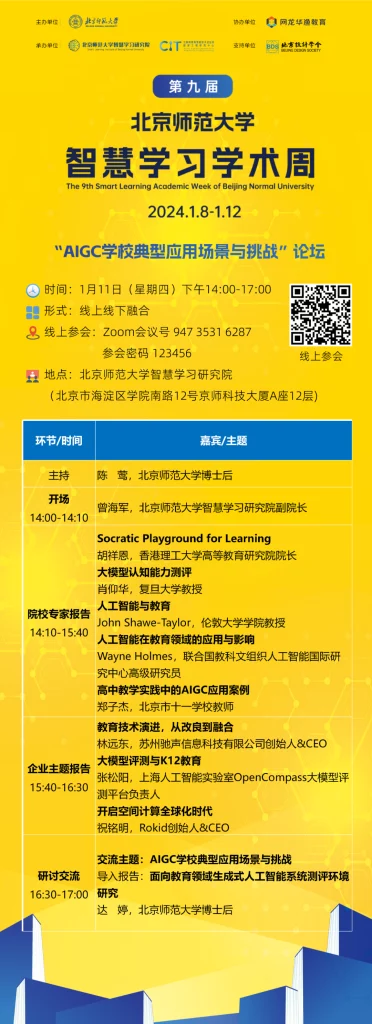
Forum announcement and organizers
The original forum poster identified the following organizations:
- Host: Beijing Normal University.
- Organizers: BNU Smart Learning Institute and the National Engineering Research Center of Cyberlearning and Intelligent Technology.
- Co-organizer: NetDragon Huayu Education.
- Supporting organization: Beijing Design Society.
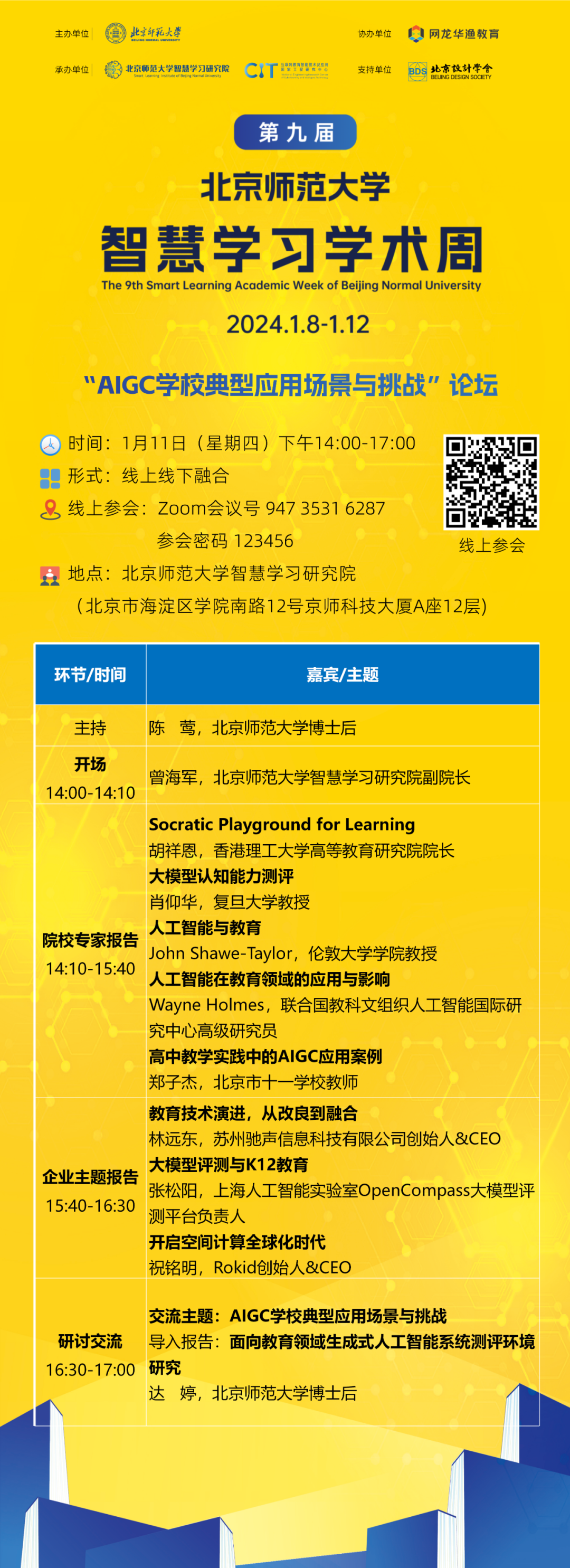
Time, format and venue
The forum was scheduled for Thursday afternoon, 11 January 2024:
- Time: 14:00–17:00, 11 January 2024.
- Format: hybrid; the poster’s Zoom meeting information is now historical only.
- In-person venue: BNU Smart Learning Institute, 12th floor, Building A, Jingshi Science and Technology Building, 12 Xueyuan South Road, Haidian District, Beijing.
Opening and chair
The chair was BNU postdoctoral researcher Ying Chen. From 14:00 to 14:10, Haijun Zeng, Deputy Dean of BNU’s Smart Learning Institute, was scheduled to give opening remarks. The times and speakers below are the programme announced on the poster.
Academic presentations: planned programme
The academic session, 14:10–15:40, listed five presentations:
- Xiangen Hu, Director of PolyU’s Institute for Higher Education Research and Development: “Socratic Playground for Learning”.
- Yanghua Xiao, Professor at Fudan University: cognitive-capability assessment of large models.
- John Shawe-Taylor, Professor at University College London: artificial intelligence and education.
- Wayne Holmes, listed on the poster as a senior researcher at the International Research Centre on Artificial Intelligence under the auspices of UNESCO: applications and impacts of AI in education.
- Zijie Zheng, Beijing National Day School teacher: AIGC applications in high-school teaching practice.
Industry presentations: planned programme
The industry session, 15:40–16:30, listed three presentations:
- Yuandong Lin, founder and CEO of Suzhou Chivox Information Technology: educational-technology evolution, from improvement to integration.
- Songyang Zhang, head of Shanghai AI Laboratory’s OpenCompass large-model evaluation platform: large-model evaluation and K–12 education.
- Mingming Zhu, founder and CEO of Rokid: opening a global era of spatial computing.
Discussion: planned programme
Discussion was scheduled for 16:30–17:00 on typical school applications and challenges of AIGC. BNU postdoctoral researcher Ting Da was to introduce research on an evaluation environment for generative AI systems in education.
Historical-source note
Sources are the original site poster and SLI’s academic-week notice of 9 January 2024. The original archive date, 11 January 2024, remains unchanged. The poster is a planned programme: it lists Wayne Holmes, for example, while the subsequent report does not list that presentation. This announcement therefore does not establish actual attendance. See the forum report for the reported proceedings.
Forum report and teaching resources
Further reading: forum report; background: UNESCO guidance on generative AI; classroom practice: AI and STEM learning resources.
Original link: https://aiedchair.bnu.edu.cn/news-6334-en/