
CITLAB shared an article from issue 20 of China Information Technology Education in 2026. It examines how learners and teachers retain agency as AI expands into feedback, assessment and decision support, and argues for judging tools against real teaching needs and sustained results.
“China Information Technology Education”, Issue 20, 2026

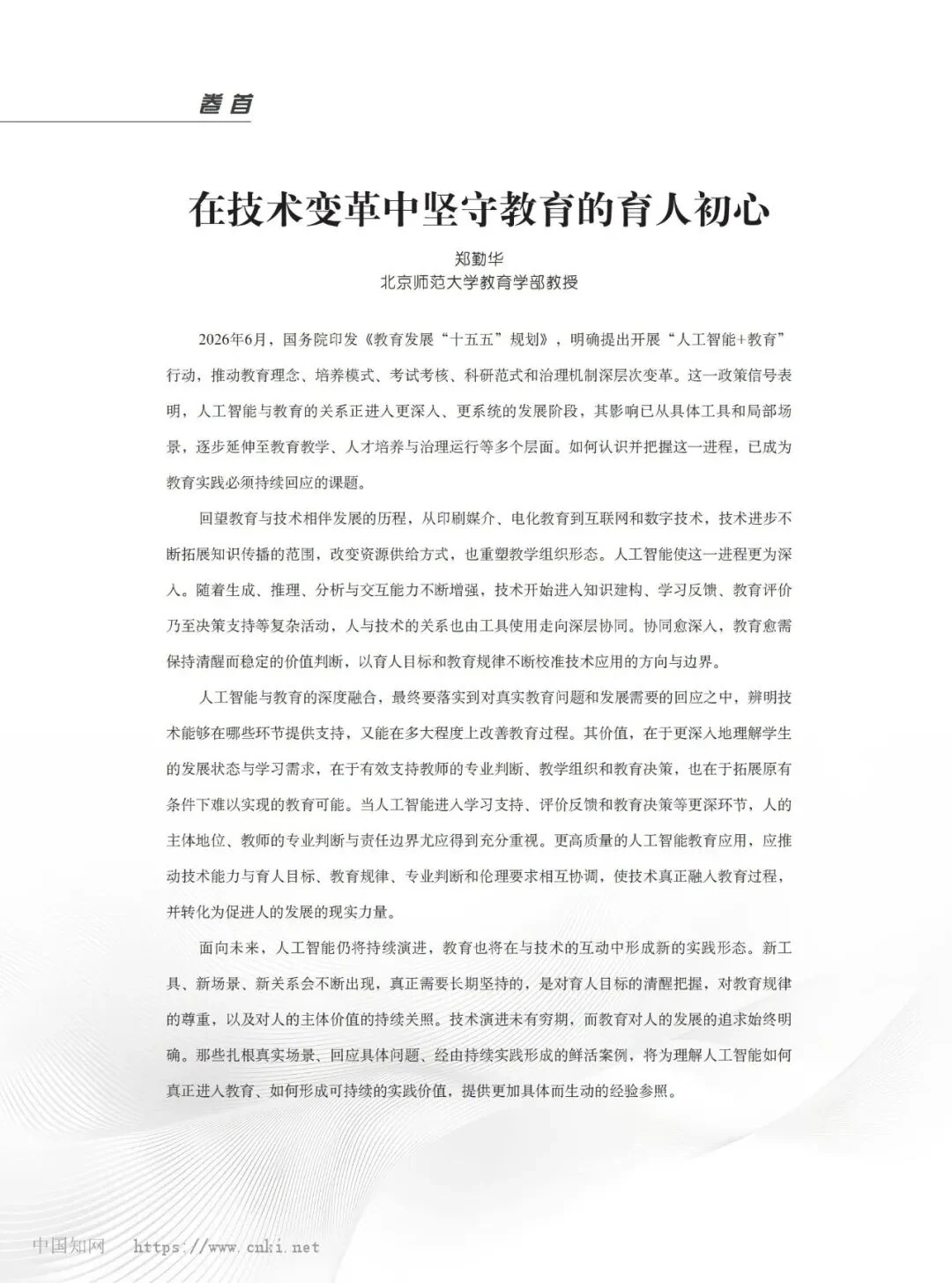

In June 2026, the State Council issued the “15th Five-Year Plan for Education Development”. It explicitly proposed to carry out initiatives related to “artificial intelligence in education”, in order to promote profound changes in educational concepts, training methods, examination systems, research approaches, and governance mechanisms.
This policy signal indicates that the relationship between artificial intelligence and education is moving into a more profound and systematic stage of development. Its impact has expanded from specific tools and specific scenarios to various aspects such as education and teaching, talent development, and governance. Understanding and grasping this process has become an issue that educational practices must continuously address.
Looking back at the history of the development of education and technology, from print media and electro-education to the Internet and digital technologies, technological advancements have continuously expanded the scope of knowledge dissemination, changed the way resources are provided, and also transformed the structure of teaching organizations. Artificial intelligence has further deepened this process.
As the capabilities for generation, reasoning, analysis, and interaction become more advanced, technology begins to be involved in complex activities such as knowledge construction, learning feedback, educational evaluation, and decision support. The relationship between humans and technology also moves from simply using tools to a more deep-level collaboration. The deeper this collaboration becomes, the more important it is for education to maintain clear and stable value judgments, so that the direction and boundaries of technological applications can be continuously aligned with educational goals and principles.
The deep integration of artificial intelligence and education ultimately needs to be reflected in responses to real educational challenges and developmental needs. It is necessary to determine in which aspects technology can provide support, and to understand to what extent it can improve the educational process.
Its value lies in enabling a deeper understanding of students’ developmental status and learning needs; in effectively supporting teachers’ professional judgment, teaching organization, and educational decisions; and in expanding the possibilities of education that are difficult to achieve under existing conditions.
As artificial intelligence becomes involved in more complex aspects such as learning support, evaluation and feedback, as well as educational decision-making, the role of humans, the professional judgment of teachers, and the boundaries of their responsibilities must be given due attention.
Higher-quality artificial intelligence applications in education should ensure that technical capabilities are in harmony with educational goals, educational principles, professional judgment, and ethical requirements. This will enable technology to truly integrate into the educational process and become a real force for promoting human development.
Looking towards the future, artificial intelligence will continue to evolve. Education will also develop new forms of practice through its interaction with technology. New tools, new scenarios, and new relationships will emerge continuously. What truly requires long-term commitment is a clear understanding of educational goals, respect for educational principles, and continuous attention to the subjective value of individuals.
The evolution of technology has no end; meanwhile, the goal of education in human development is always clear. Those practical examples that stem from real-world scenarios, address specific problems, and are developed through continuous practice, will provide more concrete and vivid examples for understanding how artificial intelligence can truly be integrated into education, and how it can create sustainable practical value.

Original link: https://aiedchair.bnu.edu.cn/news-citlab-2247627439-1-en/