
Historical archive: the Chair’s original publication date, 30 October 2024, is retained. This is Miao Fengchun’s interpretation of the framework, rather than the framework itself.
On this page
Miao Fengchun
Abstract: UNESCO released the world’s first AI Competency Framework for Students in September 2024. This article interprets that framework. As countries enter a new era of AI societies, education systems, whose central responsibilities are to guide thinking and cultivate citizenship, must anticipate the citizenship needed for inclusive and sustainable AI societies and proactively define and develop students’ AI competencies. At primary and secondary levels, the framework advocates preparing students to become responsible users and co-designers of AI and creative citizens of AI societies. Competency frameworks should therefore begin with a human-centred orientation towards AI and comprehensively define AI ethics knowledge and citizens’ social responsibilities, transferable AI knowledge and skills for lifelong learning, and AI system-design competencies that serve social inclusion and environmental sustainability. Primary and secondary AI curricula are the principal channel for laying the foundations of citizenship in AI societies. Curriculum-planning bodies should establish transdisciplinary AI competency structures and core curricula, explore interdisciplinary course clusters and spiral curricular sequences, advance the professional preparation and development of AI teachers, and construct criterion-referenced assessment systems for AI.
Keywords: AI competencies for students; primary and secondary AI curricula; citizenship in AI societies; a human-centred mindset towards AI; AI ethics; underlying AI techniques and application skills; AI system design
Please cite the following bibliographic information:
苗逢春.为智能社会公民素养奠基的《学生人工智能能力框架》[J].中国电化教育,2024,(11):1-12.
In the AI era, education should uphold its central mission of guiding thinking and cultivating citizenship, rather than becoming a passive testing ground for profit-driven AI. Students’ AI competencies should be grounded in citizenship in AI societies, rather than reduced to blindly operating commercial AI systems or mechanically experiencing coding. AI curricula should strengthen their comprehensive role as the main channel for developing human-centred thinking, internalizing ethical principles and cultivating scientific and technological creativity; they should not shrink into an adjunct to commercial training or a subject that exists in name only. In September 2024, UNESCO released the world’s first AI Competency Framework for Students [1], referred to here as the Framework. It seeks to help policymakers, researchers and practitioners think ahead about the citizenship their countries desire in the AI era, define the structure of students’ AI competencies and its interrelated core concepts, build core curricula and adapt interdisciplinary courses, and explore teaching and assessment methods that reflect the cognitive characteristics of particular domains while supporting whole-person development.
I. Cultivating human-centred citizenship in AI societies
1. Education systems should proactively define citizenship for AI societies, rather than become passive testing grounds for AI
Through integrated innovations in data, computing power, algorithms and model architectures, AI research and development has advanced at an accelerating pace over the past decade and more. Its applications have spread widely and deeply across production and everyday life. The release of generative AI for public use in November 2022 and its rapid iteration further accelerated its penetration across sectors, including education. Although AI’s advantages in improving productivity have not yet fully materialized in every sector, it has already profoundly affected fundamental human rights, human agency, autonomy in thinking and decision-making, and linguistic and cultural diversity [2][3]. If human society in the AI era is understood as an AI society, its construction necessarily involves a historical process in which social and economic orders are reconstructed together. Within the new economic order, AI will appear as increasingly intelligent digital infrastructure, general-purpose intelligent production tools, ubiquitous human–machine decision-making tools in government and public services, and intelligent platforms and applications that control and support individual lives. This AI-driven economic order will trigger a reconstruction of social order. Its central conflict is between AI machine-centrism controlled by capital oligopolies and human-centred values that advocate intelligent machines serving individual capabilities and sustainable social development. Machine-centrism is reflected in deep technological and social relationships: production relations that extract human data predatorily to train AI models; service relationships that entice or pressure users to exchange data privacy for AI services; and the collusion of concentrated capital and algorithms to control society’s digital infrastructure. Human-centred transformation should be advocated to protect everyone’s basic rights, agency and safety.
As humanity again stands at a historical crossroads in the reconstruction of economic and social orders, education systems responsible for guiding thinking, preparing citizens and developing human resources should not reduce themselves to passive AI testing grounds. They have an unavoidable responsibility to define proactively the citizenship needed in AI societies and plan AI competency structures and their development. Research and policy must address fundamental questions: what kinds of citizens should be educated to build safe, inclusive and sustainable AI societies [4]? How should students’ AI competency structures and expected developmental stages be defined in primary and secondary education, where citizenship foundations are laid? How can curricula, as the main channel for competency development, move beyond subject-centred limitations towards a transdisciplinary curriculum system? UNESCO developed the Framework as the first global reference blueprint to help countries address these historical questions.
2. Advancing the forward-looking concept of citizenship in AI societies and debate on whom AI societies should educate
The Framework introduces the concept of AI Society Citizenship and attempts to provide an operational definition. It aims to stimulate countries’ forward-looking thinking about the people an AI society should educate, the competencies required and the curricular transition needed.
On the basis of its definition of citizenship in AI societies, the Framework outlines the overarching educational goals of AI competencies in primary and secondary education. Citizens of AI societies should maintain a critical but open mindset and a lifelong-learning attitude towards learning and using AI, applying it to support self-fulfilment and social development. They should carry forward and dynamically adapt the values of law-abiding, responsible citizens to the AI era. In particular, they should develop critical thinking about AI’s effects on society and recognize that technology should serve human capability development in emerging AI-related social practices, becoming critical evaluators of AI. They should continually internalize and practise human-centred AI values, ethical principles and legal requirements as responsible AI users. They should also move beyond a humanism centred solely on individual people, considering AI’s effects on fairness in AI societies and broader conditions of human existence, including climate change. In this way, they can become AI co-developers who support social inclusion and environmental sustainability, and innovative leaders of the next generation of AI technologies.
The Framework offers more detailed recommendations on the values underpinning citizenship in AI societies and how to cultivate them:
(1) Critical values for citizens of AI societies. Students should use examples and evidence to examine and analyse the profound consequences of AI’s widespread integration into society’s infrastructure, continually deepening their critical understanding of AI’s social effects. They should recognize and form critical views on the trilemma facing AI and social development: prioritizing faster AI innovation while accepting relative sacrifices in safety and inclusion; prioritizing AI safety; or ensuring inclusive opportunities for use despite limited capabilities to use it. Students should be helped to analyse critically how AI can amplify discrimination against particular genders, marginalized ethnic groups and socioeconomically disadvantaged groups, as well as its effects on social relations, norms and structures. At an age-appropriate level, they should investigate the causes of AI’s far-reaching social effects and evaluate how legal frameworks, ethical guidelines and social norms could be adapted to address these challenges.
(2) Individual social responsibilities in AI societies. Students should collaboratively imagine and share the AI societies they hope to build, discuss individual citizens’ responsibilities and obligations in constructing inclusive, sustainable and just societies, and define these from the perspectives of AI designers and users. Social and emotional scaffolding should support the continuing internalization of individual civic responsibilities. Students should be encouraged to examine ethical principles for AI design and use in complex simulated situations, strengthening the resilience of their human-centred commitments.
(3) Self-fulfilment and lifelong learning as citizens of AI societies. Students should continually assess how AI applications across different domains affect work and life and analyse the competencies needed to live and work in AI societies. They should reflect on their personal development goals and examine AI’s role in individual self-fulfilment. Education should support the lifelong-learning attitudes and adaptability needed to keep learning about AI and use it critically for personal fulfilment and sustainable social development.
3. Defining a human-centred AI competency framework to guide curriculum development and adaptation
Education systems lack a neutral international reference framework for assessing whether curricula and training programmes move beyond product training to support students’ human-centred AI competencies. With citizenship in AI societies as its educational goal, the Framework proposes an international reference structure with four core aspects: a human-centred mindset towards AI, AI ethics, underlying AI techniques and applications, and AI system design. It also defines three progression levels: Understand, Apply and Create.
In terms of political commitment, governments reached a consensus in the Beijing Consensus on Artificial Intelligence and Education [5] on incorporating AI-related skills into primary and secondary curricula and curricula and qualifications at other levels and of other types. Yet a substantial gap remains between political will and curriculum development. UNESCO’s 2022 global survey [6] found that only fifteen countries had developed and were implementing government-endorsed primary and secondary AI curricula. Existing curricula also show structural imbalances that emphasize technical operations while neglecting values and AI ethics, alongside nominal or hollow provision allocating only a few teaching hours. In sharp contrast to the slow development of public curricula, private companies’ product-based platform courses and commercial training have expanded rapidly and been promoted widely without adequate evaluation or validation. Private companies also commonly define AI competencies under the banner of popularizing AI literacy while promoting operating skills for their commercial platforms. The immediate effect is that school AI curricula become rebadged commercial courses or nominal subjects. The deeper effects are the weakening of public education systems’ capacity to develop curricula and the deprofessionalization of AI teachers.
The Framework advocates a balanced curriculum covering human-centred thinking, AI ethics, knowledge and skills, and capacities for innovation in AI systems. It details the distinctive meaning and scope of each competency block and their intrinsic connections, with the aim of accelerating neutral and systematic AI curriculum planning and development.
II. Guiding principles
1. Begin critical thinking and changes in mindset by judging whether AI is appropriate for real-world problems
Critical thinking is a fundamental way of thinking, a cognitive starting point and a practical orientation for safe and meaningful interaction between individuals and AI. To build human-led AI societies, primary and secondary students should be prepared as decision-makers in iterative and next-generation AI development. Human-centred awareness and critical thinking should enable them to consider and judge what kinds of AI ought to be developed, and how they should be used, for inclusive and sustainable AI societies. The Framework therefore encourages students to consider and discuss fundamental questions. Will AI necessarily help solve humanity’s genuine global challenges, or will it create threats beyond human control? Do the negative climate effects of training and using AI substantially exceed the positive effects that might be expected from its contribution to the climate response? Which major social, economic, political and demographic effects of AI applications should humanity particularly examine and evaluate?
AI-driven change profoundly affects human agency, human–machine interaction, social equity and economic inclusion. Students should develop both critical awareness of current AI technologies’ strengths and weaknesses and the ability to evaluate them using objective evidence. The Framework seeks to help students assess AI’s appropriateness by considering its effects on human agency, social inclusion and equity, institutional and individual safety, linguistic and cultural diversity, the formation and expression of different perspectives, and environmental and ecological sustainability. Students should reject the mistaken belief that AI is the solution to every problem or task. They should develop a critical understanding of when AI should not be used, which problems it cannot currently solve, when it can form one part of a solution, and the strengths and limitations it brings to problem-solving.
For knowledge and skills, the Framework emphasizes learning relevant procedural knowledge through meaningful, authentic tasks and exploring and practising the design and development of AI tools and systems to address real-world sustainability issues. Citizens of AI societies need to comply with relevant laws and ethical principles, but should also contribute to adapting AI governance rules and constructing inclusive and equitable societies. The Framework supports students’ inquiry and discussion around core controversies in AI ethics, the internalization of ethical principles and the development of self-regulated, compliant conduct. It also encourages them to question whether AI product manuals adequately reflect ethics by design and to consider how existing ethical rules could be improved.
2. Prioritize competencies and practices for human-centred human–AI interaction
Whether every citizen has the awareness and ability to interact with AI in a human-centred way, or is instead controlled without awareness or agency by commercially driven intelligent machines, will determine whether humanity moves towards a society in which AI becomes more capable while people become less capable, AI wealth becomes more concentrated and those whose data are exploited become poorer. Developing students’ competencies for human-centred interaction is therefore a fundamental value orientation in AI education. UNESCO’s human-centred approach to AI includes the following core commitments: AI design and use should enhance individual human capabilities and sustainable social development; everyone should have equal and inclusive rights to access and use AI; AI deployed systematically should be explainable, safe, reliable and non-harmful, especially in protecting human agency and dignity; and the selection, use and oversight of AI should emphasize human control and human accountability.
The Framework stresses that AI should challenge and extend higher-order human cognition, rather than usurp or replace human thinking. It proposes protecting and enhancing human agency as a core guiding principle for AI curricula. Curricula should help students understand what data AI systems collect, how those data are used to train models, and how the data collection and use cycle affects privacy and broader aspects of their lives. They should stimulate students’ intrinsic motivation to grow and learn as human individuals, and reinforce autonomous human choice and human accountability in settings where AI is increasingly widespread. Students should understand that human interaction and human creations, especially artistic creation, should not be replaced by AI-generated outputs. By developing human-centred interaction competencies, the Framework also seeks to prevent students’ addictive attachment to, or excessive dependence on, AI platforms.
3. Lead climate-friendly AI design and use
To prepare students as human-centred AI co-developers and critical leaders of iterative and next-generation AI development, curriculum designers and teachers must first model the critical assessment of existing AI’s human-centredness. They should not disregard AI’s harms and far-reaching threats to the environment, ecosystems, human capabilities and social order throughout its life cycle, while blindly requiring students to understand, repeat and entrench harmful existing approaches to model training, production and deployment.
The Framework is among the first international documents to advocate climate-friendly AI design and use. It observes that, in a commercially driven AI development race, negative effects on environmental sustainability may deliberately be relegated to secondary considerations, while rational concerns about environmental damage are obscured by misleading claims that AI will save humanity by reversing climate change. Alongside calls for policymakers to regulate matters such as AI energy consumption, competency frameworks, curricular goals and learning topics should deliberately cultivate students’ deep understanding of the destructive effects of existing model-training approaches on the environment and ecosystems. Project-based learning on AI’s environmental effects should stimulate and support students’ exploration of emerging AI technologies and methods that could reduce environmental harm.
4. Develop inclusive AI competencies through inclusive approaches
Access to AI and AI competencies will become basic rights of every citizen in AI societies. Every student should learn to embed inclusion in key stages of AI system design and use and to take individual social responsibility for building inclusive societies. The Framework explains inclusion in competency development comprehensively. Relevant topics and learning activities should be integrated throughout the competency framework, helping students understand and apply inclusion across the AI life cycle: selecting data representative of different populations, designing algorithms to reduce bias, training models to prevent discrimination, designing inclusive access features, testing outputs for inclusion, and assessing systems’ effects on social inclusion in practice. AI curricula should be inclusive of, and appropriate for, different student groups nationally and locally, rather than relying on high-technology environments disconnected from most schools’ and students’ realities or on excessive implementation costs. When recommending AI platforms or tools, rigorous review and validation mechanisms should prevent the use of systems with algorithmic biases relating to gender, ability, socioeconomic background, language or culture. AI tools that specifically assist students with physical or intellectual disabilities should be encouraged.
5. Establish transferable values and knowledge schemas for lifelong learning
Students’ meaning-making about AI in particular situations depends on the amount of relevant prior knowledge and experience they possess, how that knowledge is organized, and how proficiently they can retrieve and use it. Competency structures and curricula should identify and organize transferable values, knowledge and skills and their relationships. They should help students build foundational conceptual structures and broad knowledge schemas encompassing values, knowledge and skills, so that new knowledge can be assimilated during lifelong learning or schemas can be adapted and extended for new problem-solving situations and technologies.
First, human-centred thinking and ethical principles provide transferable orientations for thought and habitual patterns for selecting and using AI. Curricula should progressively help students distinguish non-negotiable core values—such as fundamental rights and dignity, equality, non-discrimination, and linguistic and cultural diversity—from concepts requiring dynamic adaptation to AI-mediated situations, such as the specific forms of human and machine agency in different interactions. Students should then understand and internalize AI ethics from a human-centred perspective and deepen this into understanding and practising ethics by design. Second, public curricula should go beyond the brand-bound or platform-bound limitations of commercial training. They should identify AI principles independent of particular brands and products, helping students construct transferable knowledge-and-skill schemas that remain useful across technological iterations. The Framework recommends building and progressively deepening conceptual understanding of AI data, algorithms, models and system design. Appropriate teaching and practical settings should enable students to construct conceptual schemas by learning knowledge and using technologies in authentic, challenging tasks and by assessing technologies critically in terms of their effects on human society. The Framework also encourages creativity through optimizing existing AI models and co-developing meaningful tools. Engineering design, technical implementation and feedback-driven iteration in AI system design should further cultivate the adaptability needed for complex applications and rapidly evolving technologies. Together, human-centred values, conceptual knowledge schemas, technological adaptability and creativity form the integrated capabilities and dispositions that students need for lifelong learning, co-creation and civic responsibility in AI societies.
III. An AI competency framework: spiral progression across distinct but organically connected aspects
1. A two-dimensional AI competency framework guided by a human-centred mindset
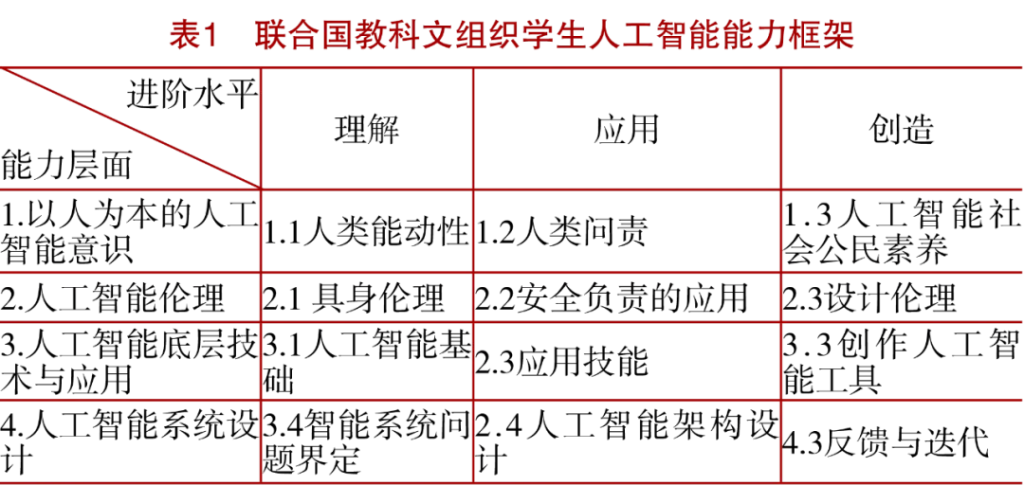
AI competencies must reflect both the structure formed at the intersection of technical domains and values, knowledge and skills, and the stages of students’ competency development. The Framework therefore operationally defines students’ AI competencies along two dimensions. (1) Competency aspects: four relatively distinct but interrelated aspects that underpin citizenship in AI societies—a human-centred mindset towards AI, AI ethics, underlying AI techniques and applications, and AI system design. AI ethics particularly emphasizes the intersection of values with knowledge and skills, while AI system design highlights scientific and technological innovation. (2) Progression levels: Understand, Apply and Create. Their specific definitions and descriptions of practical performance guide students’ development and give curriculum designers entry benchmarks and attainment standards for planning spiral curricular sequences. The four aspects and three progression levels intersect to form twelve competency blocks, as shown in Table 1. Each block is named for the characteristic competencies expected at that level within a particular knowledge or task-related focus of the aspect.
On small screens, swipe the table sideways. With a keyboard, focus the table region and use the left and right arrow keys to view the remaining columns.
| Competency aspect | Understand | Apply | Create |
|---|---|---|---|
| Human-centred awareness of AI | Human agency | Human accountability | Citizenship in the era of AI |
| Ethics of AI | Embodied ethics | Safe and responsible use | Ethics by design |
| AI techniques and applications | AI foundations | Application skills | Creating AI tools |
| AI system design | Problem scoping | Architecture design | Iteration and feedback loops |
This text version includes every competency name in the source image’s row and column order, without cell numbers. A few printed numbers do not match their row and column; the original image is retained for comparison. The three levels do not directly correspond to particular school grades.
2. Define competency blocks through technological and application examples, avoiding concepts disconnected from practice
Constructing a framework with multiple aspects and levels is an abstract process: general and consistent competency performances are identified across diverse technologies and applications and then conceptualized. The Framework defines blocks that highlight students’ distinctive behaviours in particular domains while interweaving the intrinsic relationships between aspects, reflecting their organic unity and whole-person capability.
1. Competency blocks at the Understand level: a baseline for citizenship in AI societies for every student
All students facing an AI society should possess human-centred AI values and the basic knowledge and skills for everyday human–AI interaction, enabling them to become critically minded citizens who use AI safely and responsibly. Understand is an introductory foundational level for every student. It supplies the basic attitudes, cognitive foundations and initial practical experiences needed for further learning. It can serve as a basic AI literacy level for all citizens, but should not be the completion standard for students’ AI curricula. At this level, students should understand what AI is and develop age-appropriate understanding and explanations of relevant values, ethical issues, conceptual knowledge, training processes and technical methods. They should explain and illustrate their knowledge through real-world and social practices and have the basic ability to assimilate new knowledge into existing schemas or update their knowledge structures when necessary. The specific blocks are defined below.
(1) Human agency. This block concerns critical thinking about who controls whom in human–AI interaction. Students should recognize that humans lead AI and that developers’ decisions profoundly affect users’ rights, human–AI interaction, students’ own lives and social activities. Drawing on personal experience, they should understand the practical importance of protecting human agency in AI design, provision and use. They should understand what human control means in technological development and application and the consequences when that control is absent.
(2) Embodied ethics. This block addresses basic questions such as why AI ethics concerns me and which ethical principles must be learned. Students should develop a foundational AI ethics knowledge framework through which personal experience helps them understand the causes of typical ethical issues and their effects on human rights, social equity, inclusion, equality and climate change. They should internalize the Framework’s six essential ethical principles and reflect and apply them through embodied experience in AI use, reflection on practice and critical thinking. The six principles are defined as follows. a. Do no harm. Students should demonstrate an understanding that AI systems intended to harm people must not be developed or used. They should evaluate whether particular solutions accord with human-centred values and protect rights and data privacy, and judge whether particular approaches comply with international or local AI-related laws and regulations. b. Proportionality. Students should assess whether a particular AI system offers comparative advantages in overall costs and benefits, effectiveness and efficiency when pursuing a legitimate goal. Using age-appropriate knowledge and skills, they should judge whether a tool is suitable for its sociocultural context. c. Non-discrimination. Students should develop the awareness and basic skills to detect explicit or implicit biases in AI tools and outputs. They should analyse and identify possible discrimination relating to gender, race, age, ability, income, language and cultural background, and develop an awareness of inclusive AI. d. Sustainability. In age- and ability-appropriate ways, students should use examples or understandable evidence to explain a particular system’s effects on the environment, climate change, and social and cultural sustainability. They should advocate forms of AI design, production and use that support social and environmental sustainability. e. Human determination in human–AI interaction. Students should explain why humans must bear ethical and legal responsibility when using AI, rather than transferring decision-making authority to machines. They should use examples to explain how human accountability is exercised in AI-supported decision-making. f. Transparency and explainability. Students should recognize users’ legal rights to request explanatory information from AI designers and providers: how a system works, how its algorithms and models generate outputs, and the age and ability ranges for which its main functions are appropriate.
(3) AI foundations. This block establishes basic understanding of how AI works. Students should acquire foundational AI knowledge and skills, including basic knowledge of data and algorithms and an appreciation of interdisciplinary foundations in progressively understanding them. They should relate AI concepts to other social activities and personal life. Their deepening knowledge of AI’s operation should give concrete substance to their human-centred thinking and understanding of relevant ethical principles.
(4) Problem scoping for AI systems. This block asks which problems should not use AI and how to define a good AI problem. Students should understand why problem scoping is the starting point of AI innovation. The Framework is almost unique among AI competency guidance documents in emphasizing that students should first judge when AI should not be adopted as a solution. In specific circumstances, they should use legal, ethical and logical reasoning to decide whether an AI system is appropriate. Once its appropriateness has been reasonably established, they should learn to define the problem’s boundaries, goals and constraints in light of needs and real conditions. They should acquire the knowledge and skills to conceptualize an AI system, including assessing different technologies’ suitability, specifying data requirements and planning evaluation and feedback tools.
2. AI competencies at the Apply level: a curriculum attainment standard for every student
School education should prepare students as responsible AI users, co-developers and effective users whose activities support their own interests and sustainable social development. Apply is therefore relevant to all students. Effective learning at this level presupposes the human-centred mindset, internalized basic ethical principles and foundational knowledge and skills acquired at Understand. Students should construct transferable conceptual knowledge structures and connected practical skills. They should habitually use human-centred thinking and ethical principles to guide the evaluation, learning and use of AI tools. Although education systems should encourage progression towards Create wherever possible, Apply may be selected as the completion standard for primary and secondary AI curricula for the many students without strong interests in the field, or in systems with insufficient teaching time. The competencies and dispositions at this level can be described through the following blocks.
(1) Human accountability. This block addresses who is responsible when human–AI interaction supports decisions. Students should recognize human accountability as a legal obligation of developers and service providers and learn to assume appropriate human responsibilities when developing and using AI. They should understand the legal and social responsibilities of institutions and individuals using AI to support decisions about people, and learn not to transfer decision-making authority to systems in high-stakes situations. They should strengthen their judgement and resistance to misleading claims that AI outputs can replace human thinking or intelligent predictions can usurp human decision-making.
(2) Safe and responsible use. This block teaches compliant AI use. Students should be able to use AI responsibly in accordance with ethical rules and local regulations. They should recognize risks from breaches of data privacy and learn the knowledge and skills needed to ensure their data are collected, used, shared, stored and deleted only with their informed understanding and permission. They should recognize typical AI safety incidents and particular systems’ specific risks and take reasonable actions to protect themselves and their peers when using AI.
(3) Application skills. This block develops the knowledge and skills needed to make data and algorithms work for AI. Students should construct age-appropriate knowledge structures in data, algorithms and AI programming and acquire transferable application skills in these domains. They should learn to evaluate critically and use open-source AI tools, algorithm libraries and datasets.
(4) Architecture design. This block develops understanding of how the layered architecture of an AI system works. At a level appropriate to their capabilities, students should acquire procedural knowledge and practical skills for planning and configuring architectures that are scalable, maintainable and reusable, including the data, algorithm, model and application-interface layers. They should develop the basic ability to use databases, programming tools and computing resources to build systems. Human-centred values and ethical principles should be integrated into configuring, constructing and optimizing architectures.
3. AI competencies at the Create level: an extended competency horizon for students with particular strengths
To build inclusive and sustainable AI societies, students should be prepared to lead the definition of trustworthy AI design specifications. Create guides students towards becoming thoughtful AI system co-developers who practise human-centred design that supports social inclusion and environmental sustainability. It is primarily intended for students with stronger interests and foundations in AI. For students without strong interest or adequate teaching time and resources, its learning outcomes may be optional rather than compulsory. At this level, students should critically apply prior knowledge and skills in data, algorithms and ethics by design to combine and use tools and help adapt and improve AI governance rules. They should further develop interest and capability in scientific and technological AI innovation and learn to create new tools using available tools and models, including open-source resources. They should strengthen their identity and sense of belonging as AI co-developers. Practical experience should deepen their critique of AI’s social effects and develop a personal sense of civic responsibility. The following blocks describe this level.
(1) Citizenship in the era of AI. This block asks which civic responsibilities everyone should fulfil in an AI society. Students should form critical views of AI’s effects on society and extend human-centred values into advocacy for human-centred design and use. They should consolidate civic awareness and social responsibility and strengthen their openness and curiosity towards learning and using AI for self-fulfilment.
(2) Ethics by design. This block concerns how to ensure tools’ compliance during AI design and product evaluation. Students should adopt an ethics-by-design approach when designing, evaluating and using tools and when evaluating and improving governance rules. They should recognize that assessing and revising design intentions must begin at system conceptualization and cover the entire AI life cycle. They should use appropriate indicators to evaluate tools’ compliance with ethical and legal requirements and methods such as multi-stakeholder ethical assessment matrices to evaluate particular governance rules and propose improvements.
(3) Creating AI tools. This block develops creativity and adaptability in combining and customizing tools to solve real problems. Students should deepen their data and algorithm knowledge and skills and adapt existing AI tools into task-driven tools. They should integrate human-centred thinking and ethical rules when evaluating existing tools and testing their own creations, while developing the social and emotional skills required for co-creation, including adaptability, complex communication and teamwork.
(4) Iteration and feedback loops. This block prompts students to consider the complex decision of whether to shut down or optimize a system and develops integrated capabilities for improvement. They should acquire the interdisciplinary knowledge and operational methods needed to assess the human-centred justification of model design, technical robustness and social and environmental effects. They should apply human-centred thinking and ethical rules in simulated decisions about when to shut down a system and how to mitigate harm already caused. They should gain age-appropriate technical abilities to improve datasets, reorganize algorithms and strengthen architectures in response to testing and feedback, and develop an identity as AI co-creators.
IV. Detailed curriculum planning by competency block: conceptual structures and teaching recommendations for AI curricula
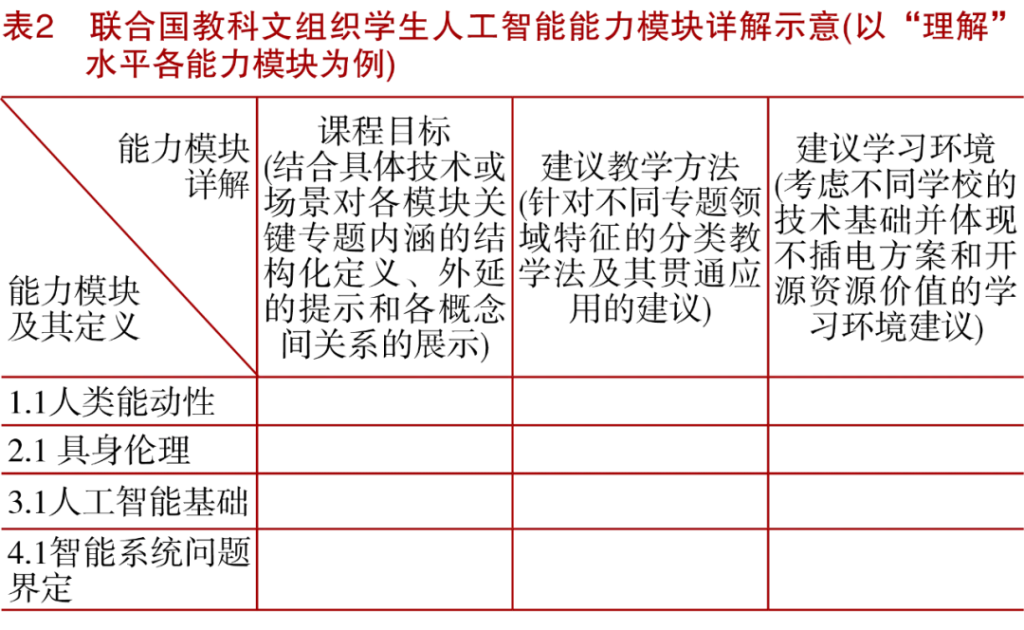
After defining the competency blocks, the Framework provides detailed curriculum-planning specifications for each. These specifications regard citizenship in AI societies as the combined result of school AI curricula, as the principal channel, and other channels such as extracurricular learning, non-formal learning through the internet and other media, and interactions with families and peers. Education systems should first strengthen school curriculum planning and implementation, while enhancing the school curriculum’s role in guiding and integrating other channels. Columns on curricular goals, suggested teaching methods and suggested learning environments explain each topic’s relatively self-contained concepts and appropriate pedagogies and settings. They also show intrinsic and practical connections between blocks, forming a curriculum-planning map for diverse contexts. Table 2 illustrates these columns and their design purposes.
On small screens, swipe the table sideways. With a keyboard, focus the table region and use the left and right arrow keys to view the remaining columns.
| Competency block and definition | Curricular goals: use technologies or scenarios to show key topics’ structure, meaning, scope and conceptual links | Suggested teaching methods: domain-specific approaches and their connected application | Suggested learning environments: school technology conditions, unplugged approaches and the value of open-source resources |
|---|---|---|---|
| 1.1 Human agency | Unfilled in the illustration | Unfilled in the illustration | Unfilled in the illustration |
| 2.1 Embodied ethics | Unfilled in the illustration | Unfilled in the illustration | Unfilled in the illustration |
| 3.1 AI foundations | Unfilled in the illustration | Unfilled in the illustration | Unfilled in the illustration |
| 4.1 Problem scoping | Unfilled in the illustration | Unfilled in the illustration | Unfilled in the illustration |
This illustrates a planning structure. All twelve planning cells are intentionally unfilled in the source image; they do not represent missing full specifications.
1. Curricular goals: a grid of knowledge schemas and their practical application
Curricular goals specify, from curriculum designers’ perspectives, the intended competencies, breadth and depth of foundational topics, and possible competency-development activities. Their definition balances the following tensions:
(1) Systematic coverage and necessity of concepts. Having surveyed the important concepts that students’ AI competencies might include, the Framework selects and defines core topics of fundamental value. Definitions emphasize both completeness across values, knowledge and technologies and practical usefulness. For example, Human agency builds a knowledge structure encompassing awareness that humans lead AI, understanding why sufficient human control is necessary, and critical thinking about the dynamic relationship between human and machine agency. Embodied ethics distils six ethical principles essential to students’ AI use.
(2) Conceptual and contextual dimensions of competence. Technological examples and application scenarios explain concepts’ abstract meanings and scope, helping students learn technologies, co-develop and innovate in relation to their own and society’s needs. For example, the specification on understanding why sufficient human control is necessary within Human agency emphasizes understanding the dialectical relationship between human and machine agency through situations. Authentic cases in which AI supports agency help students understand how appropriate interaction can enhance human capabilities. Cases of conflicting human and machine agency also prompt discussion—for example, AI assisting medical diagnosis beyond human perceptual limits, or generative AI automatically correcting computer code. These examples help students understand that the boundary between human and machine agency is not fixed but should be adjusted reasonably and dynamically to specific circumstances.
(3) Distinctiveness and connections between topics. Detailed specifications define students’ distinctive performance in particular topics while showing how every aspect is indispensable and complements the others. Across blocks, human-centred thinking supplies the critical-thinking orientations and dispositions needed for civic responsibility. Ethical principles show concretely how that thinking guides safe, compliant use and students’ evaluation, use and co-development of tools. In turn, learning underlying technologies and designing systems provide technical situations, from specific to integrated, that deepen the internalization of ethical principles.
2. Suggested teaching methods: domain-appropriate approaches and their integration
Laying the foundations of students’ AI competencies requires schools to organize typical learning activities and open-ended practices inside and outside school to achieve goals beyond a single subject. This is characteristically transdisciplinary teaching. Typical learning includes the formation of values, social and emotional learning, internalization of ethical thinking, understanding and inquiry into interdisciplinary conceptual knowledge, learning and applying data and algorithms in authentic settings, developing tools for real tasks, designing AI systems using engineering thinking, and individual and collaborative learning. Students also face many ill-structured concepts and problem situations without fixed answers.
The Framework’s teaching recommendations advocate domain- or topic-specific instructional design combined with planning and implementation that connect and integrate different methods. For human-centred thinking and AI ethics, it recommends approaches such as perspective-taking through dilemmas. In Embodied ethics, for example, teachers use specific AI-related dilemmas to help students identify the ethical considerations behind conflicts, choose between perspectives and explain the ethical grounds for their choices. For ethical principles, examples include scenario-based examination of the causes of basic disputes, understanding principles and internalizing ethical rules. When teaching the six principles, case analyses of ethically conflicting situations can prompt discussion of controversies arising from tools and their applications, reveal causes and relevant principles, and then use concept maps across cases to construct and extend understanding. For conceptual knowledge schemas, it recommends problem-based inquiry around tools or situations and progressive updating of knowledge structures. AI foundations, for instance, suggests defining and delimiting AI through examples: teachers organize investigations and experiments with tools from different domains, asking which are not AI, which are AI and which techniques they principally use. For technical operations and tool-making, it proposes projects based on simulated tasks and transfer exercises using variations in tasks. Creating AI tools may involve combining or adapting tools to monitor school and household electricity use, forecast micro-weather for local everyday or travel routes, or track a particular infectious disease locally. For AI system design, the main recommendation is integrated project-based learning and practice. Iteration and feedback loops, for example, calls for projects in which students simulate critical testing of systems they have designed, learn systematic testing and examination methods, and decide whether to shut down, redesign or optimize a system.
3. Suggested learning environments
The Framework identifies conditions for effective AI curriculum implementation: teacher training and support, AI teaching resources, school-based teaching research, maintaining and updating schools’ digital infrastructure, and providing basic learning resources through purchase or sharing with companies and research institutions. Its main recommendations on learning environments are as follows.
1. Expand digital learning environments while fully recognizing the value of unplugged learning
To give every student access to basic AI learning conditions, the Framework recommends that all countries consider providing available and affordable digital devices and basic AI tools. It also emphasizes unplugged solutions as transitional environments in schools lacking basic digital provision, allowing students to begin exploring foundational digital knowledge early. For aspects that do not require devices, such as mindsets and AI ethics, unplugged learning can remove unnecessary online distractions and support sustained inquiry into values and scientific principles. Even for application skills and system design, which require more developed digital environments, carefully designed unplugged activities can help students consider which problems should not use AI, how to scope an AI problem, and how algorithms and design processes work. Computer-based practice or simulated tasks can then build on that understanding. The Framework gives examples including Everyday AI (https://everyday-ai.org/resources) and AI Unplugged (https://www.aiunplugged.org).
2. Use open-source resources as cognitive scaffolding for inquiry and making, while critically examining open data and algorithms
At Apply and Create, learning underlying AI techniques, operations and system design relies heavily on open-source databases, programming code and design tools. Interpreting algorithm examples and working with partially completed tools can deepen understanding of scientific and technological principles. Simulated model training and the combination and adaptation of tools can then develop technological innovation capabilities. The Framework’s definition of Create explicitly includes developing new tools and systems using open-source databases, programming tools and models. Detailed specifications integrate open-source recommendations into every block involving data, algorithms and tools, with examples of open databases and algorithm libraries. They also deliberately emphasize critically examining these resources’ safety and suitability for specific development purposes.
3. Guarantee basic school software and hardware and encourage partnerships for open learning environments
School departments responsible for digital teaching equipment should establish minimum standards for basic AI software and hardware in light of national budgets, curricular teaching needs, and the sustainability of maintenance and use within school operating and teaching funds. To support such standards, the Framework lists the following configurations. It recommends that national authorities encourage and coordinate cooperation with companies, research institutions and other external organizations to share resources and build open, more climate-friendly, transdisciplinary AI learning environments:
(1) Tools for learning underlying AI techniques: tools that help students understand and explore complex AI technologies, such as Machine Learning for Kids (https://machinelearningforkids.co.uk/), which supports understanding of machine learning; Teachable Machine (https://teachablemachine.withgoogle.com), which simulates training machines; and TensorFlow (https://www.tensorflow.org), an end-to-end open-source machine-learning platform;
(2) AI programming languages;
(3) AI operating software: for example, free or low-cost open-source operating software such as Ubuntu (https://ubuntu.com);
(4) Hardware for teaching AI. Not every competency-development activity or course requires hardware. Common equipment includes sensors and data-collection devices for temperature, humidity, sound and other data; devices for presenting AI processing results or providing necessary human–machine interfaces; and integrated AI hardware such as robots.
V. Implications for China: what robust AI curricula are needed for educational strength in the AI era?
Since the beginning of the twenty-first century, China has been a global leader in guiding and implementing primary and secondary information-technology curricula. Through the 2003 General Senior Secondary Technology Curriculum Standards (Experimental) [7], China anticipated the importance of AI competencies during the internet era and became one of the few earliest countries to cultivate them through formal primary and secondary curricula. The 2017 senior secondary information-technology standards [8] and the 2022 compulsory-education information-science-and-technology standards [9] strengthened competency-based approaches, systematic disciplinary knowledge and AI topics. Facing global AI transformation, China’s accumulated curricular foundations should not become a basis for complacency. They should instead help propel a timely curricular transition towards AI societies. The fundamental questions explored by the Framework can inform the adaptation of China’s AI curricula to cultivate citizenship in those societies.
1. What transdisciplinary curricula are needed for citizenship and scientific and technological creativity in AI societies?
1. Break with subject-centred thinking to construct transdisciplinary AI curriculum systems
As discussed above, citizenship in AI societies and scientific and technological creativity will be decisive capabilities underpinning countries’ new quality productive forces and emerging social relations. AI also warrants a foundational curriculum because its technologies can integrate all information-technology domains and shape the theoretical depth and research frontiers of other technologies. Reducing AI to one information-technology topic alongside other technical fields, following a separated-subject approach, is a form of curricular equalization that overlooks its epoch-defining significance. Education should therefore move beyond both information-technology subject-centrism and narrow AI subject-centrism. Beginning with citizenship and innovation capabilities, it should build a curriculum system for integrated educational goals beyond any single discipline: strengthen core AI curricula, explore formal interdisciplinary courses, stimulate adaptations in related subjects and guide non-formal learning. It should also move beyond treating school curricula as the only channel, draw on excellent external courses and strengthen review and admission mechanisms for private AI training entering schools, preventing unvalidated commercial courses from proliferating and displacing public curricula. The Framework presents the Republic of Korea’s 2019 national AI strategy, which distinguishes four categories of citizens’ competency needs:
(1) The general public’s competencies for using AI in everyday life;
(2) AI practitioners’ ability to use AI tools and software in labour-market settings combining AI with different domains;
(3) AI professionals’ integrated competencies for developing platforms and systems;
(4) Advanced specialists’ high-level capabilities for solving core AI problems and developing new models and algorithms. The government develops transdisciplinary programmes for these different needs. At primary and secondary levels, AI curricula focus on computational thinking, including supporting AI use in other subjects and establishing specialized secondary schools and advanced courses with an AI focus.
2. Strengthen the core substance of AI curricula
Moving beyond subject-centred thinking does not mean abandoning AI’s disciplinary substance. It means strengthening the core curriculum, its systematic structure and its interdisciplinary coordinating role. First, if AI competencies are becoming foundational in society, AI curricula should receive an appropriate foundational-subject status, curricular forms and protected teaching time proportionate to their importance. Second, drawing on the Framework’s competency structure beyond a single subject, goals should cross the boundaries of closed information-technology or AI disciplines. Teaching time and curricular forms should be defined for each educational stage, considering dedicated courses commensurate with AI competencies’ importance. Core curriculum development should cover human-centred thinking, internalized ethics, understanding and applying principles, and system design, while making interdisciplinary connections that break subject barriers. It must also handle the tension and unity between general AI knowledge and specific technological platforms. The Framework’s topics and specifications can support modules relatively independent of particular platforms. For underlying techniques and applications, a sequence from underlying logic to core technologies and typical domain applications can organize general knowledge and skills around underlying principles, core technologies and concrete platform examples. Commercial platforms may illustrate principles and support practical skills, but passive, uncritical operation of particular products should not dominate curriculum content. Education authorities should guide and fund a curriculum tree rooted in basic principles, branched into domain applications and illustrated by platform-specific leaves, together with free MOOC clusters—for example, the government-led AI Singapore courses (https://learn.aisingapore.org/students-2/).
3. Explore interdisciplinary courses led by AI
Education should assess the gaps that a single core AI course may leave in competency development and explore, construct and validate interdisciplinary courses led by AI. The Framework cites the United Arab Emirates’ Computing, Creative Design and Innovation curriculum [10] as a practical example. It developed from an operational, technology-centred subject, through a stage extending beyond computer-centred teaching, into an interdisciplinary curriculum integrating robotics, AI programming and electronics. Its integrated goals include creativity, problem-solving and AI ethics awareness, repeated learning and practice of fundamental principles, and greater proficiency and transfer across domains. Its content comprises five connected areas:
(1) Computer science, including data and data analysis;
(2) Engineering principles and systems, including microelectronics, robotics and AI systems, and embedded systems;
(3) Design and innovation, including entrepreneurial knowledge and skills and engineering design processes;
(4) Sustainability, including AI’s effects on sustainable social development;
(5) Visual communication, including visual design, computer-aided design and the realization of designed products.
4. Establish the case for multidisciplinary curricula strengthened by AI
The core curricula and subject clusters needed for AI competencies offer a potentially disruptive impetus to move beyond separated subjects and initiate systemic curricular reform. AI is intrinsically interdisciplinary and has deepening connections with mathematics, science, engineering, languages, citizenship and social studies. Successful learning requires an integrated conceptual system grounded in data, programming and computer engineering, together with computational thinking, engineering thinking and scientific reasoning. Human-centred AI thinking also needs appropriate social and emotional skills. Once AI curricula have systematically established their requirements for knowledge and skills from other subjects, multidisciplinary adaptation or reform should follow in a timely way. Examples include adapting social and citizenship education goals and content for human-centred AI values, civic awareness and responsibility, and AI ethics; adjusting the breadth and depth of relevant mathematics in response to underlying technological principles; and strengthening computational thinking, engineering thinking and design in technology and engineering courses to support system-design learning.
2. How can spiral curricular scaffolding support competency development?
1. Spiral curricular sequences around core competency topics
The Framework’s three progression levels are not defined by school grade. They summarize different cognitive depths and practical performances within each aspect’s core topics. Its detailed blocks can help identify topics and connections appropriate to Chinese students. Curriculum content, progressively deepening goals and specific modules or subjects should be coordinated across relatively consistent but expanding primary, lower-secondary and upper-secondary topics, providing scaffolding across grades. For example, MIT’s Everyday AI curriculum for young learners builds increasingly challenging and broad sequences around what AI is, which AI works well or poorly, how it works and how it learns. Students move from experiences with concrete tools and intuitive understanding towards abstract principles and complex operations through progressively more demanding activities in AI programming, teachable AI and generative AI. Related ethical and social issues are examined at increasing depth throughout.
2. Organize teaching through interest- and competency-based cohorts
The Framework recommends considering cohort-based teaching: providing courses and instruction to groups drawn from different classes whose competencies are comparable and who share interests in particular AI fields or topics. This requires flexible integration of appropriate learning approaches, an interest-based sense of belonging, and competency-based collaboration and creation. Lower- and upper-secondary schools with sufficient AI teachers, or schools with flexible local curricula, can offer diverse AI courses or interdisciplinary courses alongside guaranteed compulsory provision, allowing students to choose according to interest and ability. Schools with fewer teachers that cannot offer electives may use the Create specifications to provide extension opportunities within a relatively uniform compulsory course or organize extracurricular learning for students able to go further.
3. How can the professional preparation and development of AI teachers advance?
The Framework notes that information technology and AI are commonly regarded as peripheral subjects, leaving their teachers in marginalized professional positions. It therefore recommends advancing AI teachers’ professional preparation and development. First, dedicated AI teachers should receive the same professional status and conditions as teachers of other foundational subjects. Competency frameworks for primary and secondary AI teachers should then strengthen initial preparation and continuing training. The Framework recommends using UNESCO’s concurrently released AI Competency Framework for Teachers [11][12] while fully considering AI subject teachers’ specific pedagogical needs to develop more specialized standards and training. It cites the non-governmental Competency Standards for Primary and Secondary AI Teachers (Trial), jointly developed and published by the China National Academy of Educational Sciences and Tencent Education. ①
4. How can a competency-based AI assessment system be constructed?
1. Establish competency-based, criterion-referenced testing
Competency-based education assumes that certain knowledge, skills and values are foundational to everyone’s survival and development and that education systems should ensure every student meets basic standards before entering society. The Framework therefore recommends that basic education consider criterion-referenced testing systems. Its detailed blocks already translate AI competencies into measurable expected behaviours and cognitive levels. These can underpin localized frameworks and sets of reference criteria specifying attainment benchmarks for each aspect. Testing can then determine whether students meet standards and diagnose progress across aspects, providing individualized evidence on whether further curricular support is needed.
2. Design performance-assessment situations that reveal both observable performance and underlying capabilities
AI’s practical orientation requires performance assessment in simulated task situations to measure how students apply human-centred thinking, ethical principles, knowledge and skills. Criterion-referenced AI testing should improve performance assessment in the following ways:
(1) Assess both external practical performance and internal competency development. Move beyond examining observable behaviour—what students can do—to using practical performance and psychometric methods to examine underlying development across AI competencies. This includes the organization and applicability of knowledge and technical systems—what students potentially can do—and human-centred thinking and ethical values—how well they can put AI ethics into practice;
(2) Move from assessing rote learning to testing transfer, adaptability and creativity. Rather than measuring mechanically repeated procedures, use varied tasks to assess how students transfer and flexibly apply principles across contexts, indicating the transferability of their knowledge-and-skill schemas; update knowledge and skills for new technologies, indicating adaptability; and critically assess existing tools and co-create new ones, indicating co-development capabilities;
(3) Balance separate topic-specific assessment with holistic competency assessment. Alongside assessing particular values, knowledge and skills within an aspect, use integrated questions or projects based on simulated tasks or problems to evaluate the combined application of ethics, knowledge and skills. Such assessments should also examine deeper computational and engineering thinking involved in redesigning algorithms and improving AI systems.
3. Build banks of simulated assessment tasks and sample items
The detailed competency blocks provide reference points for designing assessment tasks and methods, with different emphases across Understand, Apply and Create. Understand tasks may focus more on recognizing, interpreting and internalizing ethical principles, conceptual knowledge and problem scoping, together with basic operations, and less on specific complex procedures. Apply should emphasize problem-based operational competence and adaptability to variations in authentic tasks. Create tasks should focus more on integrating different values, principles, knowledge and skills; algorithm planning and programming; designing new tools or system prototypes; and the computational and engineering thinking associated with co-development. They should also assess the contextual enactment of ethics and values throughout tool-making and system design and implementation. The Framework suggests differently weighted task types for each aspect and gives representative examples:
(1) Human-centred thinking towards AI: a. task-based perspective-taking; b. conflict-based critical case evaluation; c. conflict-based social behaviour;
(2) AI ethics: a. context-based ethical value orientations; b. context-based ethical behaviour; c. context-based rule-making;
(3) Underlying AI techniques and applications: a. problem-based understanding of AI knowledge; b. tool-based examination of conceptual knowledge and transferable operational skills; c. task-driven tool-making;
(4) AI system design: a. project-based design thinking; b. project-based system-configuration competencies; c. project-based iterative decisions and operations.
VI. Conclusion
Developing AI competency frameworks must first recognize citizens’ value as human beings. Frameworks should protect each person’s rights and well-being in human–AI interaction and support timely personal development and self-fulfilment within AI societies. Second, they must recognize inclusive coexistence as essential to society itself, balancing individual rights and social responsibilities and pursuing social empowerment alongside individual empowerment. Only through both can the knowledge, skills and creativity required of citizens as human resources remain within a human-centred value framework, preventing individuals from unknowingly being controlled by intelligent machines or subordinated to AI capital. Primary and secondary AI curricula must move beyond subject-centred limitations to define transdisciplinary human-centred competencies. They must also return to curricular substance, reviewing and strengthening goals, curricular forms, content systems, teaching methods and assessment. Only then can they cultivate autonomous, safe, responsible and creative individuals and citizens for AI societies, together with the scientific and technological innovators needed for national economic transformation and self-directed development.
①https://cn.chinadaily.com.cn/a/202203/25/WS623d8cc0a3101c3ee7acd735.html.
References
[1] Miao,F.,Shiohira,K..AI competency framework for students [M].Paris:UNESCO,2024.
[2] Miao,F.,Holmes,W..Guidance on generative AI in education and research [M].Paris:UNESCO,2023.
[3] 苗逢春.基于教师权益的自主人工智应用:教师人工智能能力框架解读[J].开放教育研究,2024,30(5):4-16.
[4] UN.Global Digital Compact [Z].New York:UN,2024.
[5] UNESCO.Beijing consensus on artificial intelligence and education [Z].Paris:UNESCO,2019.
[6] Miao,F.,Shiohira,K..K-12 AI curricula:A mapping of government-endorsed AI curricula [M].Paris:UNESCO,2022.
[7] 教基[2003]6号,教育部关于印发《普通高中课程方案(实验)》和语文等十五个学科课程标准(实验)的通知[Z].
[8] 教材[2017]7号,教育部关于印发《普通高中课程方案和语文等学科课程标准(2017年版)》的通知[Z].
[9] 中华人民共和国教育部.义务教育信息科技课程标准(2022年版)[M].北京:北京师范大学出版社,2022.
[10] UNESCO.AI in the UAE’s computing,creative design and innovation K-12 curriculum [M].Paris:UNESCO,2024.
[11] Miao,F.,Cukurova,M..AI competency framework for teachers [M].Paris:UNESCO,2024.
[12] 苗逢春.生成式人工智能及其教育应用的基本争议和对策[J].开放教育研究,2024,30(1):4-15.
Editorial and source notes
The Chair’s archive is dated 30 October 2024. The journal’s official record lists China Educational Technology, issue 11 of 2024, pages 1–12, with publication dated 10 November 2024. Both dates are retained without inferring a reason for the difference. The journal’s full-text PDF was not obtained for this page.
The English, Arabic, Spanish, French and Russian versions are full site translations prepared from the original Chinese archive, not official UNESCO translations. The original citation, footnote URL and all 12 bibliographic entries are retained for traceability.
Technical note: the author lists Ubuntu under “AI operating software”. Ubuntu is an open-source operating system that can host AI/ML software, rather than a specific AI application. The author’s wording is retained.
The third option in the original “trilemma” contains ambiguous wording: “确保包容性的应用机会和应用能力有限”. The original is retained and the translations follow its literal related meaning; it has not been rewritten as a verified policy proposition.
Original link: https://aiedchair.bnu.edu.cn/news-8867-en/