Historical notice — registration has closed and the 2024 event has ended. The Chair’s original publication date, 6 September 2024, is retained. The programme, capacity, professional positions, contact details and travel information describe the original announcement, not a current invitation.
On this page
Generative AI was opening up new approaches to collaboration between people and machines in education. Although educational uses of large models were still at an early stage, they were prompting interest and new thinking about classroom practice. To explore their potential in K–12 education, the National Engineering Research Center of Cyberlearning and Intelligent Technology, CIT, announced the second Advanced Workshop on AIGC-Empowered Human–AI Collaborative Teaching, bringing experts and companies together to examine the roles and boundaries of large models.
Preview of the second advanced workshop
Workshop features
1. A varied learning model combining theory and practice
The announced programme combined expert lectures, guidance on AI-agent concepts, innovative classroom design and team projects, integrating online and in-person learning.
2. Individual practical guidance from experts and teaching assistants
Experts and assistants would provide one-to-one guidance, with the aim of enabling every participant to complete an AI agent.
3. AI-agent projects grounded in teaching needs
Teams would design innovative lessons and build agents for classroom settings, particularly mathematics and information technology, drawing on front-line needs.
4. Subject-specific human–AI classroom design
Participants would discuss innovative classroom models with experts and use team brainstorming to explore new forms of collaborative teaching.
5. Experiences with large models and AI agents
Participants would explore large language models through heuristic voice-based teaching and a Turing-test platform, encountering contemporary AI developments.
6. Sharing examples of human–AI collaborative teaching
The programme would present applied classroom examples and project outcomes to inspire teaching innovation.
7. Teacher–student–machine roles in the AIGC era
Participants would exchange ideas about collaborative roles among teachers, machines and students and possible directions for education.
Organiser
National Engineering Research Center of Cyberlearning and Intelligent Technology
Date and venue
Date:21 September 2024.
Venue: Smart Learning Institute of Beijing Normal University,12 th floor, Block A, Jingshi Science and Technology Building,12 Xueyuan South Road, Haidian District, Beijing.
Programme
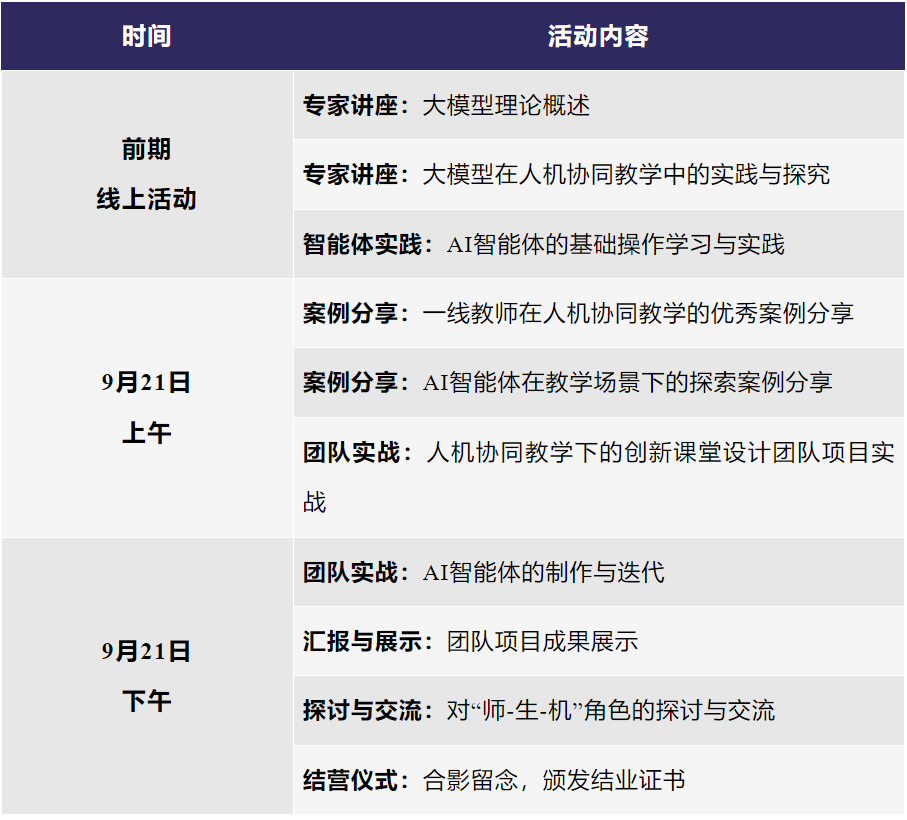
The table below transcribes the original programme image. The Chair’s notice also stated that the final arrangements were subject to the announcements or notices issued at the venue on the day.
| Phase | Format | Programme content |
|---|---|---|
| Earlier online activities | Expert lecture | Overview of large-model theory |
| Earlier online activities | Expert lecture | Practice and exploration of large models in human–AI collaborative teaching |
| Earlier online activities | Agent practice | Learning and practising basic AI-agent operations |
| 21 September 2024, morning | Case sharing | Front-line teachers’ examples of human–AI collaborative teaching |
| 21 September 2024, morning | Case sharing | Exploratory applications of AI agents in teaching |
| 21 September 2024, morning | Team practice | Team project on innovative classroom design for human–AI collaborative teaching |
| 21 September 2024, afternoon | Team practice | Building and iterating AI agents |
| 21 September 2024, afternoon | Reports and presentations | Presentation of team project outcomes |
| 21 September 2024, afternoon | Discussion and exchange | Roles of teachers, students and machines |
| 21 September 2024, afternoon | Closing ceremony | Group photograph and completion certificates |
Transcribed from the original programme image. It gives morning and afternoon phases, without clock times, and does not specify the date of the earlier online activities. Those details have not been inferred from the later report.
View the original programme image
Registration information — historical
Eligibility
The notice invited primary and secondary teachers across China, with preference for mathematics and information-technology teachers; education administrators; vocational and university teachers; university students, especially in teacher-education computing, educational technology, modern educational technology, mathematics and applied mathematics, or subject teaching in mathematics; working postgraduate students; and other people interested in AI.
The announced limit was 30 participants. The workshop itself was free; participants were responsible for meals, accommodation, transport and other expenses.
Original registration method — closed
The original notice directed applicants to a registration link, QR or the WeChat article’s original-source link. This page retains only the historical QR image and does not offer registration.
Original deadline:20:00 on Saturday,14 September 2024.
The 2024 notice asked applicants to provide accurate information and stated that personal information would be handled confidentially and used only for workshop registration and review. This is a record of the original notice.
The notice planned to notify successful applicants by email and SMS within two days after the deadline.
This QR is retained only as an archived source image. Its present validity has not been checked, and this page does not provide an active registration form or link.
Historical registration QR — registration closed

Historical event contacts
The following were public event contacts in the 2024 notice. They are archived information, not current registration channels.
Contact Da:15389200168; the same number was listed for WeChat.
Contact Chen:13161092527; the same number was listed for WeChat.
Practical information in the original notice
Completion certificate
The notice stated that participants completing the workshop could receive a certificate from CIT, Beijing Normal University.
Travel information
The 2024 notice listed buses 92, 645, 620, 16, 510 and 579 to the Beijing Normal University South Gate stop, followed by a walk to Block A of the Jingshi Science and Technology Building. Drivers were directed to the same destination.
Announced expert team
The initiative was launched by CIT. The notice described research and university–industry work on collaborative teaching and a team including university professors, centre researchers, senior engineers and doctoral researchers.
Zhang Jinbao
Zhang Jinbao was an associate professor in the Faculty of Education at Beijing Normal University, Director of its Computational Thinking Research Center and Assistant Dean of its science-education institute. His listed roles also included Vice-Chair of the Chinese Society of Education’s primary and secondary information-technology education committee and China Chair of the Bebras International Challenge on Informatics and Computational Thinking. He had led or participated in dozens of ministry- and provincial-level educational-informatics projects.
Zhu Lixin
Zhu Lixin held a doctorate from the Institute of Automation, Chinese Academy of Sciences, and had been a research associate and postdoctoral researcher at Michigan State University, USA. The biography identified him as a senior engineer at Beijing Normal University’s National Engineering Laboratory for Cyberlearning and Intelligent Technology and Director of its learning-environment design and assessment laboratory. His work covered AI and STEM education, educational robotics, AI and educational big data, smart classrooms, edge computing and research and commercialisation of learning environments. It also listed visiting research at the Institute of High Energy Physics, Chinese Academy of Sciences, and technical advice to Hongtai Intelligent Manufacturing.
Wang Huanhuan
Wang Huanhuan was an assistant researcher and educational-technology postdoctoral researcher at Beijing Normal University, with a doctorate in Learning, Design and Technology from Purdue University, USA. Her interests included personalised learning, instructional feedback, motivation, learning analytics and social experiments involving educational AI. Her projects included AI and future education, UNESCO-IBE work on blended education, learning and assessment, and educational social experiments under AI. The biography reported SSCI-, EI- and CSSCI-indexed publications and contributions to two English research reports, two English book chapters and two textbooks or other books.
Da Ting
Da Ting was a postdoctoral researcher at Beijing Normal University and head of CIT’s large-model evaluation project. Her work concerned evaluating and applying large models in education. During her doctorate she undertook a publicly funded, one-year joint-training placement at Johns Hopkins University. The biography reported participation in more than ten provincial or national projects, including the Ministry of Science and Technology’s New Generation Artificial Intelligence programme, more than ten international-journal papers and participation in international conferences including ACM events.
Chen Hongyu
Chen Hongyu was a researcher at the Educational Robotics Engineering Center of the Smart Learning Institute, Beijing Normal University, a CIT engineer and head of the Youth Artificial Intelligence Innovation Programme, known as the Yuanzhuo Programme.
The poster’s certificate, travel, team and five biography sections are available as accessible text in this article. The original complete poster is preserved below; the portraits have not been cropped or retouched.
View the original expert and practical-information poster

Read the later event report
Second workshop: activities and outcomes
Sources and image notes
The Chair’s 48 original text units were checked against the official SLI notice of 9 September 2024 and its original expert-information poster. Four complete source images are included: cover, programme, historical registration QR and expert poster. Their local WebP versions preserve the full frames. The Chair’s eight former image URLs return 404; recovery of those original files is not claimed. Two additional images about the first workshop have not been reused. This pre-event announcement remains distinct from the later report; the announced 30-place limit is not a statement of actual attendance.
Original link: https://aiedchair.bnu.edu.cn/news-8487-en/