Archive report | The three sessions took place on 17, 23 and 30 March 2024; the original Chair article is dated 5 April. The report, course/materials entries, original poster and reading aids are provided below. Roles and book descriptions retain their historical context.
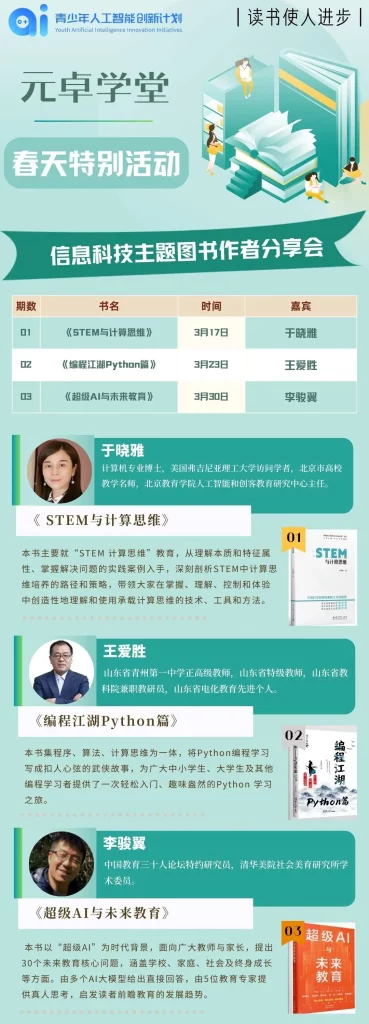
Yuanzhuo’s Spring Is the Time to Read series concluded with three sessions led by Xiaoya Yu, Director of the AI and Maker Education Research Centre at Beijing Institute of Education; Aisheng Wang, a senior teacher at professorial grade at Qingzhou No. 1 High School, Shandong; and Junyi Li, an invited research fellow of the China Education 30 Forum. They discussed STEM and Computational Thinking, Programming Jianghu: Python, and Super AI and the Future of Education respectively, with in-depth exchanges among participating teachers.
1. Exploring computational thinking: future directions for STEM education
In the first session, Xiaoya Yu presented Developing Computational Thinking through STEM Education around the book STEM and Computational Thinking. She explained computational thinking’s core concepts and importance in computer science and in developing multidisciplinary talent. Introducing eight practice areas, she showed its applications across fields and proposed a practical process that STEM students and teachers could use for self-checking. The talk presented this as an approach to putting computational thinking into practice.
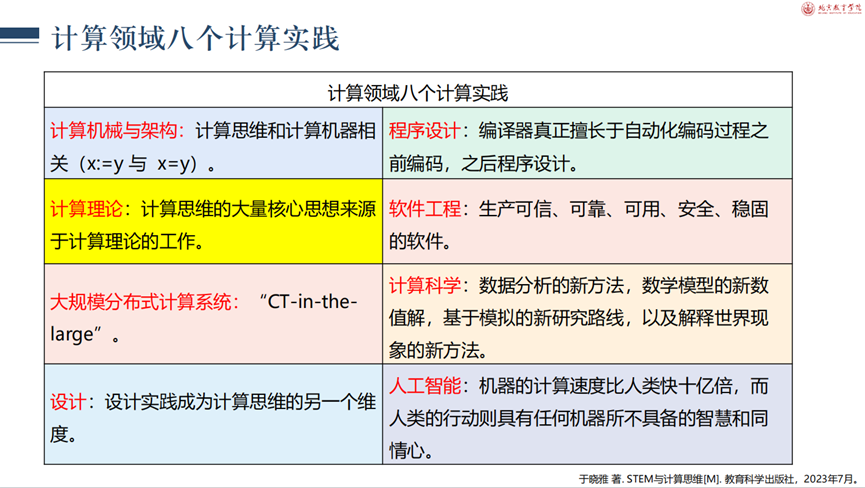
Eight computing practices in the original slide
- Computers and architecture: computational thinking relates to computing machines; the slide contrasts x:=y with x=y.
- Computational theory: many core ideas in computational thinking originate in work on the theory of computation.
- Large-scale distributed computing systems: the slide describes this as CT-in-the-large.
- Design: design practice provides another dimension of computational thinking.
- Programming: the slide emphasizes compilers’ role in automating coding and distinguishes coding from program design.
- Software engineering: producing trustworthy, reliable, usable, safe and robust software.
- Computational science: new methods of data analysis, new numerical solutions for mathematical models, simulation-based research approaches and ways to explain phenomena.
- Artificial intelligence: the historical slide uses a one-billionfold speed comparison alongside a contrast with human wisdom and empathy. No common task or test conditions are specified, so this is preserved as presentation material rather than a general performance benchmark.
2. Coding and cultural traditions: new directions for Python education
In session two, Aisheng Wang presented Algorithm and Programming Education Based on Computational Thinking: Creating Programming Jianghu. His book combines algorithm education with Chinese martial-arts fiction, using sword techniques, sword methods and the way of the sword as analogies for programming knowledge, algorithm design and computational thinking. He explained how computational thinking is expressed in programming and used challenging tasks such as Panlong Zhen, the Coiling Dragon Formation, and Feihua Ling, a poetry game, to deepen understanding of code and algorithms. He also emphasized practice and described data experiments for testing algorithm efficiency so that students could appreciate why it matters.
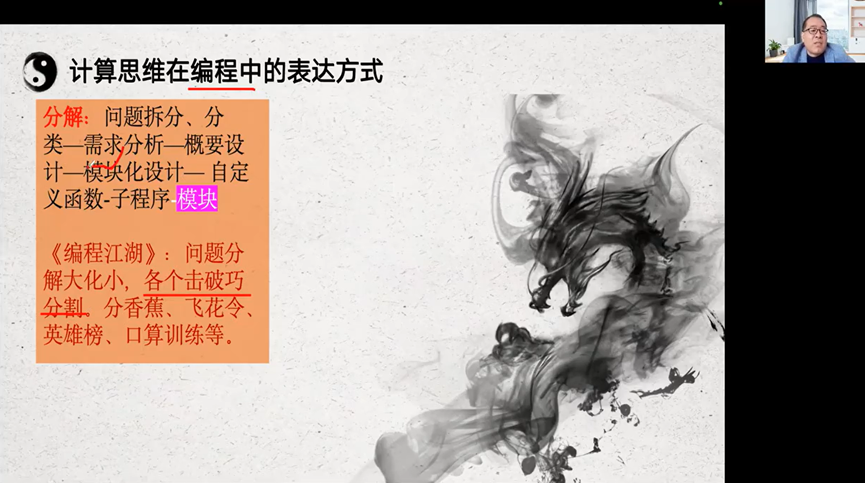
The programming slide illustrates decomposition through problem splitting, classification, requirements analysis, outline and modular design, custom functions, subprograms and modules. It advocates making large problems smaller and tackling their parts, with cases including dividing bananas, Feihua Ling, a heroes’ ranking and mental-arithmetic training. Book and task names belong to its martial-arts and classroom context.
3. Exploring education’s future: Super AI and new educational directions
Session three focused on Super AI and the Future of Education. Junyi Li presented Four Courses for Educators to Savour, identifying four AI-and-education themes: exploring contrasting perspectives, cognitive models, role definition and practical action. Thirty questions explored AI’s educational effects and teachers’ changing roles. He stressed teacher development in the AI age and shared his own work, including co-authoring books with AI, forming AI-focused study groups, and participating in metaverse and digital-education research projects.
Four AI-and-education themes in session three
- Exploring contrasting perspectives
- Cognitive models
- Role definition
- Practical action
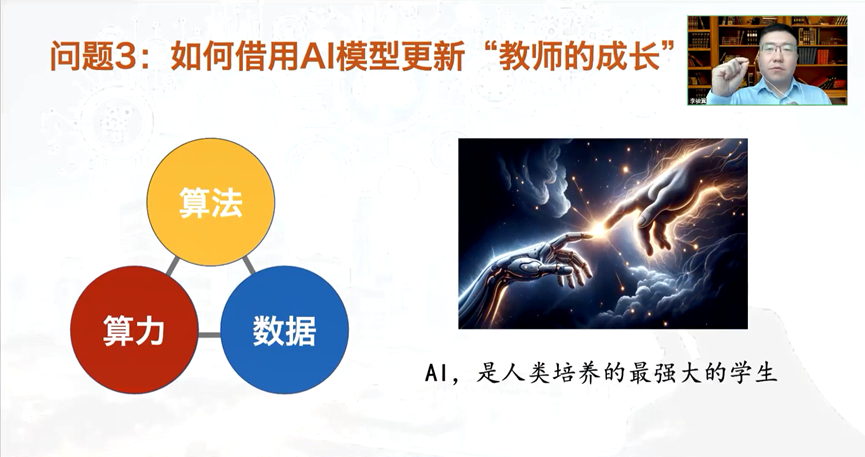
The slide uses algorithms, computing power and data to discuss teacher development and calls AI the most powerful student humanity has raised. These are archived presentation ideas and metaphors, rather than a universal ranking of machine capabilities.
The series concluded after exchanges on STEM, programming practice and educational AI applications. The original report regarded these discussions as helping clarify future directions for computational thinking and AI education. Yuanzhuo expressed its intention to continue contributing to AI education for young people.
Replay and teaching-materials entries for the three historical sessions
Session 1 | 17 March 2024 | Xiaoya Yu | STEM and Computational Thinking
Replay and materials entry · Handbook section
Session 2 | 23 March 2024 | Aisheng Wang | Programming Jianghu: Python
Replay and materials entry · Handbook section
Session 3 | 30 March 2024 | Junyi Li | Super AI and the Future of Education
Replay and materials entry · Handbook section
Earlier Yuanzhuo Classroom activities
Browse earlier Yuanzhuo Classroom activities
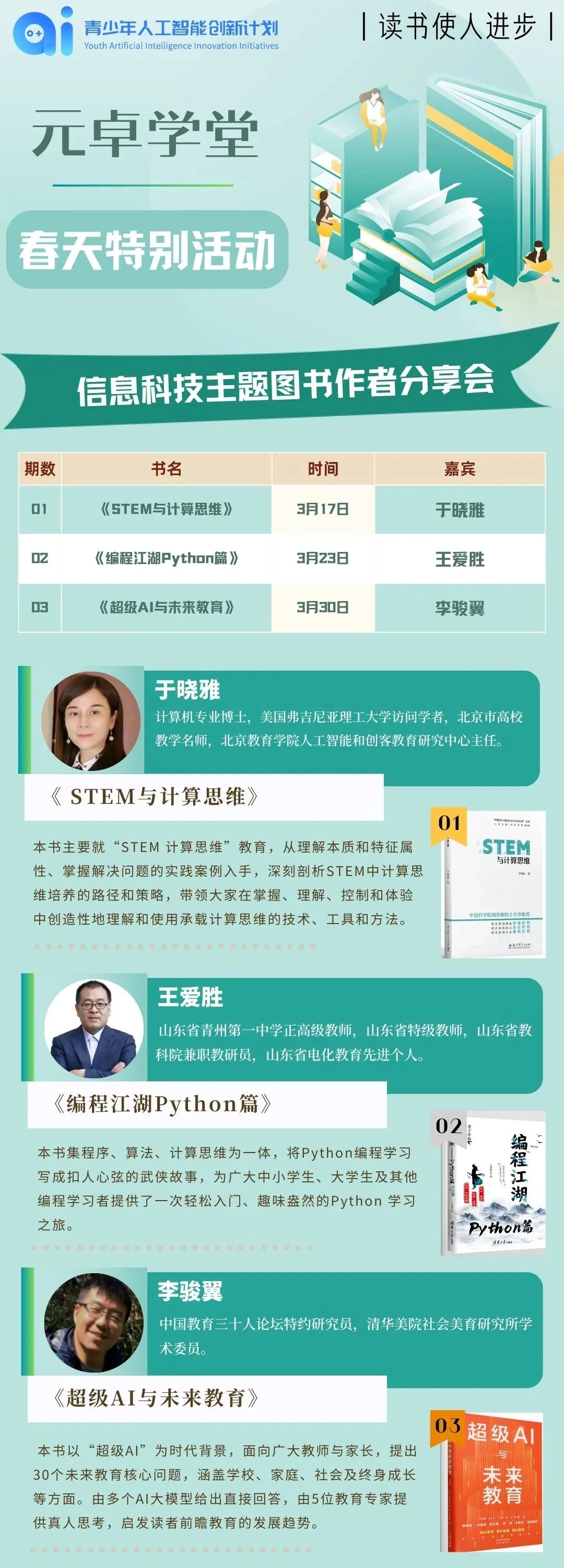
Speaker and book information from the original poster
Xiaoya Yu | STEM and Computational Thinking
The original poster describes a PhD in computing, a visiting scholar at Virginia Tech in the United States, a recognized Beijing higher-education teacher and Director of Beijing Institute of Education’s AI and Maker Education Research Centre.
The poster introduces the book through the nature and features of STEM computational thinking and problem-solving cases. It examines development pathways and strategies and encourages creative understanding and use of the technologies, tools and methods that embody computational thinking through mastery, understanding, control and experience.
Aisheng Wang | Programming Jianghu: Python
The poster identifies a teacher at professorial grade at Qingzhou No. 1 High School, a Shandong special-grade teacher, a part-time teaching researcher at Shandong’s education research institute and a recognized contributor to educational technology in the province.
The book combines programming, algorithms and computational thinking, framing Python learning through martial-arts stories. It offers primary, secondary and university students and other learners an accessible, engaging introduction.
Junyi Li | Super AI and the Future of Education
The poster identifies an invited research fellow of the China Education 30 Forum and academic committee member of the Institute of Social Aesthetic Education at Tsinghua University’s Academy of Arts and Design.
Addressed to teachers and parents in the context of Super AI, the book raises 30 questions about education’s future across schools, families, society and lifelong development. Several large AI models supply direct answers and five education experts contribute human reflections, encouraging readers to consider emerging trends.
Yuanzhuo Classroom community activities
Since January 2022, the Yuanzhuo Programme has organized Yuanzhuo Classroom community activities, encouraging young people to create original AI work and use innovative algorithms to solve real problems. It seeks collaboration among universities, primary and secondary schools, and technology companies; solicits and develops youth AI projects; and offers algorithms, computing power, datasets, knowledge and experience. The report presented support for youth AI education, international presentation of strong work and China’s development as a major AI innovation centre as aspirations. The start date here concerns the Classroom community activities.
Yuanzhuo Programme website
Visit the Yuanzhuo Programme website
Sources and archive notes
- Dates were cross-checked among the poster, Yuanzhuo’s first-quarter 2024 activity handbook and SLI’s Jingshi Zhixue, spring 2024, issue 29. Handbook printed pages 23–34 are physical PDF pages 25–36; newsletter printed pages 12–13 occupy physical PDF page 9. The original 5 April site date is retained. Upload-directory dates are not event or publication dates. Yuanzhuo activity handbook; SLI spring issue activity report
- The original my/course/216, 217 and 218 entries now link to public course-description pages with the same IDs. All three titles match the sessions; reachable descriptions do not establish playback without sign-in. The 38-page Chinese handbook and SLI issue remain original-language attachments, not claimed fully translated. Course description 216; Course description 217; Course description 218; Yuanzhuo activity handbook
- Text aids follow the original eight-practice, programming and teacher-development slides. The billionfold comparison lacks test conditions, and the most-powerful-student wording is rhetorical; neither is presented as a general measured result. All original images remain complete. Original Chair article; Yuanzhuo activity handbook
- Roles, honours and poster book descriptions are archived from 2024. Foreign-language book titles are descriptive translations here, not evidence of editions in those languages. January 2022 refers to Classroom community activities, not the founding of the entire Yuanzhuo Programme. Original Chair article; Yuanzhuo activity handbook
Find more AI and STEM learning resources in the Resource Centre
Original link: https://aiedchair.bnu.edu.cn/news-6520-en/