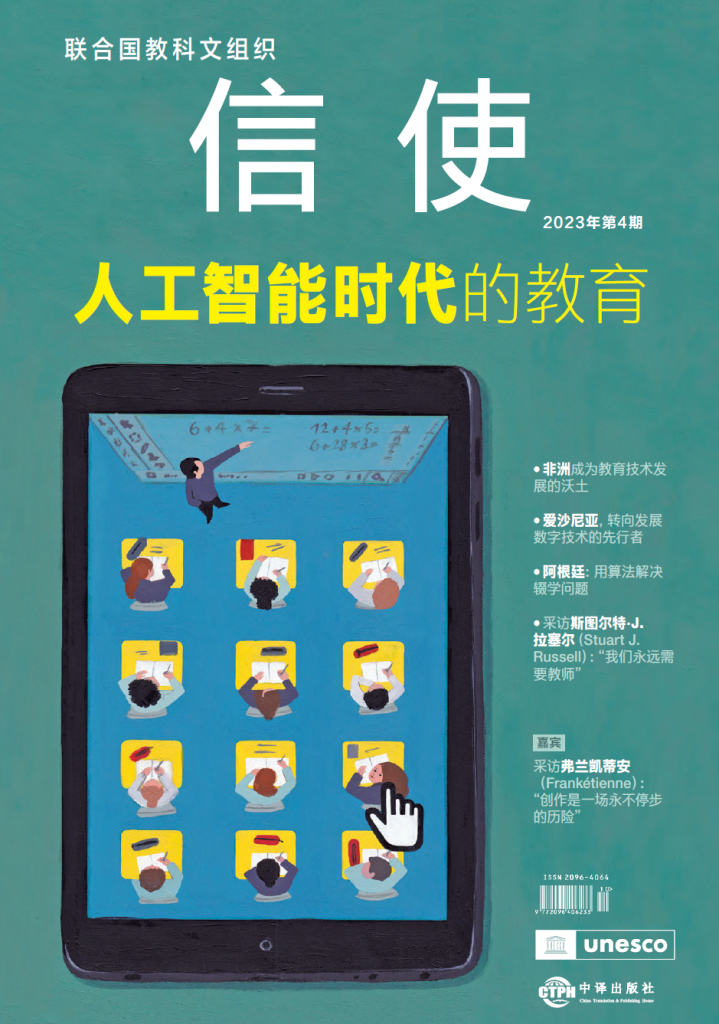
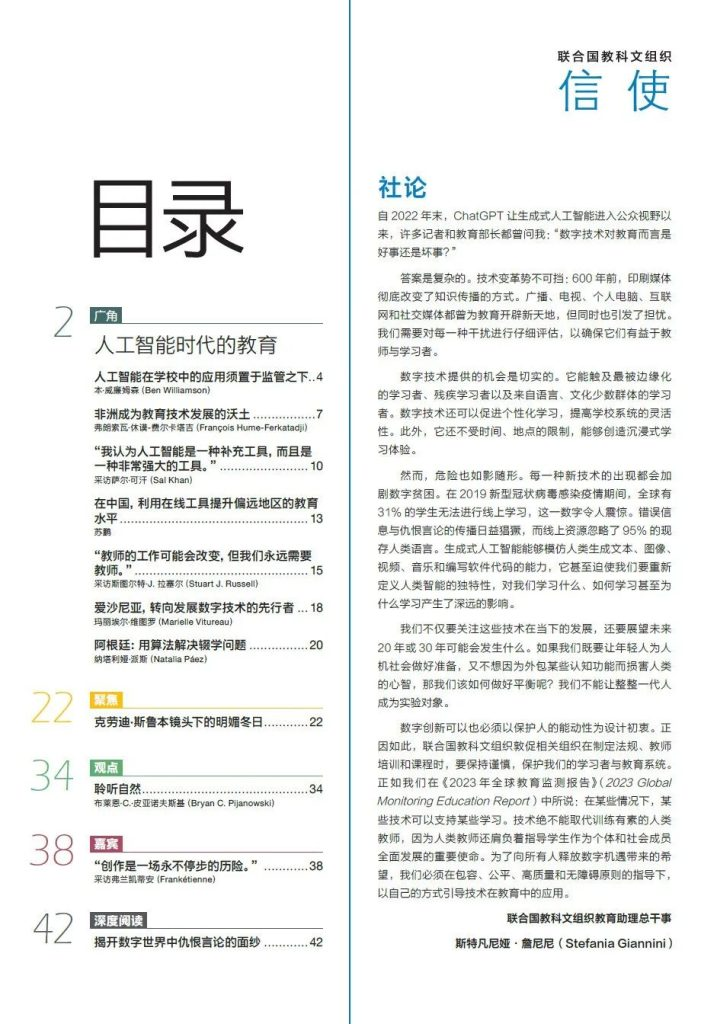
This page preserves the editorial and excerpts from seven articles in The UNESCO Courier, issue 4 of 2023, “Education in the age of artificial intelligence”, with consistent sections and author credits. Project figures, policy timelines and technological assessments reflect the reporting context of 2023. The original site archive date, 15 November 2023, is retained.
Editorial
Stefania Giannini, UNESCO Assistant Director-General for Education. The first-person voice in this editorial is the author’s.
Since ChatGPT brought generative artificial intelligence to public attention in late 2022, many journalists and education ministers have asked me: “Is digital technology good or bad for education?”
The answer is complex. Technological change is inevitable: six hundred years ago, printing transformed the transmission of knowledge. Radio, television, personal computers, the internet and social media opened new educational horizons, while also raising concerns. Each disruption needs careful evaluation to ensure that teachers and learners benefit.
Digital technology offers real opportunities. It can reach the most marginalized learners, learners with disabilities, and members of linguistic and cultural minorities. It can support personalized learning and more flexible school systems. It can also overcome barriers of time and place to create immersive learning experiences.
Yet dangers accompany these opportunities. Each new technology can deepen digital poverty. During the COVID-19 pandemic, an alarming 31% of students worldwide could not access online learning. Misinformation and hate speech are spreading, while online resources overlook 95% of living human languages. Generative AI can imitate human abilities to produce text, images, videos, music and software code. It even forces us to reconsider what is distinctive about human intelligence, with profound implications for what we learn, how we learn, and why.
We must consider not only these technologies today, but what may happen twenty or thirty years from now. How can we prepare young people for a human–machine society without weakening the human mind by outsourcing cognitive functions? We cannot make an entire generation the subjects of an experiment.
Digital innovation can and must be designed to protect human agency. UNESCO therefore urges caution as regulation, teacher training and curricula are developed to protect learners and education systems. As the 2023 Global Education Monitoring Report concluded, some technology supports some learning in some contexts. Technology must never replace well-trained human teachers, whose mission includes guiding students’ holistic development as individuals and members of society. To make digital opportunities available to everyone, we must shape technology’s educational use on our own terms, guided by inclusion, equity, quality and accessibility.
AI must be kept in check at school
By Ben Williamson.
AI in education poses important questions for educators and education-system leaders. Schools worldwide need informed advice on using AI, grounded in clear educational goals and risk assessment. International bodies are already developing ethical and regulatory frameworks for AI; education must receive equally strong protection.
Alongside regulatory instruments, national bodies and public officials should consider new forms of oversight of educational AI. The UK’s Digital Futures Commission recently proposed an “EdTech certification scheme”, requiring companies to demonstrate educational benefits and robust protection for children before operating in schools.
With AI, organizations able to conduct independent “algorithmic audits” to assess potential harms from automated systems could prevent technologies entering schools before scrutiny and necessary rules are in place. These safeguards require political will from governments and external pressure from influential international organizations. Independent assessment and certification may be the best way to protect schools from becoming laboratories for an unchecked expansion of AI.
Africa emerges as the hotbed for edtech
The health crisis associated with the COVID-19 pandemic accelerated the adoption of new educational technologies across Africa. It opened opportunities for innovative solutions, while inequalities in digital access remained.
In Sierra Leone, more than half the population is under eighteen, teacher shortages are severe, and teaching quality often suffers. Many young teachers are placed in classrooms without training to fill vacancies. Insufficient training is a problem across much of the continent: UNESCO’s 2023 Global Education Monitoring Report states that only 64% of primary and 50% of secondary teachers in sub-Saharan Africa have received the minimum required training. AI can help teachers find pedagogical approaches and build courses suited to students’ needs. At the time of the report, at least 1,500 teachers had registered for the Sierra Leone AI programme. Services for students were also emerging: Kenya’s Eneza Education platform specializes in primary and secondary tutoring accessible by mobile phone, reaching remote communities with limited internet access. Higher education, too, was moving towards digital technologies.
“I see AI as an additional tool, but a very powerful one”
An interview with Sal Khan, conducted by Anuliina Savolainen.
From March 2023, Khan Academy, the non-profit provider of free online courses, piloted an AI teaching assistant called Khanmigo. Its founder, Sal Khan, believes that with appropriate supervision it can consolidate students’ learning and build their confidence.
“Students are delighted to be able to ask Khanmigo questions immediately. We have all experienced forgetting something and feeling too embarrassed to ask another person; on-demand video or an AI assistant can ease that anxiety. Teachers have been surprised by how many questions students are afraid to ask in class. They say feedback reports on those questions help them make sure concepts are explained thoroughly. They also appreciate Khanmigo’s lesson-planning and assignment functions. Another feature valued by teachers and students is simulated conversation with historical or literary figures. Debating with AI gives children a safe setting to refine their arguments before returning to the classroom for a real discussion.”
In China, online tools to level up learning in remote areas
By Su Peng (苏鹏).
Some companies have launched charitable initiatives to improve rural education through digital technology. Tencent’s digital volunteer teaching project is one example: at the time of the report it had recruited more than 10,000 volunteers to provide online teaching for over 1,000 rural schools.
Many urban residents in China are keen to volunteer as teachers, in contrast to the shortage of teachers in rural areas, but distance and scheduling prevent them from teaching in person. Digital volunteering addresses this practical barrier. The project mainly recruits university students alongside experienced volunteers; training and assessment prepare its core volunteer team. A digital platform handles recruitment, course planning, teaching and administration, supporting quality digital courses for thousands of rural schools simultaneously. Research cited by Feng Xiaoying, a professor of educational technology at Beijing Normal University, indicates significant improvements in children’s subject knowledge and higher-order thinking.
Educational informatization can advance fairness and equity in rural China, but using digital tools also challenges rural teachers. Feng notes that rural digital infrastructure has long been underused, with many teachers treating electronic screens merely as slide projectors. Government and businesses are working on this problem. Onion Academy, for example, developed a smart teaching-assistant solution to explore human–machine co-teaching and co-education, enrich lessons and strengthen rural teachers’ capabilities. In another example, by October 2022 the Basic Education Research and Development Institute of Wuhua District, Kunming, Yunnan, had uploaded more than 500,000 teaching cases and teacher-training resources to an AI platform for district-wide sharing.
Feng also advocates the “dual-teacher classroom”: online and local teachers cooperate in the digital volunteer project. Local teachers can improve their technological literacy and explore new teaching and research methods with remote colleagues. AI can help project staff record key phrases and analyse classroom interactions and presentation effects, facilitating subsequent performance assessment. “We now pay more attention to ‘digital intelligence’,” Feng explains. Previously, rapid technological development required experts to evaluate classroom performance and student learning. Advanced systems can now assist with this work: “With big data and AI, digital technology is changing not only teaching models but also the way educational governance is conceived.”
“Teachers’ work may change but we will always need them”
An interview with Stuart J. Russell, conducted by Anuliina Savolainen.
Where do these latest developments leave teachers?
“Teachers’ work will change, but teachers will still be needed. One challenge is making AI tutoring systems understand the nature of teaching: their job is not to be right all the time or provide every answer, but to help students find answers themselves. There have been impressive demonstrations of training general-purpose language models in ways similar to teacher training.
How does each student interact with an AI system? Are students getting the help they need? What do they not understand? Which learning approaches are appropriate? Answering these questions requires human involvement. Students must also learn to cooperate and function socially, for which adult guidance remains necessary. One possible model would have a teacher working with eight to ten students and spending much time on individual guidance, acting somewhat as an intellectual guide. Students would then have more direct contact with teachers, rather than less.
Traditional education leaves struggling students in every grade. Some very capable children find school boring, while others cannot follow lessons and quickly lose motivation. Alarmingly, some finish school still unable to read and write. Clearly, our systems are failing to attend to each learner’s performance. They also do not adequately recognize differences in how people learn. Excellent AI teaching systems could adapt rapidly to each learner’s needs, but we have not achieved that yet.”
Estonia, an early convert to digital technology
In 1997 Estonia launched Tiger Leap, a government programme to equip primary and secondary schools with computers. Its influence went beyond education, changing Estonians’ ways of thinking. The X-Road platform, launched in 1999 as core infrastructure for electronic government, provides access to many state and municipal services online. The article anticipated greater emphasis on information-technology skills in the curriculum beginning in the 2024 school year. Estonia was confident about adopting the next generation of technology: the next revolution would be digital school textbooks that adapt to individual students’ abilities.
An algorithm to combat school dropout in Argentina
By Natalia Páez.
Victoria Ocampo secondary school took part in a pilot early-warning system using AI software to prevent pupils dropping out. Begun in 2022 with funding from the US-based Tinker Foundation, the system was designed by the Applied Artificial Intelligence Laboratory at the University of Buenos Aires. It raises alerts when dropout risk is identified, allowing action to follow, and covers all secondary students in Mendoza province.
The system provides schools with information about students’ circumstances. A form teacher opens a module showing a dashboard with the class programme and student list, with a dropout-risk indicator beside each name. The algorithm uses four variables: grades, absences, family educational background, and the gap between age and grade level. A protective school-education system can tailor provision to each student’s situation. Crucially, form teachers bring emotional commitment to the work and information needed to build relationships. When a student encounters problems, they can investigate whether support is lacking, whether the family needs assistance, or whether particular subjects are difficult.
Sources, correction and further reading
Source: The UNESCO Courier, issue 4 of 2023 (October–December). The issue page was published on 29 September 2023. These are the site’s existing excerpts, not a reproduction of the entire issue. On page 10 of the English original, the teacher-shortage and 1,500-teacher example concerns Sierra Leone; “Côte d’Ivoire” in the old repost is corrected accordingly. The original texts are licensed CC BY-SA 3.0 IGO; this arrangement and the site translations use the same licence. Images fall outside that text licence.
Read the issue page, official English issue and text licence; background: UNESCO guidance on generative AI; teaching resources: special and inclusive education resources.
Original link: https://aiedchair.bnu.edu.cn/news-6232-en/