
CITLAB highlights research on AI literacy and agency among language teachers, adolescents’ critical evaluation of online video, pair programming and computational thinking, rural students’ experiences with generative AI, and a review of AI for self-regulated learning.
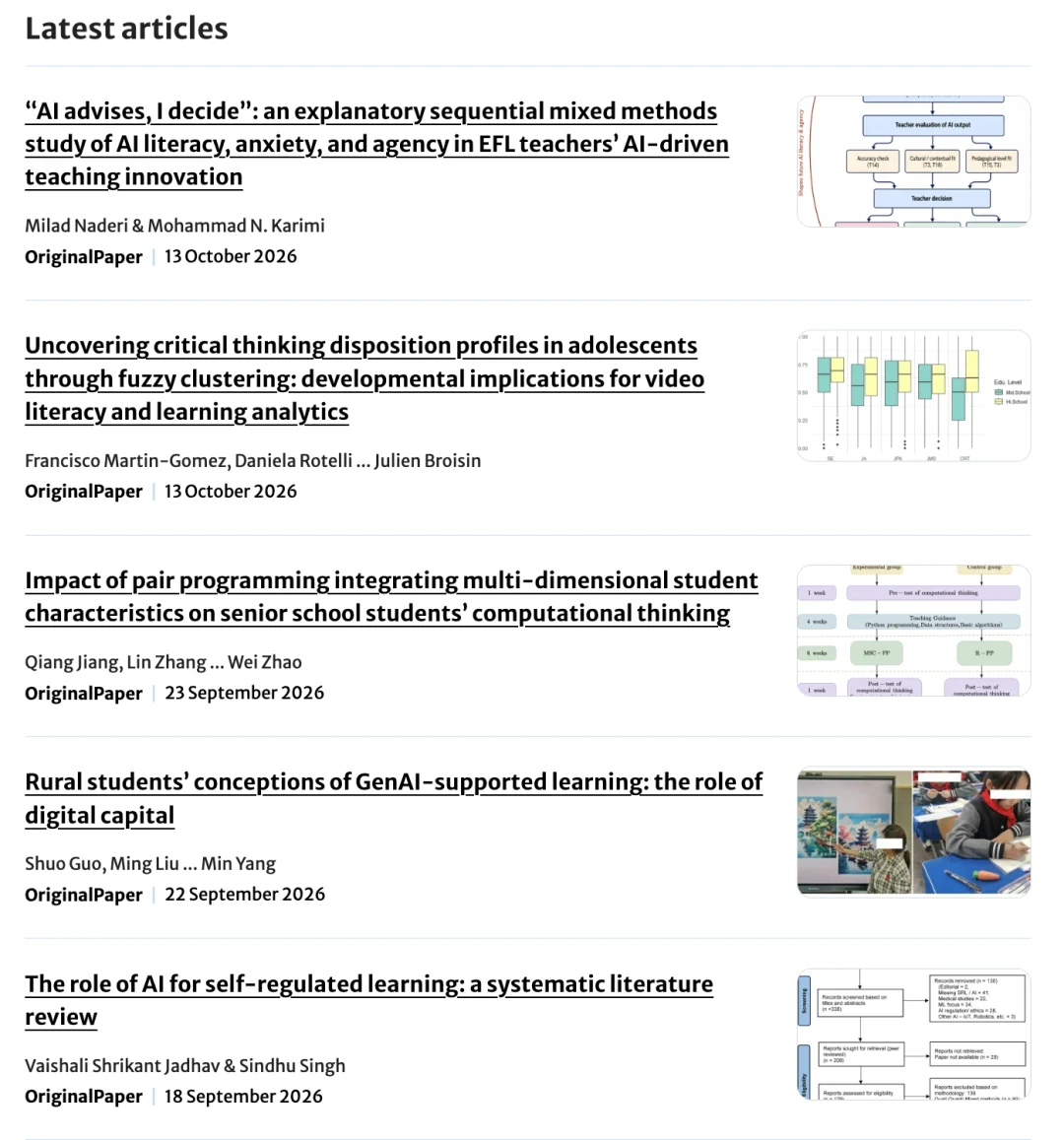
This article presents five papers from the Journal of Computers in Education. Let’s take a look together—
See the source links for the PDF.
01 “AI advises, I decide”: an explanatory sequential mixed methods study of AI literacy, anxiety, and agency in EFL teachers’ AI-driven teaching innovation
Authors:
Milad Naderi
Mohammad N. Karimi
Research Topic:
The present study aims to test a sequential mediation model examining the psychological and cognitive assets of EFL teachers navigating the current technological era. We propose that AI literacy does not mechanically yield AI-driven teaching innovation in isolation. Rather, we hypothesize that this relationship is sequentially mediated by the reduction of AI anxiety and the subsequent bolstering of teacher agency.
Abstract:
Generative AI has repositioned English as a foreign language (EFL) teachers from technology consumers to architects of AI-driven teaching innovation (AITI). Yet, little is known about the psychological mechanisms that determine whether this transition succeeds. Grounded in Self-Determination Theory (SDT) and the Ecological Model of Teacher Agency, this explanatory sequential mixed methods study tested whether AI anxiety and teacher agency sequentially mediate the relationship between AI literacy and AITI among EFL teachers. In the quantitative phase, 361 EFL teachers completed validated self-report measures, analyzed through structural equation modeling (SEM). The findings indicated that AI literacy positively predicted AITI directly and indirectly, with AI anxiety and teacher agency emerging as significant sequential mediators. In the subsequent qualitative phase, semi-structured interviews with 21 teachers, analyzed through reflexive thematic analysis, both substantiated and extended these pathways. Findings revealed that anxiety was relationally produced through professional comparison, that agency functioned as deliberate boundary-setting around AI’s instructional jurisdiction, and, most critically, that this psychological pathway unfolded largely in the absence of institutional policy or support, leaving teachers to innovate alone. The integrated findings suggest that cultivating AI literacy is necessary but insufficient; sustained innovation requires institutional scaffolding alongside individual psychological readiness.
Keywords:
AI-driven teaching innovation
AI literacy
Teacher agency
AI anxiety
EFL
Mixed-methods
Sequential mediation
Link:
https://link.springer.com/article/10.1007/s40692-026-00407-z
02 Uncovering critical thinking disposition profiles in adolescents through fuzzy clustering: developmental implications for video literacy and learning analytics
Authors:
Francisco Martin-Gomez
Daniela Rotelli
Mar Pérez-Sanagustín
Julien Broisin
Research Topic:
The present study is aimed at evaluating the effectiveness of a digital platform designed to foster critical thinking through video analysis.The study seeks to deepen the understanding of the cognitive processes and individual factors that influence how students evaluate online videos. This work extends the findings of Hémon et al. (2025), who demonstrated that certain dispositions, namely self-efficacy and epistemic beliefs, predict students’ ability to discriminate between videos based on source expertise.
Abstract:
This article investigates how integrated configurations of critical thinking dispositions, combining self efficacy, epistemic beliefs, and reasoning style, influence educational video evaluation and school related usage decisions among 1,079 secondary school students. Fuzzy C-Means clustering identified three distinct dispositional profiles at each educational level. In high school, two high disposition subtypes emerged: an intuitive profile (high self efficacy, low analytical reasoning) and an analytical profile (moderate self efficacy, high analytical reasoning). Only the analytical profile linked to superior critical performance and confirmation bias resistance. The intuitive profile, despite high confidence, matched low disposition students. In middle school, performance scaled with overall disposition intensity, without reasoning style moderation. Findings indicate that effective high school critical thinking requires motivation analytical reasoning coupling, suggesting a late adolescent threshold. The study informs differentiated pedagogy and computer-based decision support systems (e.g., learning analytics platforms) in digital education.
Keywords:
Critical thinking dispositions
Video literacy
Self-efficacy
Epistemic beliefs
Cognitive reflection
Analytical reasoning
Fuzzy C-Means clustering
Person-centred approach
Learning analytics
Adolescent development
Digital literacy
Educational decision-making
Link:
https://link.springer.com/article/10.1007/s40692-026-00404-2
03 Impact of pair programming integrating multi-dimensional student characteristics on senior school students’ computational thinking
Authors:
Qiang Jiang, Lin Zhang
Weiyan Xiong, Qi Li
Pan Liu, Wei Zhao
Research Topic:
Considering that future programming activities will increasingly involve interactions between humans and AI systems, understanding how to optimize human–human collaboration provides an important foundation for developing students’ capacity to participate effectively in AI-mediated programming environments. Building on this foundation, this study further explores the integration of these three characteristics into the design of pairing method to evaluate whether such integration yields an additive effect on the effectiveness of programming instruction.
Abstract:
Although substantial research has been conducted on pair programming, the optimal approach to pair students remains insufficiently explored. Most studies on K-12 programming have concentrated on pairing formats but have paid little or no attention to student characteristics. This study addresses this gap by determining the effectiveness of a pairing method based on multi-dimensional characteristic fusion in improving students’ computational thinking. The proposed method integrates rule-driven and data-driven pairing algorithms, incorporating three key characteristics: personality, learning skills, and collaborative attitudes. A Random Forest regression model was employed to learn the contribution of each characteristic to predict and dynamically adjust pairing weights. Subsequently, a quasi-experimental design was adopted to designate 104 senior school students to a random pairing group or a multiple student characteristics-integrated pairing group. Then, the students’ performance across core dimensions of computational thinking was assessed. The results indicate that learning skills ranked highest in characteristic importance, followed by collaborative attitude and personality. Moreover, the characteristic-recommended pairing group had significantly higher scores than the random pairing group in all targeted computational thinking except critical thinking. The interview results also confirmed the effectiveness of the proposed method. This study demonstrates that student characteristics positively affect pair programming outcomes and provides empirical validation and practical insights for fine-tuning pairing strategies in K-12 programming.
Keywords:
Pairing programming
Student characteristics
Computational thinking
Senior school students
Random Forest
Link:
https://link.springer.com/article/10.1007/s40692-026-00408-y
04 Rural students’ conceptions of GenAI-supported learning: the role of digital capital
Authors:
Shuo Guo, Ming Liu
Yun-Fang Tu, Errun Liu
Wei Zhang, Yiling Ren
Chongrong Xu, Min Yang
Research Topic:
the present study aims to explore rural students’ conceptions across different levels of digital capital using drawing analysis and ENA. The findings are expected to offer novel insights for researchers and educators to develop appropriate learning activities tailored to students’ conceptions of GenAI-supported learning. The research questions are listed as follows:
(1) What are the general structures of rural students’ experienced and ideal conceptions of GenAI-supported learning?
(2) How do rural students with different levels of digital capital differ in their experienced and ideal conceptions of GenAI-supported learning?
Abstract:
Generative artificial intelligence (GenAI) is increasingly integrated into K-12 education. However, little is known about how rural primary students conceptualize GenAI-supported learning. Digital capital is a critical sociocultural resource that shapes how students form and differentiate their conceptions. Thus, this study investigated 112 rural students’ conceptions of GenAI-supported learning using drawing analysis and epistemic network analysis (ENA), and further examined how digital capital influenced these conceptions. Each student drew paired drawings representing both experienced and ideal contexts, which were coded into 32 elements in six categories. The results revealed that:
(1) the students’ experienced conceptions emphasized collaborating with GenAI to learn mathematics at home. However, their ideal conceptions envisioned GenAI as an embodied companion for dialogic learning in natural environments.
(2) The students with higher digital capital (HDC) envisioned richer interdisciplinary applications, while those with lower digital capital (LDC) continued to frame GenAI as a functional tool for mathematics-related information searching. Overall, this study reveals how rural students conceptualize GenAI-supported learning, highlighting the pivotal role of digital capital in shaping these conceptions. The findings contribute novel insights for designing student-centered, equity-oriented strategies that leverage GenAI to enhance rural education.
Keywords:
Generative artificial intelligence
Rural education
Students’ conceptions of learning
Digital capital
Epistemic network analysis (ENA)
Link:
https://link.springer.com/article/10.1007/s40692-026-00405-1
05 The role of AI for self-regulated learning: a systematic literature review
Authors:
Vaishali Shrikant Jadhav
Sindhu Singh
Research Topic:
the present study undertakes a systematic review of experimental and quasi-experimental studies focused on AI-supported SRL to generate a rigorous synthesis of empirical evidence to clarify AI support or hindrance for distinct SRL processes. Accordingly, this study is guided by the following research questions:
(1) What is the theoretical basis used in implementing AI tools for SRL?
(2) What is the learning context and profile of learners who have used AI tools for SRL support?
(3) Which are the areas of self-regulated learning that AI tools have helped scaffold?
(4) Which AI technologies have been used for scaffolding SRL?
Abstract:
Self-regulated learning (SRL) is known to impact motivation, performance, and learning outcomes positively with learners. Recent progress in AI technologies have triggered development of AI-enabled learning technologies to scaffold SRL. The complexity of AI tools can cause cognitive overload, and the ubiquitous use of AI in learning can impact critical thinking capabilities. Implementing AI tools using SRL concepts and frameworks can alleviate these concerns. The pace of AI innovation and the large number of dimensions and constructs of SRL necessitate an investigation of cause-effect relations between SRL processes and AI tool implementation and usage in real-life scenarios using experimental studies. Prior review studies have largely focussed on conceptual frameworks and technology specific application with limited attention to experimental studies which can validate the practical efficacy of these AI tools to support SRL for diverse learning settings, including informal and collaborative learning contexts. Most of the review studies have narrowed their focus to a specific AI technology and a narrow SRL dimension. Building on these identified gaps, this SLR study reviewed 41 experimental studies to understand the theoretical grounding, learning contexts, types of AI technologies used, and SRL processes being supported by various AI technologies to ascertain the usefulness of AI tools for SRL support and to review the empirically proven cause-and-effect relationship between various SRL and AI constructs. The study identified that experimental studies h ave limited operationalization of SRL theories for AI-supported SRL, negligible focus on informal learning environments and limited AI tools for enabling the SRL phases of forethought and performance. The study offers a concept of AI personas to understand how learners interact with AI systems and a guidance for future experimental researchers to address the challenges of limited theoretical integration, learning contexts, and SRL processes. To improve completion rates and reduce dropout rates for online learning platforms, attention to implementation of AI for SRL in non-formal learning contexts is needed in future experimental research.
Keywords:
Self-regulated learning
Artificial intelligence (AI)
Professional learning
Online learning
AI in education (AIEd)
Link:
https://link.springer.com/article/10.1007/s40692-026-00406-0
Source: JCE Journal, Volume 13, Issue 3
See the source links for the PDF.
Original link: https://aiedchair.bnu.edu.cn/news-citlab-2247627313-1-en/