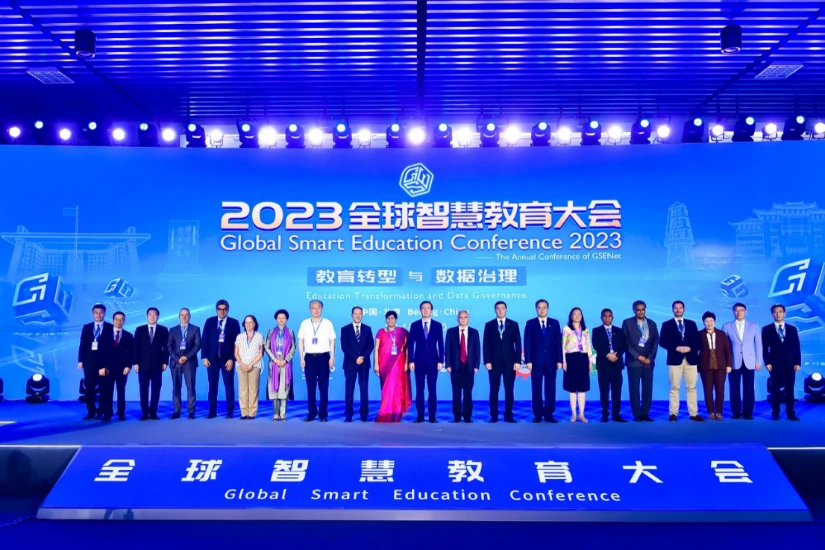
The Global Smart Education Conference 2023 opened in Beijing on 18 August under the theme of educational transformation and data governance. Experts, scholars and teachers from education, technology and business explored digital transformation strategies, technology-enabled education, regional ecosystems, learning societies, the digital generation and assessment innovation, sharing theories, technologies, perspectives and results. More than 300 domestic and international guests and over 1,200 on-site delegates participated. Roles and programme details below reflect the opening report from 2023.
Digital transformation and smart education innovation
Digital transformation requires strategic, systemic planning across educational elements, processes, functions and sectors, with smart education as its intended form. The UN Transforming Education Summit highlighted the digital revolution’s potential to make quality education and lifelong learning a common good for everyone. China proposed digitalising education and building a learning society and nation with lifelong opportunities for all.
China’s Vice Minister of Education Chen Jie described smart education as an important route to equitable, inclusive quality education and lifelong learning. As AI applications expanded, data governance became a central challenge for educational transformation.
He outlined China’s priority for education and its national digital education action: strengthening infrastructure and support systems, developing the national Smart Education platform, expanding quality resources, integrating technology with teaching reform and pursuing international cooperation.
Chen proposed three areas of cooperation:
- Policy dialogue on ideas, strategies, planning, standards, data governance, safety and ethics, to develop effective approaches to smart education.
- Resource sharing through jointly developed public digital platforms for lifelong learning, enabling more countries and communities to help create quality resources.
- Capacity development through international teacher cooperation, digital teaching skills, exchange of reform experience, collaborative research and curriculum development.
BNU President Ma Jun emphasised teacher education universities’ role in connecting basic and higher education, developing digital literacy and supporting educational transformation. BNU’s demonstration projects, Internet Plus Education reform and teacher development initiatives sought to share the benefits of digital development more widely.
He proposed the following directions:
- Advance original basic research and intelligent technology ecosystems to support educational modernisation.
- Connect teacher education universities through information, resources and complementary strengths, improving teacher education and balanced provision.
- Help diverse learners understand, think, develop skills and communicate and collaborate in digital spaces for their futures.
Chinese Academy of Engineering member Zhao Qinping stressed technology and data governance in educational transformation. Learners need flexible, ubiquitous, networked environments combining physical and virtual settings for authentic collaborative and inquiry learning. He described a move from virtual reality 1.0 to 2.0: intelligence, interoperability and evolution would complement immersion, interaction and imagination. Connections would extend to digital twins of physical objects, human avatars and digitally native objects, supporting life across physical and digital worlds and more relaxed, engaged and effective learning.
International cooperation on learning crises and digital divides
The conference highlighted international dialogue and cooperation to address educational challenges and learning crises, promote innovation and spread the benefits of digital education.
Mauritius Vice Prime Minister and Minister of Education, Higher Education and Technology Leela Devi Dookun-Luchoomun described persistent inequality in the Global South, particularly sub-Saharan Africa, with the digital divide a tangible barrier. She advocated human well-being and mutually supportive human and artificial intelligence, outlined Mauritius’s technology-enabled lifelong learning measures and called for technical cooperation supporting growth, employment and social welfare.
Turkmenistan’s Deputy Minister of Education Azat Atayev described a digital education strategy developed with UNESCO IITE, BNU and other partners. Measures included legislation, e-learning platforms, technology-supported teaching and data-informed decisions. He proposed identifying structures and clusters in educational data, analysing networked digital footprints and personal digital records, and exploring cognitive development prediction using educational and human development data.
Mahmoud Zouaoui, Chief of Staff at Tunisia’s Ministry of Higher Education and Scientific Research, discussed digital platforms and information systems that support researchers, teachers and students, improve resource use, narrow divides and inform decisions. He highlighted privacy, information security and online abuse risks, advocating infrastructure and collaboration to support equity, safety and learning experiences.
Talent development and lifelong learning
At the forum on educational digitalisation and lifelong learning, Chinese Academy of Sciences member Lü Jian connected the purposes of educating people, universities and the needs of the times. He presented Nanjing University’s use of strong disciplines to support talent development, build the underlying capabilities of its disciplinary ecosystem and develop a problem-oriented, integrated bachelor’s–master’s–doctoral education model.
Asha S. Kanwar, President and CEO of the Commonwealth of Learning (COL), connected lifelong learning with SDG 4’s inclusive and equitable quality education for all. Smart education should be enjoyable, engaging, efficient, effective and ethical. In her 2023 remarks, she warned that climate disasters could become a major disruption over the following decade. Technology should be meaningful, support livelihoods, reach vulnerable and marginalised groups, address stakeholder needs and build preparedness for shocks, while developing independent thinkers. Lifelong learning must extend through culture, policy, planning and daily life, sustaining knowledge, skills and values within a learning culture.
Chinese Academy of Engineering member Zhang Jun discussed green education supported by data collection, knowledge graphs, the metaverse and large models. Data about resources, behaviours and outcomes can inform understanding; connecting fragmented knowledge supports synthesis and innovation. Immersive, interactive, contextual and game-based courses, diverse learning paths and innovative models can support learning. He introduced Beijing Institute of Technology’s iSPACE+X green education system, addressing values, educational models and programme design to develop innovative talent.
UNESCO IIEP Director Martín Benavides described technology as an important part of educational transformation, with responsible use essential to success. It should sit within broader government strategies, strengthen educational planning and management, and develop the digital capabilities of students, educators and other participants so they can use technology successfully and responsibly.
Chinese Academy of Engineering member Chen Xiaohong identified five shifts in talent development:
- From conventional thinking to digital and intelligent thinking.
- From disciplinary specialisation to cross-disciplinary work.
- From mainly theoretical research to innovative practice.
- From traditional assessment to comprehensive evaluation.
- Towards deeper integration of science, humanities and the arts.
She advocated interdisciplinary and innovative education for innovative, practical and versatile graduates. She described Hunan University of Technology and Business’s integration of emerging engineering, business and humanities, with innovation in learning spaces, teaching models, resources and assessment to develop advanced entrepreneurial and applied capabilities.
UNESCO IICBA Director Quentin Wodon presented African teacher digital learning platforms and skills development by video. Human capital matters for national wealth and education, yet many African ten-year-olds lacked basic literacy amid a severe learning crisis. Computers alone would not improve teaching: teachers need digital skills and effective resource use. He advocated infrastructure, free internet access for teachers and pre-service and in-service training to integrate technology and pedagogy.
ALECSO Director-General Mohamed Ould Amar spoke by video about ICT and educational transformation in the Arab region. Initiatives included Arab Code Week, blockchain verification of university degrees and the ALECSO NFT educational platform introducing young people to the metaverse and NFTs. He proposed wider cooperation with international and regional organisations, universities and research institutions to support learners in a knowledge society.
Research on Internet Plus Education
At the opening, BNU Professor Chen Li, Chair of the Technical Committee of the National Engineering Research Center of Cyberlearning and Intelligent Technology, presented theoretical research on Internet Plus Education addressing three areas:
- Explain how the internet changes education, the meaning and scope of Internet Plus Education and priorities for innovation.
- Develop its philosophical foundations in ontology, epistemology, methodology and worldviews.
- Identify educational patterns including learner self-organisation, collective emergence of knowledge and nonlinear teaching–learning relationships.
The original report described this as China’s first comprehensive, systematic account of the field’s underlying theories, intended to support the national strategy. It also announced further conference outputs on smart education, AI and future education.
BNU Vice-President Zhou Zuoyu chaired the opening. UNESCO IITE Director Zhan Tao chaired the digitalisation and lifelong learning forum; Qin Changwei, Secretary-General of the Chinese National Commission for UNESCO, attended.
First-day parallel forums
Three further first-day forums addressed data governance and cognitive development, generative AI and education’s future, and digital education strategies and policy planning. Contributions included:
- Lei Chaozi, Director of the Ministry’s Department of Science, Technology and Informatization, described data governance and education big data supporting reform.
- Mammo Muchie, member of the Academy of Science of South Africa, discussed digital higher education and AI in the FOCAC Dakar Action Plan.
- John Shawe-Taylor, Director of IRCAI under the auspices of UNESCO and UCL professor, proposed human-centred AI supporting experience, energy and creativity.
- Zhang Zhiyong, Director of BNU’s Education Survey Center, discussed strategies for strengthening education.
- Sun Shanxue, member of the Ministry’s education strategy advisory committee, analysed TVET digitalisation challenges.
- Raúl Valdés-Cotera, programme coordinator at UNESCO UIL, examined widening higher education access with technology.
- Harlena Harris, programme director of APEC’s Human Resources Development Working Group, proposed technology-enabled thinking and educational change.
- Andreas Schleicher, OECD Director for Education and Skills, advocated learning in a digital world.
Design for Future Education competition
The sixth Global Competition on Design for Future Education held its finals alongside the conference. Since its 1 March launch, over 1,000 university students and 2,000 school teachers from more than 30 countries and regions had registered. Each track selected 20 projects for the 18–20 August finals. Interdisciplinary mentors supported student teams’ innovative designs and technologies; the 20 teacher finalists defended and presented their teaching cases.
Later forums and the smart education exhibition
The opening report described a conference running until 20 August with 16 thematic forums. The programme for 19–20 August included:
- Generative AI large models and psychological assessment.
- New regional smart education ecosystems.
- Regional educational digital transformation.
- New teaching and learning models integrating information technology.
- Teacher digital competence and innovative talent development.
- Youth skills and TVET digital transformation.
- Smart villages and rural education transformation.
- Technology-supported innovation in comprehensive student assessment.
- Digital campuses and intelligent educational equipment.
- Innovative smart education practice: teachers’ forum.
- Innovative design for future education: students’ forum.
- Technology-enabled educational transformation and the closing ceremony.
A Smart Education Exhibition ran alongside the programme, showcasing educational products and services from businesses.
Organisers and supporting partners
BNU and UNESCO IITE jointly organised the conference. BNU’s Smart Learning Institute, Faculty of Education, Faculty of Psychology, China Institute of Education and Social Development and National Engineering Research Center of Cyberlearning and Intelligent Technology jointly implemented it.
Supporters included ALECSO, COL, ISTE, SEAMEO and Shenzhen’s Longhua District Education Bureau. Business and other supporters included NetDragon, China Unicom, iFLYTEK, 紫光魔度, H3C, Baidu, Huawei, Alibaba Cloud, 京师睿道, 一起教育科技, Tencent Education, 洋葱学园, Squirrel Ai, OUR SCHOOL, 纯净资溪, Rokid and 金沙江科技. Original Chinese names are retained where appropriate.
Further reading: CIT’s opening report; the corresponding SLI report; the official GSE2023 synthesis report.
Original link: https://aiedchair.bnu.edu.cn/news-5989-en/