Historical report | This page records the training held on 30 March 2025 and retains the Chair’s original publication date of 1 April 2025. The 20 April activity, 30 April application deadline and roles printed on the poster are historical information. These dates have passed; current replay availability has not been verified.
On this page
On 30 March, training for the Higher Education Track of the 8th Global Competition on Design for Future Education was successfully held in separate Chinese and English sessions. University and industry mentors from Beijing Normal University, Beijing University of Chemical Technology, Communication University of China and Trimble were invited. Focusing on well-defined project topics and the quality of submissions, the mentors explained the five judging criteria, design thinking and AIGC applications, and shared practical resources to help participants improve innovation and design quality.
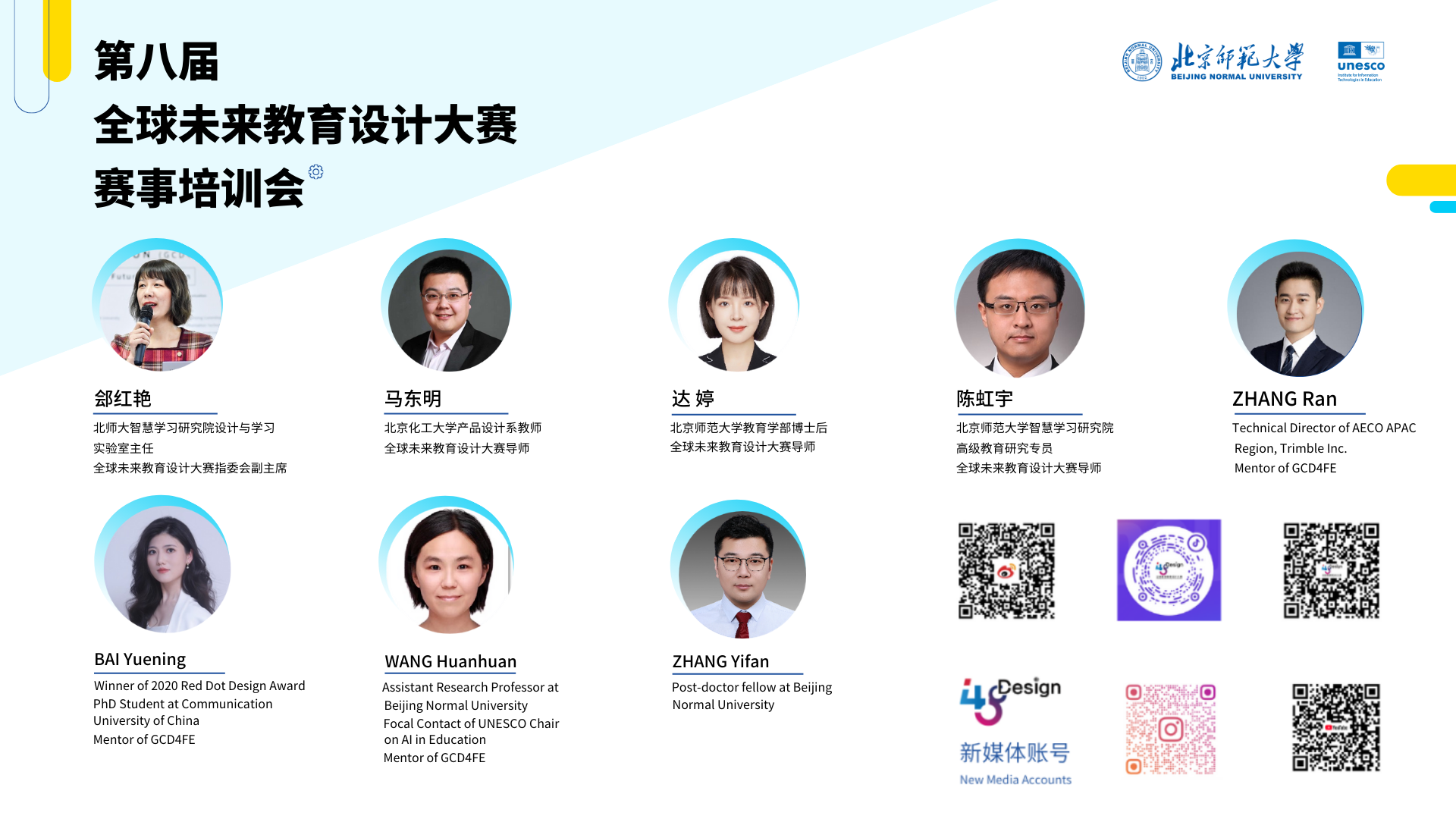
Text description of the training poster
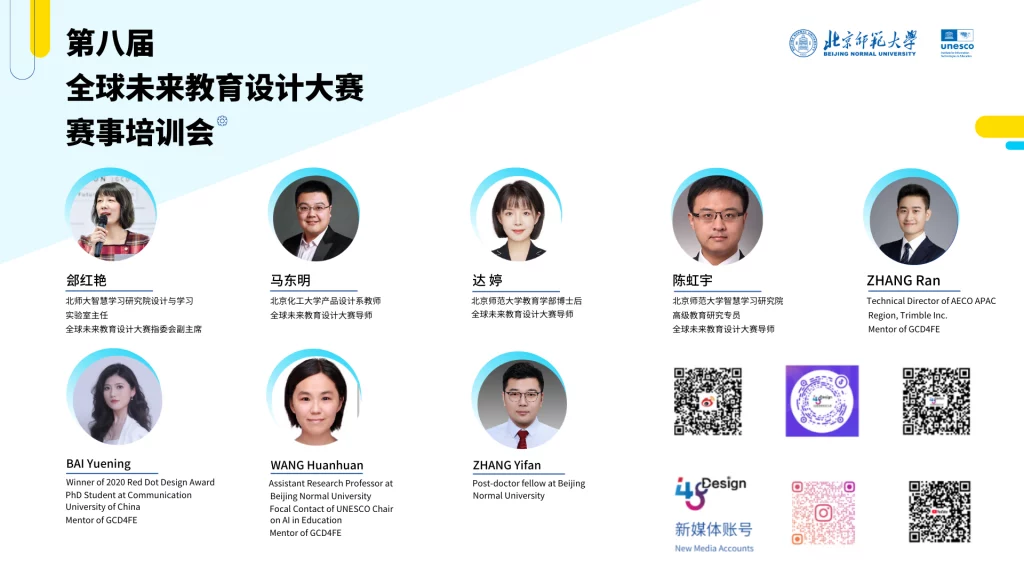
- The poster is headed “8th Global Competition on Design for Future Education — Competition Training.” BNU and UNESCO Institute for Information Technologies in Education logos appear at the top right. The names and roles below transcribe the poster’s historical text.
- Kuai Hongyan: director of the Design and Learning Laboratory, Smart Learning Institute of BNU; vice-chair of the competition’s steering committee.
- Ma Dongming: product design lecturer at Beijing University of Chemical Technology; competition mentor.
- Da Ting: postdoctoral researcher in BNU’s Faculty of Education; competition mentor.
- Chen Hongyu: senior educational research specialist at the Smart Learning Institute of BNU; competition mentor.
- Zhang Ran: technical director for the AECO Asia-Pacific region at Trimble Inc.; competition mentor.
- Bai Yuening: identified on the poster as a winner of the 2020 Red Dot Design Award, a PhD student at Communication University of China and a competition mentor.
- Wang Huanhuan: assistant research professor at BNU; focal contact of the UNESCO Chair on AI in Education; competition mentor.
- Zhang Yifan: postdoctoral researcher at BNU.
- The lower-right “4CDesign / New Media Accounts” area contains several social-platform QR codes. They are retained as part of the original 2025 poster; current account and link availability has not been verified.
Understanding the judging criteria
Competition mentors Ma Dongming, a product design lecturer at Beijing University of Chemical Technology, and Zhang Ran, Trimble’s Asia-Pacific technical director for architecture and engineering software, provided detailed guidance on five assessment dimensions: awareness of problems, innovative thinking, integration of science and education, application prospects, and presentation and communication. They encouraged participants to seek truth and ground their work in facts, start with specific problems, avoid repetitive topics, and draw on their own experiences and distinctive strengths to create innovative work. Projects should respond closely to social needs and educational trends rather than simply combine technologies.
Using design thinking to improve project quality
Kuai Hongyan, vice-chair of the competition’s steering committee and director of the Design and Learning Laboratory at BNU’s Smart Learning Institute, presented the core ideas and methods of design thinking through the theme “Project Design Based on Design Thinking.” She emphasized that design thinking is an approach to innovation that everyone can learn. Using the EDIPT model and NetDragon’s design methodology as examples, she examined the processes and contexts of different models and encouraged participants to select an approach suited to their real-world context and users’ needs.
Competition mentor Bai Yuening, described in the report as a PhD from Communication University of China, explained design research and divergent thinking. Research can examine cultural, practical and political perspectives, combining factual and visual primary research with secondary research to investigate problems. She recommended mind maps to integrate findings, connect related ideas around a central concept, and use functional and structural divergence, 5W+H and reverse thinking to challenge habitual assumptions and stimulate innovation.
How can AIGC support educational project design?
Competition mentors Da Ting, a postdoctoral researcher in BNU’s Faculty of Education, and Wang Huanhuan, an assistant research professor at BNU and focal contact of the UNESCO Chair on AI in Education, explored the value of AIGC in educational project design. They noted AI’s strengths in rapid data processing and multidisciplinary information integration, alongside human capacities for empathy, creativity and self-awareness that cannot be replaced. AIGC can support topic selection, research and analysis, ideation, prototyping and visual presentation. Participants were also urged to think critically, assess generated content carefully and avoid excessive reliance on AI in order to achieve human–AI collaborative innovation.
Practical tools and resources
Competition mentors Chen Hongyu, senior educational research specialist at BNU’s Smart Learning Institute, and Zhang Yifan, a postdoctoral researcher at BNU, introduced practical AIGC tools and techniques. These covered low-fidelity prototypes of websites, apps and 3D models; visualization of proposed solutions; writing and evaluating design reports; and generating images, audio and video. They encouraged participants to let creativity lead and use tools appropriately, rather than be constrained by AI, to enhance originality and distinctiveness.
Higher Education Track activity preview
On 20 April, the competition planned an in-person “Future Education Creativity Camp — AIGC-Supported Eight-Hour Educational Project Design” for Higher Education Track entrants. Combining theory, practice and mentoring, the activity aimed to help turn projects into workable solutions. The original report directed readers to the competition website for application and participation details.
Team registration for the Higher Education Track of the 8th Global Competition on Design for Future Education was open until 30 April. The organizing committee planned further training and mentoring sessions during the competition and welcomed teams of students enrolled in universities worldwide to explore innovative designs and practical solutions for future education.
Access to training resources
https://meeting.tencent.com/v2/cloud-record/share?id=b23185b3-a425-4b17-8a27-16034541ab84
Public replay access code: TX19.
Archive and source notes
All 16 original text units and the single 1920×1080 poster are retained. The poster is converted to lossless WebP without cropping or removing text. The added description supports screen readers and article narration.
The body describes Bai Yuening as a PhD from Communication University of China, while the poster says “PhD Student at Communication University of China.” Both source descriptions are retained and attributed to the 2025 material; neither is presented as confirmation of current qualifications or employment.
The 20 April camp and 30 April registration deadline refer to 2025. The original preview is retained to document the arrangements at that time and is not a new invitation to apply.
The public Tencent Meeting replay URL in the Chair’s original ends in “ab84”; the link shown in SLI’s corresponding report ends in “ab8.” This page preserves the original Chair URL and its publicly supplied access code TX19. It does not guess a corrected address or claim that playback has been verified.
Original link: https://aiedchair.bnu.edu.cn/news-12004-en/