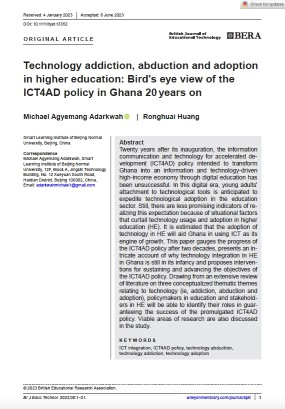
Michael Agyemang Adarkwah and Ronghuai Huang review two decades of Ghana’s Information Communication and Technology for Accelerated Development (ICT4AD) policy. They critically assess progress at the time, arguing that its intended transformation into an information- and technology-driven high-income economy through digital education had not succeeded.
Policy aims and higher-education context
The study connects technology integration in higher education with national development. Young adults’ attachment to devices does not automatically translate into effective educational adoption; contextual conditions may still restrict use.
Three concepts in the review
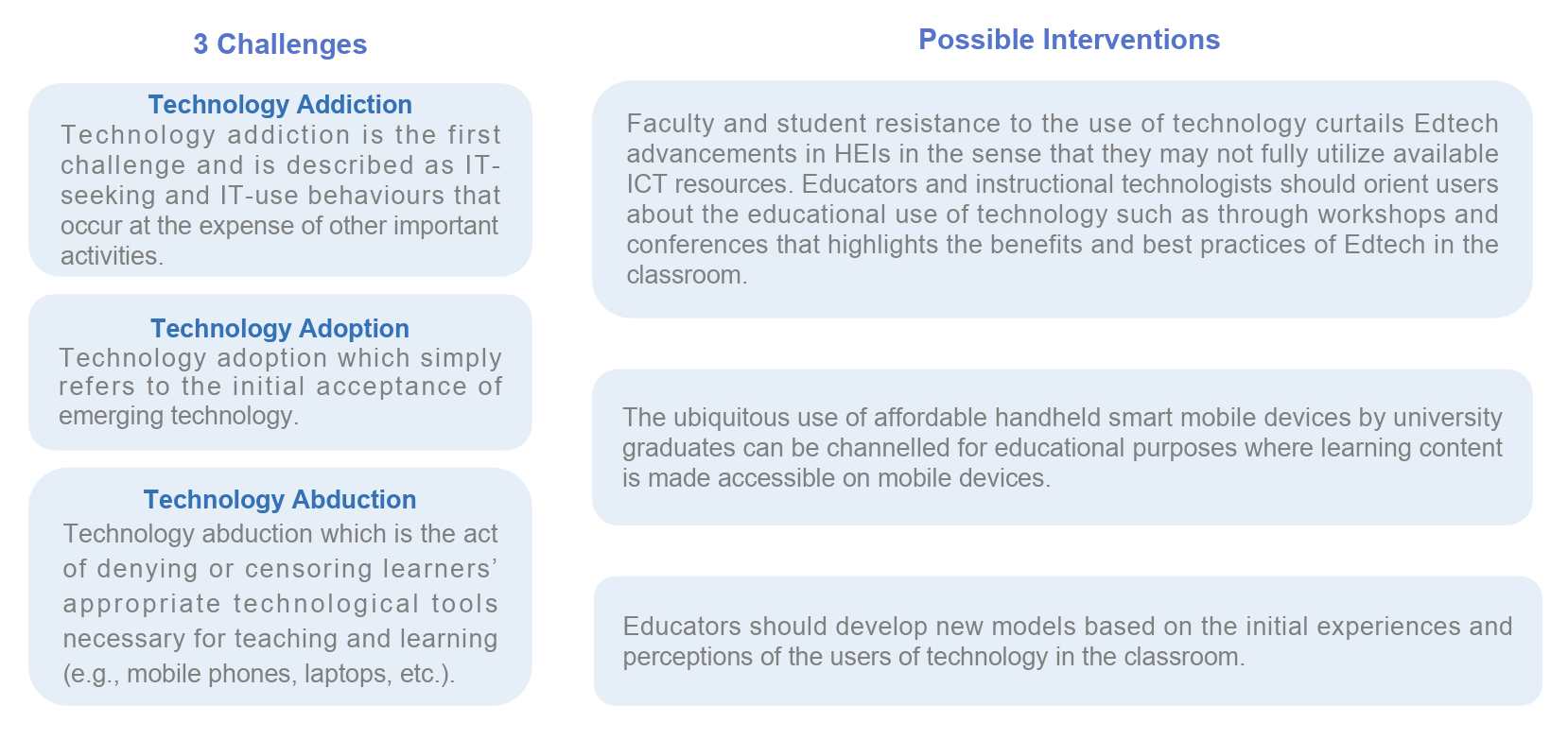
An extensive literature review organizes the discussion around three conceptual themes. The site’s original summary graphic defines them as follows:
- Technology addiction: IT-seeking and use that occur at the expense of other important activities.
- Technology adoption: initial acceptance of an emerging technology.
- Technology abduction: denying or restricting learners’ appropriate tools needed for teaching and learning, such as phones and laptops, following the graphic’s definition.
Original summary graphic
The original graphic places three challenges alongside possible interventions. It summarizes research arguments rather than demonstrating that the measures have been effective in every institution.
Three possible interventions
Its three possible intervention directions are:
- Address staff and student resistance through workshops, conferences and guidance on educational benefits and classroom practices.
- Channel widely available, affordable smart mobile devices into education and make learning content accessible on them.
- Develop new models based on classroom technology users’ initial experiences and perceptions.
Policy and practical implications
The paper discusses responsibilities of education policymakers and higher-education stakeholders, calling for policy review, revision and renewed investment. Implications include effective adoption, learners’ 21st-century skills and multifaceted action in comparable settings, alongside future research directions.
Interpreting the scope
This is a 2023 literature-based policy analysis. Its assessment is the authors’ argument, not a current comprehensive measurement of Ghana’s economy or every university.
Related reading
Related reading: the technology-supported student-centred learning review and gamification learning-analytics study examine educational technology through literature synthesis and course-level learning behaviours respectively.
Publication details
First published online on 16 June 2023, the article appears in British Journal of Educational Technology, volume 54, issue 6, pages 1484–1504. The original English title, archive date and URL are retained; graphic content is also transcribed for reading.
Reference: Michael Agyemang Adarkwah; Ronghuai Huang. Technology addiction, abduction and adoption in higher education: Bird’s eye view of the ICT4AD policy in Ghana 20 years on. British Journal of Educational Technology 54(6), 1484–1504 (2023). DOI: 10.1111/bjet.13352.
Original link: https://aiedchair.bnu.edu.cn/technology-addiction-abduction-and-adoption-in-higher-education-birds-eye-view-of-the-ict4ad-policy-in-ghana-20-years-on/