
Teachers in Chengdu’s Shuangliu District combined AI analysis, classroom observation and pupil work to review a Year 1 lesson on an animal rhyme. They redesigned the questions to move from observation to comparison, reasoning and application.
AI enhances the development of advanced thinking in classrooms – taking “Animal Nursery Rhymes” as an example
Tanghu Middle School Experimental School (East Area), Shuangliu District, Chengdu; Shuangliu District, Chengdu Education Technology and Equipment Management Center
Abstract:This case focuses on the teaching of “Animal Songs” in the Chinese language textbook compiled by the Ministry of Education, and explores how to cultivate higher-level thinking skills in first-grade students within the Chinese language classroom. Teachers use various evaluation tools, such as AI classroom analysis techniques, classroom observation records, as well as analysis of students’ performance in class and their homework, to accurately analyze the teaching process. In response to issues such as insufficient display of higher-level thinking by students during the first teaching session, and poor classroom questioning and feedback, teachers implement key improvement measures: they restructure the problem sets, create a four-level sequence of questions—“observation—comparison—reasoning—application”—to encourage deeper thinking; they provide scaffolding through visual-sound word components, physical imitation actions, and connections to scientific knowledge; and they establish a three-level feedback mechanism of “affirmation—questioning—transfer” to promote further development of students’ thinking. This case utilizes artificial intelligence technologies for accurate analysis and practical suggestions, combines multiple teaching methods, and creates a three-stage development system. It provides useful insights for optimizing teaching strategies and improving the quality of classroom instruction.
Keywords:AI diagnosis; advanced thinking; evaluation and feedback
1. Text analysis and key points for developing advanced thinking skills
In the “Compulsory Education Chinese Curriculum Standard (2022 Edition)”, the core competencies of the Chinese subject are clearly defined as four key dimensions: cultural confidence, language application, thinking ability, and aesthetic creation. “Animal nursery rhymes” is a literacy verse in Unit 5 of the first-grade lower volume of the national Chinese textbook. It uses the Chinese character with the “insect radical” as its core structure, linking the habits of six animals with the rhythmic beauty of six-line sentences. In terms of language and writing learning, this lesson fulfills the instrumental goal of “the pattern of constructing characters with pictographs and sounds”; from the perspective of thinking development, it also provides an opportunity for the cultivation of advanced thinking through “observation—comparison—reasoning—creation”. The 2022 edition of the curriculum standard emphasizes “developing thinking through language practice”, and particularly requires that lower grades use visual aids to stimulate inquiry awareness, which provides a basis for the cultivation of advanced thinking in this lesson.
II. First-time teaching practice: Diagnosis of issues related to the development of advanced thinking skills
(1) Cognitive dilemmas in classroom recordings
During the “Exploration of the Pattern of Pictophonetic Characters” session, the teacher asked, “What is common among the names of these animals?” The students replied, “All have the character for ‘worm.’” Then the teacher asked further, “What is the relationship between the character on the right side and the pronunciation when the ‘worm’ character is removed?” The students could only vaguely mention “qing = qingding” and “hu = huli”, and it was difficult for them to summarize the character-formation rule that “the pictographic component indicates meaning, while the phonetic component indicates sound”. When the teacher asked, “Why is a spider not an insect but still has the ‘worm’ character,” due to a lack of transitional support, the students remained silent, and eventually the teacher explained directly. Such scenarios reveal the typical problem in the classroom where advanced questions exist independently, and the thinking chain is broken.
(II) Quantitative data from AI diagnosis confirm this
Based on Bloom’s classification theory of teaching and the IRE model, the process of thinking development during classroom teaching is presented through data on teachers’ questions and students’ responses. Using an AI classroom analysis system, the sequence of questions, answers, and evaluations in the classroom is analyzed, and several key issues are identified:
1. Imbalance in thinking levels: Advanced thinking problems (analysis, evaluation, creation) accounted for 21.69%, with “creation” problems accounting for 15.66%. However, nearly half of the “creation” problems turn into “false advanced” thinking due to the lack of scaffolding, such as “guess why the character ‘cao’ is written this way”. Students can only repeat that “on the left is a worm, on the right is a category”, without touching the essence of a pictographic-syllabic character.
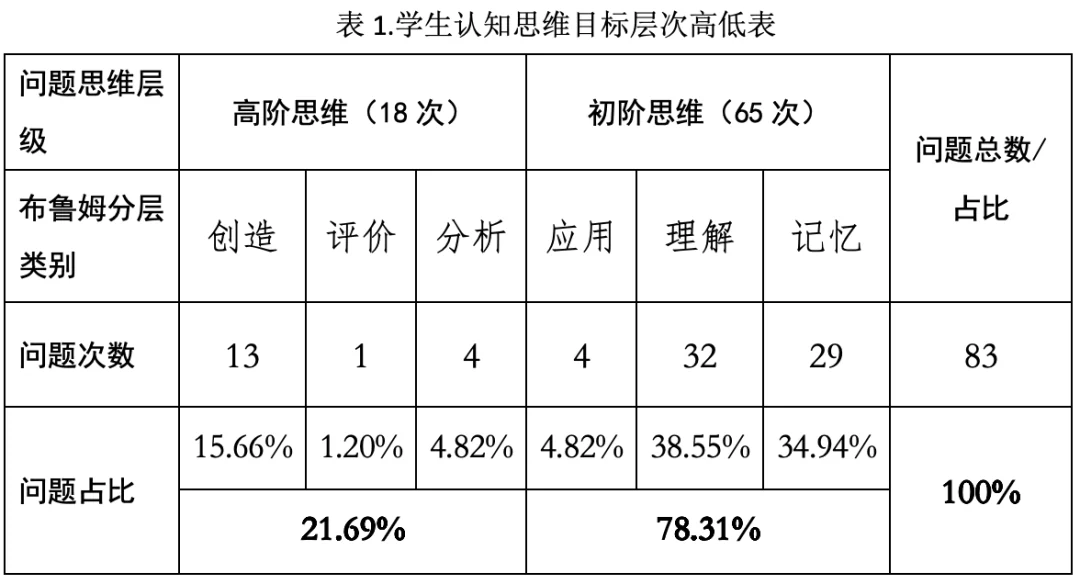
Read the table as text
| Category | Count | Share |
|---|---|---|
| Create | 13 | 15.66% |
| Evaluate | 1 | 1.20% |
| Analyze | 4 | 4.82% |
| Higher-order subtotal | 18 | 21.69% |
| Apply | 4 | 4.82% |
| Understand | 32 | 38.55% |
| Remember | 29 | 34.94% |
| Lower-order subtotal | 65 | 78.31% |
| Total | 83 | 100% |
2. Insufficient time for students to respond: Teachers should design questions in a way that provides students with adequate time for reflection. The purpose is to enable students to provide high-quality answers, thereby enhancing the effectiveness of classroom discussions. At the same time, the classroom should encourage students to ask questions boldly and critically. This is one of the effective ways to develop students’ critical and creative thinking. In this class, the average time taken for students to respond to advanced questions was 1.75 seconds, which is far below the ideal range of 10–12 seconds. Teachers often “answer on behalf of students” to keep the class moving forward, resulting in students’ thoughts staying at a superficial level.
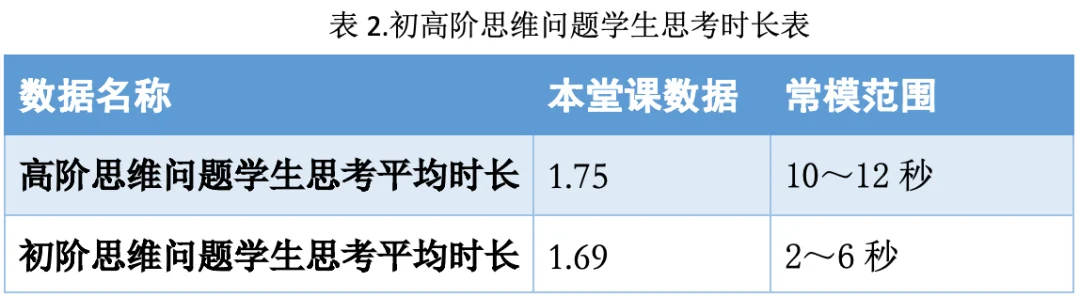
Read the table as text
| Question level | Lesson average | Reference range |
|---|---|---|
| Higher-order thinking | 1.75 | 10–12 |
| Lower-order thinking | 1.69 | 2–6 |
3. Low effectiveness of feedback: From the teacher feedback forms, it can be seen that in the class of “Animal nursery rhymes”, there were only 3 effective questions asked by the teacher regarding the students’ answers, accounting for 4.41%; 41 times there was no feedback on the students’ answers, accounting for 60.29%. For example, when a student said that “earthworms build palaces by digging tunnels”, the teacher merely commented “Well said”, missing an opportunity to help students develop the ability to use analogies in their thinking.
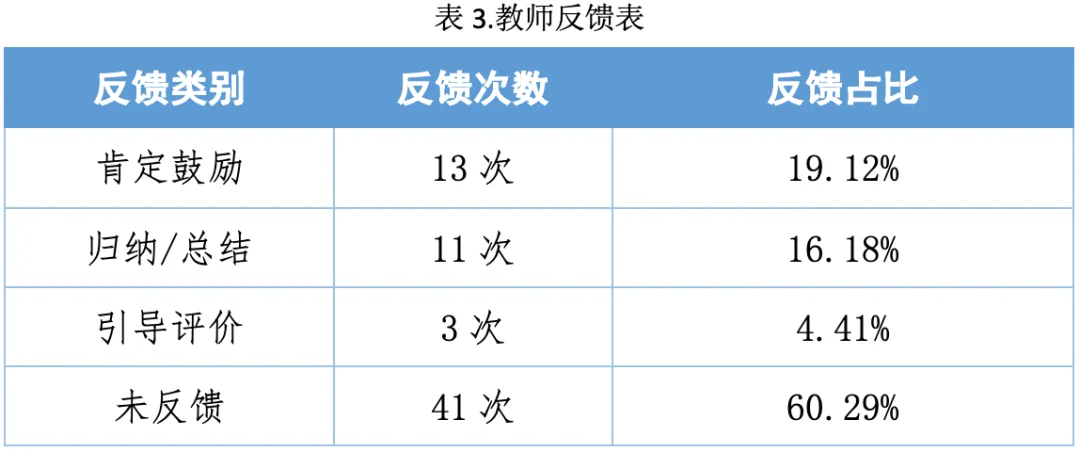
Read the table as text
| Type of feedback | Count | Share |
|---|---|---|
| Affirmation or encouragement | 13 | 19.12% |
| Synthesis or summary | 11 | 16.18% |
| Guided evaluation | 3 | 4.41% |
| No feedback | 41 | 60.29% |
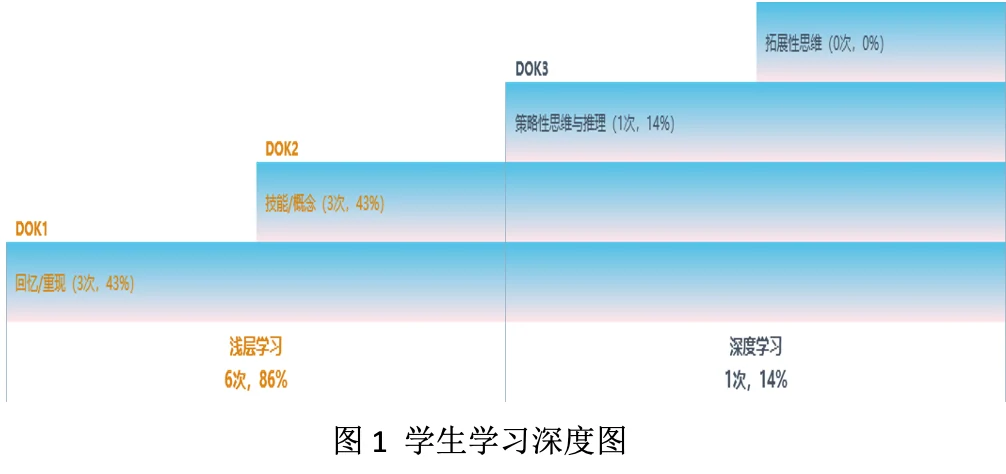
4. Insufficient deep learning in students’ classroom activities: After the teacher poses questions in class, it prompts students to think. The level of understanding required for students to answer questions or carry out activities can be categorized as deep learning or shallow learning. By focusing on the questions posed by the teacher, as well as on the students’ performance during classroom activities, we can determine the depth of knowledge that students have acquired in class. We found that there were 6 instances where students’ activities were classified as shallow learning, and only 1 instance where they were classified as deep learning.
III. Targeted improvement: Establishing a three-stage development system of “problem chain – support mechanism – feedback”
In response to these issues, teachers reflect on their classroom designs, thereby optimizing teaching strategies and methods.
1. Reconstructing problem chains and guiding thinking. Based on AI diagnostic results, teachers reconstruct the problem chains. In the teaching of Chinese characters with both radical and sound components, a four-level problem chain structure of “observation—comparison—reasoning—application” is designed. At the level of memory and understanding, questions such as “Identify the animal names in the nursery rhymes; what common components do they have?” and “How is the word read when the ‘insect’ radical is removed?” are used to help students establish an intuitive connection between radicals and sound components. At the level of analysis and questioning, questions like “A spider has 8 legs, while an insect has 6 legs; why does its name also contain the ‘insect’ radical?” and “Which character in ‘ant’ represents the sound, and which represents the meaning? Why?” are posed, thereby creating cognitive conflicts among students and helping them understand the historical logic behind the classification of Chinese characters. At the level of creation and transfer, questions such as “If we want to create a new character for ‘butterfly’, which radical and component would you use? Why?” and “Create a similar character for ‘bee’ using the structure of ‘qing (insect + qing)’” are asked, thereby turning the rules of character formation into a means of creative ability. In class, when the teacher asks, “A spider has 8 legs, while an insect has 6 legs; why does its name also contain the ‘insect’ radical?” students think actively. Some students answer, “Because it crawls on the ground just like insects!” Others say, “Perhaps people in ancient times thought it looked like an insect, so it was grouped together with insects.” The students’ thinking becomes more active, allowing them to engage in deeper thinking and reasoning.
2. Embodied supports facilitate learning. Considering the concrete thinking characteristics of younger students, teachers have designed three types of embodied supports, enabling abstract thinking to be made tangible. First is the visual support: students engage in a “shape-sound character puzzle” activity. Through this game, where students combine “shape components (animals) + sound components (qing, hu, ma),” they can intuitively understand the principle that “the shape component indicates meaning, while the sound component indicates pronunciation.” Second is the motoric support: when learning concepts like “a dragonfly flying with its wings spread out” or “butterflies playing hide-and-seek,” students use their bodies to imitate the movements of animals, and they say along with the actions, “How do the dragonfly’s wings move? What game is the butterfly playing by hiding among the flowers?” This transforms verbal understanding into embodied thinking. Third is the interdisciplinary support: this involves connecting knowledge from science classes about the body structure of insects. By comparing “spiders (8 legs) – dragonflies (6 legs),” students can understand the difference between Chinese character classification and scientific classification, thereby developing interdisciplinary analytical skills. Through these supports, students gain a deeper understanding of knowledge. For example, when learning about shape-sound characters, students can more clearly grasp the roles of shape components and sound components through the puzzle activities.
3. The three-level feedback mechanism promotes the development of thinking. Teachers have established a hierarchical feedback model consisting of “affirmation – questioning – application”, which helps to deepen the development of thinking. Take a segment of a classroom session as an example:
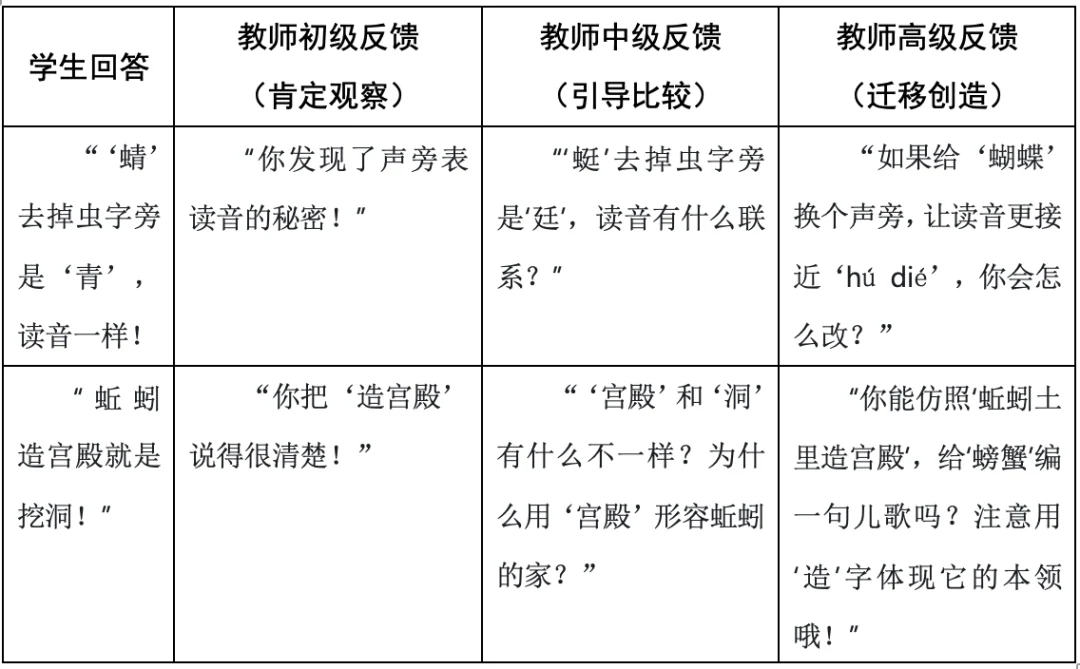
Under this feedback mechanism, students’ thinking is continuously expanded and deepened. During the section involving the creation of nursery rhymes, the quality of the students’ works improves significantly. Works that combine scientific observations with literary imagination, such as “The mantis practices its skills on the leaf (observing the shape of its forelimbs)” and “The cricket plays a guitar among the grass (relating to its sound),” emerge. Compared to the simple sentence imitation methods used in the first teaching session (such as “The bee busily collects honey from the flowers”), the depth of students’ thinking is greatly enhanced.
IV. Improvements in effectiveness: Moving from data to visible thinking
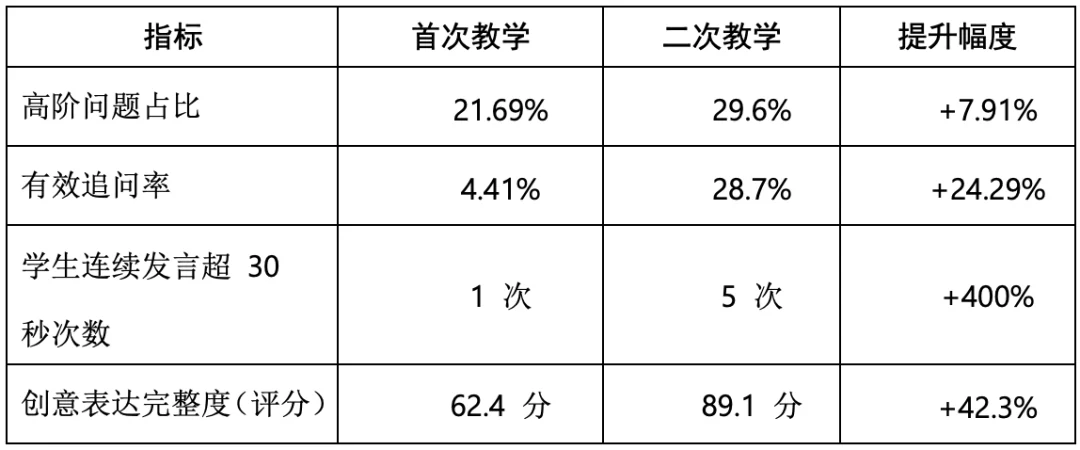
(1) Quantitative data comparison
Read the table as text
| Indicator | First lesson | Second lesson | Increase as reported |
|---|---|---|---|
| Share of higher-order questions | 21.69% | 29.6% | +7.91% |
| Effective follow-up question rate | 4.41% | 28.7% | +24.29% |
| Student turns longer than 30 seconds | 1 | 5 | +400% |
| Score for completeness of creative expression | 62.4 | 89.1 | +42.3% |
By comparing the first teaching and the second teaching, we find that the proportion of higher-level questions and effective inquiries by teachers in the classroom has increased significantly. Also, the number of times students speak for more than 30 seconds has increased. This indicates that teachers pay more attention to guiding students’ deep thinking during the class, which helps develop students’ higher-level thinking skills.
(II) Qualitative manifestations: The traces of thinking become visible
1. Development of reasoning skills: Students are able to independently recognize that “bats” and “whales” are not insects or fish. However, due to the limitations of ancient people’s knowledge, these words were given prefixes related to “insects” or “fish”. This shows cultural reasoning across time and space.
2. Activation of creative ability: During the imitation session, works that combine scientific observation with literary imagination appear, such as “The mantis practices sword skills on the leaf (observing the shape of its front legs)” and “The cricket plays the guitar among the grass (relating to its sound)”. This leads to a significant increase in the depth of thinking, compared to the simple sentence imitation methods used in the initial teaching (e.g., “The bee collects honey among the flowers”).
3. Emergence of critical thinking: Some students asked, “Why is ‘kē’ written as ‘kē’ + ‘chong’, rather than ‘kě’ + ‘chong’? Is it related to ‘science’?” Although the understanding was incorrect, it demonstrated the characteristic of actively exploring the reasons behind the formation of words.
V. Conclusions of comparative analysis
1. Major issues in initial teaching: During the initial teaching sessions, although students showed interest in the course content, they had significant deficiencies in demonstrating higher-level thinking skills. AI-based classroom analysis helped teachers identify problems such as imbalances in the level of thinking during questioning, insufficient response time, and poor feedback effectiveness. As a result, students were unable to understand the knowledge thoroughly, and their higher-level thinking abilities could not be effectively improved. Data-driven approaches enable the development of thinking skills to be measured and tracked, acting like a “teaching CT” that helps teachers pinpoint the challenges in thinking development, thereby enabling improvements from being driven by experience to being driven by evidence.
2. Significant improvements have been achieved: Through the reconstruction of problem chains, the establishment of “embodied support structures”, and the implementation of a three-level feedback mechanism, the second round of teaching has yielded remarkable results. The proportion of high-level questions increased to 29.6%, while the number of memory-related questions decreased to 18.3%. The average thinking time of students increased to 4.85 seconds. The rate of effective questioning increased to 28.7%, and the completeness of creative expressions improved from 62.4 points to 89.1 points. Students have made significant progress in their thinking abilities such as reasoning, creativity, and critical thinking.
6. Conclusion
In the implementation of this teaching case for “Animal Nursery Rhymes”, efforts were made to explore ways in which AI can support the development of higher-level thinking skills. This approach has its own characteristics and innovations. By utilizing AI-based classroom diagnostic techniques, precise analysis of the teaching process can be achieved, providing a scientific basis for teaching improvements. This helps to overcome the subjectivity and ambiguity inherent in traditional teaching evaluations in language classes. In terms of teaching methods, gamified and contextualized teaching methods are combined with scaffolding that supports learning, which is suitable for the cognitive abilities of first-grade students. This effectively stimulates students’ interest and enthusiasm for learning. The “problem chain – scaffolding – feedback” three-stage training system helps students gradually develop higher-level thinking skills. However, there are still some areas that need improvement in teaching: for example, the integration of thinking during writing guidance is insufficient, and the interdisciplinary integration is not deep enough. In the future, teaching strategies will be further optimized, with a stronger integration of writing guidance and thinking training, as well as deeper interdisciplinary collaboration. This will help improve the quality of classroom teaching and provide more effective support for students’ cognitive development.
Original link: https://aiedchair.bnu.edu.cn/news-citlab-2247627407-5-en/