Historical academic article | HUANG Ronghuai, HU Ying, LIU Mengyu, PAN Jingwen and ADARKWAH Michael. e-Education Research, 2024, 45(6), pp. 14–22, 33. Originally posted by the Chair on 23 September 2024. The discussion retains the paper’s historical research and policy context.
Authors: HUANG Ronghuai, HU Ying, LIU Mengyu, PAN Jingwen, ADARKWAH Michael
Affiliation: National Engineering Research Center of Cyberlearning and Intelligent Technology, Beijing Normal University, Beijing 102200, China.
Article contents
Abstract, keywords and funding
Abstract. As emerging technologies such as artificial intelligence develop, digital technology is becoming more deeply embedded in education. Whether its application can effectively improve learning outcomes and teaching quality remains a subject of global debate. Evidence is particularly limited concerning effective methods of digital learning, the people for whom they work, and the settings in which they work. Research into the regularities of digital learning and teaching amid education’s digital transformation is therefore urgently needed. The key to transforming digital learning is understanding how technology facilitates learning; its mechanisms can be considered at three levels: technology application, the extension of capabilities, and human–machine collaboration. The key to teaching’s digital transformation is ensuring that technology serves effective teaching. This requires attention to three basic regularities of teaching and learning in the digital age: (1) teaching is essentially a bilateral activity encompassing teaching and learning; (2) technology’s role is to empower teaching and learning effectively; and (3) digital teaching is rooted in digital pedagogy. Building on this discussion, the study identifies the development of digital pedagogy as the fundamental path to comprehensive teaching transformation. It comprises four dimensions: (1) technology-enabled deep learning; (2) green, robust digital learning environments; (3) evidence-oriented teaching practice; and (4) collaborative education founded on mutual trust between humans and machines.
Keywords: technology-enhanced learning; digital transformation of teaching; digital pedagogy; deep learning; human–machine collaborative teaching
Funding: The 2024 Science, Technology and Informatization Work Special Project of the Ministry of Education’s Department of Science, Technology and Informatization, “Construction of Smart Education Demonstration Zones.”
I. Introduction
Since the beginning of the twenty-first century, scientific and technological innovation worldwide has entered an exceptionally intensive and active period[1]. Digital technology has increasingly become a leading force fundamentally changing and comprehensively reshaping society’s ways of thinking, organizational structures and operating models[2]. The rapid development of artificial intelligence, represented by technologies such as ChatGPT and Gemini, has prompted extensive educational debate. Using new technologies to transform educational ecosystems, management, learning environments and teaching models has attracted wide public attention. Yet whether technology use in education can genuinely improve learning and teaching quality remains contentious worldwide. The 2023 Global Education Monitoring Report, Technology in education: A tool on whose terms?, examines technology use in education around the world. It finds that although educational technology can improve learning in some circumstances, reliable, impartial evidence of its impact is seriously lacking[3]. As efforts to universalize education advance, questions of quality, equity and relevance, together with how students can learn effectively, have become increasingly prominent. The international community is pursuing a learning agenda that places effective learning and the acquisition of relevant knowledge, skills and competencies at the heart of Sustainable Development Goal 4.
The global educational situation is complex, with the dual challenges of an economic crisis and a learning crisis. Against this background, UNESCO convened an expert meeting on the learning sciences in October 2023. The meeting launched a global learning-sciences network alliance and established a learning-sciences community devoted to researching and applying the regularities of digital learning in education’s digital transformation. Its concerns include improving learning outcomes by redesigning and implementing learning innovations, and redesigning effective learning environments and teaching strategies with digital technology, ultimately proposing alternative or innovative learning models[4]. Although educational software and platforms are now widely used, a systematic methodology for teaching in the digital age remains unclear. In his vision statement on transforming education, UN Secretary-General António Guterres emphasized the need to innovate in curricula, pedagogy and teaching processes so that today’s learners are prepared for a rapidly changing world[5]. Evidence nevertheless remains limited about effective digital-learning methods, the groups they suit, and the circumstances in which they work. It is therefore urgent to examine the regularities of learning and teaching in the digital age, and how an understanding of their underlying nature can help realize digital technology’s benefits for teaching and learning and advance teaching’s digital transformation.
II. Mechanisms of digital learning transformation: how technology facilitates learning
To improve the effectiveness of technology use in education, a fundamental principle must first be clarified: the logic of an educational application depends on the principles behind the technology—what problem education needs it to solve and how that problem is to be solved[6]. Technology can therefore have a real educational effect only when it is used appropriately on the basis of research into the basic regularities and principles of teaching and learning. Technology-enhanced learning (TEL) is an interdisciplinary research field combining theory and practice from education, computer science, psychology, cognitive science and human–computer interaction. It primarily concerns the comprehensive use of digital technologies to support student learning, including assessment, tutoring and guidance. It encompasses web-based and computer-based learning, virtual classrooms and learning environments, and digital collaboration[7]. As digital technology develops rapidly, more application settings—such as open online courses, mobile learning and blended learning—are emerging, and technology-enhanced environments are opening up new possibilities for learning.
Learning refers to relatively enduring changes in a learner’s behavior, capabilities and psychological dispositions resulting from experience[8]. Appropriate technology use can facilitate learning because it changes the learner’s experience, thereby changing the structures of knowledge, behavior and ability. TEL emphasizes technology’s support for, and facilitation of, the learner’s activities. How does the learner, as the subject of learning, learn through interaction with technology? How do a learner’s abilities, cognition and thinking change with technological support? Answering these questions requires a deeper examination of the mechanisms through which technology facilitates learning.
Following Stokes’s distinction between basic and applied research in Pasteur’s Quadrant: Basic Science and Technological Innovation, research into the mechanisms of TEL belongs to use-inspired basic research[9]. This has two implications. First, real educational practices and specific settings provide the logical starting point for technological research. Second, the internal mechanisms through which technology facilitates learning must be investigated, moving beyond appearances to their underlying nature. Examining these mechanisms therefore requires systematic attention to authentic situations and fields of practice, and to the relationship between technology and people.
The contemporary phenomenologist and philosopher of technology Don Ihde examines human–technology relations through the real and complex interconnections among technology, people and their settings. He identifies four relations that arise in people’s interactions with technology: embodiment, hermeneutic, alterity and background relations[10]. In an embodiment relation, a person incorporates technology into experience in a particular way, perceiving through it and thereby transforming perceptual and bodily experience[10]. Technology achieves its greatest degree of “transparency,” appearing to enter the person’s own perception and become part of the body. In a hermeneutic relation, technology and the world form an integrated whole: people understand the world by interpreting the world presented through technology. For example, watching a travel documentary allows someone to learn about a place they have never visited. In an alterity relation, technology is encountered as an object distinct from the human being and must be addressed consciously. In a background relation, people are surrounded by ubiquitous technology, as if living in a “technological cocoon”[11]. This cocoon produces close human–technology collaboration: technology is everywhere in learning, while those immersed in it cease to notice the technology itself. Background technology transforms the gestalt structure of human experience; because it manifests itself through absence, it may influence ways of experiencing the world more subtly and indirectly[10].
Ihde’s classification and discussion of human–technology relations offer an important basis for studying and analyzing the mechanisms of TEL. Different kinds of technology establish different interactive relations with learners as they enter learning, and their effects and value consequently differ. As Figure 1 shows, the mechanisms through which technology facilitates learning can be divided into three levels: technology application, functional extension, and human–machine coexistence.
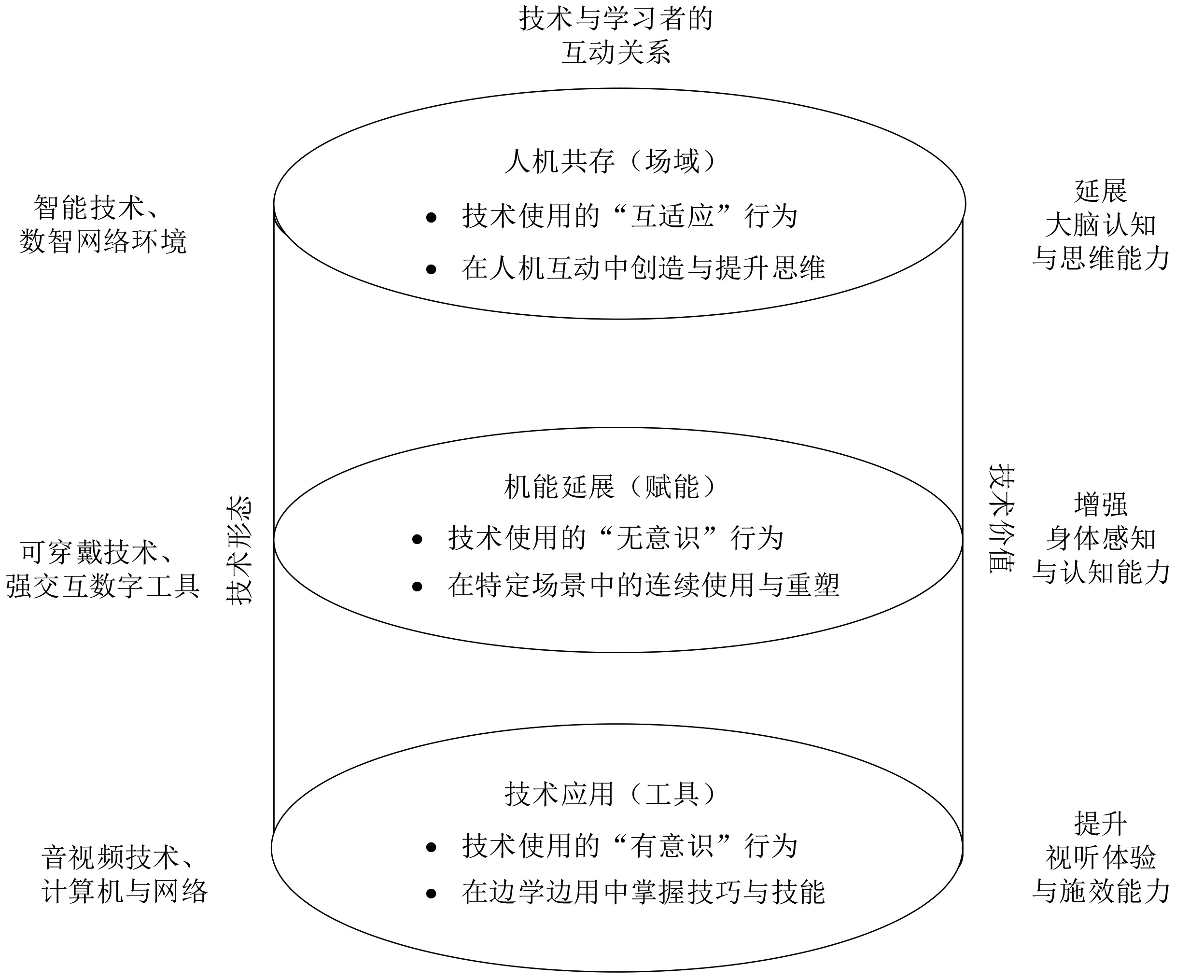
Original embedded journal image; printed page 15, PDF page 2.
Full description of Figure 1: three mechanisms, technologies and values
Three cylindrical levels show the progression from technology application to functional extension and human–machine coexistence. Technology forms appear on the left and their value on the right. This is the paper’s conceptual model, not a chart of measured quantities.
- Technology application (tool)
- Technology forms: audio/video, computers and networks.
- Interaction: conscious use; mastering techniques and skills through learning while using the technology.
- Value: improved audiovisual experience and capacity for effective action.
- Functional extension (empowerment)
- Technology forms: wearables and highly interactive digital tools.
- Interaction: unconscious use; continuous use and reshaping in particular situations.
- Value: enhanced bodily perception and cognitive capabilities.
- Human–machine coexistence (field)
- Technology forms: intelligent technologies and digitally intelligent network environments.
- Interaction: mutual adaptation; creating and advancing thinking through human–machine interaction.
- Value: extended cerebral cognition and thinking capabilities.
The first level is technology application. Here, technology primarily serves as an externally introduced tool or means for assisting and facilitating learning. Examples include conventional audio and video technologies, computers and networks. In the interaction between these technologies and learners, using technology is a conscious activity: learners have to study and explore it deliberately before they can use it effectively. Through learning while using it, they progressively adapt to and master the techniques and skills involved. The use of these tools improves audiovisual experience and the learner’s capacity to act effectively.
The second level is functional extension. Technology enhances or extends learners’ bodily functions and abilities, enabling them to accomplish tasks that would otherwise be impossible or to complete them more efficiently and effectively. Such extension may improve information processing and memory, enrich sensory experience, and strengthen communication and collaboration. The technologies involved include wearables and highly interactive digital tools, such as VR/AR tools, smart wristbands, and interactive learning and teaching platforms. In these interactions, technology use becomes an “unconscious” activity. This means that technology, thoroughly integrated with and empowering the learner, recedes into the background rather than remaining the object of attention. Learners perceive through technology without consciously attending to it, and their bodily perception is thereby transformed. It is important to emphasize that this form of unconscious use emerges only through repeated technology use in particular situations that continually reshapes bodily perception. As technology “withdraws,” high-quality learning activities become possible[12]. In this process, technological tools enhance bodily perception and cognitive capabilities.
The third level is human–machine coexistence. Technology has become a ubiquitous background to life, quietly entering everyday activities and creating an entirely new technological field. This primarily involves intelligent technologies and digitally intelligent network environments. In their interaction with learners, technology itself becomes an important actor: it does more than mediate connections between people and content, creating the entire ecosystem in which those connections occur. Technology use becomes a process of mutual adaptation. Learners and technology adapt to one another, forming a collaborative relationship in which technology becomes a learning partner. Together, they create and advance thinking through human–machine collaboration. In this process, technology extends learners’ cerebral cognition and thinking capabilities.
Examining these mechanisms makes the significance and effects of technology in learning clearer. As digital and intelligent technologies become more deeply embedded in education, they will also have important effects on educational ideas. These changes involve a view of knowledge as collaboratively created and shared, a view of learning as intelligently connected construction, an integrated and open view of curriculum, and a view of teaching based on human–machine collaboration[13]. Much contemporary education, however, still retains the characteristics of the industrial age. Systems remain constrained by standardized examinations and uniform syllabuses; teachers continue to dominate classrooms; and students’ digital skills, capacity for active learning, creativity and other core competencies remain insufficiently developed. Having clarified the central educational purpose of technology and its mechanisms for facilitating learning, it is therefore necessary to consider further how technology can serve effective teaching.
III. Digital pedagogy at the core of teaching’s digital transformation
Educational science seeks to formulate appropriate, empirically supported teaching principles and identify which teaching methods are most effective. An important task for educators is to bring about changes in learners through a range of effective methods[14]. Teaching for the digital age requires a central concern with comprehensive digital transformation and with how technology can be integrated into, and serve, effective teaching. Such transformation entails digitally changing and improving all elements of teaching, including educational goals, content, teaching models, assessment methods, teacher capabilities and learning environments. Technology plays a key role: it promotes new educational ideas and practices, provides intelligent digital learning environments, expands the boundaries of conventional teaching and learning, and creates new possibilities for both. Just as the digital transformation of learning must follow relevant regularities and mechanisms of learning, successful digital transformation of teaching depends on whether technological integration respects fundamental teaching principles and has a fundamental, positive effect on its key elements.
1. Teaching is essentially a bilateral activity of teaching and learning
The Chinese term for teaching appears in the Xueji, or Record of Learning, in the statement that teaching and learning come first in establishing a state and governing its people. Here, the term’s basic meaning encompasses both imparting knowledge and learning, implying activity by teachers and learners alike[15]. The respective positions of teachers and students, the two principal actors in teaching, have long been fiercely debated in educational history. Two sharply different educational ideas emerged: teacher-centered and student-centered education.
Herbart and Kairov are among the representatives of teacher-centered education. Its proponents regard the teacher as a helmsman: students’ intellectual development depends primarily on carefully designed instruction and specific guidance. They attach great importance to teacher authority and absolute control over the instructional process, arguing that “the student must remain passive toward the teacher”[16]. Comenius, Rousseau and Dewey are among the representatives of student-centered education. Comenius maintained that people make great progress through educating themselves[17]; Rousseau argued that children have their own ways of seeing, thinking and feeling[18]; and Dewey advocated replacing teacher-centered and textbook-centered education with child-centered education[19]. Proponents of this approach regard student development as a natural, active process. The teacher’s role is to guide students’ interests and meet their individual needs rather than intervene directly in their learning.
Teaching should in fact be understood as a two-way interaction between teachers and students rather than a one-way transmission centered solely on either group. Students’ activity—learning—and teachers’ activity—teaching—form two parallel, unified systems of activity on which instruction depends[20]. The regularities of individual human development mean that children must acquire knowledge accumulated by previous generations. This acquisition requires both guidance and assistance from those who already know, and active participation by learners themselves. Education must be grounded in children’s experience, while the teacher acts as the designer of significant personal experiences and the leader of collective activities[21]. Teaching and learning therefore cannot be separated. Within instruction, they are distinct yet closely unified, assuming mutually supporting responsibilities in shared activity: learning takes place under the guidance of teaching, and teaching serves learning[22]. The essence of teaching must therefore always remain a bilateral activity unifying teaching and learning.
2. Technology’s role is to empower teaching and learning effectively
Teaching is a bilateral activity in which teachers’ teaching and students’ learning interact. Different forms of interaction produce different forms of instruction. Every instructional activity includes key factors such as objectives, content, methods, means and organizational forms; differences among these factors, their structures and their connections produce differences in teaching[15]. In modern instructional systems, teachers, students, instructional media and content constitute the basic elements. Their combinations form an organic whole with a stable structure, known as the instructional structure[23]. This is a relatively macro-level concept reflecting fairly stable relations among core elements under a particular educational theory. Because it does not depend on specific content or particular learners, it can serve as a framework for analyzing stable forms of teaching. Having established the basic educational principle that teaching is a bilateral activity of teaching and learning, the digital teaching discussed here can be understood as instruction organized around teachers and students as its two principal actors.
Technology plays a key role in effectively empowering teaching and learning during teaching’s digital transformation. For teachers, it provides additional resources and tools, enabling more flexible course and activity design and timely adjustments based on students’ learning data supplied by platforms. For students, technological empowerment allows more active participation in learning. Online platforms and resources enable autonomous learning according to personal interests and abilities. Online collaborative and social tools make communication with peers and teachers more convenient, helping learners develop self-management and problem-solving capabilities.
The widespread and extensive use of emerging technologies, and their effective empowerment of teaching and learning, profoundly changes educational ideas, learning environments, teachers’ methods and students’ learning patterns. First, educational ideas in the digital age should particularly emphasize students’ active and deep learning, their ability to adapt to future society, and their basic competencies. They should attend to creativity, knowledge transfer, interaction with the real world and problem solving. Second, digital-age learning environments are sufficiently intelligent to make learning easier, more engaging and more effective by recording processes, recognizing contexts, connecting communities and sensing the environment[24]. Recording learners’ authentic performance throughout knowledge acquisition, classroom interaction, group collaboration and other parts of instruction provides important evidence for accurate assessment. Third, digital-age ways of learning emphasize students’ instincts and capabilities, higher-order cognitive goals, and the occurrence of deep learning. Effective ways of learning are inseparable from the free development of learners’ own cognitive regularities, interests and instincts. Finally, ways of teaching should involve teachers’ full use of technology to design flexible, varied methods that improve participation and experience and strengthen connections between bodies of knowledge. Greater attention should be paid to activity design, fostering problem-solving and higher-order thinking through group collaboration, inquiry and problem solving.
During teaching’s digital transformation, technology’s effective empowerment of teaching and learning fundamentally changes the basic elements of instruction, producing a new, digital and stable form in which teachers and students are both principal actors. This new instructional structure encompasses four dimensions—ideas, teachers, students and environment—and seven elements: educational ideas, instructional content, classroom organization, learning activities, learning strategies, learning spaces, and instructional media and digital tools. This structure can serve as an analytical framework for technology-enabled teaching. It can be used to examine whether digital technology fundamentally changes the forms taken by effective teaching elements and produces a pedagogy different from conventional pedagogy—digital pedagogy—and thus to judge whether teaching has genuinely undergone digital transformation.
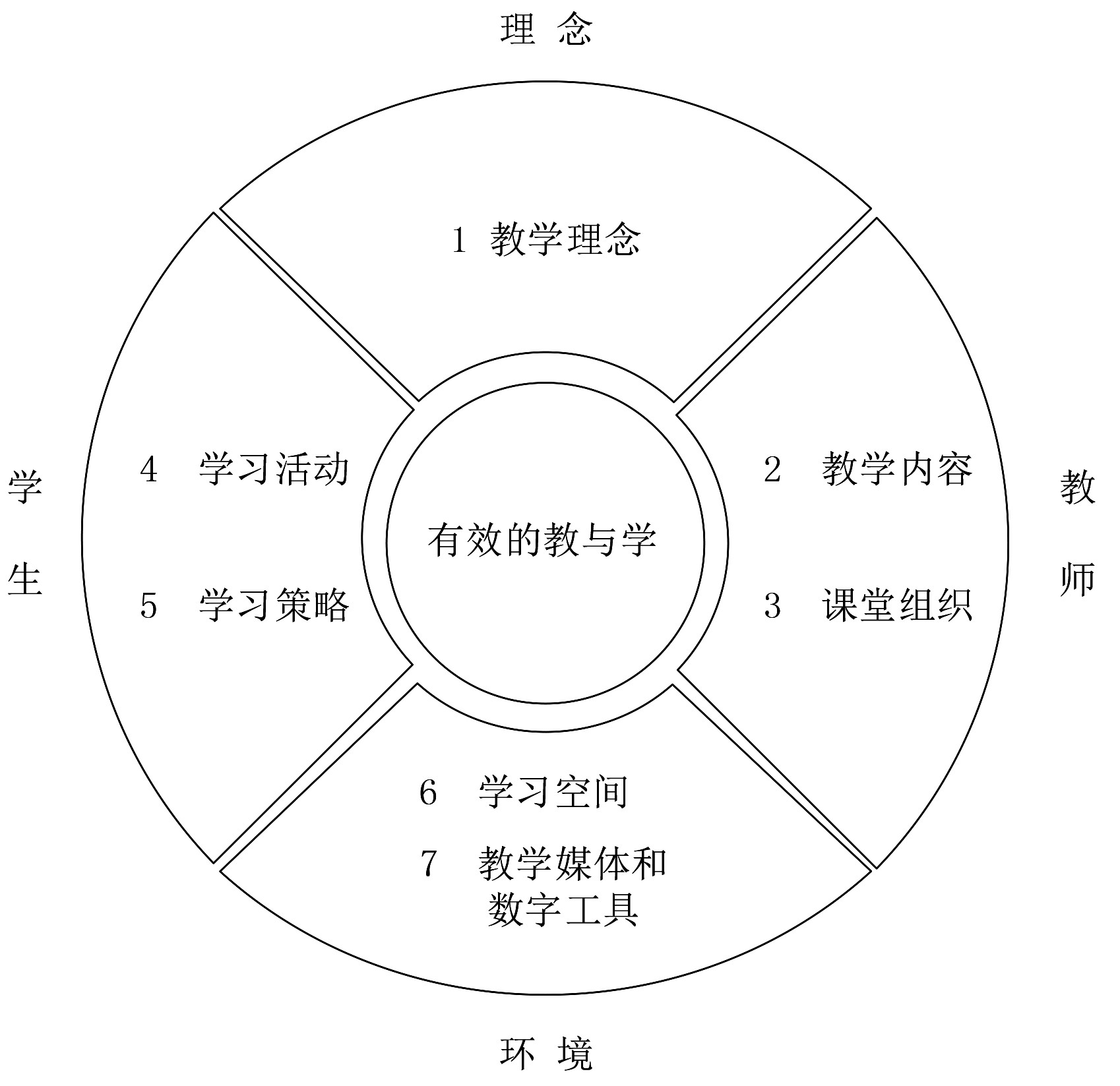
Original embedded journal image; printed page 17, PDF page 4.
Full description of Figure 2: four dimensions and seven elements
Effective teaching and learning are at the center. The outer ring has four dimensions—ideas, teachers, students and environment—and seven numbered elements. Instructional media and digital tools jointly constitute element 7 in the figure and Table 1.
- Ideas
- 1. Educational ideas
- Teachers
- 2. Instructional content
- 3. Classroom organization
- Students
- 4. Learning activities
- 5. Learning strategies
- Environment
- 6. Learning spaces
- 7. Instructional media and digital tools
3. Digital teaching is rooted in digital pedagogy
The central aim of teaching’s digital transformation is to bring digital technologies into front-line instruction, using them to optimize instructional processes, increase efficiency, improve quality and cultivate high-quality innovative talent[25]. It is not simply a shift from conventional teaching to teaching that uses digital technology. Rather, it represents a deeper change extending from tool use into educational ideas, learning environments, and ways of teaching and learning. Whether digital transformation has occurred therefore ultimately depends on whether a stable digital pedagogy has emerged. The analytical framework for technology-enabled teaching developed above makes it possible to compare pedagogy in the conventional context of technology and tool use with digital pedagogy viewed through the lens of teaching’s digital transformation (Table 1). This comparison further identifies the basic form of ideal, effective teaching in the digital age—digital pedagogy.
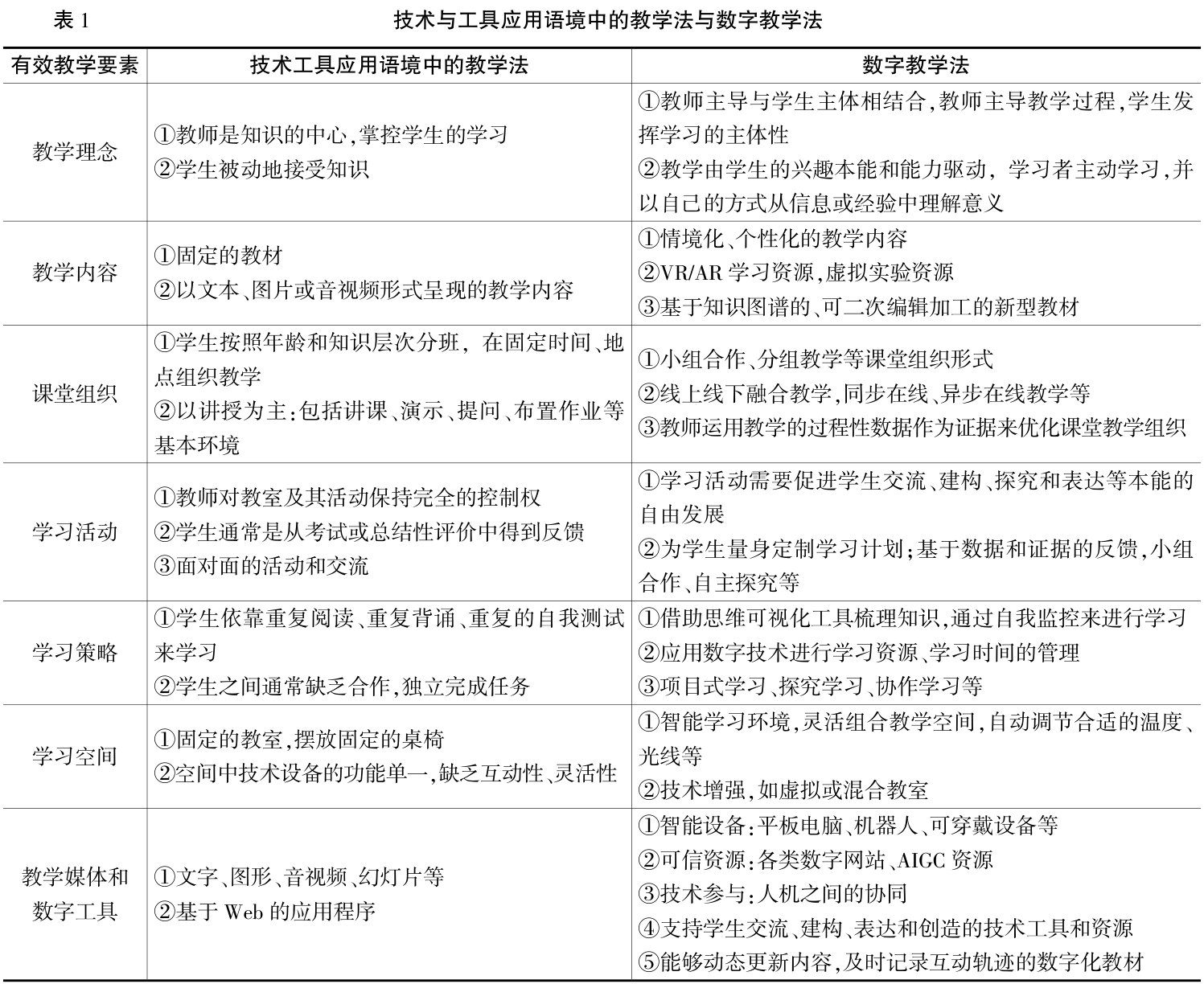
Faithful rendering of the journal’s vector table; printed page 18, PDF page 5.
Full text of Table 1: two pedagogies compared across seven elements
The seven rows, three columns and 35 descriptions are retained. Instructional media and digital tools form one element. The table can be scrolled horizontally by keyboard; row and column headers are associated.
| Effective teaching element | Pedagogy in a technology-and-tool application context | Digital pedagogy |
|---|---|---|
| Educational ideas |
|
|
| Instructional content |
|
|
| Classroom organization |
|
|
| Learning activities |
|
|
| Learning strategies |
|
|
| Learning spaces |
|
|
| Instructional media and digital tools |
|
|
1. Educational ideas centered on student development
Educational ideas provide a concise expression of educational values and a concentrated understanding of the underlying regularities of teaching and learning activities. In the digital age, they concern how technology can better promote student development. Teachers therefore need to understand students’ cognitive development, recognize their instincts and abilities, and teach in accordance with the basic regularities of children’s cognitive growth. As Dewey argued, children’s own instincts and abilities provide the material and starting point for all education; education must begin by exploring children’s energies, interests and habits[26]. As technological development and social change accelerate, learners increasingly need to acquire substantial knowledge and skills rapidly, develop diverse capabilities and participate actively in social life. Teaching in the digital age should therefore give greater attention to students’ initiative: teaching becomes more effective when students learn actively[20]. Particular emphasis should also be placed on deep learning, adaptability to future society and basic competencies, including creativity, knowledge transfer, interaction with the real world and problem solving.
2. Instructional content and classroom organization
Two key elements of teachers’ work are selecting instructional content and organizing the classroom. Appropriate content and organizational arrangements are needed to facilitate student learning. Instructional content is a structure or system composed of knowledge, capabilities, ideas, emotions and related elements[20]. During digital transformation, content takes new forms: audio and video, VR games, virtual experiments and other materials can all carry instructional content. New textbooks based on knowledge graphs use knowledge extraction to organize interconnected knowledge across disciplines and enable content resources to be reorganized and reprocessed[27]. They can provide important support for teachers’ and students’ blended teaching and learning across multiple settings, for big-data-based learning-behavior analysis, and for precise teaching and personalized learning.
Classroom organization concerns how teachers group students and relate to them, including how instructional activities are arranged and time is allocated[15]. The most typical conventional form is the class-based instructional system, in which students are assigned to fixed classes according to age and knowledge level and taught fixed content at fixed times. This constrains students’ agency and independence and is unfavorable to active learning and creative thinking. Digital transformation makes classroom organization more diverse. It includes group collaboration and group teaching in physical classrooms, as well as blended online and offline teaching, synchronous online classes and asynchronous online classes. As AI and big data become more deeply integrated into education, evidence-based teaching is also becoming a trend. Teachers need to learn how to use data as evidence for organizing and delivering classroom instruction.
3. Learning activities and learning strategies
Learning activities and strategies are key elements of students’ learning. Activity design must fully consider students’ interests, motivation and instincts. Its effectiveness depends on how well an activity fits learners’ physical and psychological development, existing knowledge structures, individual characteristics, aptitudes and readiness. Dewey proposed judging activities by whether they are unified or divided[26]. When learners experience an activity merely as a task they are forced to complete, learning ceases as soon as the external pressure is removed. At the opposite extreme, continually invoking interest to stimulate children externally can lead to excessive entertainment. This diminishes attention and dissipates willpower and concentration through artificial interest. Both are “divided activities” that waste learners’ gifts and capacity to learn[26]. A genuinely good activity maintains continuity between the facts or actions being learned and the growing learner’s self; it develops the instincts required for growth[26]. Dewey described children’s instincts in four categories: communication, construction, inquiry and artistic expression[26]. Effective learning activities should therefore support the free development of these instincts, and teachers should combine digital technologies to enable such activities.
Learning strategies are complex plans that learners deliberately and consciously devise to improve the effectiveness and efficiency of the learning process. They are essential to effective learning[28]. Helpful strategies include four groups. (1) Cognitive-learning strategies: provide a framework within which students can place the concepts they learn. Concept maps and mind maps help establish connections among knowledge and concepts. Clear, complete feedback improves learning: students benefit when they understand why an answer is right or wrong[8]. Immediate-feedback and assessment tools can therefore help them understand their progress and make timely adjustments. (2) Metacognitive strategies: guide students to learn through self-monitoring, including setting goals, selecting methods and strategies, monitoring and controlling cognitive activity, adjusting in response to feedback, and managing behavioral motivation. These processes can promote learning. (3) Resource and time-management strategies: use time-management tools to develop reasonable study plans, make effective use of periods when learners are at their best, and employ digital tools and resources for collaborative learning. Communication and joint problem solving can produce mutual benefits. (4) Knowledge-transfer strategies: create inquiry and problem-solving situations, encourage students to apply knowledge learned in one subject to other subjects, and develop transfer capabilities through solving problems[8].
4. Digital learning environments
Digital learning environments include learning spaces, instructional media and digital tools. Research indicates that students’ academic performance depends substantially on the functions of learning spaces[29]. Different spaces affect how students approach subject content. In conventional spaces, students tend toward listening and memorization: learning involves listening to teachers’ instructions, repeating definitions and formulas, memorizing theories and regularly rehearsing topics. In intelligent, flexibly configured and technology-enhanced spaces, students engage more in connecting, constructing and creating ideas and in group discussion. They are more inclined toward collaborative processes that connect different parts and integrate new ideas[30]. Learning spaces for the digital age should therefore provide immersive experiences and meet personalized needs. They need flexible arrangements and adaptations to support collaboration, inquiry, problem solving and other diverse ways of learning, while also providing the necessary support for mobile and ubiquitous learning.
Instruction designed for effective learning can be delivered through different media. Media are combinations of objects or systems used to convey communication or other instructional stimuli to learners[31]. During digital transformation, instructional media and digital tools create more possibilities for teaching. The technological revolution redefines the nature of the educational experience, and learning is no longer constrained by time and place. Intelligent devices and wearable technologies provide rich opportunities for perception and experience. Trusted learning resources, websites and technological tools support students’ instincts for communication, construction, expression and creation. Human–machine collaboration among teachers, students and AI reshapes the roles of teachers and learners and opens new possibilities for instruction.
IV. Developing digital pedagogy: a fundamental path to comprehensive teaching transformation
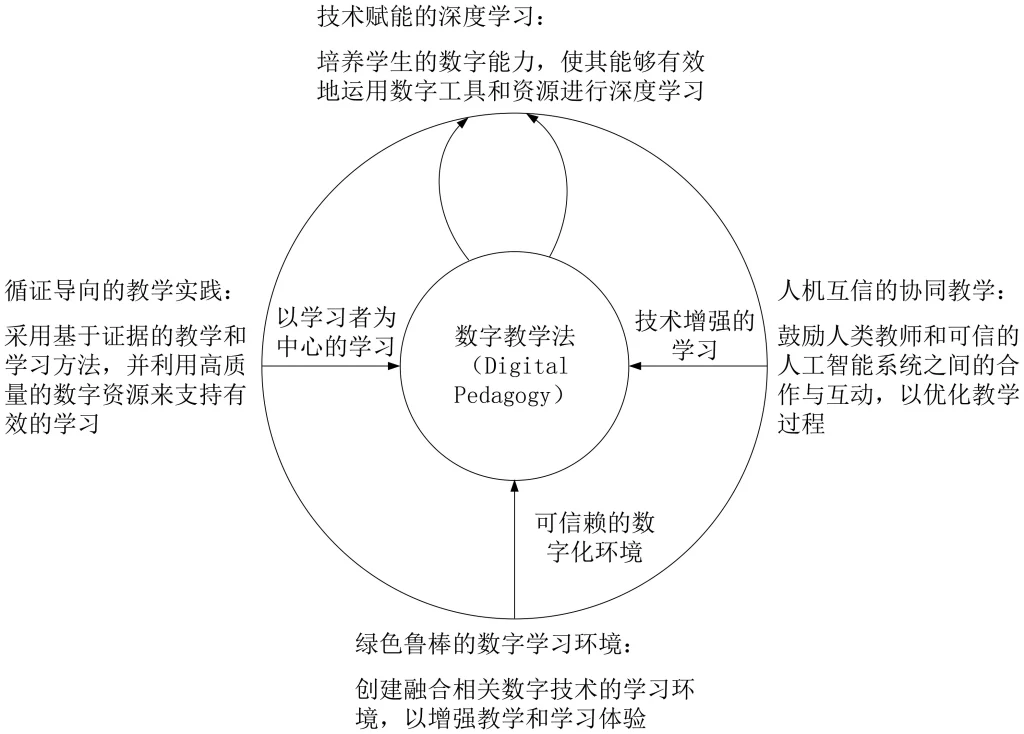
Pedagogy encompasses the basic principles and methods that should guide instruction. It is a system of teaching practices gradually formed to meet a society’s needs for talent in particular circumstances[32]. Digital teaching is rooted in digital pedagogy. As teaching’s digital transformation deepens, developing digital pedagogy becomes a fundamental path to comprehensive teaching transformation and warrants close attention and sustained research. Drawing on trends in educational ideas, learning environments, teaching and learning in the digital age, this paper proposes that digital pedagogy should be anchored in effective teaching and deep learning. It should take the optimization of digital environments as its foundation, digital resources and new technologies as its means, and effective learning and teaching practices as its purpose. Specifically, it encompasses four dimensions (Figure 3). First, technology-enabled deep learning guides learners to use digital resources and tools effectively to improve outcomes. Second, green, robust digital learning environments, characterized by trustworthiness, intelligent connectivity and integration, improve learning and teaching experiences. Third, evidence-oriented teaching practice puts learner-centered ideas into practice using an explainable evidence baseline. Fourth, collaborative education based on human–machine mutual trust enables the combined benefits of cooperation and interaction in teaching to be realized.
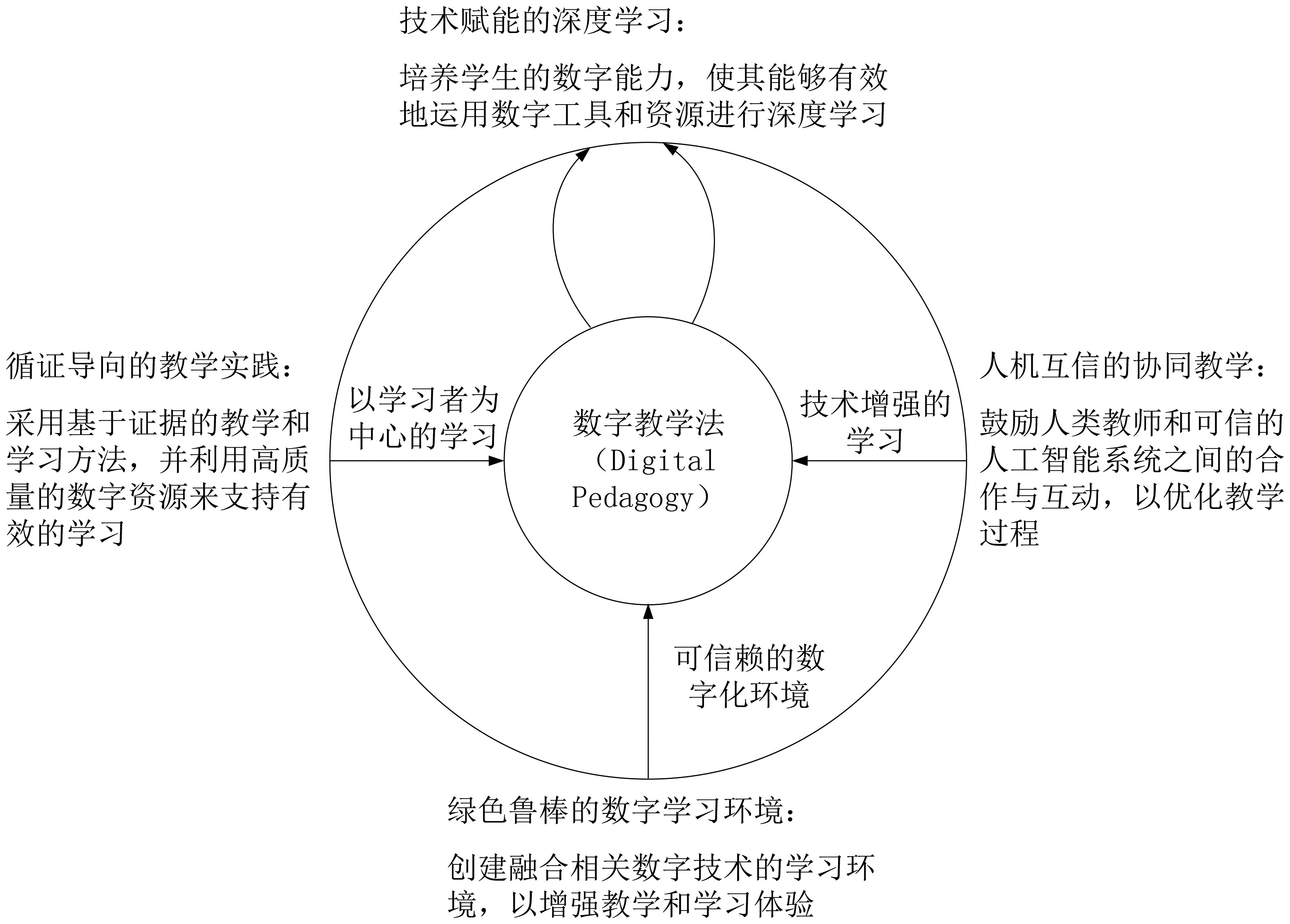
Original embedded journal image; printed page 20, PDF page 7.
Full description of Figure 3: four development dimensions
Digital Pedagogy occupies the center. The inner ring identifies learner-centered learning, technology-enhanced learning and a trustworthy digital environment, connected to the center by arrows. Intersecting curves at the top link deep learning. The outer text presents four dimensions and their explanations.
- Technology-enabled deep learning
- Develop students’ digital capabilities so they can use digital tools and resources effectively for deep learning.
- Green, robust digital learning environments
- Create learning environments integrating relevant digital technologies to enhance teaching and learning experiences.
- Evidence-oriented teaching practice
- Use evidence-based teaching and learning methods and high-quality digital resources to support effective learning.
- Collaborative teaching founded on human–machine mutual trust
- Encourage cooperation and interaction between human teachers and trustworthy AI systems to optimize instruction.
1. Technology-enabled deep learning
Deep learning involves students attending to the underlying meaning of course materials and experiences through analysis, cross-referencing, imaginative reconstruction and independent thinking[33]. Surface learning, in comparison, places more emphasis on simply describing course content[34]. Deep learning develops higher-order thinking and students’ core competencies, with particular attention to learning development that strengthens learning capabilities and qualities of thought and supports their transfer and application[35]. It requires teachers to understand knowledge deeply, organize content appropriately and design learning activities. It also requires learners to practice, experience and investigate personally, improving their cognitive structures and problem-solving abilities. As digital learning environments are continually improved, teachers can use technology to design more authentic, engaging situations that motivate learners and stimulate their interests. These environments support problem solving, collaborative inquiry and deep thinking in authentic contexts, creating favorable conditions for deep learning. Teachers should actively adopt digitally enabled teaching and learning models to support autonomous learning, group inquiry and collaborative learning, making full use of digital tools and resources to design activities that encourage communication, expression, construction and creation.
Three aspects require attention if technology-enabled deep learning is to be achieved effectively. First is human–machine collaborative teaching involving teachers and students. Digital environments make human–machine coexistence and collaboration possible in instructional practice. Human teachers and machines need to interact and function as an integrated whole within these environments to achieve shared goals and improve teaching outcomes[36]. Second is teachers’ digital teaching. Teachers should make full use of digital technologies and resources to prepare instruction, select suitable strategies and methods, support and enhance classroom teaching, assess instruction using real-time data, and adjust plans promptly[37]. Third is students’ digital learning. Students should actively use technology for collaborative and autonomous learning, constructing knowledge deeply through communication, cooperation and the sharing of experience. They should also use technology to plan, monitor, reflect on and evaluate their own progress, enabling autonomous learning and personal development.
2. Green, robust digital learning environments
As a new generation of intelligent digital technologies becomes integrated into education, it brings convenience alongside problems such as data-ethics risks and algorithmic black boxes[38]. Safe, reliable digital environments are crucial to both teaching and learning. Green, robust digital learning environments are therefore needed to enhance educational experience. First, they must be secure and consistent with educational ethics and regulations. Students and teachers use online platforms, applications and digital resources, so stable network infrastructure is essential: high-speed, reliable connectivity and normally functioning network equipment and servers must be ensured. Second, security and privacy-protection mechanisms are needed. Data encryption, user authentication, access control, content filtering and related measures should be strengthened to protect personal information and the privacy and security of learning data. Third, environments must be stable, reliable and scalable. Digital teaching depends on computers, tablets, internet connections and other equipment and infrastructure. Smooth instruction requires high stability and reliability and the ability to accommodate many simultaneous users. Environments should also be extensible enough to meet growing user numbers and evolving technological requirements.
3. Evidence-oriented teaching practice
An evidence-based orientation is a commitment to making practice more scientific and professional through evidence. It is also an approach that values evidence-guided practice and uses evidence to address practical problems[39]. Learning management systems (LMS), adaptive platforms, learning analytics, data analysis and related technologies increasingly record and support the learning process. Their deeper use enables teachers to move from subjective, experience-based instruction toward instruction grounded in process-based learning data, realizing evidence-oriented practice. Teachers use learning evidence to identify and address key instructional problems accurately, apply resources innovatively to improve outcomes, and sustain innovation and improvement. This involves evidence-based learning analytics and evidence-based organization of instruction. Learning analytics requires data-collection, measurement, analysis and visualization tools to extract potentially valuable patterns systematically from the large volume of data generated during teaching. Instruction should seek the best and most appropriate evidence. Real-time collection and analysis of multimodal learning data can reveal students’ actual academic performance. Classroom-behavior data about teachers can likewise clarify their teaching performance and support improvements in teaching and learning. Evidence-based organization of activities requires teachers to use analytical findings to design strategies and activities consistent with evidence-supported best practice, implement them, and evaluate their effects. This helps students achieve learning goals and improve outcomes, while helping teachers continually refine their own practice and improve instructional quality and efficiency.
4. Collaborative teaching founded on human–machine mutual trust
As the intelligent age arrives, teachers will collaborate with AI, using precise, timely and personalized resources to strengthen students’ agency. This can help develop digital intelligence, capabilities for sustainable development, self-identity and self-integration, together with the thinking abilities, ethical understanding and value orientations required for human–machine collaboration. Teachers’ roles will change fundamentally: rather than primarily transmitting knowledge, they will construct learning situations and organize and guide learning. They will focus more on innovative and inspiring activities, emotional communication, personalized support and facilitating learning. AI can undertake more replaceable, procedural work, such as presenting content, supporting human–machine interaction and providing learning guidance[13]. Collaborative teaching must consider students’ physical and mental health and cognitive development, as well as teachers’ professional-development needs. It must be reliable and controllable, transparent and explainable, inclusive and fair, thereby supporting high-quality educational AI applications and interaction[40]. Such teaching involves substantial private data and sensitive information about teachers and students. Collection, use and dissemination can create data-security problems[36]. Relevant privacy laws and regulations must therefore be followed, and data-compliance standards and workflows established, to protect their data and privacy. To safeguard technological ethics, designers developing intelligent agents should adopt a human-centered approach, consider diverse needs, perspectives and goals, use varied and representative training datasets, and avoid discrimination and bias so that agents serve instructional systems fairly and effectively.
V. Conclusion
In the latest wave of scientific and technological change, rapid digital development has had disruptive effects on society’s ways of thinking and operating. Redesigning effective teaching with digital technology is a key issue in education’s digital transformation. Technology’s central educational role is to help learners learn more effectively, making an understanding of its mechanisms essential. These mechanisms comprise technology application, functional extension and human–machine coexistence. They show progressively deeper interaction between technology and learners: from conscious use, through unconscious use, to mutual adaptation. When technology is an applied tool, learners need deliberate study and gradual adaptation to use it more effectively. When it extends learners’ functions, it enhances perceptual and cognitive capabilities. In human–machine coexistence, technology creates new learning environments and collaborative relationships with learners, further extending cerebral cognition and thinking.
Technology’s effective empowerment of instruction depends on comprehensive digital change in the basic elements of teaching. Teaching is essentially a bilateral activity of teaching and learning, organized as an integrated structure of teachers, students, ideas and environment. Effective instruction follows this structure and encompasses seven elements: educational ideas, instructional content, classroom organization, learning activities, learning strategies, learning spaces, and instructional media and digital tools. When digital technology transforms these elements in effective instruction, a form distinct from teaching in conventional informatized environments emerges—digital pedagogy—signifying that teaching’s digital transformation has taken place.
Teaching’s digital transformation is a deep process extending into educational ideas, environments, and ways of teaching and learning. Anchored in effective teaching and deep learning, it takes optimized digital environments as its foundation, digital resources and new technologies as its means, and effective teaching and learning practices as its purpose. It is expressed through technology-enabled deep learning, green and robust digital learning environments, evidence-oriented teaching practice, and collaborative education founded on human–machine mutual trust. Digital pedagogy is a methodological system for developing talent in the intelligent age. It can advance teaching’s digital transformation and renew educational forms, helping build a human-centered, efficient and resilient digital education ecosystem.
References
All 40 references and their original languages are retained in journal order. In-text citations link to references; reference numbers return to the first citation. Web addresses are listed separately. Historical access dates follow the journal.
- [1] 习近平. 努力成为世界主要科学中心和创新高地[EB/OL].(2021-03-15)[2024-02-05].
- [2] 怀进鹏.数字变革与教育未来——在世界数字教育大会上的主旨演讲[J].中国教育信息化,2023,29(3):3-10.
- [3] UNESCO. Global education monitoring report,2023:technology in education:a tool on whose terms?[EB/OL].[2024-03-13].
- [4] UNESCO. UNESCO expert meeting on the learning sciences | Unesco[EB/OL].(2023-08-11)[2024-01-13].
https://glhconnect.unesco.org/unesco-expert-meeting-learning-sciences
- [5] United Nations. Transforming education:an urgent political imperative for our collective future[EB/OL].[2024-01-28].
https://www.un.org/en/transforming-education-summit/sg-vision-statement
- [6] 陈晓珊,戚万学. “技术”何以重塑教育[J].教育研究,2021,42(10):45-61.
- [7] HUANG R,KINSHUK,CHEN N. The new development of technology enhanced learning:concept,research and best practices[M]. Singapore:Springer,2014.
- [8] 施良方. 学习论[M].2 版.北京:人民教育出版社,2001:5,431-432,447-448.
- [9] D. E. 司托克斯.基础科学与技术创新:巴斯德象限[M].周春彦,谷春立,译.北京:科学出版社,1999.
- [10] 唐·伊德. 技术与生活世界——从伊甸园到尘世[M].韩连庆,译.北京:北京大学出版社,2012.
- [11] 曹继东.现象学的技术哲学——伊德技术哲学解析[D]. 沈阳:东北大学,2005.
- [12] 陈文新,赵婧.信息化学习的发生机制研究——基于唐·伊德技术现象学的思考[J]. 华东师范大学学报(教育科学版),2022,40(10):100-107.
- [13] 黄荣怀.人工智能正加速教育变革:现实挑战与应对举措[J].中国教育学刊,2023(6):26-33.
- [14] 理查德·E.梅耶.应用学习科学心理学大师给教师的建议[M].盛群力,丁旭,钟丽佳,译.北京:中国轻工业出版社,2016:2.
- [15] 王策三.教学论稿[M].2 版.北京:人民教育出版社,2005.
- [16] 赫尔巴特.普通教育学[M].李其龙,译.北京:人民教育出版社,2015.
- [17] 夸美纽斯. 大教学论[M]. 傅任敢,译.2 版.北京:教育科学出版社,2014.
- [18] 卢梭.爱弥儿——论教育[M].李平沤,译.北京:人民教育出版社,2001:88.
- [19] 滕大春.杜威和他的《民主主义与教育》[M]//约翰·杜威.民主主义与教育.王承绪,译.北京:人民教育出版社,2001:15.
- [20] 李秉德.教学论[M].北京:人民教育出版社,1991:13,109,119.
- [21] DEWEY J. Experience and education[M]. New York:Macmillan,1938:160.
- [22] 郭华. “教与学永远统一”再认识——教学认识论的视角[J].四川师范大学学报(社会科学版),2017,44(1):75-83.
- [23] 何克抗.信息技术与课程深层次整合理论:有效实现信息技术与学科教学深度融合[M].2 版.北京:北京师范大学出版社,2019:94.
- [24] 黄荣怀,杨俊锋,胡永斌. 从数字学习环境到智慧学习环境——学习环境的变革与趋势[J]. 开放教育研究,2012,18(1):75-84.
- [25] 郑永和,王一岩,郑宁,杨杰. 教学数字化转型:表征样态与实践路径[J].电化教育研究,2023,44(8):5-11.
- [26] 约翰·杜威. 学校与社会·明日之学校[M]. 赵祥麒,任钟印,吴志宏,译. 北京:人民教育出版社,2005.
- [27] 郭文革,黄荣怀,王宏宇,贾艺琛. 教育数字化战略行动枢纽工程:基于知识图谱的新型教材建设[J].中国远程教育,2022(4):1-9,76.
- [28] 刘儒德.论学习策略的实质[J].心理科学,1997(2):179-181.
- [29] MAHAT M,DOLLINGER M. Mind the gap:co-created learning spaces in higher education[M]//FISHER K. The translational design of universities:an evidence-based approach. Boston:BRILL,2019(12):221-235.
- [30] YU J. Exploring the relationships between learning space and student learning in higher education:a comparative case study in China [M]//WESLEY I,THOMAS K. Teacher transition into innovative learning environments:a global perspective. Singapore: Springer,2021:215-225.
- [31] 加涅.学习的条件和教学论[M].皮连生,王映学,郑葳,译. 上海:华东师范大学出版社,1999:285.
- [32] 郭文革,杨璐,唐秀忠,等.数字教学法:一种数字时代的教学法及一种教学法的数字教材[J].中国电化教育,2022(8):83-91.
- [33] WARBURTON K. Deep learning and education for sustainability [J]. International journal of sustainability in higher education, 2003,4(1):44-56.
- [34] UNESCO. The role of digital technologies in 21st century learning [EB/OL].[2024-02-13].
- [35] HATTIE J A C,DONOGHUE G M. Learning strategies:a synthesis and conceptual model[J]. npj Science of learning,2016(1):1-13.
- [36] 黄荣怀,刘德建,阿罕默德·提利利,等.人机协同教学:基于虚拟化身、数字孪生和教育机器人场景的路径设计[J].开放教育研究,2023,29(6):4-14.
- [37] 罗生全,郑欣蕊. 教师数字能力研究的现实图景与未来展望[J].现代教育管理,2023(8):19-30.
- [38] 罗生全,谭爱丽,钟奕军. 人工智能教育应用中的伦理风险及其规避[J].中国教育科学(中英文),2023,6(2):79-88.
- [39] 朱旭东,朱志勇.构建循证教育体系推动教育决策和实践科学化专业化[N].光明日报,2020-09-01(13).
- [40] 苗逢春.教育人工智能伦理的解析与治理——《人工智能伦理问题建议书》的教育解读[J].中国电化教育,2022(6):22-36.
Original English abstract in the journal
Show the journal’s original English title, authors and abstract
The following material is the journal’s original English text.
Towards the Basic Theories of Teaching Transformation in the Digital Age: Digital Pedagogy
HUANG Ronghuai, HU Ying, LIU Mengyu, PAN Jingwen, ADARKWAH Michael
(National Engineering Research Center of Cyberlearning and Intelligent Technology, Beijing Normal University, Beijing 102200)
With the development of emerging technologies such as artificial intelligence, the application of digital technology in education is deepening. Whether the use of technology can effectively improve the learning effect and teaching quality remains a global hot topic, especially in terms of effective methods, applicable objects, and effective scenarios, where evidence is still insufficient. Therefore, there is an urgent need to study the laws of digital learning and teaching under the digital transformation of education. The key to the transformation of digital learning is how technology facilitates learning, and its mechanisms can be summarized into three levels: technology application, skill extension, and human-machine collaboration. The key to the digital transformation of teaching is that technology serves effective teaching. In order to achieve this goal, it is necessary to follow the basic laws of teaching and learning in the digital age: (1) the essence of teaching is a bilateral activity between teaching and learning; (2) the role of technology is to effectively empower teaching and learning; (3) the root of digital teaching lies in the digital pedagogy. Based on the exploration of the basic laws of teaching and learning in the digital era, the research further clarifies that the basic path for the comprehensive teaching reform is the development of digital pedagogy, which specifically contains four dimensions: (1) technology-enabled deep learning; (2) green and robust digital learning environments; (3) evidence-oriented teaching practices; (4) human-machine collaborative education with mutual trust.
Technology-empowered Learning; Digital Transformation of Teaching; Digital Pedagogy; Deep Learning; Human-Machine Collaborative Teaching
Journal source and editorial note
Original citation (Chinese): 黄荣怀,虎莹,刘梦彧,潘静文,ADARKWAH Michael. 迈向数字时代教学变革的基本理论:数字教学法[J]. 电化教育研究,2024,45(6):14—22,33. DOI:10.13811/j.cnki.eer.2024.06.002。
Prepared from the official journal article, including its three figures, comparison table and 40 references. Text alternatives accompany the visuals. Site translations support academic exchange; consult the journal for the original arguments, images and citations. Gemini and New York spellings have been regularized; the paper’s historical context is retained.
Original link: https://aiedchair.bnu.edu.cn/news-7967-en/