
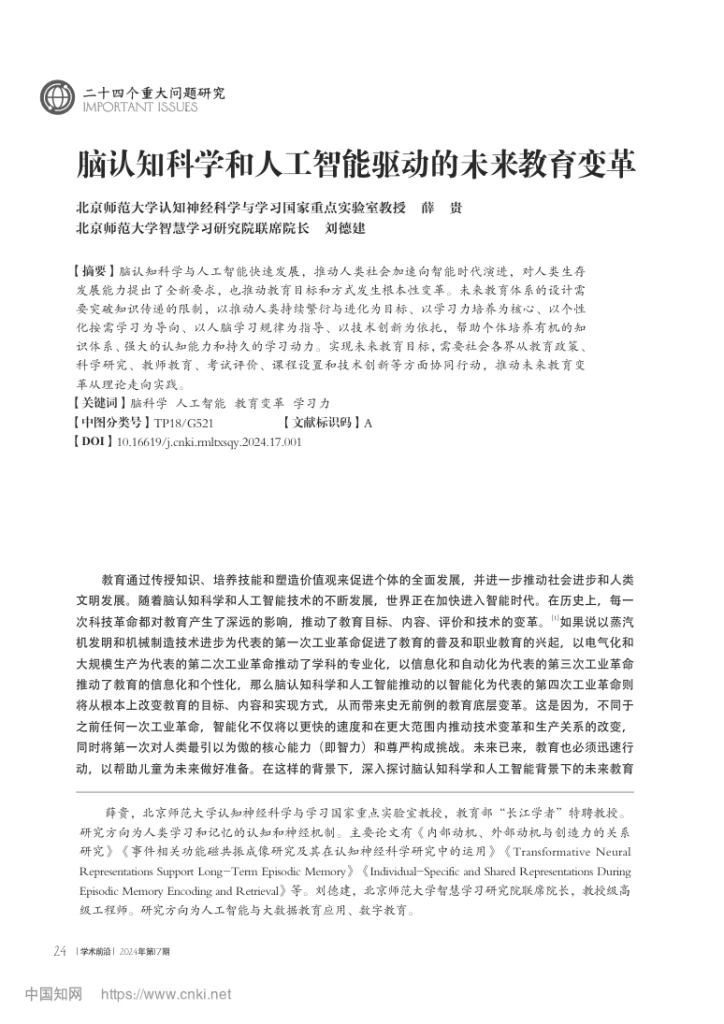
A 2024 academic article by Xue Gui and Liu Dejian. This edition retains the Chair website’s original publication date of 24 September 2024. Research developments, professional positions and proposals are presented in their historical context.
On this page
About the authors
Xue Gui was a professor at the State Key Laboratory of Cognitive Neuroscience and Learning, Beijing Normal University, and a Distinguished Professor under the Ministry of Education’s Chang Jiang Scholars Programme. His research concerns the cognitive and neural mechanisms of human learning and memory. His publications include studies of the relationship between intrinsic motivation, extrinsic motivation and creativity; event-related functional magnetic resonance imaging and its applications in cognitive neuroscience; Transformative Neural Representations Support Long-Term Episodic Memory; and Individual-Specific and Shared Representations During Episodic Memory Encoding and Retrieval.
Liu Dejian was Co-Dean of the Smart Learning Institute of Beijing Normal University and a professor-level senior engineer. His research concerns educational applications of artificial intelligence and big data, and digital education.
Abstract
Rapid advances in brain and cognitive science and artificial intelligence are accelerating society’s transition into the intelligent era, creating new requirements for human survival and development and transforming educational goals and methods. Future education systems need to move beyond knowledge transmission. With continued human development and evolution as their aim, they should centre on learning capability, personalised learning on demand, principles of human brain learning and technological innovation. They should help individuals build interconnected knowledge systems, strong cognitive abilities and lasting motivation to learn. Achieving these goals requires coordinated action in education policy, research, teacher education, assessment, curriculum design and technological innovation, bringing educational transformation from theory into practice.
Education promotes individuals’ all-round development through knowledge, skills and values, thereby supporting social progress and human civilisation. Advances in brain and cognitive science and AI are accelerating the arrival of the intelligent era. Every technological revolution has affected educational aims, content, assessment and tools. The first industrial revolution, associated with steam power and mechanised manufacturing, encouraged mass education and vocational education; the second, marked by electrification and mass production, encouraged disciplinary specialisation; and the third, based on information technology and automation, encouraged digital and personalised education. The fourth revolution, driven by brain and cognitive science and AI, could fundamentally reshape what education seeks to achieve, what it teaches and how it operates. Unlike earlier revolutions, it could change technology and production relations more quickly and widely while challenging intelligence, a source of human pride, and human dignity. Education must act promptly to prepare children for this future. This article first reviews scientific and technological trends and their implications for human survival and development; it then considers principles and systems for innovative education, followed by practical implementation pathways.
Trends in brain and cognitive science and artificial intelligence
Paradigm shifts and frontier advances in brain and cognitive science
Better neuroscience methods enable researchers to record and analyse neuronal structures, connections, gene expression and activity at unprecedented scale and resolution. This improves understanding of brain structure and function. Spatial transcriptomics, recognised by Nature Methods as its Method of the Year 2020, can identify brain cell types and illuminate their functions. Researchers have used it to construct cell-type atlases of mouse and non-human-primate brains, begin mapping the human brain, and describe the brain-wide spatial organisation of projections from individual hippocampal neurons. Combining spatial transcriptomics with intracranial electrophysiology has also linked gene expression to brain oscillations, identifying genes associated with oscillatory signatures of memory formation.
Neuropixels, introduced in 2017, made large-scale recording of individual neurons possible and helped researchers investigate the brain’s complex dynamic networks. Such methods reveal how human brain cells encode, understand and produce language, including neurons responsive to word meanings. Advanced analyses also explore mechanisms underlying complex cognition: ring-like representations in macaques’ spatial-sequence memory; prefrontal mechanisms that strengthen and transform memory representations to reduce interference; and the formation of human cognitive maps.
Advances in brain and cognitive science have also supported clinical research. Brain–computer interfaces create direct information links between the brain and external devices. The article discusses progress in movement, speech, psychiatric diagnosis, vision-restoration research, including Neuralink’s Blindsight, motor imagery and thought. Nature included brain–computer interfaces among seven technologies to watch in 2024. In a study using a bidirectional interface, microstimulation of somatosensory cortex provided tactile feedback and reduced the time needed to grasp objects from 20.9 to 10.2 seconds, approaching the performance of people without the relevant impairment. Speech interfaces can decode neural activity associated with attempted speech into text or sound, supporting communication for people with paralysis at up to 62 words per minute. Other systems generate speech and an avatar, with reported communication accuracy above 85%.
AI development pathways and recent advances
AI has progressed in chips, network architectures, algorithms, foundational applications and scientific applications. Image recognition, natural-language understanding and reinforcement learning have advanced especially rapidly. Word-embedding methods such as Word2Vec appeared in 2013; long short-term memory networks and attention mechanisms also became widely used, deepening machine processing of language. Transformers use self-attention to capture long-range dependencies in sequences. Large pretrained language models based on Transformers subsequently improved language understanding and generation. Fine-tuning adapts these models to downstream tasks and broadens their applications. Graph neural networks combined with multimodal learning support understanding and generation of complex language and visual scenes; the article cites Midjourney V5, ChatGPT-4o and Sora as contemporary examples. In reinforcement learning, DeepMind’s AlphaGo defeated world Go champion Lee Sedol in 2016; AlphaStar defeated leading human StarCraft II players in 2019; and MuZero, introduced in 2020, demonstrated strong strategies in Go, chess and shogi.
AI for Science is another important application area, spanning biology, chemistry, mathematics, neuroscience and archaeology. Successive AlphaFold systems from DeepMind addressed the longstanding problem of predicting protein structures. In June 2024, EvolutionaryScale released ESM3, a protein language model that works across sequence, structure and function. Its team generated a new green fluorescent protein, describing the result through an evolutionary-timescale comparison of 500 million years. In December 2023, DeepMind used AI to find larger constructions for the cap-set problem. In January 2024, AlphaGeometry solved 25 of 30 selected International Mathematical Olympiad geometry problems, reaching a level compared with gold medallists. In May 2024, MIT researchers used AI to discover three new integrable partial differential equations.
Mutual development of brain and cognitive science and AI
Alongside rapid progress in each field, the two are increasingly converging. AI provides analytical and explanatory tools for brain research. Deep-learning models of neural activity help explain and predict image recognition, natural-language processing, speech recognition and responses to videos. AI algorithms also inspire accounts of brain computation. Examples include recurrent neural architectures supporting rapid object recognition, infants’ image recognition through unsupervised learning, and higher-level, longer-timescale predictive coding in frontoparietal regions during language processing.
Conversely, brain and cognitive science can assess AI capabilities, investigate mechanisms and inspire algorithms. Cognitive science offers established evaluation methods and multidimensional benchmarks. The article reports that large language models such as ChatGPT approached or exceeded human performance on certain Raven’s-matrix reasoning, emotion-recognition and text-annotation tasks, and displayed patterns resembling human theory of mind. Performance in complex analogical, causal and verbal reasoning, and planning, still needed improvement. Research on mind, brain and behaviour also provides theoretical foundations: artificial neural networks and deep learning draw inspiration from neurons and vision; Transformers are related to selective attention; and GPT models incorporate reinforcement learning from human feedback, or RLHF. Incorporating human-style meta-learning into neural networks can support systematic and flexible behaviour; modelling hippocampal and entorhinal mechanisms can produce cognitive maps; and chain-of-thought prompts can improve GPT performance on particular tasks.
Both fields have advanced rapidly. Brain and cognitive science investigates intelligence through neuronal populations and circuits, supporting research into decoding, or ‘reading’, and modulating, or ‘writing’, brain activity. AI is progressing in hardware, algorithms, foundation models, sector-specific applications and scientific work, reshaping many industries. Their convergence, the authors argue, will accelerate society’s transition into a broadly intelligent era.
New requirements for human survival and development in the intelligent era
Changing eras bring different challenges, opportunities and capability requirements. Understanding them helps individuals adapt and remain competitive. The agricultural era, approximately 9000 BCE to the seventeenth century, with regional differences in timing, centred on agriculture. Families and communities organised production around natural conditions and human labour. Strength, endurance and skills in cultivation, animal husbandry and irrigation were important, alongside cooperation and mutual assistance. Rice-irrigation systems required extensive coordination; the article cites cooperation in southern China as an example.
The industrial era began with the first industrial revolution, conventionally dated 1760–1840, and was characterised by mechanisation, large factories and urbanisation. Operating and maintaining machines made technical and engineering knowledge important. Electrification gradually reduced some physical demands while increasing specialisation and efficiency requirements. Literacy became essential, together with discipline, punctuality and compliance with workplace rules. In The Wealth of Nations, Adam Smith stressed division of labour and specialised skills as sources of productivity. Basic education, vocational competence, cooperation and discipline consequently became central to modern education systems and remain influential.
From the late twentieth century, information and communication technologies, the internet and big data transformed life and work. Digital literacy involved using computers and networks and managing information overload. Bill Gates emphasised programming, data analysis, innovation and adaptability. Complex issues such as globalisation and cybersecurity also required systems thinking and complex problem-solving. The World Economic Forum’s Future of Jobs reporting highlighted combinations of skills, including problem-solving, critical thinking and emotional intelligence. Yet the spread of digital technology in education did not mean that educational content and aims had fully met the information era’s demands.
A further challenge is the accelerating transition into the intelligent era, which places different demands on people.
First, the intelligent era highlights the value of human intelligence
Brain and cognitive science and AI investigate and emulate how the brain works. The authors envisage progress from narrow AI supported by data and computation towards more general intelligence. Just as machines displaced much manual work after the industrial revolution, they anticipate AI replacing parts of skilled work: production-line tasks, driving, translation, professional game-playing, junior accounting, legal work, programming and surgery. Even activities considered creative, such as illustration and aspects of mathematics, chemistry, biology and archaeology, may be affected when tasks have clear boundaries and goals and permit data-based computation or prediction. These changes call for deeper understanding and development of human intelligence. Education must help identify human strengths and support cooperative coexistence between people and AI.
Second, the intelligent era puts greater emphasis on learning capability
Expanding knowledge and more frequent changes in occupations require continual acquisition of skills. The internet and generative AI make information easier to obtain, while AI-supported knowledge graphs improve analysis and integration. The article envisages wearable and minimally invasive brain–computer interfaces making interaction more natural. In this setting, isolated, rigid or seldom-used facts become less valuable than systematic, interconnected knowledge that can support flexible application and innovative problem-solving. Learning extends beyond classrooms into many settings, beyond books into mixed reality, and beyond passive reception into active construction. The authors therefore anticipate major changes in knowledge-focused education and a foundational place for learning how to learn, comparable with language and mathematics.
Third, the intelligent era favours T-shaped capability: breadth combined with specialist depth
Easier access to knowledge and shared intelligent tools allows individuals to work across more fields. People with interdisciplinary knowledge and proficiency in multiple tools may gain an advantage. One person could perform roles previously requiring several people, reducing coordination and management costs. Small and even single-person businesses could become more flexible, efficient and competitive. Individuals who also develop exceptional expertise beyond AI’s capabilities in particular areas, and create new knowledge-based products, may gain further advantages. This combination of general and specialist capability defines the T-shaped profile discussed here.
Fourth, the intelligent era places higher demands on motivation for personal development
Longer lives and faster-changing knowledge make one-off education inadequate; lifelong learning becomes a condition for both quality of life and future development. Scientific and technological advances may improve learning efficiency while intensifying competition and raising the threshold for advantage, requiring greater motivation and persistence. Meanwhile, AI-mediated consumer products can target reward systems through high-fat and high-sugar foods, emotionally appealing products, immersive games, personalised short videos, convenient shopping, targeted advertising and consumer credit. The authors warn that these influences can distract attention, weaken resolve and contribute to anxiety or depression. They argue that resisting temptation and sustaining the desire to grow may become a greater challenge than access to resources alone.
The intelligent era thus brings new social and economic arrangements and new combinations of capability. People need intelligence, learning capability and motivation to acquire knowledge across fields, innovate in specialist areas, resist distraction and pursue personal goals. Education should extend beyond knowledge transmission to the foundations of human survival and development: adapting to rapid change and uncertainty. The authors treat this as a first principle for future education.
Designing innovative education systems for the intelligent era
Education prepares people for the future and therefore needs to act ahead of rapid change. Historically, education has responded to technological and social transformations. Education 1.0, associated with industrialisation, was teacher-led, with teachers transmitting knowledge, students receiving it, fixed textbooks and standardised examinations. Education 2.0 emphasised active, student-centred learning, autonomy, interaction and broader resources, with assessment through projects, essays and practical work. Information technology supported Education 3.0: internet, computers and multimedia, online and personalised learning, and data-informed approaches. What kind of education is needed in the intelligent era?
Some researchers describe Education 4.0, characterised by intelligent technology and extensive personalisation. AI and big data can support highly personalised pathways, while virtual and augmented reality provide immersive practical experiences. The World Economic Forum’s April 2024 report presented AI as both a challenge and a possible response to educational problems. It highlighted global citizenship, innovation and creativity, technology and interpersonal skills. AI could support personalised and self-paced learning; accessible and inclusive learning; problem-based collaborative learning; and lifelong, student-driven learning. Personalisation and self-direction are central to this account of Education 4.0, helping individuals develop capabilities needed for the future.
Whether Education 4.0 fully answers the challenge remains open. The revolution driven by brain and cognitive science and AI differs from previous technological revolutions. Inherited assumptions and linear extrapolation may not capture its direction or the resulting educational requirements. New principles are needed. The authors discuss five dimensions.
Crossing conceptual boundaries as a prerequisite
Changes in science, technology and human capability requirements call for a break with habitual thinking and traditional educational frameworks. Reconsidering education from first principles is a prerequisite for substantive change.
First, future education should move beyond transmitting knowledge towards supporting human continuity and evolution. Faster renewal, broader availability and easier access to knowledge reduce the need for formal education to deliver a limited, standardised body of facts. The authors argue that prescribed common knowledge lacks sufficient systematic justification and may not suit changing needs. More urgent challenges, including weakened motivation for development and mental-health difficulties, also require educational responses. They therefore propose a shift from transmitting knowledge and skills towards supporting the continuation and evolution of humanity, seeing this as a major change in educational purpose.
Second, future education should cross disciplinary and professional boundaries. Existing subject divisions reflect industrial-era specialisation. Their necessity is weakening in light of how the brain organises knowledge, interdisciplinary research, changing social needs and personal development. Thematic and project-based learning can support connected knowledge and flexible use; interdisciplinary work can generate innovation; and careers increasingly span multiple fields. Education should support the whole person rather than knowledge and skills alone. Alongside mathematics, languages, physics, geography, biology, chemistry and computing, the authors emphasise physical education, health science, psychology, cognitive science, neuroscience, sociology and other humanities concerned with people.
Third, future education should expand its methods into a comprehensive approach to shaping the brain. The authors view enhancing learning capability as education’s central task. Beyond instruction, practical activity supports knowledge and skills; aerobic exercise supports fitness, emotional regulation and memory; adequate sleep supports attention, mood and learning; and computer games informed by learning principles may support motivation and efficiency. They also discuss medicines, neurofeedback and brain stimulation, then used chiefly in treatment, rehabilitation and support for learning difficulties. Any prospective extension to cognitive enhancement in people without a diagnosed condition is explicitly conditional on safety and ethical considerations.
Finally, education should cross technological boundaries to support learning consistent with brain processes. Digital and AI applications often emphasise technical capability and data collection more than learning needs, analysis and the conversion of data into evidence. Brain and cognitive science can provide theories, indicators and methods for collecting and analysing data, assessing needs and evaluating interventions. Integrating it with the internet of things, big data and AI, rather than maintaining technological silos, could strengthen the foundations of future education.
Capability development at the centre
Conventional approaches predict future trends and specify matching competencies, such as technological skills, interpersonal capabilities and global awareness in Education 4.0. Such predictions are useful but limited. People often overestimate short-term technological effects and underestimate long-term transformation. Rapid advances in brain and cognitive science and AI make future social arrangements especially uncertain, including production, communication and international competition.
Human evolutionary history offers another perspective on the capabilities needed in an unpredictable world. Over millions of years, brain size, cognition and the speed of learning increased. Yet knowledge acquired during an individual’s lifetime is not genetically passed to descendants. Apart from instinctive behaviour, newborns do not possess explicit language, motor or social knowledge. They do have powerful learning capacities that allow them to acquire local languages, adapt to natural and social environments, understand cultures and learn skills for survival. This capacity helped humanity survive major environmental changes and should be treated as a foundational capability for a rapidly changing future.
The authors identify this foundational capacity as learning capability. They trace the concept to Jay Forrester at MIT and his 1965 paper, ‘A New Corporate Design’. By the mid-1990s it had become influential in management and organisational culture. In education it remains a newer concept, commonly described as a combination of motivation, persistence, ability and innovation in learning, encompassing acquiring, sharing, applying and creating knowledge. The article invokes UNESCO’s Learning to Be in arguing that future illiteracy concerns failure to learn how to learn, rather than inability to read alone.
The article reviews several accounts of learning capability. Guy Claxton at the University of Bristol proposed four elements in 2002, given here as the 4Rs: resilience, resourcefulness, reflection and relationships. The ELLI project subsequently described seven dimensions: changing and learning, critical curiosity, meaning making, creativity, learning relationships, strategic awareness and resilience. It also describes Professor Kirby at Harvard as expanding the concept through teaching practice and a 2005 book, Learning Power, incorporating motivation, attitude, methods, efficiency, innovative thinking and creativity.
Drawing on previous research and brain science, the authors propose three components: an organic knowledge system, strong cognitive abilities and enduring learning motivation. An organic knowledge system is a structured, interconnected network with multiple levels from concrete to abstract, supporting faster learning, transfer, flexible application and innovation. Sensorimotor and temporal cortices and the inferior parietal lobule are identified as important neural substrates. Cognitive abilities encompass selecting information through attention, short-term storage, planning and reasoning, updating and inhibition through executive functions, long-term retention and transformation, and metacognitive monitoring. These functions rely substantially on prefrontal and executive-control networks. Enduring motivation includes a drive system of enthusiasm, curiosity and growth; a control system for emotion regulation, impulse control, delayed gratification and resilience; and a directional system of purpose, meaning and aspiration. The authors link these to interactions between older limbic systems and more recently evolved medial prefrontal systems.
The authors describe learning capability as relevant not only to attainment but to long-term outcomes such as careers, income, life satisfaction, health and longevity. They argue that a brain-informed framework can address immediate educational needs while preparing students for the future, aligning short- and long-term goals and reconciling examination achievement with broader development.
Learning on demand as the orientation
Each brain reflects a distinct combination of genes and environment. Research on adult functional connectivity finds individual patterns sufficiently distinctive to be compared with fingerprints. This uniqueness supports a biological rationale for personalised education. In contrast, intense competition around a single standard can produce stress and threaten wellbeing. Respecting differences and teaching according to individual needs can help realise potential and reduce such competition. Smaller student populations and wider use of AI may make personalisation more feasible. The authors envisage learning on demand: learners connect resources, environments and services through intelligent technology in natural settings, responding to different needs and progressively achieving multiple goals. This approach should also strengthen learning capability itself.
First, learning on demand can help individuals build organic knowledge systems. Drawing on Gardner’s theory of multiple intelligences, the article describes possible strengths in linguistic, logical-mathematical, spatial, musical, bodily-kinaesthetic, interpersonal, intrapersonal and naturalistic domains. Learners also differ in prior knowledge, preferred approaches, interests and current capabilities. Selecting suitable content in light of prior knowledge and adjusting learning approaches to individual differences can make resources more targeted and efficient, reducing wasted time and educational effort.
Second, learning on demand can respond to each child’s cognitive abilities and provide targeted support. Teachers can offer appropriately challenging tasks and assistance. Learners experiencing difficulties can receive additional resources and support, while higher-attaining learners can receive more demanding tasks and opportunities. Assessment can help identify areas needing support and existing strengths, with the aim of combining balanced development with distinctive capabilities.
Finally, learning on demand can strengthen motivation and interest. Plans tailored to individual strengths allow students to be recognised in areas where they excel. Designing content and methods around interests and intrinsic motivation can encourage enthusiasm and initiative. Supportive relationships and learning environments also address emotional needs and wellbeing. Whereas competition driven by rankings and admission pressures relies on external motivation, personalised learning can cultivate an internal desire to learn and sustain development.
Matching content, challenge and learning approaches can therefore support interconnected knowledge. Targeted assessment and support may strengthen cognitive abilities, while alignment with goals and values can enhance interest and intrinsic motivation. The authors see learning on demand as a means of cultivating learning capability and an important direction for future education.
Brain principles as a guide
To develop learning capability through feasible and effective change, educational design should take account of brain development, functioning and learning. This involves appropriate curricula and development pathways, effective learning strategies and sound assessment.
A central learning goal is an organic knowledge system, characterised by modules, hierarchy and structure. Materials can be arranged through similarities and connections; larger units, cross-topic work, projects, chunking and mind maps can improve organisation. More fundamentally, the emphasis should shift from what teachers deliver to what students construct, and from input to output. Explaining ideas through approaches such as the Feynman technique and completing integrative assignments can reveal relationships and connect new knowledge with existing understanding. The authors also highlight spaced learning and retrieval practice as effective approaches that remain underused.
The article argues that China’s education system had not given cognitive development sufficient priority. Apart from some schools using cognitive assessment to identify exceptional potential, attainment and subject competitions often dominated. It identifies four reasons: longstanding examination-based evaluation; beliefs that cognitive ability is fixed; assumptions that ordinary teaching alone provides sufficient training; and insufficient familiarity with scientific definitions, assessment tools and targeted approaches. Brain-informed development requires understanding cognition’s importance, developmental trajectories and influences, alongside appropriate assessment and training methods. Primary school is discussed as an important period for prefrontal development and gains in attention and working memory. The authors advocate assessing learning capability and providing targeted support. They cite research suggesting that sustained working-memory training, designed for ecological validity and transfer, can improve cognition and academic performance.
Motivational development also needs to consider brain processes. The article describes dopamine pathways involved in anticipation, learning, decisions and pleasure; serotonin pathways related to emotional states and associated, when disrupted, with depression, impulsivity, alcohol misuse, suicidal behaviour, aggression or violence; and the hypothalamic–pituitary–adrenal, or HPA, axis in stress responses, with effects across digestion, immunity, mood, metabolism and sexual behaviour. Together, such systems contribute to approach and avoidance. Liking and aversion influence repeated behaviour; uncertainty can evoke both curiosity and risk avoidance. Self-control regulates motivation towards goals, while habits support stable behaviour acquired through repeated experience rather than immediate rewards or punishment. Interactions with learning and life experiences create individual motivational patterns.
This account suggests several approaches to motivation. First, schools should give motivation and emotion at least as much attention as knowledge and ability, rather than addressing them only in mental-health crises. Second, teaching should cultivate intrinsic interest alongside efficient instruction, using real-life connections, suitable challenge, timely positive feedback and an environment that supports innovation and tolerates failure. Third, career planning and values should be considered throughout learning, because they influence direction, motivation and personal pathways. Fourth, goals such as a global outlook, commitment to one’s country and community, exploration, scientific innovation, social equality and care for others can support growth. Fifth, reward, consequences, habits and self-control can be considered together to sustain flexible motivation. Sixth, teaching about motivation should be accompanied by development of social and emotional skills, helping motivation become a stable, self-directed habit.
Physical education also deserves a central place. Physical activity, particularly aerobic exercise, is associated with fitness, academic attainment and mental health. The article cites adolescent research linking exercise with reading, mathematics, grade-point averages and cognition. It discusses brain-derived neurotrophic factor, or BDNF, and hippocampal development as possible mechanisms relevant to memory. Exercise can also support emotional regulation and stress relief through physiological changes, including dopamine and serotonin, and through shifts from negative to positive experiences. The article cites WHO guidance for ages 5–17, describing 60 minutes of moderate-to-vigorous, mainly aerobic activity daily, with vigorous aerobic and muscle- and bone-strengthening activity on at least three days per week.
Brain and cognitive science can thus offer theoretical and practical perspectives on learning capability. The authors argue that policy, curricula, teaching methods and assessment should all take brain processes into account.
Technological innovation as a foundation
Technology can support educational transformation when it aligns with educational aims and learning principles. Brain and cognitive science can provide theories, indicators and methods. AI and the internet of things can change tools and assessment while automating administrative and teaching tasks, freeing educators for work AI cannot perform. Virtual reality and game engines can provide more realistic environments and support motivation and efficiency.
Beyond clarifying brain function and educational goals, brain and cognitive science can guide technology development. Understanding brain development, learning and memory can inform the thinking and actions of administrators, teachers and students, as well as policy and pedagogy. It can also guide AI and virtual-reality applications through product concepts, functions, indicators, targeted data collection, model building and empirical validation.
It can also contribute to assessment and training. Cognitive assessments combined with neuroimaging may improve measurement of brain function and cognitive abilities. The article refers to Anderson’s 1982 account of cognitive skill development and Glaser and colleagues’ 1985 classification of cognitive-skill dimensions. It identifies measures of knowledge acquisition, organisation and structure; depth of problem representation; mental models; metacognition; task automaticity; and procedural efficiency. These could support deeper assessment of knowledge systems and skills. Motivation can also be investigated through questionnaires, projective techniques, implicit-association methods and neuroimaging. The authors envisage combining such approaches with AI, big data and virtual reality to improve assessment and support.
Finally, the authors describe education as shaping the brain and discuss prospects for more targeted modulation. They cite approaches presented as comparatively non-invasive, including neuroimaging, non-invasive stimulation and brain–computer interfaces, alongside certain neurological medicines. They discuss established medical uses in brain disorders, cognition and emotion, and possible future applications to learning difficulties or cognitive enhancement. They also consider invasive interfaces and stimulation involving light, electricity, sound, magnetism or optogenetics, and interventions involving neurotransmitters or hormones. Their proposed educational applications remain prospective and explicitly dependent on resolving safety and ethical questions.
In discussing AI, the article quotes Kumar Murty, then Director of the Fields Institute for Research in Mathematical Sciences, on opportunities extending beyond technology or individual disciplines to educational renewal worldwide. The World Economic Forum’s April 2024 report likewise describes augmentation and automation of teachers’ work. Potentially automated tasks include compiling subject-specific reading and audiovisual lists; checking facts, dates and statistics against standard references; and marking, calculating and recording homework and examination results. Augmentation can support analysing performance data to evaluate teaching systems or materials, designing learning products and online support, preparing handouts and tests, and assigning work to teaching assistants or volunteers. This could leave teachers more time for curriculum design, pedagogy, social and emotional support, individual guidance and communication with families.
The article also cautions against misuse. Under a narrow examination-driven approach, AI could become an efficient drill machine. Breaking knowledge into small units and matching exercises may improve isolated mastery without developing an organic knowledge system, reproducing uniform learners rather than responding to individual needs. Large volumes of data may remain in separate silos or fail to produce meaningful evidence through systematic analysis, wasting resources. AI can also be misused to monitor teachers and students continuously, increasing pressure and insecurity and potentially obstructing learning.
Virtual reality and game technologies offer further possibilities. Simulated settings can provide embodied experiences that text alone cannot convey, connecting concrete and abstract knowledge. Combined with generative AI, virtual worlds could model quantity, geometry, physics, chemistry, biology, politics, economics, history, society and psychology, allowing students to learn through interaction rather than transmission alone. Game-based assessment and training in virtual environments may improve ecological validity and transfer compared with conventional approaches. Audiovisual design, immersion and immediate feedback can strengthen interest and motivation, although they may also create a risk of compulsive use. The authors also envisage simulations of physical or social pressure to develop resilience, and personalised experiences of success to support confidence and motivation.
Together, these developments could help redefine education, place learning capability at its centre, provide brain-informed methods, support personalised pathways and supply technologies aligned with these aims. The authors see this combination as a foundation for transforming future education.
Pathways for putting innovative education into practice
Moving from theory to practice requires coordinated action by governments, education administrators, researchers, teachers, students, families and educational-technology professionals.
Government and policy
The authors call for faster evidence-informed and intelligent transformation, with policies, standards, funding for basic and applied research, implementation oversight and accumulated evidence. Teaching changes should be supported by research and independently evaluated, creating a positive cycle from data to evidence to practice. Equity should mean responding fairly to different needs, rather than imposing identical provision. Exceptionally able students and children experiencing learning difficulties need sufficient support, while learners with different strengths and interests need meaningful choices and differentiated pathways. Smaller classes, distinctive school approaches and varied, comprehensive evaluation could help meet these needs.
Scientific research
Understanding of the brain, including relationships between activity at small scales and educational practice, needs to deepen. Foundational AI and its educational applications also need further development. The authors advocate strategic investment where brain and cognitive science, AI and education intersect, including research centres, projects and talent development. Brain science, information science, computing and education should collaborate on major questions about future learning.
Teacher education
Teachers need opportunities to learn brain and cognitive science, research methods and practical applications. Proposals include general brain-science courses in teacher-training institutions; specialist courses on brain and learning or neuroscience and education in psychology and education programmes; and continuing professional learning for practising teachers. AI and information literacy should help teachers use relevant tools effectively. Changes in knowledge and practice should also enable teachers to assess learning capability, psychological attributes and knowledge organisation, understand students’ interests and needs, and guide individual development.
Curriculum development
Schools should strengthen thematic, project-based and other deep-learning approaches that connect knowledge. Brain-informed learning can be incorporated through dedicated courses on learning capability, revised mental-health courses, integration with subjects, after-school electives and themed activities. Information and AI literacy should develop understanding of underlying concepts, thinking and skills. Physical education, particularly aerobic activity, should receive greater emphasis for fitness, wellbeing and learning. Humanities should likewise support humanistic understanding, direction and enduring motivation.
Assessment and evaluation
The authors propose moving beyond a single examination model towards varied methods that combine foundational literacies, learning capability and individual strengths. Assessment should examine knowledge organisation, cognition, flexible application and innovation. Multiple approaches can also investigate motivation and psychological attributes, which the authors propose considering in education-quality monitoring, progression and selection. Assessment points and feedback should be designed carefully, with reporting and developmental evaluation supporting student growth.
Technology research and development
Products should address brain-informed educational goals in the intelligent era, combining AI, cognitive assessment and support, virtual reality, the internet of things, big data, neurofeedback and modulation technologies where appropriate. The aim is to support connected knowledge, cognitive development and sustained motivation in ways consistent with learning principles. Alongside product development, practical claims need rigorous experiments, data-based validation, mathematical modelling and identification of generalisable findings. The authors see such work as necessary for technology to strengthen learning capability and contribute to educational transformation.
In conclusion, brain and cognitive science and AI are accelerating scientific progress and social change, creating new demands and challenges. Future education needs to support human development, respond to change and act promptly. Understanding intelligence, brain development, learning, memory, motivation and emotion, together with assessment and modulation research and appropriate AI integration, could provide clearer goals, practical pathways and technological support. The authors present this combination as a basis for bringing future educational transformation into practice.
Source: Frontiers,2024, issue 17.
Authors: Xue Gui and Liu Dejian.
Sources and editorial notes
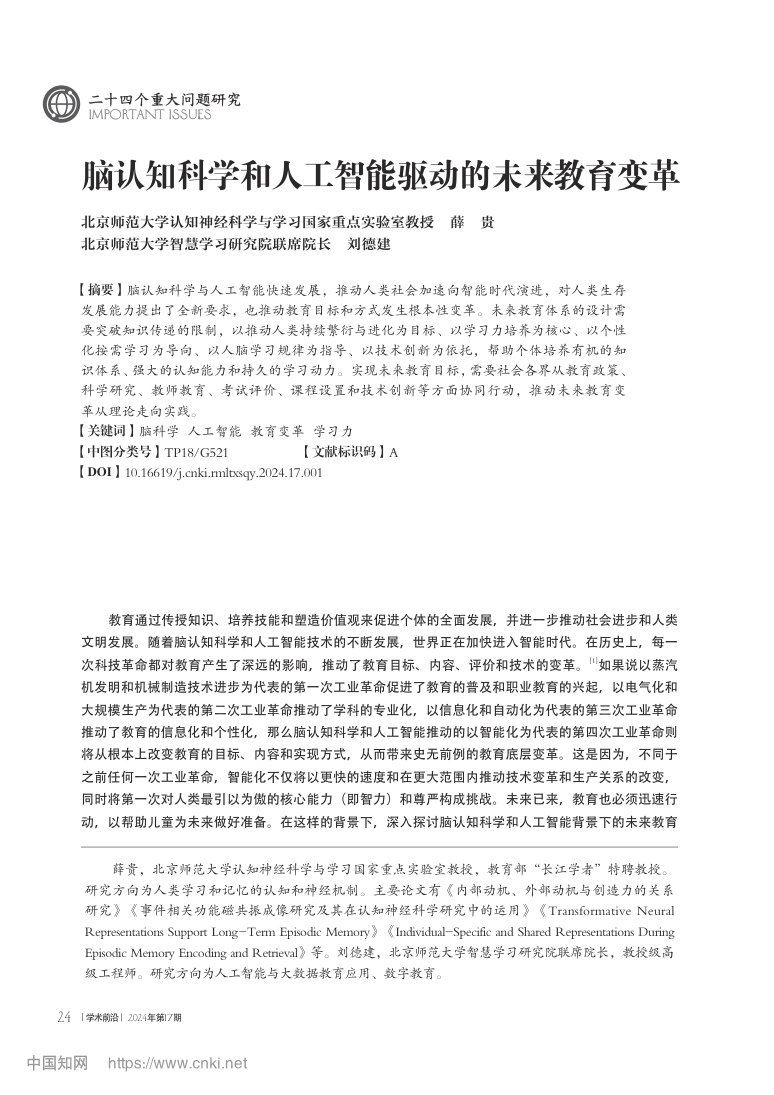
The Chair’s original main text and author biographies have been checked against the journal’s official article, published on 18 September 2024. Two passages on assessment and technology development were each duplicated in the Chair archive; each is retained once. The original numbered citations, reference list and journal English abstract remain available in the complete 17-page paper, pp.24–40, through CIT’s official PDF. The image is a full first-page preview of that PDF, not a photograph from the article. The SLI page found during checking is an annual achievements review that lists the paper; its unrelated images have not been reused.
Original link: https://aiedchair.bnu.edu.cn/news-8379-en/