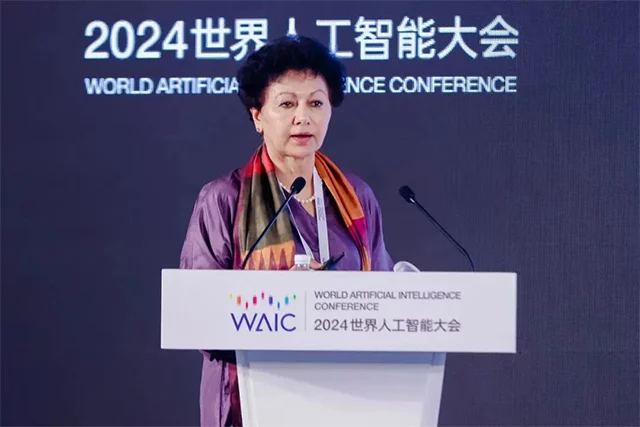
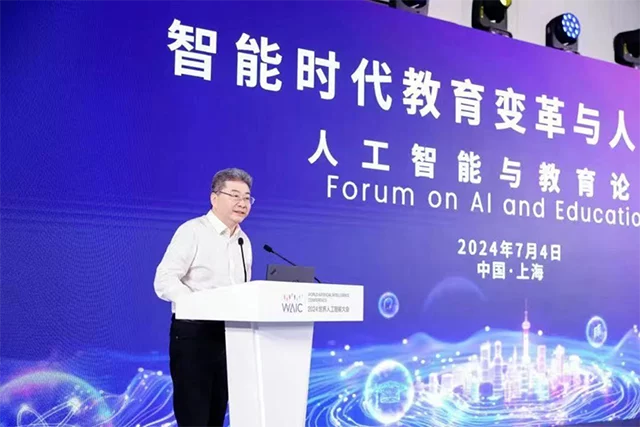
The World Artificial Intelligence Conference 2024 opened in Shanghai on 4 July. That afternoon, its Forum on AI and Education took place at the Shanghai World Expo Exhibition and Convention Center.
Joint hosts and forum objectives
Tongji University, the Shanghai Municipal Commission of Economy and Informatization, the Shanghai Municipal Education Commission and China Mobile Communications Group Co., Ltd. jointly hosted the forum. It explored educational opportunities and challenges associated with AI, shared useful practices in educational applications of intelligent technologies, advanced the development of outstanding innovative talent, and discussed sustainable pathways for improving educational equity and quality together in the intelligent era.
Opening addresses
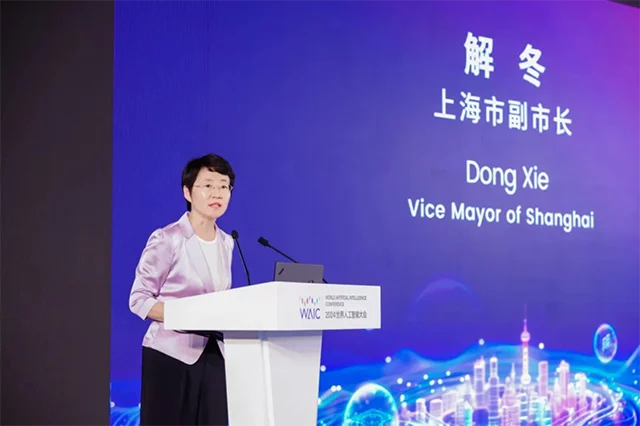
Wu Yan, a member of the Ministry of Education’s Party Leadership Group and Vice Minister of Education, and Xie Dong, Vice Mayor of Shanghai, attended and delivered opening addresses.
Kanwar’s keynote
Professor Asha Singh Kanwar, Chair of the Governing Board of the UNESCO Institute for Information Technologies in Education, former President and CEO of the Commonwealth of Learning, and Chair Professor at the Smart Learning Institute of Beijing Normal University, was invited to deliver the keynote “Education Transformation and Talent Development in the AI Era”.
Her presentation examined strategies and practices in AI and education in China, India, Singapore, the Republic of Korea and other countries. It analysed AI’s profound effects on the younger generation and the employment market, exploring new trends in education transformation and new requirements for talent development.
Five important competencies for the intelligent era
- Lifelong, continuous self-directed learning
- The ability to innovate using AI
- Adaptability to flexible employment
- The ability to handle uncertain situations
- The ability to live in intelligence-rich environments
Investment and education transformation
The presentation called on stakeholders to increase investment in smart education infrastructure, curriculum resources, teaching methods, and skills and literacies.
Kanwar advocated using open-source large language models (LLMs) to improve educational accessibility and innovation, support education transformation, and enhance the quality of education and talent development.
Chairs and participating guests
Zhou Yaming, Director of the Shanghai Municipal Education Commission, chaired the opening ceremony. Zhou Dawang, Director of the Ministry of Education’s Department of Science, Technology and Informatization, and Ye Zhenzhen, Chairman of People.cn, attended the forum.
Other keynote speakers
- Yao Qizhi: Dean of Tsinghua University’s College of AI; member of the Chinese Academy of Sciences, Turing Award laureate and international member of the US National Academy of Sciences.
- Ding Kuiling: President of Shanghai Jiao Tong University and member of the Chinese Academy of Sciences.
- Zheng Qinghua: President of Tongji University and member of the Chinese Academy of Engineering.
- Zheng Nanning: Director of the Institute of Artificial Intelligence and Robotics at Xi’an Jiaotong University and member of the Chinese Academy of Engineering.
- Yonggang Wen: Associate Provost (Graduate Education) and Dean of the Graduate College at Nanyang Technological University, Singapore; Fellow of the Singapore Academy of Engineering.
- Gao Tongqing: Deputy General Manager of China Mobile Communications Group Co., Ltd.
- Liu Qingfeng: Chairman of iFLYTEK Co., Ltd.
Zhao Xianzhong, Vice President of Tongji University, chaired the keynote session.
Sources and historical notes
- The forum took place on 4 July 2024. Tongji’s report appeared on 5 July. The Chair’s original title, URL and archive time of 18:00 on 6 July are retained. CIT republished the report on 8 July at 11:03 and credited the BNU Smart Learning Institute’s official WeChat account. Positions are those reported at the time of the event.
- The original archive and CIT text give the third competency as “多利灵活就业的适应能力”. This edition renders the unambiguous reference to adaptability to flexible employment, retains the original wording for comparison and does not expand the unclear modifier. The other four competencies and the investment and open-source LLM proposals are retained in full.
CIT original report · Tongji co-host report · AI and STEM learning resources
Original link: https://aiedchair.bnu.edu.cn/news-9141-en/