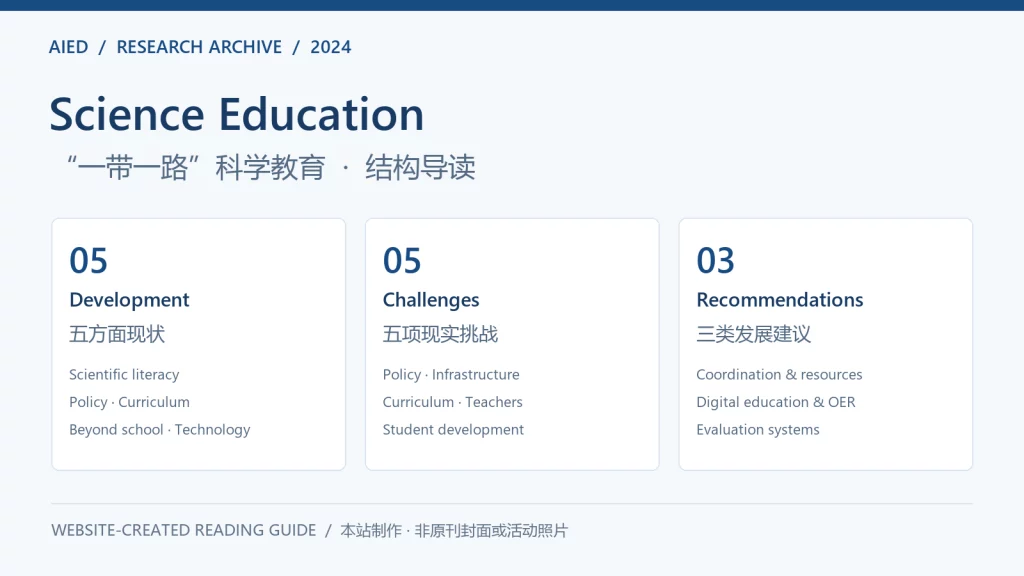
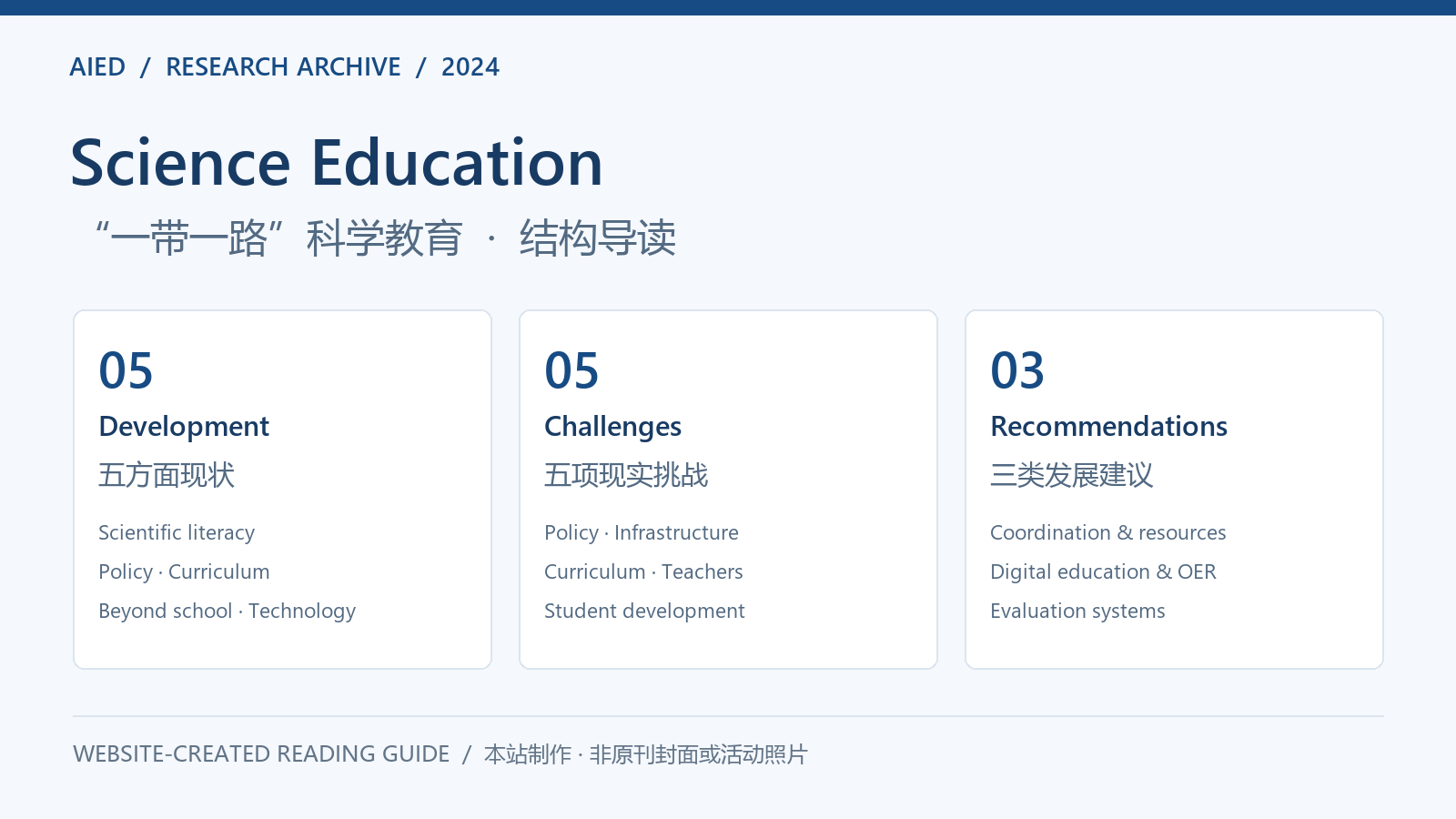
Full historical research article: originally published in World Education Information, volume 37, issue 4, 2024, by Zhu Lixin, Li Xin and Zhang Xiangling. The five areas of development, five challenges, three sets of recommendations and all 28 references are retained. Country groupings, policies and data reflect the study’s contemporary context.
Zhu Lixin · Li Xin · Zhang Xiangling
Abstract: Science education in countries along the Belt and Road is unevenly developed in students’ scientific literacy, policy and standards, curricula, out-of-school provision and the use of new technologies. Its development faces inadequate policy safeguards, insufficient infrastructure and curriculum resources, uneven teacher quality and narrowly focused student development. Coordination mechanisms and better resource allocation are principal strategies for sharing the benefits of science education.
Education digitalization and open educational resources offer important ways to address uneven development, while evaluation systems provide a key means of advancing science education. The article recommends action in these three areas.
Keywords: Belt and Road; science education; current development; challenges; recommendations for development
About the authors
- Zhu Lixin: Senior Engineer, National Engineering Research Center of Cyberlearning and Intelligent Technology, Beijing Normal University, Beijing 100084, China.
- Li Xin, corresponding author: Lecturer, School of Smart Education, Jiangsu Normal University, Xuzhou 221116, China.
- Zhang Xiangling: Lecturer, School of Information Technology Education, Beijing Institute of Education, Beijing 100120, China.
Funding
A project of the Children and Youth Science Center of the China Association for Science and Technology: Research on the Concepts and Strategies of International Cooperation in Science and Technology Education along the Belt and Road.
I. Introduction
To realize the Belt and Road Initiative’s important role in international educational cooperation and exchanges and strengthen the cultivation of innovative scientific and technological talent, China issued the Special Plan for Cooperation in Science, Technology and Innovation in Advancing Belt and Road Development, the Education Action Plan for the Belt and Road Initiative, and China’s Education Modernization 2035. Building a Belt and Road education community and cultivating innovative scientific and technological talent are major objectives.[1][2]
Throughout more than a decade of the initiative, China has consistently attached great importance to developing scientific and technological talent. At the first Belt and Road Forum for International Cooperation in 2017, President Xi Jinping launched the Belt and Road Science, Technology and Innovation Cooperation Action Plan.[3] The Ministry of Education’s 2018 Action Plan for Scientific and Technological Innovation in Higher Education to Serve the Belt and Road Initiative further called for joint talent development through platforms, personnel exchanges, collaborative projects and technology transfer.
It proposed an international university network for collaborative innovation, rooted in countries along the route and open to the world, together with a friendly and stable environment for scientific and technological talent exchanges.[4] At the opening of the third Belt and Road Forum in 2023, President Xi emphasized continuing the science, technology and innovation action plan and holding the first Belt and Road Conference on Science and Technology Exchange.[5] These policies and measures demonstrate the importance China’s Party and state attach to cooperation and innovative talent development along the Belt and Road.
Science education is an important foundation for building a global talent hub and centre of innovation,[6] and is essential to developing innovative scientific and technological talent.[7]
II. Current development
Over more than a decade, China signed over 200 Belt and Road cooperation documents with more than 150 countries and 30 international organizations, making the initiative a widely welcomed international public good and the largest platform for international cooperation.[8] To understand science education more comprehensively across countries along the Belt and Road, this article systematically reviews and analyses students’ scientific literacy, policy and standards, curricula, out-of-school provision and the use of new technologies.
1. Students’ scientific literacy
Scientific literacy refers to an individual’s capacity to identify scientific questions, explain phenomena scientifically and use scientific evidence.[9] Among the ten highest mean science scores in the Programme for International Student Assessment, PISA 2022, besides Hong Kong (China), Macao (China) and Chinese Taipei, the countries included in the article’s Belt and Road grouping occupied three positions: Singapore first, Korea fifth and Estonia sixth. Six countries in its grouping were among the bottom ten: Cambodia, the Dominican Republic, El Salvador, the Philippines, Panama and Uzbekistan.
These data reflect the participation and influence of the countries studied in this assessment. Of the 48 countries and economies below the OECD average cited by the authors, 28 were in their Belt and Road grouping, or approximately 58%. Comparing scientific literacy across countries and over time, the article finds a polarized pattern, with most of the countries studied lagging behind. The pattern resembles earlier PISA results,[10] indicating persistent disparities in students’ scientific literacy.
In geographical terms, students in Belt and Road countries with more stable economic, political and cultural circumstances tended to perform better.
2. Science education policies and standards
In 2023, China’s Ministry of Education and seventeen other departments jointly issued the Opinions on Strengthening Science Education in Primary and Secondary Schools in the New Era. They called for a student-centred approach, teaching adapted to individual needs and science education based on inquiry and practice, stimulating children’s curiosity, imagination and desire to investigate, planting the seeds of science and encouraging their dreams of becoming scientists.[11] The policy emphasizes individualized education, cultivating a scientific spirit through practical inquiry and fostering interest and enthusiasm in science.
Singapore’s science education policy centres on inquiry-based learning and developing communication through inquiry.[12] It stresses independent learning and active participation, encouraging critical thinking and teamwork through problem solving. Malaysia’s policy focuses on students’ overall competencies and thinking skills, alongside a gradual adjustment and improvement of teaching approaches across the education system.[13] It links science education to everyday life, emphasizing comprehensive capabilities and students’ roles in solving practical problems.
In 2011, the Philippines issued a Framework for Science Teacher Education, specifying the knowledge and capabilities required in professional knowledge, professional practice and professional attributes.[14] The framework seeks to improve science teachers’ professionalism so that they can guide learning more effectively and develop students’ scientific literacy and skills.
3. Science curricula
The United Arab Emirates, Estonia, Serbia, Greece, Cyprus and Malaysia have extensive science curricula and supporting digital resources. Some countries with more limited economic resources, including Pakistan, Palestine, South Africa and Montenegro, face inadequate investment in science curriculum development and digital resources, a challenge that cannot be overlooked in the digital era. As understanding of science education grows, countries along the Belt and Road increasingly recognize its importance, and more are establishing databases of science curriculum resources.[15]
In Estonia, for example, science teachers can use the digital resource collection e-schoolbag to find materials for kindergarten, primary, secondary and vocational education.[16] The UAE Ministry of Education introduced Manara, described in the article as its largest public digital library of open educational resources. As a free, openly licensed platform, it provides texts, media and other digital assets to support science curricula.[17]
4. Out-of-school science education
Out-of-school science education mainly involves science and technology competitions and the use of learning resources such as science centres and research institutes.[18] It complements classroom learning and helps students consolidate scientific knowledge, develop innovative capabilities, master inquiry methods and cultivate scientific attitudes and values. However, complex political, economic and cultural circumstances have led to uneven provision across Belt and Road countries. Countries with weaker economies and more unstable political and cultural conditions often lack adequate safeguards.
In Libya and Sudan, for example, political upheaval and continuing conflict have left major gaps in policies, institutions, facilities and teaching personnel, without effective mechanisms to support out-of-school science education. Countries with more stable circumstances generally face fewer such difficulties and have more comprehensive policies, professional teaching teams and resources to support activities. Singapore’s KidsSTOP, for instance, is its first children’s science centre.
Covering around 3,000 square metres, it offers scientific exploration for children aged eighteen months to eight years, stimulating curiosity and interest.[19] Its 24 zones cover four themes: Imagine, Experience, Discover and Dream. It offers services for families and schools, including birthday parties and out-of-school science inquiry activities, and regularly organizes STEAM festivals for young learners. Italy’s Science Education as a Tool for Active Citizenship project, SETAC, develops new science education pedagogies and provides quality resources and guidance for teachers, secondary students and museum educators.[20]
It illustrates the strengths of linking school and out-of-school learning, including teacher development, cooperation among government, business and schools, and attention to educational equity.
5. New technologies in science education
Many countries along the Belt and Road have introduced virtual reality, augmented reality and artificial intelligence into science education to improve learning experiences and teaching. Türkiye, for example, uses the internet to provide learning opportunities across the country and offers resources such as intelligent content recommendations, gamification and EBA portfolios.[21] Oman identifies enhancing education, learning, scientific research and national capabilities as a national priority.
Its measures include establishing the University of Technology and Applied Sciences, providing young people with specialist ICT training and building a talent pipeline covering learning, certification and employment.[22] These countries have developed forms of cooperation with enterprises that offer useful examples for others, supporting science education and innovative talent. Yet some schools with fewer economic resources cannot afford the high costs of emerging technologies, contributing to unequal access to technological resources.
III. Practical challenges
1. Inadequate policy safeguards
Incomplete policy support systems in Belt and Road countries such as Pakistan, Nepal and Montenegro create major challenges for science education, especially where development is more limited. In Pakistan, incorporating science education into primary and secondary education policy has become a first step towards improvement,[23] offering a reference for other countries. Nepal has not yet established effective coordination among government, schools, universities, the private sector and international organizations.
Without overarching design, systematic planning and relevant safeguarding policies and plans, sustainable development of science education is constrained. Montenegro recognizes the need to strengthen coordination between education and science, but has not yet developed policy documents and measures jointly bringing together education, science and finance, leaving orderly development without strong support. Establishing and improving science education policy is necessary not only for raising domestic standards, but also for participating in global affairs and achieving sustainable development.
2. Insufficient infrastructure
Pakistan, Nepal and Türkiye face inadequate educational funding, weak foundations for science education and limited capacity for scientific and technological innovation, seriously affecting talent development. Outdated university science laboratory equipment is particularly evident in Nepal. Many schools cannot fully use scientific equipment and laboratories because they lack trained teachers, supporting resources and maintenance budgets. This limits practical learning and weakens students’ interest in and understanding of science.
Countries need to strengthen laboratories, science centres and other infrastructure, while using competitions, exhibitions and scientific projects to stimulate interest and create better learning environments. Teacher training must also be strengthened so that infrastructure effectively supports the delivery and development of science teaching.
3. Insufficient curriculum resources
First, economic constraints are a major cause of inadequate curriculum resources. Many Belt and Road countries have less-developed economies and limited education budgets, making sufficient investment in developing and updating resources difficult.[24] Without funding, schools cannot buy up-to-date textbooks, laboratory equipment and other teaching aids, affecting learning experiences and teaching quality. Second, inadequate technological equipment and IT infrastructure are another important cause.
Schools and education institutions in some countries lack the devices and connectivity needed for online learning, sharing teaching resources and distance education. This restricts students’ access to new scientific knowledge and limits teachers’ methods and tools. Finally, outdated and conservative education systems also play a part. Some countries retain traditional teaching methods and curricula disconnected from contemporary development and scientific progress.[25] Without renewed educational ideas and curriculum design, resources fail to keep pace with science, affecting educational quality and students’ competitiveness.
4. Uneven teacher quality
Science teachers are central to developing science education, and strengthening the teaching workforce has become a shared priority in the field.[26] Belt and Road countries face uneven development of their science teaching workforces. Estonia, for example, has an ageing teaching workforce; some teachers in physics, mathematics, chemistry, geography and biology find it difficult to integrate new technologies and pedagogies.[27] Slovenia plans to use distance learning to improve science teacher training, but faces declining enrolment in science disciplines and teacher shortages.
More attention to training is needed in countries with more limited economic resources, including Nepal and Pakistan. Nepal emphasizes highly skilled science teachers, while Pakistan needs a more comprehensive training programme. A strong science teaching workforce is essential for sustainable development. Training and exchanges can support professional development and help teachers respond effectively to the demands and challenges of science teaching.
5. Narrowly focused student development
First, limited access to science education is one of the main causes of students’ insufficiently rounded development. Weak basic education, outdated school facilities and inadequate teacher quality restrict provision in some countries. Students consequently have unequal opportunities and resources, and some remote areas have no access to science education, limiting their scientific development. Second, narrow teaching methods and approaches also contribute. Traditional instruction still dominates in some Belt and Road countries, focusing on transmitting theoretical knowledge while offering few practical or inquiry-based activities.
Such teaching does little to develop practical capabilities, innovative awareness or problem-solving skills, resulting in an incomplete science education. Finally, unsuitable assessment systems are another major factor. In some countries, educational evaluation relies mainly on examination results and marks, neglecting practical capabilities and broader competencies. A single assessment standard may encourage students to focus on examination techniques at the expense of scientific thinking and innovation.
IV. Recommendations
Coordination and resource allocation
Establishing coordination mechanisms and improving resource allocation are principal strategies for sharing the benefits of science education. Global online resource-sharing platforms, including discussion forums and sharing services, can promote knowledge flows and access to resources. Science-centre activities should be brought into schools, strengthening cooperation between schools and community education sites. Joint talent-development mechanisms should recognize the key role of universities and research institutes in international cooperation.
Science education student-exchange programmes and dedicated research funds for science education in Belt and Road countries, for example, can encourage diverse forms of talent development and collaboration.[28]
Digitalization and open educational resources
Education digitalization and open educational resources offer important ways to address uneven science education. China’s substantial progress in education digitalization can inform the development of digital resources that support sharing and cooperation among countries. Countries should be encouraged to create and use open science education resources, including online support platforms, scientific experiment resources, virtual laboratory platforms and teaching aids.
Science education services can be improved through talent databases, directories of activities and competitions, repositories of science education outputs and other resource platforms, providing countries along the Belt and Road with more valuable information and support.
Science education evaluation
Building evaluation systems is a key means of advancing science education. Evaluation helps establish its level of development and is a prerequisite for evidence-informed policy. First, its objectives and orientation must be clear. Its fundamental purpose is to develop students’ scientific literacy and innovative capabilities, guiding them to master scientific knowledge, methods, thinking and attitudes, fostering interest, inquiry and innovation, and unlocking scientific potential and creativity.
Its orientation should centre on well-rounded education, attend to students’ comprehensive development, emphasize both learning processes and outcomes, and meet social and individual needs. Second, indicators and standards should reflect the full scope and characteristics of science education, express its value and significance, guide implementation and improve evaluation. Finally, evaluation should use varied, flexible and effective methods. Quantitative and qualitative approaches can be combined through examinations, project assessments, reviews of student work, teaching observation and feedback.
References
References retain their original languages, authors and journal details to support source retrieval. Numbers correspond to the citations in the text. Historical access dates for online materials are not dates of this review.
- 刘宝存.以“一带一路”教育共同体助力人类命运共同体建设[J]. 比较教育研究,2023,45(8):13-14.
- 秦进,谈世鑫,沈义竹,等.“一带一路”科技创新人才培养:中国优势、挑战与关键路径[J].中国科学院院刊,2023,38(9):1325-1342.
- 中华人民共和国中央人民政府.习近平出席“一带一路” 国际合作高峰论坛开幕式并发表主旨演讲[EB/0L].[2017-05-14][2023-12-01]. · View source
- 中华人民共和国教育部,教育部关于印发《高校科技创新服务“一带一路”倡议行动计划》的通知[EB/OL]. [2018-11-12][2024-03-13]. · View source
- 中华人民共和国中央人民政府.习近平在第三届“一带一路”国际合作高峰论坛开幕式上的主旨演讲(全文)[EB/OL]. [2023-10-18][2023-12-01]. · View source
- 张黎,赵磊磊。我国科学教育政策的历史演进、变迁逻辑与未来展望[J]. 教育学术月刊,2023(11):88-95,112.
- 田雪葳,王晶莹,宋倩茹,等. STEM 导向的当代国际科学教育研究图景——基于NARST2020年会的文本挖掘[J]. 现代远距离教育,2021(1):78-88.
- 涂端午,董倩. 共建“一带一路”教育行动高质量发展的路径与策略[J].现代远程教育研究,2023,35(3):13-21.
- 胡咏梅,唐一鹏,高中生科学素养的性别差异基于无条件分位数回归的经验研究[J].北京大学教育评论,2013,11(4):110-128,188.
- 叶晓梅,蔡娟,何二林,“一带一路”不同文化区的中学生科学素养差异性分析[J]. 教育学术月刊,2023(2):75-82.
- 中华人民共和国教育部.教育部等十八部门关于加强新时代中小学科学教育工作的意见[EB/OL].[2023-05-26][2024-03-13]. · View source
- KADIR M A.Singapore's educational policy through the prism of student voice:recasting students as co-agents of educational change and 'disrupting' the status quo?[J].Journal of education policy,2019,34(4):547-576.
- 李小红,蒋雄琼,杨文静. “一带一路”视域下马来西亚高等教育在地国际化研究[J]. 世界教育信息,2023,36(9):62-69.
- 徐佳蓉,欧阳袁媛,丁雨楠,等. 菲律宾科学教师专业标准的内容、特点与启示[J].世界教育信息,2023, 36(11):43-52.
- 陈会民,田慧君,王孙禺. “一带一路”沿线国家工科大学生中国在线教育的选择动因及学习效果[J].高等工程教育研究,2022(2):100-104.
- ekoolikott.Kasuta, jaga ja loo oppematerjale![EB/OL].[2024-03-19]. · View source
- UAE. Open educational resources [EB/OL].[2024-03-19]. · View source
- 王素,张永军,方勇,等.科学教育:大国博弈的前沿阵地——国际科学教育战略与发展路径研究[J].中国教育学刊,2022(10):25-31.
- Blooloop. Science Centre Singapore opens new children's science centre, KidsSTOP[EB/OL].[2024-03-19]. · View source
- Department of Science Education. SETAC-science education as a tool for active citizenship [EB/OL]. [2024-03-19]. · View source
- 亚萨尔·孔达奇,斯韦尼亚. 贝登利耶,坚吉兹·哈坎·艾登,等.数字时代远程开放教育:土耳其篇[J].中国远程教育,2019(10):52-63,93.
- 华为技术专栏.为阿曼智能化转型培养生力军[EB/OL] [2024-03-19]. · View source
- MUNAWAR A, 任定成,曹志红. 巴基斯坦科技教育政策的历史和现状[J].科技导报,2019,37(9):87-93.
- 闫月勤,郑淳,王海超.“一带一路”高校国际联盟建设:成效、问题与建议[J]. 世界教育信息,2021,34(5):53-61.
- 段颀. “一带一路”背景下高校专业教学面对的挑战与机遇[J].教育现代化,2019,6(32):64-66.
- 王晓生.小学科学教师队伍建设:价值使命、现实羁绊与实践路径[J].中国教育学刊,2023(6):91-95.
- 中国教育报,教师需要更多专业培训与支持[EB/OL]. (2019-06-28)[2024-03-19]. · View source
- 郑永和,周丹华,王晶莹.科学教育的本质内涵、核心问题与路径方法[J]. 中国远程教育,2023,43(9):1-9,27.
Zhu Lixin · Li Xin · Zhang Xiangling · 世界教育信息, 2024, 37(4):15–20.
Editorial and historical source notes
- The Chair’s original title, URL and archive time of 22 June 2024, 12:31 are retained. BNU’s author profile confirms World Education Information, 2024, volume 37, issue 4, pages 15–20. The related ICTEDU article is dated 13 May 2024. Journal issue, source webpage and archive dates are distinguished; October in an old image path is not a publication date.
- The complete original article, authors and corresponding author, three affiliations and addresses, funding, all sections and 28 references are retained. PISA assesses countries and economies; Hong Kong (China), Macao (China) and Chinese Taipei are not listed as independent countries. The original “48 countries” is rendered as “48 countries and economies.” Belt and Road groupings and the 28/48, approximately 58%, figures retain the study’s historical scope, not a current membership list. Mean-score order does not replace OECD’s statistical rank ranges.
- The URLs printed in references [3] and [5] do not correspond to their titles and dates. Verified supplementary links point to the related 2017 Ministry of Foreign Affairs report and an official reproduction of the complete 2023 speech. Stray spaces are removed from [11] and the Huawei source path repairs [22]. Original bibliography entries remain in the editorial archive. Historical links not individually retested are not labelled as currently available services. The old image returns 404 and its attachment record is absent; the reading guide is not a recovered original.
Related ICTEDU original · BNU author profile and bibliography · OECD PISA 2022 science performance · Education resource centre · AI and STEM learning resources
Original link: https://aiedchair.bnu.edu.cn/news-8755-en/