
Historical recommendation, originally published on 18 September 2023. The article retains the research perspectives and context of that time.
Article contents
Background and research context
Artificial intelligence is a strategic technology and a major driving force behind a new wave of scientific and technological revolution and industrial transformation, with profound implications for human society. Education is one of its important areas of application, but intelligent technologies also bring new challenges. Across the global education community, a consensus has emerged on using AI to transform education, promote quality and equity, reconcile education at scale with individual development, and cultivate innovative talent for a future intelligent society.
The Chinese government attaches great importance to the transformative impact of information technology on education. In recent years, it has issued a series of policy documents to promote educational change through intelligent technologies. The report to the 20th National Congress of the Communist Party of China called for accelerating efforts to build a strong education system, greater scientific and technological strength, and a high-quality workforce. Its integrated approach to education, science and technology, and talent constitutes a major strategic decision by the CPC Central Committee in the context of building a modern socialist country in all respects.
Intelligent technologies in education can provide appropriate learning support, improve the validity and accuracy of assessment, advance teachers’ professional development and changing roles, create a new generation of learning environments, and improve educational governance and evidence-informed management decisions. How trustworthy AI can support and guide educational transformation, smart learning environments, new teaching models and modern education systems is a major question requiring further research. As AI develops rapidly, applications of large models represented by ChatGPT are spreading through education. Researchers in China and elsewhere are giving increasing attention to the roles and contributions of AI in future education, with extensive and in-depth discussion.
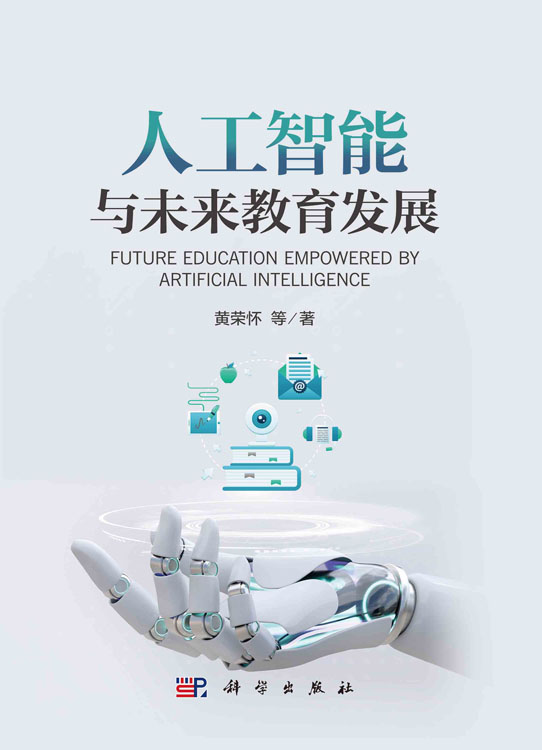
Future Education Empowered by Artificial Intelligence (Chinese title: 人工智能与未来教育发展; Huang Ronghuai and colleagues, Beijing: Science Press, August 2023) is a core outcome of the 2019 National Social Science Fund key project in education, Research on Artificial Intelligence and the Development of Future Education. Led by Professor Huang Ronghuai of Beijing Normal University, the project brought together research teams from Beijing Normal University, Central China Normal University, Southwest University, Zhejiang Normal University, Beijing Sport University and other universities and research institutions.
Framework diagram and text description
Expand the full text description of the diagram
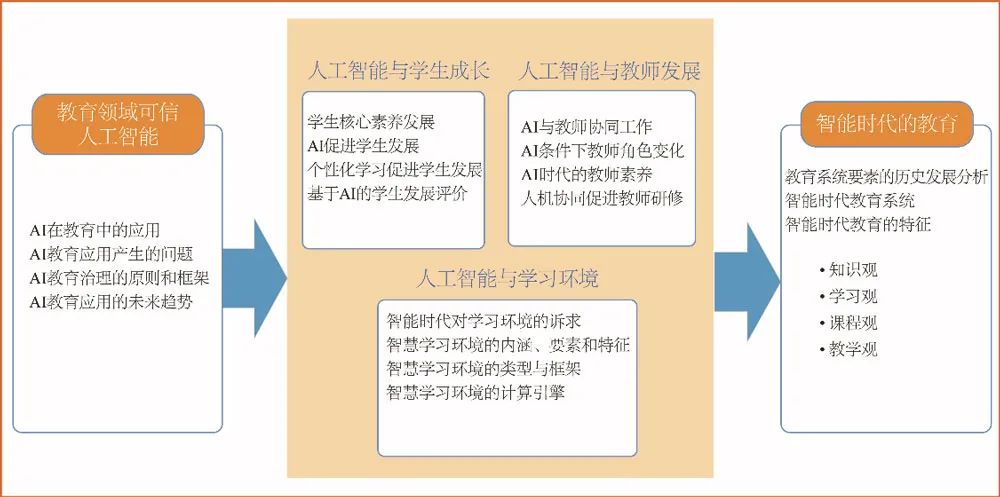
The left-hand panel presents trustworthy AI in education. Three central panels address student growth, teacher development and learning environments. The right-hand panel presents education in the intelligent age. Arrows connect these areas from left to right. The panel text is transcribed below:
- Trustworthy AI in education
- AI applications in education
- Problems arising from educational AI applications
- Principles and frameworks for educational AI governance
- Future trends in educational AI applications
- AI and student growth
- Development of students’ core competencies
- AI supporting student development
- Personalised learning supporting student development
- AI-based assessment of student development
- AI and teacher development
- AI and teachers working collaboratively
- Changes in teachers’ roles with AI
- Teacher competencies in the AI age
- Human–AI collaboration supporting teacher professional learning
- AI and learning environments
- Demands on learning environments in the intelligent age
- Meaning, elements and characteristics of smart learning environments
- Types and frameworks of smart learning environments
- Computational engines of smart learning environments
- Education in the intelligent age
- Historical development of educational system elements
- Educational systems in the intelligent age
- Characteristics of education in the intelligent age
- Conceptions of knowledge
- Conceptions of learning
- Conceptions of curriculum
- Conceptions of teaching
Diagram: the Chair’s 2023 recommendation. The original image is retained; the text description follows its contents.
Ten core arguments
Starting from the major practical needs of China’s educational reform and development, the book examines the medium- and long-term development of AI and the central concerns of future education from historical and global perspectives. Focusing on talent needs, student growth, teacher development and learning environments, it investigates the relationship between AI and future education, the mechanisms through which AI transforms education, and potential risks and governance. Its core arguments can be summarised in ten points.
1. AI in education will shift from an emphasis on technology applications towards the development of human–AI collaborative systems, with a trend from narrow towards strong AI.
A new generation of science and technology, represented by AI, is changing how people work, live and learn, as well as their environments, driving deep social change and rapid transformation towards greater intelligence. As society moves into the intelligent age, new demands arise from uncertainty, complexity and intelligence, including in social equity, economic development, resource sustainability and climate change. Trends across AI subfields in education indicate a shift from technology applications alone to the development of human–AI collaborative systems. Over time, AI in education is expected to move from narrow towards strong AI.
2. Conceptions of education in the intelligent age will change, encompassing co-created and shared knowledge, learning through intelligently connected construction, an integrated and open curriculum, and human–AI collaborative teaching.
- First, knowledge will be co-created and shared. In the intelligent age, knowledge is a generative construction of information and meaning acquired by people and AI through interaction with other learners, agents and environments within particular contexts and sociocultural settings. This reflects co-creation. Through networks and interaction, people and machines can form highly organised activities, jointly producing knowledge and using it to make decisions and solve problems. This reflects knowledge sharing.
- Second, learning will involve intelligently connected construction. Within an intelligent social environment shaped by the internet, the Internet of Things and an intelligence-connected network, learners can interact with peers, teachers, other people and interconnected agents. By participating in collaborative construction, they acquire knowledge, skills and attitudes, and learning takes place. Fragmented, ubiquitous and dynamic knowledge challenges earlier forms of learning; future learning will therefore be meaningful, active and deep.
- Third, curricula will be integrated and open. Future curricula will become networked and structured, with integrated courses developed around major disciplinary concepts. A more comprehensive, connected and coherent curriculum system will promote students’ transfer of learning and deep understanding across time, space, cultures and contexts.
- Fourth, teaching will involve human–AI collaboration. Teaching structures will evolve towards a system comprising intelligent machines, teachers, content, students and media. Intelligent technologies will support person-to-person and person-to-machine collaborative learning, strengthen teachers’ capabilities and allow students to surpass teachers in particular fields. Teachers and students can then learn from one another, while new teacher roles emerge, including learning facilitator, organiser and guide.
3. Alongside basic life and work skills, people in the intelligent age especially need digital literacy, the capacity for deep learning, inquiry and creativity, collaboration with people and intelligent machines, and a willingness to participate actively in society. They must respond to an unknown and changing future with adaptability and flexibility.
To prepare for future work and life, people need digital literacy and technological skills, the ability to understand and use extensive knowledge and information, and capacities for deep, active and lifelong learning and effective self-management. They also need higher-order cognitive abilities, including computational thinking, reflective and critical reasoning, inquiry, meaning-making and solving complex problems, so that they can adapt flexibly to a changing world. Social and civic literacy enables active, dynamic and constructive participation in development, sustainable living and working, respect for others and protection of civic rights. Broad person-to-person and person-to-machine communication and collaboration should express humanistic values and humanity.
4. Teachers need to adapt progressively to human–AI collaborative teaching. They require subject knowledge and the ability to follow developments in their disciplines; pedagogical knowledge and the ability to support learning across settings; technological knowledge and innovative application; a commitment to growth and professional development; and collaborative awareness and adaptability to teaching contexts.
Teachers and AI will work together throughout teaching, learning, management, assessment and testing. Teachers’ new roles will focus on facilitating learning, integrating resources, applying AI, personalising learning and communicating emotionally, while serving as mentors in students’ lives. To take on these roles and ways of working, teachers need disciplinary knowledge and awareness of advances; pedagogical knowledge and learning facilitation across settings; technological knowledge and innovative use; growth and professional development capabilities; and collaborative awareness and contextual adaptability.
5. Built on intelligent infrastructure, a new generation of learning environments will form dynamic, open and intelligently connected ecosystems combining physical and virtual settings. Their interoperable components can perceive, identify, compute, analyse and evaluate learning contexts, processes and learner characteristics, providing personalised resources, services and tools.
Smart learning environments can perceive, identify, compute, analyse and evaluate learning contexts, processes and learner characteristics. They provide personalised resources, teaching services and convenient interactive tools, supporting engaged, comfortable and effective learning while dynamically optimising and evolving. Their elements include learning resources, intelligent agents, tools, learning communities, teaching communities, and approaches to learning and teaching. They support person-to-person and person-to-machine interaction and collaboration, with ubiquitous accessibility and universal design among their core features.
6. AI promotes student development by expanding the forms of learning resources, allocating them on demand, enabling personalised recommendations and support services, enriching interaction and meeting diverse needs.
- AI applications in education will diversify teaching and learning resources, including online multimedia materials, robotics resources and virtual reality learning materials.
- By modelling students, teachers and other users, capturing their current states and collecting data, AI can identify individual needs. Data analysis and intelligent recommendations can then allocate resources and services on demand.
- The internet and AI can extend both the depth and reach of personalised education. Recommendation systems incorporating user profiles can provide tailored learning resources and finely targeted learning services.
- AI can enrich how resources are used, making learning more engaging through interactive reading and virtual experiences while meeting diverse developmental needs.
- AI is already widely used to meet students’ needs in knowledge, skills and attitudes across disciplines such as programming, biology, physics, languages and mathematics.
- Big data analysis can capture group learning patterns promptly and promote social participation and interaction through prompts, questions, recommendations of partners and suggestions for interaction strategies.
- AI can deliver rapid, precise assessment and feedback, enabling immediate evaluation and improving the precision and efficiency of teaching.
7. An evidence-centred approach can construct contexts that elicit behaviour, extract evidence of competence and infer student achievement, creating a big-data-based model of academic achievement assessment.
- First, develop competency assessment standards, collect and store process data, and construct a task model of student competencies. Different types of tasks should elicit behavioural responses corresponding to the competency indicators.
- Then extract characteristic variables from competency-related behaviour: identify meaningful student behaviour, derive observable competency variables, and verify their validity.
- Next, use Bayesian networks to automate competency assessment. New sample data update the conditional probability tables, and the highest-probability value becomes the basis for automatically assessing each record.
- Finally, validate the effectiveness of automated assessment in practice. Its scientific soundness and validity require empirical investigation.
8. AI can connect pre-service and in-service teacher development, bringing initial preparation closer to real teaching contexts and experiences. Intelligent teacher education platforms can integrate observation and practicum with teaching communities, link personalised preparation to professional development, and enable development data to flow, connect and be shared throughout the process.
An intelligent teacher education platform spanning teacher education institutions, teaching organisations and education authorities can dynamically recognise student teachers’ learning states and practising teachers’ teaching contexts, and profile their development. Professional development data can flow across pre-service and in-service stages and be connected and shared across institutions and authorities. Mixed reality and platforms combining online, offline, physical and virtual observation and practicum can let student teachers understand and experience authentic classroom situations and problems, encounter future-oriented learning environments and adapt to future-oriented teaching. Appropriate learning content close to practice can simulate diverse students and teaching environments, providing personalised teaching, comprehensive process assessment and data-driven management throughout.
9. National education networks need more intelligent infrastructure deployment, together with AI-enabled educational support environments and public smart education platforms. Classrooms, laboratories and libraries should become ubiquitously and intelligently connected. Classroom design should support teacher–student interaction, rich learning experiences, humanistic care and aesthetic qualities.
- First, cloud-based data centres can support dynamic traffic scheduling in intelligent education networks, rapid self-optimisation and system-wide configuration, enabling intelligent configuration and load balancing to ensure network capacity and service quality.
- Second, build AI-enabled educational support environments and public smart education service platforms. Foundational resources include educational data, algorithmic frameworks and computing power. Improve data quantity, quality and security, along with algorithmic accuracy, effectiveness and security.
- Third, use an intelligence-connected network as the core engine for classrooms, laboratories and libraries. Comprehensive sensing and capture of information about students, teachers and environments, combined with analysis of diverse data, can support intelligent computation across teaching, learning, practice, management, assessment and testing, delivering comprehensive, precise and personalised services.
- Fourth, combine online and offline learning spaces to extend classrooms across time and space. Enable flexible teacher–student interaction and dynamic, varied learning experiences, with humanistic care and aesthetic qualities that support student growth in multiple dimensions.
10. Protecting humanity’s shared fundamental rights is the starting point for trustworthy AI. Educational social experimentation and AI governance should be strengthened in ethics, law, regulation and robustness.
Alongside its benefits for teaching and learning, AI brings potential inequity, privacy breaches and data security risks. Its development and governance should be guided by human development, uphold a community with a shared future for humanity and protect common fundamental rights. They should follow transparency, fairness, non-maleficence, accountability and privacy protection. Governance of educational AI should be improved by strengthening teachers’ and students’ information literacy, establishing admission arrangements, regulating application scenarios, protecting user privacy and data, conducting educational social experiments, and developing and deploying intelligent systems for social governance in education.
Closing remarks
The book brings together recent research in AI and education. It explores stronger theoretical foundations for education in the intelligent age, clarifies practical pathways for AI-driven educational change, and considers the basic forms of future education. The authors hope that presenting key and difficult issues in integrating AI into education will attract wider public attention and stimulate in-depth discussion with educational experts and researchers. These discussions can help address contemporary challenges in Chinese education, cultivate innovative talent and contribute to educational modernisation.
Sources and bibliographic information
Authors: Huang Ronghuai and colleagues. Publisher: Science Press. Year: 2023. ISBN: 978-7-03-076177-4. Publisher’s catalogue: 276 pages. The original recommendation cites August 2023, consistent with the book’s CIP data; its copyright page separately states first edition, July 2023.
This is a historical recommendation and introduction to a Chinese-language book; it does not provide the full book. The other five language versions translate this introduction and do not imply published editions in those languages. The book’s arguments are presented in their historical context.
Original link: https://aiedchair.bnu.edu.cn/news-6165-en/