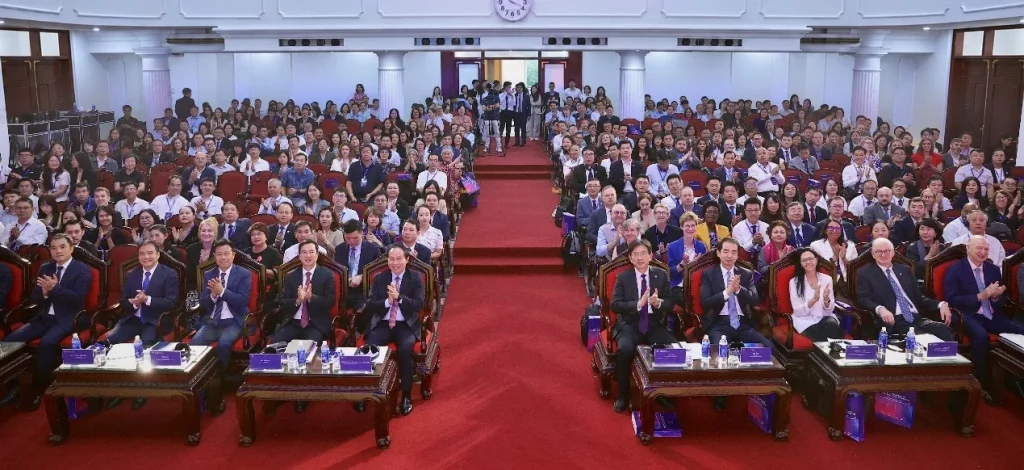
The global launch of the 2023 Global Education Monitoring Report, Technology in education: A tool on whose terms?, took place on 26–27 July 2023 in Montevideo, Uruguay. Hosted by UNESCO, Uruguay’s Ministry of Education and Culture and Ceibal Foundation, the event brought together 15 education ministers from around the world. High-level discussions examined opportunities and challenges in educational technology and the conditions needed for it to support Sustainable Development Goal 4.
The opening included a pre-recorded address by UNESCO Director-General Audrey Azoulay and remarks by Uruguay’s Minister of Education and Culture, Pablo da Silveira. GEM Report Director Manos Antoninis then presented the report’s main findings.
Four questions for evaluating education technology
The report identifies shortcomings in governance and regulation and asks policymakers and education stakeholders to consider four questions:
- Is it appropriate? Consider excessive or insufficient use, teaching contexts and teacher support so technology serves learning.
- Is it equitable? Address meaningful connectivity and basic conditions such as electricity, with priority for the most marginalised learners.
- Is it scalable? Assess evidence of effectiveness and long-term purchasing, operating and maintenance costs.
- Is it sustainable? Strengthen education systems’ ability to adapt, teachers’ digital competencies, cybersecurity training and the rights of technology users.
It prioritises learners’ needs and calls for appropriate, equitable, evidence-based and sustainable technology use. Countries should set their own terms for how educational technology is designed and used, so it supports quality education and complements rather than replaces face-to-face, teacher-led instruction. The full report is available through UNESCO’s publication record.
The Chair’s perspectives on AI in education
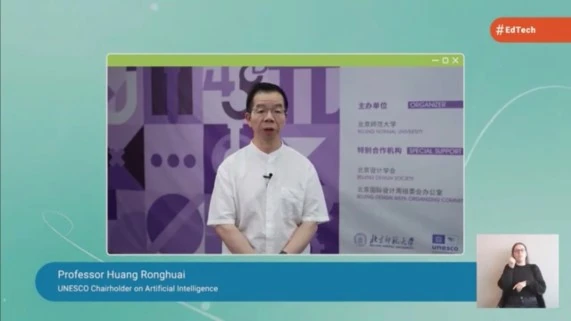
According to the Chair’s original report, Professor Huang Ronghuai, holder of the UNESCO Chair on AI in Education, was invited to contribute to the launch and share views on how technology can support learning.
The Chair outlined the following positions and areas of work:
- AI can offer new approaches to learning, teaching, administration and assessment, with potential implications beyond education targets alone.
- Educational technology should prioritise learners’ needs and be appropriate, equitable, evidence-based and sustainable.
- The Chair promotes an integrated system of research, training, information and best practices in AI in education.
- AI should contribute to inclusive and equitable quality education and expand lifelong learning opportunities for all.
Original link: https://aiedchair.bnu.edu.cn/the-chair-shares-insights-during-the-2023-gem-report-launch-ceremony/